
Preparing financial projections for a funding application
5 December 2025

Preparing financial projections for a funding application requires South African SMEs to align hypothetical scenario modelling with verified historical accounting records and statutory tax evidence.
Applying for enterprise development or capital expansion funding in South Africa demands a clear distinction between verified historical accounting records and forward-looking financial estimates. When evaluated by public development programmes or commercial funding institutions, financial projections must be built upon evidence-based operational assumptions rather than arbitrary revenue targets.
Aligning revenue growth, cost structures, and working capital requirements with historical performance and verified market quotes ensures that projected cash flows remain realistic, defensible, and compliant with statutory financial reporting standards.
Evidence based assumptions and scenario projections
This practical framework is designed for South African small and medium enterprise (SME) directors, financial managers, and business owners preparing financial submissions for grant funding, asset finance, or debt capital within the South African jurisdiction.
In the context of business funding, successful task completion means producing a 12-month to 36-month integrated financial forecast—comprising projected income statements, balance sheets, and cash flow statements—that is fully supported by historical accounting evidence and current statutory tax compliance records.
— Practical point from this guide
Financial projections serve as the operational proof of a business's capacity to deploy capital efficiently and service future obligations. Statutory financial statements report past performance under strict accounting frameworks, whereas forward-looking projections evaluate viability under varying commercial conditions. To satisfy funding evaluators, assumptions must reflect verified historical costs, contractual price agreements, and documented operational capacities.
Concurrently, applicants must maintain active statutory compliance. Funding institutions require proof that the enterprise operates on sound financial foundations, which includes holding a compliant Tax Compliance Status (TCS) PIN from the South African Revenue Service (SARS) 1 2 and maintaining complete accounting records in accordance with the Companies Act 71 of 2008 3 4.
Prepare the information and authority: evidence based assumptions
Before constructing scenario models, the enterprise must compile all primary documentation and establish legal authority for the submission. The required evidence base includes statutory accounting records, tax compliance records, and project-specific technical inputs:
- Historical Financial Records: Signed annual financial statements for preceding financial years or current management accounts prepared in terms of Section 29 of the Companies Act 5 6. These statements must bear a prominent notice indicating whether they have been audited, independently reviewed, or remain unaudited, alongside the preparer's name and designation 6.
- Statutory Tax Compliance: A valid SARS Good Standing Tax Compliance Status (TCS) PIN issued via eFiling or the SARS Online Query System 1 2. Good standing requires that the entity has no unfiled tax returns, no outstanding debt without an agreed payment arrangement, and accurate registered particulars 7.
- Operational and Cost Inputs: Written supplier quotations, technical cost breakdowns, lease agreements, and Central Supplier Database (CSD) registration details 5. For specialised grant applications, such as the Business Infrastructure Support Programme (BISP) administered by the Department of Small Business Development, qualifying micro and small enterprises (with annual turnover limits up to R10m) must provide signed management accounts, technical designs, and executive approvals 5 8.
- Governance and Authority: Board or director resolutions authorising the funding application, debt incurrence, or capital acquisition in alignment with the entity's Memorandum of Incorporation.
Complete the task step by step: scenario projections
Building robust financial projections requires a systematic process that transforms raw accounting data into structured, multi-scenario models:
- Establish the Historical Baseline: Extract baseline revenue, gross margins, and fixed operating overheads from the current accounting records maintained under Section 28 of the Companies Act 3 4. Ensure that bank balances and ledger balances are fully reconciled before setting the baseline.
- Formulate Evidence-Based Operational Assumptions: Base every projected revenue and expense line item on verifiable inputs. For instance, project raw material costs using current supplier price lists, and estimate labour expenses from current payroll schedules. Avoid applying flat percentage increases across all line items without documented justification.
- Structure Cash Flows per IAS 7 Categories: Divide cash inflows and outflows into operating, investing, and financing activities in accordance with International Accounting Standard (IAS) 7 principles 9. Operating activities are defined as "the principal revenue-producing activities of the entity and other activities that are not investing or financing activities" 9. Capital equipment purchases or facility refurbishments must be categorised under investing cash flows, while loan drawdowns and capital repayments must be reflected under financing activities 9.
- Conduct Solvency and Liquidity Stress Tests: Apply the solvency and liquidity test established in Section 4 of the Companies Act 10. Verify that, under projected conditions, the fairly valued assets of the company equal or exceed its fairly valued liabilities, and that the company maintains sufficient liquidity to pay its debts as they become due over the ensuing 12-month period 10.
- Develop Three-Tier Scenario Projections:
- Base Case Scenario: Reflects expected operational performance based on existing order books, current capacity, and stable market conditions.
- Conservative (Downside) Scenario: Models a reduction in turnover (e.g., a 15% drop in sales volume) alongside a 30-day delay in customer debt collections to test working capital resilience.
- Expansion (Upside) Scenario: Models increased production volume resulting from funded capital equipment, accounting for incremental variable costs and increased working capital requirements.
- Integrate Statutory Compliance Verification: Review the entity's "My Compliance Profile" on SARS eFiling to confirm that all tax product profiles are clean prior to submitting the projection package to external funders 1 11.
Check the result against the evidence: evidence based assumptions
To confirm that the projections are fully verified and ready for submission, review the completed model against independent internal and external evidence:
- Mathematical Consistency: Verify that the projected statement of cash flows reconciles directly with opening cash balances and projected balance sheet bank figures.
- Source Alignment: Cross-check capital expenditure figures in the cash flow statement against physical supplier quotations and technical design breakdowns 5.
- Statutory Audit and Review Marking: Ensure that all supporting historical financial statements bear the mandatory Section 29 compliance notices regarding audit status and preparer professional credentials 6.
- Tax Status Verification: Perform an online eFiling check to confirm that the shared TCS PIN displays an active Good Standing profile at the time of submission 1 2.
- Solvency Cushion: Confirm that the downside scenario maintains positive net assets and operational liquidity throughout the 12-month forward period in line with statutory solvency tests 10.
Handle exceptions and unresolved cases: scenario projections
When compiling projections, specific operational edge cases or compliance gaps may arise:
- Missing or Incomplete Historical Records: If historical accounting records have gaps or unverified balances, projections cannot be reliably established. Incomplete records constitute an offence under Section 28 of the Companies Act 12. Historical bookkeeping must be fully brought up to date before finalising forecast baselines.
- Tax Non-Compliance or Pending SARS Disputes: If "My Compliance Profile" reflects outstanding returns or debts, SARS will not issue a Good Standing TCS PIN 7 11. The entity must settle the outstanding obligations or enter into a formal payment deferral arrangement with SARS before applying for funding 7.
- Specialist Boundaries and Evolv Recommendations: Bookkeeping frameworks, bank reconciliations, 13-week cash forecasting models, and scenario analysis protocols are Evolv professional recommendations designed to establish financial readiness. They must be distinguished from statutory legal mandates (such as the Companies Act) or regulatory tax systems (such as SARS eFiling). Furthermore, programme-specific grant rules (such as BISP funding limits ranging from R1m to R23m for built infrastructure or R1m to R5m for equipment) do not represent a universal lending rule across all financial institutions, nor do they guarantee grant approval 8.
Next steps for Funding ready records
Task and completion checklist
| Step | Input or evidence | Responsible person | Completion check | Exception or next action |
|---|---|---|---|---|
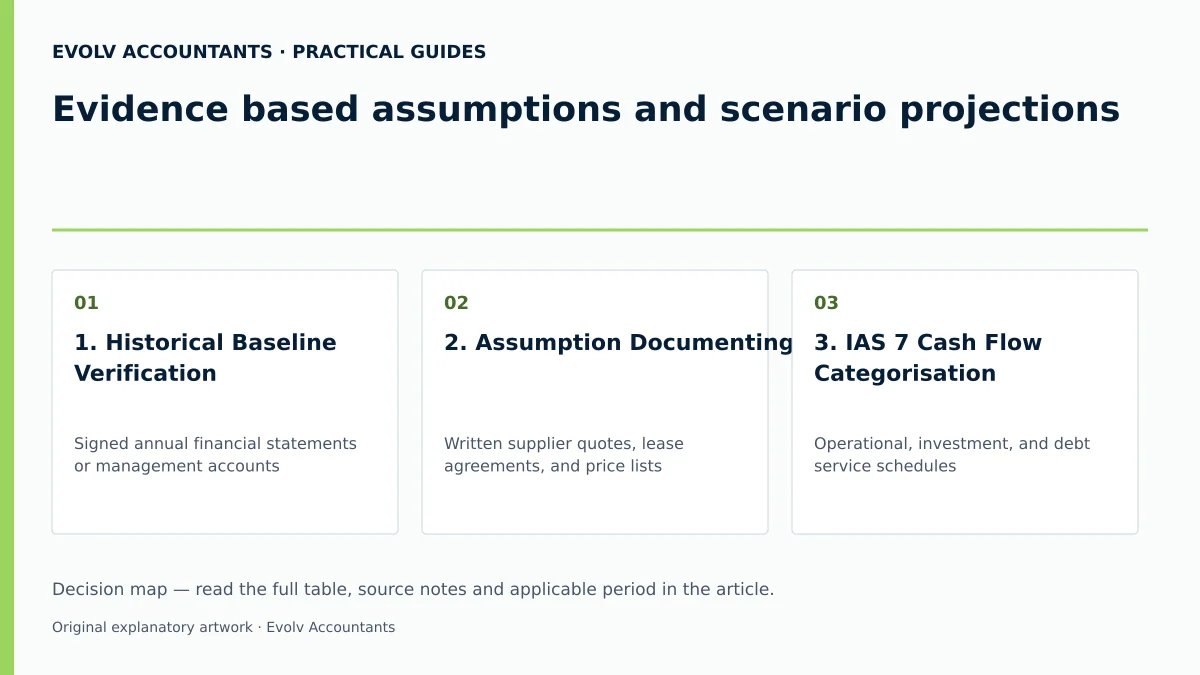
| 1. Historical Baseline Verification | Signed annual financial statements or management accounts 5 6 | Finance Manager / Accountant | Balance sheet and profit/loss agreed to reconciled general ledger | Perform bank reconciliations and update ledger if balances differ 3 |
| 2. Assumption Documenting | Written supplier quotes, lease agreements, and price lists 5 | Operational Director | Every projected cost item linked to a physical document | Adjust assumptions down to historical actuals if quotes are missing |
| 3. IAS 7 Cash Flow Categorisation | Operational, investment, and debt service schedules | Financial Accountant | Cash movements correctly split into operating, investing, and financing rows 9 | Reclassify misallocated capital items from operating to investing cash flows 9 |
| 4. Solvency & Liquidity Testing | Forward 12-month balance sheet and cash flow model | Managing Director / Board | Assets exceed liabilities and operational cash flow remains positive 10 | Revise expenditure timing or seek additional equity if liquidity fails 10 |
| 5. SARS Tax Compliance Pin Request | SARS eFiling profile and TCS PIN request screen 1 2 | Tax Practitioner / Public Officer | Active Good Standing TCS PIN generated successfully 1 | Fix non-compliant indicators on My Compliance Profile before PIN release 11 |
| 6. Grant / Funder Document Assembly | BISP/Funder application form, CSD report, and technical designs 5 | Compliance Officer / Evolv Advisor | Complete pack compiled with signed financial notices 5 6 | Obtain executive authority approvals if corporate governance requires 5 |
Reproducible hypothetical example
Consider a hypothetical South African manufacturing SME planning to apply for R2,000,000 in equipment funding (falling within the R1m to R5m BISP equipment support bracket) 8. All values below are purely illustrative and do not represent guaranteed outcomes or predictions.
- Baseline Historical Operations (Year 0): Annual Turnover = R6,000,000; Operating Overhead Ratio = 35%; Gross Profit Margin = 40%.
- Capital Expansion Input: New equipment cost = R2,000,000 (funded via R1,600,000 debt at 11% interest per annum over 5 years, and R400,000 cash deposit).
- Scenario Assumptions (Year 1 Forward Projection):
- Base Case: Equipment increases production capacity, driving turnover up by 25% to R7,500,000. Gross margin holds at 40% (R3,000,000 gross profit). Operating expenses increase to R2,400,000 due to additional plant operators. Debt service (interest + principal) = R415,000 per annum. Net operating cash flow = R185,000.
- Conservative Downside Case: Market adoption is slow; turnover increases by only 5% to R6,300,000. Customer collection terms stretch from 30 days to 60 days, creating a temporary working capital lag of R525,000. Gross margin contracts to 38% due to lower operational efficiency. Net operating cash flow before debt service drops to R220,000.
- Mitigation Step in Model: To maintain solvency and liquidity under Section 4 of the Companies Act 10, management models an adjustable draw on a pre-arranged revolving credit facility, preventing cash balances from turning negative during Months 4 to 7.
Frequently Asked Questions
What is the difference between statutory accounting compliance and evidence-based scenario projections?
Statutory accounting compliance involves accurately recording and reporting past financial transactions in accordance with statutory standards such as the Companies Act and applicable accounting frameworks 3 13. Scenario projections are forward-looking financial estimates that model future operational outcomes under varying commercial assumptions. While projections are hypothetical, they must be grounded in verified statutory records to be credible to funders.
How does SARS Tax Compliance Status (TCS) affect a business funding application?
Most public and commercial funding bodies in South Africa require an active SARS TCS PIN under Good Standing as a mandatory eligibility criterion 1 5. A compliant status confirms that the applicant has no outstanding tax returns or unresolved tax debts 7. If an entity is non-compliant, SARS will not issue a Good Standing PIN, which typically leads to the automatic disqualification of the funding application 1 7.
Why must projected cash flows be separated into operating, investing, and financing activities under IAS 7?
IAS 7 requires cash flow statements to classify cash movements into operating, investing, and financing activities to provide clear visibility into how a business generates and consumes cash 9. Funding institutions evaluate this structure to confirm that core operating activities generate sufficient cash to sustain the business, while isolating capital purchases (investing) and debt borrowings or repayments (financing) 9.
Can unverified historical management accounts be used to ground funding projections?
Unverified or unreviewed management accounts carry significant risk. Section 29 of the Companies Act requires all financial statements provided to third parties to present fairly the state of affairs of the business and prominently state whether they have been audited or independently reviewed, along with the preparer's details 6 13. Funders generally require signed financial statements or verified management accounts signed by an accountant before accepting them as a valid projection baseline 5.
What happens if financial projections indicate a breach of the Companies Act solvency and liquidity test?
If projected cash flows indicate that the company's liabilities will exceed its assets or that it will be unable to pay its debts as they become due over the next 12 months, the company fails the Section 4 solvency and liquidity test 10. In such cases, directors cannot proceed with debt-funded capital expansions or distributions without restructuring the business plan, securing additional equity, or adjusting expenditure timing to restore projected solvency 10 14. *** Tell Evolv about your funding-record question and the support needed to prepare a clearer financial evidence pack. Ask Evolv about evidence based assumptions and scenario projections. Share the relevant records so the support required can be scoped. Ask Evolv
Related guides
- Raising growth capital in South Africa in 2026
- Reconciling tax compliance before applying for funding
- Reading the Financials: Cash Flow and the Balance Sheet for Directors