
Reconciling tax compliance before applying for funding
6 February 2025

Reconciling tax compliance before applying for funding requires matching statutory filings against accounting records to establish verified tax status.
When South African micro, small, and medium enterprises (SME sector) prepare to apply for business funding or capital grants, demonstrating genuine tax compliance requires far more than verbal assurances or unverified claims 1 2. Funding entities require verified tax compliance status supported by fully reconciled accounting records, up-to-date returns, and clear audit trails that align general ledger figures with official revenue agency statements 1 3 4.
Verified tax status rather than unsupported compliance claims
Statutory and regulatory framework governing tax status
In South Africa, corporate financial management and tax compliance operate under distinct legal and regulatory tiers:
- Company Law Requirements: Under Section 28 of the Companies Act 71 of 2008, every company must maintain accurate and complete accounting records in an official language to satisfy statutory obligations and support financial statement preparation 5. Section 29 further mandates that financial statements must present fairly the state of affairs and business of the company without being false or misleading in any material respect 4.
- Regulator Guidance: The South African Revenue Service (SARS) introduced the online Tax Compliance Status (TCS) system to replace legacy paper tax clearance certificates, establishing the "My Compliance Profile" (MCP) interface on eFiling 1 6. SARS determines real-time tax compliance based on four key requirements: no outstanding tax returns, no unarranged tax debt, proper registration for all applicable tax products, and verified registered particulars 2. Taxpayers issue a secure TCS PIN enabling third parties to verify overall tax status online 1 7.
- Funding Grant Criteria: Support schemes such as the Department of Small Business Development (DSBD) Business Infrastructure Support Programme (BISP)—which targets micro and small enterprises with an annual turnover of not more than R10 million—require signed financial statements or management accounts alongside verified compliance documentation and Central Supplier Database (CSD) registration 3 8. BISP offers structured capital support across defined categories, including built infrastructure (R1 million to R23 million), machinery and equipment (R1 million to R5 million), and energy solutions (R1 million to R10 million) 3 8. Programme-specific funding records or eligibility criteria do not establish a universal lender rule, nor do they guarantee that a specific funding window remains open 3 9.
- Evolv Recommendations: Evolv Accountants recommends conducting a comprehensive pre-application reconciliation that cross-references general ledger balances against official SARS Statements of Account prior to generating a TCS PIN for prospective funders.
Distinguishing transaction matches from factual validity
An agreement or numerical match between two records does not automatically prove factual validity 4 5. A general ledger entry may match a submitted tax return figure, yet both could reflect an erroneous invoice or duplicate entry. Reconciliation requires confirming that recorded transactions represent actual economic activity supported by valid source documentation 5 10.
— Practical point from this guide
Prepare the opening balances and period: verified tax status rather than unsupported compliance claims
Establishing period parameters and cut-off rules
Preparing accounting records for funding evaluation requires setting clear temporal boundaries and cut-off points 11:
- Financial Year Alignment: Section 27 of the Companies Act specifies that a company's financial year serves as its annual accounting period 11. Opening balances for any reconciliation period must equal the verified closing balances of the preceding period 5.
- Statutory Record Retention: Under Section 24 of the Companies Act, accounting records and annual financial statements must be retained for seven years 12 13.
- Currency and Entity Identifiers: All figures must be expressed in South African Rand (ZAR) 5. Furthermore, under SARS guidelines, businesses with multiple tax reference numbers across products (such as Value-Added Tax, Pay-As-You-Earn, and Corporate Income Tax) must declare or merge all reference numbers on eFiling via the ERC01 form to ensure the MCP reflects complete compliance across all tax types 2 14.
Independent evidence completeness check
Before initiating transaction-level matching, collect all primary source documents:
- SARS Statements of Account for all active tax types.
- Official SARS eFiling filing receipts and notices of assessment (ITA34s).
- Complete bank statements covering the full financial year.
- Detailed general ledger transaction histories and trial balances.
Match transactions and explain differences: documented completion and exceptions
Transaction-level bridge methodology
A systematic reconciliation bridge compares the independent primary record A (the entity's general ledger) against independent primary record B (the SARS Statement of Account), isolating every variance.
Under IFRS IAS 7 (Statement of Cash Flows), cash and cash equivalents comprise cash on hand and demand deposits, requiring clear classification of operating, investing, and financing cash flows 15 16. Cash payments made toward SARS liabilities must be traced directly from bank statements through to the corresponding SARS account credit 2 15.
Categorising timing items versus accounting errors
Differences between internal ledgers and SARS records fall into two primary categories:
- Timing Differences: Legitimate variances caused by posting delays, such as a tax payment executed on the final business day of the month that reflects in the general ledger immediately but takes two business days to clear into the SARS bank account.
- Accounting Errors and Omissions: Mispostings, unrecorded interest or penalties charged by SARS, duplicate postings, or incorrect tax return declarations that require formal correction.
Reconciliation bridge artefact
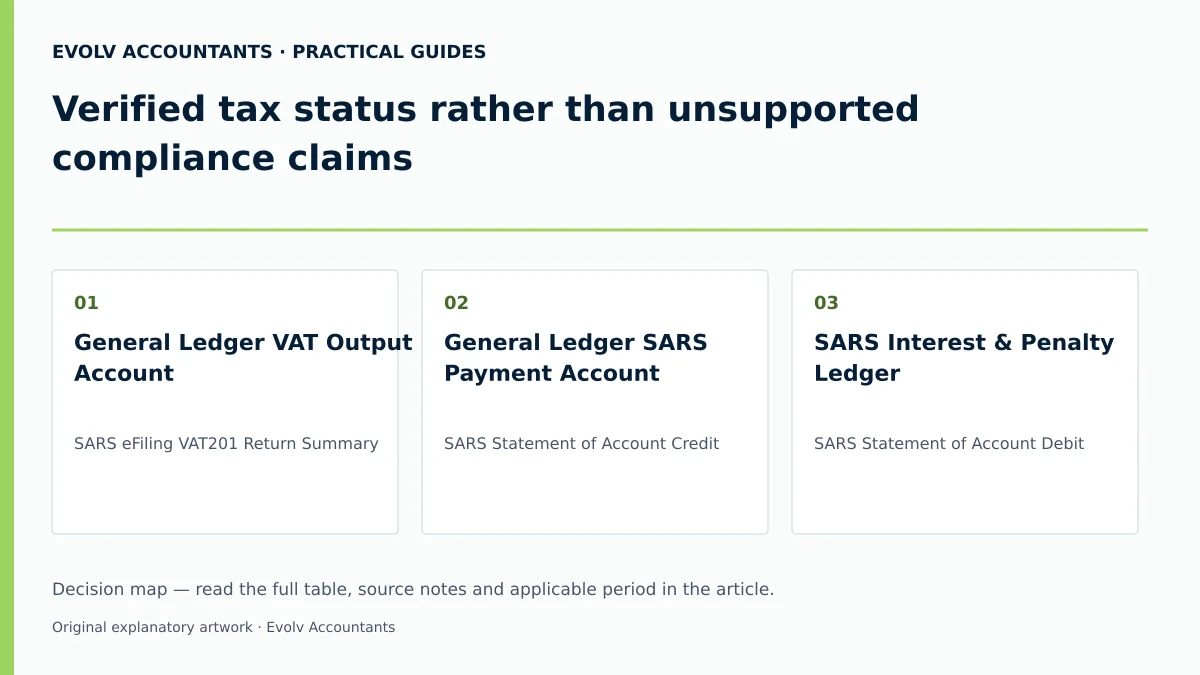
| Independent record A | Independent record B | Difference | Reason and evidence | Action and owner |
|---|---|---|---|---|
| General Ledger VAT Output Account | SARS eFiling VAT201 Return Summary | R12,500.00 | Data entry transposition error on May VAT201 submission; verified against sales journal. | Senior Bookkeeper to submit VAT201 correction via eFiling. |
| General Ledger SARS Payment Account | SARS Statement of Account Credit | R45,000.00 | Timing difference: Payment processed 28 February, cleared by SARS on 2 March; verified by bank statement. | Senior Accountant to clear upon bank statement confirmation. |
| SARS Interest & Penalty Ledger | SARS Statement of Account Debit | R3,200.00 | Late payment penalty assessed by SARS; unposted in internal ledger; supported by SARS Assessment Notice. | Tax Advisor to post journal entry to expense account and review remittance process. |
Post only supported corrections: verified tax status rather than unsupported compliance claims
Objective journal adjustments based on factual justification
Adjustments to general ledgers or tax filings must be made strictly when supported by verified objective evidence, adhering to the qualitative characteristics of financial reporting established in the IFRS Conceptual Framework 10 17. Information must provide a faithful representation of economic phenomena 10 17.
When posting corrective entries:
- Filing Revisions: If an error is identified in a previously submitted SARS return, file a formal dispute or Request for Correction (RFC) on eFiling supported by primary source documents 2 14.
- Ledger Journals: Adjust internal accounts only upon receiving official SARS confirmation or assessments, ensuring full narrative explanations and attachment of supporting schedules 5.
Review unresolved and old items: documented completion and exceptions
Aged exception log management
Unresolved variances or historical discrepancies must never be swept into suspense accounts or written off without clear documentation 5. Maintain an aged exception log containing:
- Unique item identifier and transaction date.
- Monetary value of the variance.
- Detailed description of the underlying root cause.
- Designated owner responsible for resolution.
- Specific target action and completion date.
Statutory debt management and solvency checks
Under SARS guidelines, an entity with outstanding tax debt remains non-compliant on its MCP unless an official deferred payment arrangement or suspension of payment has been formally agreed with SARS 2.
Under Section 4 of the Companies Act 71 of 2008, directors must ensure the company satisfies the solvency and liquidity test 18 19. A company meets this test if its fairly valued assets equal or exceed its fairly valued liabilities, and it appears capable of paying its debts as they fall due in the ordinary course of business for the ensuing 12 months 18 19. Unresolved tax liabilities directly affect this solvency and liquidity assessment 19.
Next steps for Funding ready records
Sequential checklist for funding readiness
Follow this verified numbered checklist to establish funding-ready financial records:
- Log into SARS eFiling and access "My Compliance Profile" (MCP) to review color-coded indicators across all tax types 6 20.
- Identify and resolve any outstanding returns or unregistered tax products 2.
- Pull official SARS Statements of Account for Income Tax, VAT, and PAYE.
- Perform line-by-line reconciliation matching general ledger accounts against SARS Statements of Account.
- Compile the Reconciliation Bridge and record justified adjustment journals.
- Verify that any outstanding tax debt is covered by an approved SARS payment arrangement 2.
- Confirm that annual financial statements are prepared within six months of financial year-end as required by Section 30 of the Companies Act 21.
- Generate a fresh SARS Tax Compliance Status (TCS) Good Standing PIN via eFiling for presentation to prospective funders 7 22 23.
Reproducible hypothetical example
Consider a hypothetical South African small enterprise, Kasi Logistics (Pty) Ltd, preparing records for a funding application.
- Step 1: Record Identification
- General Ledger SARS VAT Payable Account Balance (as at 28 February 2026): R150,000.00 (Illustrative value).
- SARS Statement of Account Balance (as at 28 February 2026): R165,000.00 (Illustrative value).
- Calculated Discrepancy: R15,000.00 (Illustrative value).
- Step 2: Evidence Investigation
- Examination reveals a payment of R15,000.00 executed via online banking on 27 February 2026.
- The payment posted to the internal General Ledger on 27 February 2026.
- The SARS Statement of Account reflects the credit effective 2 March 2026 due to banking clearance times.
- Step 3: Reconciliation Proof
General Ledger Balance (R150,000.00) + Timing Difference (R15,000.00) = SARS Statement Balance (R165,000.00) Unexplained Variance = R0.00
- Step 4: Outcome
The variance is documented as a verified timing difference. No corrective journal is required, and the funding application schedule includes the bank proof of payment and subsequent SARS receipt confirming full settlement.
Frequently Asked Questions
What is the difference between a Tax Clearance Certificate and a TCS PIN?
SARS replaced paper Tax Clearance Certificates in 2015 with the online Tax Compliance Status (TCS) system 1. Instead of a paper document, taxpayers receive a security PIN that allows authorised third parties to view their real-time tax compliance status online via eFiling 1 7.
How does SARS determine if a business is tax compliant?
Under SARS guidelines, tax compliance requires meeting four criteria: no outstanding tax returns, no outstanding tax debt (unless an official payment arrangement or suspension of payment exists), registration for all liable tax types, and accurate registered particulars 2.
Can a business apply for funding if it owes money to SARS?
A business with outstanding tax debt can maintain a compliant Good Standing tax status only if it has formally agreed to an official payment arrangement or suspension of payment with SARS 2. Unmanaged tax debt results in a non-compliant profile 2 6.
What financial records must be kept under South African company law?
Section 28 of the Companies Act requires companies to maintain accurate and complete accounting records in an official language 5. Section 24 mandates retaining accounting records, financial statements, and general ledgers for seven years 12 13.
Does a compliant TCS PIN guarantee approval for funding?
No. While funding programmes such as the DSBD BISP require compliance documentation and financial statements 3, programme-specific records do not establish a universal lender rule or guarantee funding approval or open application windows 3 9. Ask Evolv about verified tax status rather than unsupported compliance claims. Share the relevant records so the support required can be scoped.
Related guides
- Raising growth capital in South Africa in 2026
- Explaining unusual bank statement transactions to a lender
- Reading the Financials: Cash Flow and the Balance Sheet for Directors
Sources
- Manage your Tax Compliance Status | South African Revenue Service
- Business Infrastructure Support Programme (BISP) – Department of Small Business Development
- https://www.cipc.co.za//wp-content/uploads/Legal/Regulations/CompaniesAct71_2008.pdf
- IFRS - Conceptual Framework for Financial Reporting
- IFRS - IAS 7 Statement of Cash Flows