
Raising growth capital in South Africa in 2026
Debt is dearer at a 7% repo rate, development finance has consolidated, and private equity is sitting on record dry powder. A current map of the routes — and how to choose one.
13 December 2025

Raising growth capital in South Africa in 2026 requires matching your business's financial maturity to the right debt, equity, or development funding route.
While South African small and medium enterprise (SME) owners have access to diverse funding avenues—including commercial banking, state development finance institutions, private equity, venture capital, public markets, and blended finance grants—securing capital successfully depends on structural alignment rather than a standardized application. Navigating these financing options requires a clear evaluation of cash flow obligations, ownership trade-offs, and compliance obligations 1 2.
Because funder criteria, institutional mandates, and government support schemes evolve over time 3 4 5 6, business owners must verify live product eligibility while establishing accurate, verifiable financial records that can withstand rigorous due diligence 7 8 9.
Bank debt and repayment capacity
Commercial bank debt is one financing route to compare against the business’s actual cash-flow capacity and the lender’s offer. Separately, section 4 of the Companies Act defines the solvency and liquidity test by reference to fairly valued assets and liabilities and the ability to pay debts as they fall due 1 2 12. That statutory test does not establish a bank’s underwriting checklist or repayment schedule. Obtain those criteria and terms from the lender.
— Practical point from this guide
Debt commits future cash flows to the repayment obligations in the negotiated instrument. Interest may be fixed or variable, and the timing of principal repayment depends on the agreed terms. For a decision, inspect the lender’s actual offer for repayments, security, guarantees, covenants and fees; do not infer those terms from the Companies Act solvency and liquidity test.
For bank discussions, Evolv recommends preparing a financial evidence pack and checking it against the chosen lender’s actual requirements 8 14 15. Useful records to consider include:
- Accurate accounting records maintained for the current financial year and the preceding seven completed financial years, as required by Section 28 and Section 24 of the Companies Act 14 16 17.
- Up-to-date management accounts signed by an accountant or director 7 8 18.
- Annual financial statements prepared in accordance with the company's applicable financial reporting framework 9 18 19 20. Full International Financial Reporting Standards (IFRS) or an IAS 7 statement of cash flows are not required for every SME; reporting requirements depend on the company's public interest score and legal form, with many qualifying for simplified standards such as IFRS for SMEs 19 21 22 23.
- A valid Tax Compliance Status (TCS) PIN issued by the South African Revenue Service (SARS) confirming no unsubmitted tax returns or unarranged tax debts 15 24 25 26 27.
Before pursuing commercial bank debt, business owners should ask:
- Evolv’s planning question: Can projected cash flows cover the repayments actually proposed in the lender’s offer under conservative trading assumptions? This is an analytical prompt, not a statutory monthly-payment rule.
- "What specific unencumbered assets or collateral can the business pledge as security without constraining operational flexibility?" 8 13
- "Are our monthly bookkeeping records fully reconciled and supported by a valid SARS tax compliance status?" 14 15 25
Development finance and institutional mandate
State-owned Development Finance Institutions (DFIs) provide specialized capital designed to foster inclusive industrial growth, economic transformation, and job creation 5 28 29 30. Institutions such as the Industrial Development Corporation (IDC) fund bankable projects aligned with specific national development priorities, including industrialisation, export promotion, Black Industrialists, youth and women entrepreneurship, regional equity, and the green economy 5 28 31 32.
The IDC follows a structured six-step funding assessment process: application and screening, pre-investment support, due diligence, internal credit committee approvals, funding approval and disbursement, and post-investment monitoring 28 33. IDC documentation sets out these criteria specifically for its own internal process 5 34.
Similarly, historical records show that the National Empowerment Fund (NEF) provides financial products—such as the iMbewu Fund, uMnotho Fund, and Strategic Projects Fund—targeted at black-owned businesses 35 36 37. However, primary NEF disclosures reflect its FY2024/25 annual reporting period rather than live 2026 product terms 6 29 38, meaning live eligibility must be verified independently.
Earlier references to entities like the Small Enterprise Finance Agency (sefa) represent historical operational contexts 10 39; current terms for the Small Enterprise Development and Finance Agency (SEDFA) cannot be inferred from older records and require live confirmation 39.
Compare the institution’s commercial-viability, ownership, sector and developmental-outcome conditions with the proposed financing terms 28 31 33. Pricing, security and monitoring requirements vary by product; assess the actual offer alongside its development mandate.
Preparation checklist to match against the selected DFI product; these are examples rather than universal eligibility rules:
- The financial-statement history requested by the funder, with any audit or review requirement checked separately from the company’s statutory minimum 8 18 19.
- Recent management accounts for the period and freshness specified by the chosen provider 8.
- Comprehensive financial forecasts, including projected income statements, balance sheets, and detailed cash flow models 8.
- Valid CIPC registration documentation, B-BBEE certificates or sworn affidavits, and a SARS Tax Compliance Status PIN 15 43.
- Detailed technical designs, operational plans, raw material sourcing details, and itemised expenditure breakdowns with supporting quotations 43 44.
Key questions for owners considering development finance include:
- "Does our growth project directly advance specific institutional mandates, such as job creation, manufacturing expansion, or spatial equity?" 28 31
- "Do we have the administrative capacity to supply extensive operational, technical, and governance documentation during due diligence?" 34 43
- "Can our business comply with quarterly post-investment monitoring and socio-economic impact reporting?" 33 45
Private equity and venture capital
Private equity (PE) and venture capital (VC) firms provide risk capital in exchange for direct equity ownership in high-growth enterprises 36. Venture capital typically targets early-stage or technology-enabled businesses seeking rapid expansion, whereas private equity focuses on established medium-sized companies undergoing significant scaling, acquisition, or restructuring 35 36.
Equity investment trades an ownership interest for capital on negotiated terms. Ordinary share capital does not itself create a conventional loan repayment schedule; redeemable or hybrid instruments can carry different obligations. Review the actual subscription/shareholders’ agreements, distribution rights, governance rights and intended exit before comparing the cash commitments. This is a financing comparison, not a payment rule derived from IAS 7.
To attract private equity or venture capital, business owners must present robust commercial and legal evidence:
- Historical management accounts and financial statements proving gross margin stability and revenue sustainability 8 9.
- Detailed multi-year financial forecasts supported by documented market demand, pricing structures, and customer contracts or letters of intent 8 44.
- Complete statutory records, including CIPC registration files, the Memorandum of Incorporation (MOI), share registers, and shareholder agreements 16 31 43 47.
- Financial information prepared under the company’s applicable reporting framework, plus the reporting package negotiated with the investor 9 18 20 21 22.
Before engaging equity investors, owners should ask:
- "Are the founding shareholders willing to dilute ownership and share strategic management control with external partners?" 8 31
- "Does our business model offer the growth trajectory required to achieve the fund's target rate of return?" 8 34
- "Have we agreed an exit route, time horizon and valuation process that work for both sides?" 36
Public equity and listing readiness
Public equity involves issuing shares to retail and institutional investors by listing on a licensed stock exchange, such as the Johannesburg Stock Exchange (JSE) 48. Public equity provides long-term capital for large-scale enterprise expansion, corporate acquisitions, or debt restructuring 36.
Before planning a public issue, verify the rules applicable to the company and transaction with the relevant exchange and its approved advisers 48. Public listing introduces strict statutory and corporate governance obligations. Under Chapter 3 of the Companies Act 71 of 2008, public companies are subject to enhanced accountability standards, mandatory statutory audits of annual financial statements, public disclosure of annual returns, and detailed financial reporting 19 23 47 49.
The main trade-off of public equity is the high cost of compliance, public scrutiny, and legal exposure. While listing unlocks access to capital markets 36 48, it requires substantial initial advisory, legal, and underwriting expenditure, followed by recurring listing fees, mandatory audit costs, and ongoing regulatory reporting duties 23 47 50 51.
Confirm the documentation needed for the proposed public-market transaction, including where applicable:
- Audited annual financial statements covering historical financial years, certified by an independent registered auditor 18 19 23.
- Statutory documentation, including the MOI, board committee charters, and director details 16 49 52.
- Formal prospectuses, pre-listing statements, or written offer documents setting out financial history, business risks, and capital structure details 53 54 55.
- Verified tax compliance profiles from SARS 15 24.
Questions an owner must ask prior to considering public equity include:
- "Is our financial scale, earnings stability, and corporate governance mature enough to meet public market expectations?" 9 23 49
- "Can the enterprise absorb the legal, audit, and administrative expenses associated with public listing?" 23 50 51
- "Have we formally engaged the exchange’s approved advisers to verify active admission criteria?" 48
Blended finance, grants and guarantees
Blended finance models combine public grants, concessionary loans, and private commercial debt to lower the overall weighted cost of capital and de-risk SME investments 56 57. Government development frameworks, such as the Department of Small Business Development (DSBD) Business Infrastructure Support Programme (BISP), aim to assist micro, small, and medium enterprises (MSMEs) by co-funding essential machinery, infrastructure, tools, technology, and energy solutions 58 59.
While government policy pages outline broad economic support strategies 3 4 48 60, they serve as macro context rather than proof that a specific historical grant programme or incentive window is open for applications in 2026 3 56 58. SME owners must verify live application windows directly with administering departments 58 61.
The trade-off of grant and blended finance is that capital is generally non-dilutive or low-cost, but requires strict matching funds, rigorous administrative tracking, and dedicated allocation to approved project costs 7 59. Check the call’s co-funding, eligible-cost and disbursement rules before including any grant in the cash plan 7 56.
Check the selected programme’s current evidence requirements. A preparation pack may include:
- Financial statements or management accounts signed by an accountant 7.
- Itemised technical designs, equipment quotations, and cost breakdowns 7 44.
- Regulatory permits, environmental impact assessments, or land-use approvals where applicable 7.
- Central Supplier Database (CSD) registration compliance and valid SARS Tax Compliance Status PINs 7 15.
Key questions for owners evaluating blended finance options include:
- "Can our business provide the mandatory owner contribution or co-funding required by the grant scheme?" 7 56
- "Do we have the administrative capacity to track and report on grant expenditure to government auditors?" 7 62
- "Have we verified that the specific grant or incentive programme is actively accepting applications?" 3 58
Choose the route and prepare the evidence
Evolv's Recommended Capital Decision Framework (Advice for SME Owners — Not an Official Lender Process)
Selecting the appropriate financing route requires evaluating your enterprise's cash flow stability, asset base, ownership flexibility, and compliance readiness. The following decision matrix summarizes the core trade-offs, evidence requirements, and strategic questions across each primary route:
| Route | Suitable business situation | Cash/ownership trade-off | Evidence | Next question |
|---|---|---|---|---|
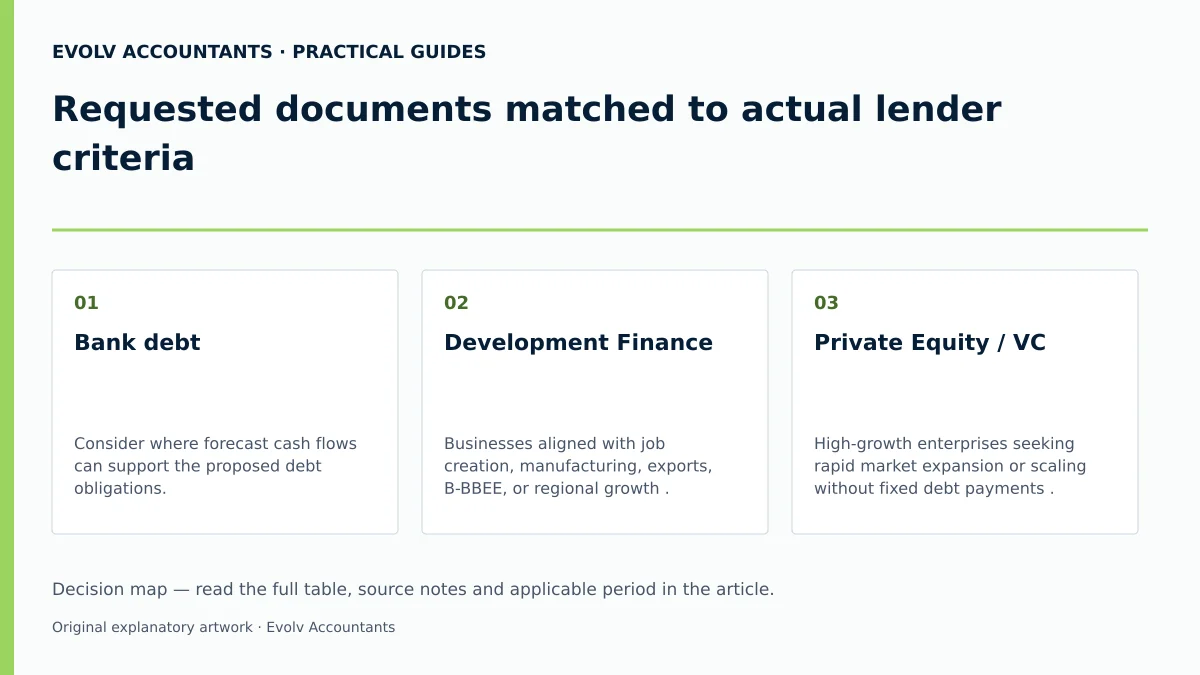
| Bank debt | Consider where forecast cash flows can support the proposed debt obligations. | Ownership need not be diluted; repayment, security and control/covenant effects depend on the negotiated loan terms. | Actual lender checklist and offer, management accounts, financial statements and tax-compliance evidence. | Evolv’s planning question: can cash flows cover the agreed repayments under downside scenarios? |
| Development Finance | Businesses aligned with job creation, manufacturing, exports, B-BBEE, or regional growth 5 28 31. | Concessionary terms or tailored debt; requires compliance with strict developmental mandates 31 33. | The provider’s specified AFS/assurance history, forecasts, ownership records and technical plans 8 15 43. | "Does our project deliver verifiable developmental outcomes such as new jobs?" 28 31 |
| Private Equity / VC | High-growth enterprises seeking rapid market expansion or scaling without fixed debt payments 35 36. | Ordinary equity adds no loan repayment obligation; ownership and governance rights depend on the negotiated terms 8 16 36. | Management accounts, multi-year projections, MOI, share register, market analysis 8 9 44 47. | "Are founding shareholders prepared to share equity ownership and governance control?" 8 16 |
| Public Equity | Large, mature enterprises seeking substantial capital expansion via public stock exchanges 36 48. | Access to deep capital markets; involves high legal costs, regulatory overhead, and scrutiny 23 47 51. | Audited AFS, prospectuses, corporate governance records, CIPC filings 18 23 49 54. | "Have we verified current exchange admission rules with licensed sponsor advisors?" 48 |
| Blended Finance / Grants | MSMEs investing in infrastructure, machinery, green energy, or targeted economic sectors 56 58 59. | Non-dilutive or subsidized capital; requires matching co-funding and strict usage tracking 7 56 59. | Signed financial accounts, technical designs, itemised quotes, CSD status, TCS PIN 7 15 43. | "Have we confirmed that the specific grant window is currently open for applications?" 3 58 |
Hypothetical R1 million growth-project capital gap analysis
To illustrate how financing routes differ in practice, consider a hypothetical SME undertaking an R1,000,000 asset expansion project. The enterprise holds R200,000 in internal cash reserves as an owner contribution, leaving an external capital gap of R800,000.
How the R800,000 capital gap is structured across financing routes:
- Illustrative commercial debt route: Assume an equipment loan of R800,000 with monthly principal-and-interest payments and no equity conversion. Those are explicit assumptions for this comparison, not universal lender requirements. The loan funds the equipment gap; cash-flow forecasts must cover the repayment schedule, costs and covenants in the actual offer.
- Illustrative ordinary equity route: Assume an investor provides R800,000 for a negotiated minority ordinary shareholding, with no loan or redemption obligation. The capital gap is funded without the assumed equipment-loan payments, while ownership, distribution and governance rights change according to the agreed investment documents. Board representation is a negotiated assumption, not an automatic entitlement.
- Blended / Development Finance Route: The SME applies for a concessionary DFI facility or matching grant programme that funds the R800,000 gap by pairing a non-dilutive grant component with a low-interest development loan 56 59. This structure reduces the overall cost of capital while preserving equity, but approval depends on proving that the project creates new jobs or supports local industrial manufacturing 28 31.
(Note: The numbers above represent a hypothetical structural illustration of an external capital gap and do not imply specific interest rates, business valuations, lender approval odds, or market statistics.)
Frequently Asked Questions
Do South African SMEs need full IFRS and IAS 7 cash flow statements to apply for growth capital?
No. Statutory financial reporting requirements depend on the enterprise's legal form, public interest score, and applicable accounting framework under the Companies Act 9 18 19 20. Many small and medium businesses qualify to report under simplified standards such as IFRS for SMEs rather than full IFRS 21 22. Neither full IFRS nor an IAS 7 statement of cash flows is universally mandated for every SME, and standard-setting frameworks like the Conceptual Framework serve as standard-setting guidance rather than a mandatory standard for small businesses 21 63 64 65. Capital providers set specific reporting requirements in their application guidelines 8.
What role does a SARS Tax Compliance Status PIN play in a funding application?
A TCS PIN allows an authorised third party to verify a taxpayer’s status through SARS 15 24 25 26 27. Supply it where the chosen programme or funder requests it; tax status and credit approval are separate assessments.
How do state Development Finance Institutions (DFIs) differ from commercial banks?
Compare each lender’s actual credit criteria and repayment terms with the stated mandate and process of a development-finance institution. The IDC describes its own application and funding process; that does not establish a universal rule for all banks or DFIs 8. Assess commercial viability, policy fit, evidence requirements and the proposed instrument separately.
What is the key operational trade-off between debt and equity financing?
Debt can fund a business without issuing shares, but the actual instrument determines repayment dates, interest, security, covenants and any conversion rights. Ordinary equity issues an ownership interest instead of a conventional loan; distributions, governance rights and exit expectations depend on the negotiated investment. Compare the actual terms rather than assuming every loan has fixed monthly payments or every equity investor receives a board seat.
How can an SME owner verify whether a government grant or DFI programme is open in 2026?
Government framework documents establish institutional policy but do not guarantee that specific grant windows or product funds are actively accepting applications 3 4 58. Business owners must verify active programme status, live eligibility criteria, and submission deadlines directly via official government portals, DFI helpdesks, or professional accounting advisors 5 58 61.
Related guides
- Preparing management accounts for a funding application
- Preparing financial projections for a funding application
- Reading the Financials: Cash Flow and the Balance Sheet for Directors
Sources
- https://www.cipc.co.za//wp-content/uploads/Legal/Regulations/CompaniesAct71_2008.pdf
- Economy and Finance | South African Government
- IDC Funding Process – How the IDC Funds Inclusive Industrial Growth
- National Empowerment Fund — Integrated Report 2025
- Business Infrastructure Support Programme (BISP) – Department of Small Business Development
- https://www.sars.gov.za/wp-content/uploads/Ops/Guides/LAPD-TAdm-G01-Short-Guide-to-the-Tax-Administration-Act-2011.pdf
- IFRS - The IFRS for SMEs Accounting Standard
- Manage your Tax Compliance Status | South African Revenue Service
- Understand funding as an SMME | Western Cape Government
- https://www.sars.gov.za/wp-content/uploads/Ops/Guides/Legal-Pub-Guide-Gen09-Tax-Guide-for-Small-Businesses.pdf
- IFRS - Conceptual Framework for Financial Reporting
- IFRS - IAS 7 Statement of Cash Flows