
Input VAT on meals and entertainment
14 November 2024
Claiming input VAT on meals and entertainment requires establishing whether an expenditure is denied as entertainment or allowed as a qualifying enterprise expense under South African tax guidance.
Under South African Value-Added Tax (VAT) law, input tax incurred on goods or services acquired for the purpose of entertainment is generally prohibited from deduction, even when the expenditure is incurred in the course or furtherance of carrying on an enterprise 1 2. Entertainment is statutorily defined as the provision of food, beverages, accommodation, entertainment, amusements, or hospitality of any kind by a vendor to anyone, including staff, clients, and business associates 3 4.
Specific statutory exceptions permit input tax recovery, such as personal subsistence for employees travelling away overnight on business, qualifying catering supplied by seminar organisers under the statutory conditions, and vendors whose regular trade involves supplying entertainment for consideration 5 6 7. To deduct permissible input tax, South African small and medium enterprises (SMEs) registered as VAT vendors must hold valid tax invoices and maintain complete audit records for at least five years 8 9 10.
Entertainment restrictions and actual supply classification
This practical guide is designed for South African SME business owners, financial managers, and vendor administrative teams operating within the jurisdiction of the Republic of South Africa. Taxable vendors account for VAT on declared supplies across assigned reporting categories, typically filing returns on a bi-monthly basis (Category A or B) or monthly basis (Category C for larger enterprises) 11 12 13.
Under the governing legal framework, a vendor's entitlement to deduct input tax spans a statutory window of up to five years from the date of first entitlement 14 15 16.
Achieving full completion of this task means systematically analysing every food, meal, and hospitality expense line item, correctly distinguishing non-deductible entertainment from qualifying enterprise inputs, accurately populating the VAT201 return on eFiling, and retaining verified supporting records to survive South African Revenue Service (SARS) audits 8 17 18 19.
— Practical point from this guide
Prepare the information and authority: entertainment restrictions
To perform a compliant supply classification and calculate deductible input tax, SME finance teams must collect relevant documentation, establish administrative permissions, and apply clear statutory definitions.
Required documentation and operational inputs
- Tax invoices: Original invoices from suppliers reflecting full vendor details, supplier VAT numbers, serial numbers, dates, detailed descriptions of supplies, and explicit VAT charges 9 20.
- Subsistence and travel records: Employee travel logs, hotel booking confirmations, and expense vouchers verifying that meal expenses were incurred during overnight business travel 6.
- Event agendas and registration proof: Seminar, conference, or workshop brochures confirming that meal costs were included in the total ticket fee 7.
- General ledger expense records: Detailed accounting transaction listings isolating meal, refreshment, client hospitality, and staff welfare entries 17 21.
Authorisation and permissions
- SARS eFiling profile access: Authorised user access to the business eFiling profile with the VAT tax type fully activated 22 23.
- Representative taxpayer authority: Power of attorney or formal designation as representative taxpayer or registered tax practitioner 24 25.
Legal, regulatory, and practice boundaries
- Law (Statutory Framework): Section 17(2)(a) of the Value-Added Tax Act 89 of 1991 explicitly denies input tax on entertainment acquisitions 2. Section 1(1) defines input tax and enterprise 26 27. Chapter 4 of the Tax Administration Act 28 of 2011 mandates strict record-keeping duties 10.
- Regulator Guidance (SARS Position): SARS VAT404 Guide for Vendors 28 and the External Guide for Completing the VAT201 Declaration 29 set the administrative classification rules. SARS web guidance confirms current registration thresholds, setting compulsory VAT registration at R2.3 million in taxable supplies over a 12-month period and voluntary registration at R120 000 30 31 32 33.
- Evolv Recommendations: SME internal financial policies should isolate entertainment expenses into separate non-deductible general ledger accounts at the point of entry to prevent erroneous input claims on VAT201 submissions.
Complete the task step by step: actual supply classification
SMEs must execute the following sequential workflow when preparing their VAT input claims for each tax period:
- Review all expense invoices for the tax period: Gather all purchase invoices, receipts, and cash slips posted to meal, refreshment, travel, and marketing general ledger accounts 9 17.
- Apply the entertainment prohibition test: Identify whether the transaction constitutes entertainment under Section 17(2)(a) 2. Non-deductible items include staff tea, coffee, and canteen refreshments, year-end parties, client business lunches, restaurant meals, golf days, and promotional hospitality 3 4 34.
- Evaluate statutory exceptions: Test disallowed items against the following statutory relief provisions:
- Personal subsistence: Meals and accommodation consumed by an employee or owner who is required to spend at least one night away from their normal place of residence and work on enterprise business 6.
- Seminars and workshops: Check the specific organiser-supply exception for meals or refreshments included in the entrance fee or ticket price. A ticket price that includes lunch does not, by itself, establish that every attendee can deduct the entertainment VAT 7.
- Entertainment businesses: Expenditures incurred by vendors whose enterprise consists of supplying entertainment to the public for an arm's-length consideration covering costs or open market value 5.
- Validate invoice compliance: Ensure that every qualifying exception item is substantiated by a valid tax invoice complying with Section 20 requirements 9 20.
- Calculate deductible input tax: Apply the standard tax fraction of 15/115 to the VAT-inclusive total of qualifying expenses at the standard 15% VAT rate 35 36.
- Populate the VAT201 declaration on eFiling: Log into eFiling, navigate to Returns Issued > Value Added Tax (VAT201), and enter total qualifying input tax into Field 15 ("Other goods and/or services supplied to you") or Field 15A for imported non-capital items 18 37 38. Exclude all denied entertainment amounts from Field 15 2 18.
- Submit the VAT201 return: Verify auto-calculated totals in Field 19 (Total Input Tax) and Field 20 (Net VAT Payable/Refundable) 39. Click "Submit VAT201" before the last business day of the calendar month following the tax period end 12 40.
- Archive compliance packs: File all tax invoices, travel proof, and event agendas in the enterprise accounting system, retaining them securely for at least five years 8 10.
Check the result against the evidence: entertainment restrictions
Filing a return on eFiling does not automatically guarantee SARS acceptance or finality 19 41. SMEs must verify completed claims against independent compliance indicators:
- eFiling Work Page status: Confirm that the VAT201 status displays "Filed through eFiling" with a unique version number 42 43.
- Payment Reference Number (PRN) verification: Ensure that the pre-populated 19-digit PRN matches the bank payment receipt or Statement of Account allocation 22 44.
- Statement of Account (VATSOA) check: Request a VATSOA on eFiling to verify that declared Field 19 input tax has posted correctly and that no unexpected penalties or interest have accrued 22 39.
- Verification and audit clearance: If selected for automated risk engine screening, check that SARS has issued a formal verification outcome letter closing the review without assessment adjustments 19 41 45.
- General ledger reconciliation: Perform an internal reconciliation matching general ledger VAT input accounts to Field 15 entries on the submitted return 17 18.
Handle exceptions and unresolved cases: actual supply classification
Certain complex operational scenarios require specialized classification rules or administrative interventions:
- Staff canteens and subsidised meals: Food and kitchen equipment acquired to provide free or subsidised meals to staff are denied input tax, unless the canteen charges fees that fully cover all direct and indirect operational costs 34.
- Promotional events and product launches: Food, drinks, and entertainment supplied to clients or prospective buyers at promotional launches remain non-deductible entertainment expenses 46.
- Mixed-use expenses and apportionment: Where goods or services are acquired for both taxable enterprise purposes and exempt or non-taxable purposes, the standard SARS apportionment method or a specifically approved alternative must be applied under Section 17(1) 47 48. Input tax is fully deductible under the de minimis rule only if taxable usage is 95% or higher 48.
- Erroneous input claims on prior returns: If an SME inadvertently claimed input VAT on restricted entertainment in a previously filed return, it must request a correction on eFiling via Returns History 49 50. Past-period input tax cannot be increased during a revision; additional legitimate input tax must be claimed in a current or future tax period within the five-year window 15 51.
- Missing supplier tax invoices: Where a supplier fails or refuses to issue a valid tax invoice, the vendor cannot claim input tax unless it applies for and receives a formal SARS ruling for alternative documentary proof under Section 16(2)(g) 21 52.
- Specialist boundaries and formal rulings: Complex structural arrangements or disputed classifications require a formal VAT ruling application under Section 41B using form VAT301 53 54, or professional advisory engagement with Evolv Accountants.
The five-year period is a minimum, not an automatic destruction date. SARS record-keeping guidance requires the relevant records to remain available; retain them beyond the ordinary minimum where an ongoing audit, investigation, objection or appeal or another applicable rule requires it.
Next steps for VAT input tax
SMEs should use the checklist below to guide ongoing meal and entertainment input VAT compliance:
| Step | Input or evidence | Responsible person | Completion check | Exception or next action |
|---|---|---|---|---|
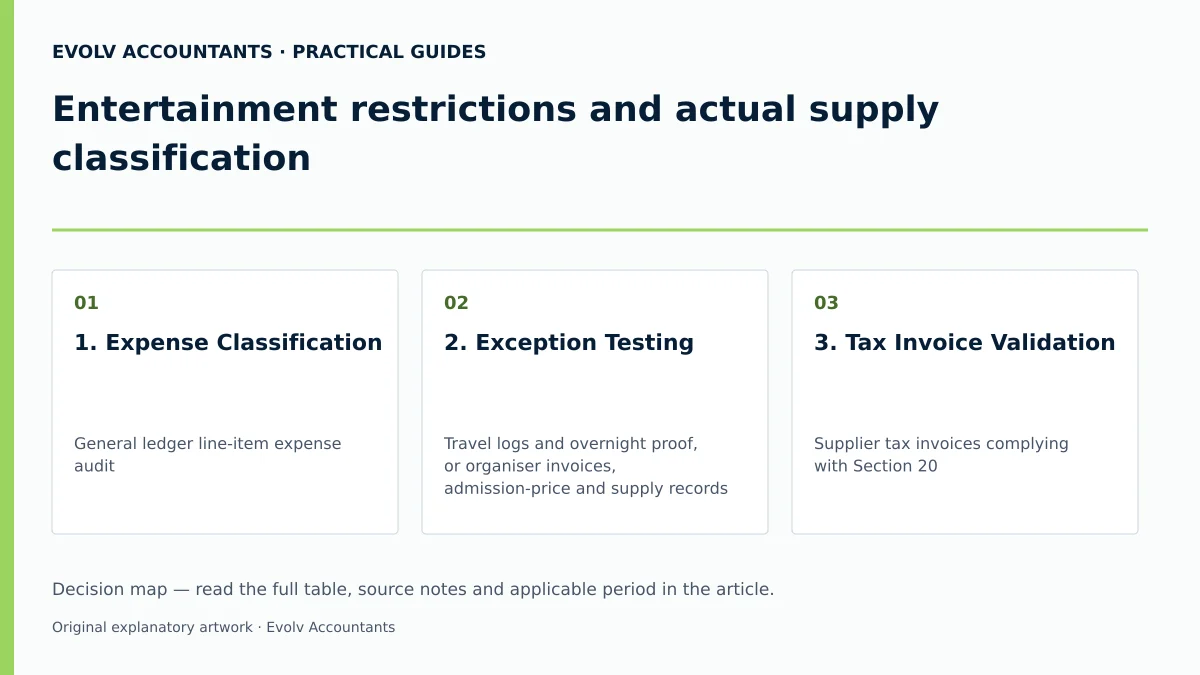
| 1. Expense Classification | General ledger line-item expense audit | Finance Manager | Meal and entertainment items segregated | Test the specific subsistence or seminar-organiser exception 3 6 |
| 2. Exception Testing | Travel logs and overnight proof, or organiser invoices, admission-price and supply records | Tax Accountant | The relevant statutory exception and its evidence verified 6 7 | Exclude non-qualifying client or staff meals 2 |
| 3. Tax Invoice Validation | Supplier tax invoices complying with Section 20 | Accounts Payable Clerk | Valid VAT numbers and 15% rate confirmed 9 20 | Request corrected invoice or seek Section 16(2)(g) ruling 52 |
| 4. VAT201 Field 15 Filing | Calculated input tax (15/115 tax fraction) | Registered eFiler | Field 15 populated; submission confirmed 18 37 38 | Pay by the applicable VAT deadline; check any refund against its statutory clock and exceptions 41 55 |
| 5. Audit Pack Retention | Full supporting pack (invoices, logs, VATSOA) | Compliance Officer | Secured in digital archive for 5 years 8 10 | Prepare upload if selected for SARS verification 19 56 |
Reproducible hypothetical example
Scenario: Cape Precision Tools CC, a registered VAT vendor operating on a bi-monthly Category A filing schedule, incurred the following expenses during a two-month tax period (all figures include 15% VAT where applicable):
- Client dinner at restaurant: R2 300 (Illustrative value). Classification: Client entertainment under Section 17(2)(a) 2 34. Permissible Input VAT: R0,00 2.
- Employee overnight business trip meals: R1 150 (Illustrative value). Classification: Personal subsistence while away overnight on enterprise business 6. Permissible Input VAT calculation: R1 150 × (15 ÷ 115) = R150,00 (Illustrative value) 35 36.
- Seminar organiser’s qualifying catering purchase: R5 750 (Illustrative value). Classification: Assume the vendor organises the seminar, charges an inclusive admission fee meeting the statutory entertainment-supply conditions, and holds the prescribed catering tax invoice 7. Permissible Input VAT calculation: R5 750 × (15 ÷ 115) = R750,00 (Illustrative value) 35 36.
- General workshop operating overheads: R11 500 (Illustrative value). Classification: Standard enterprise operational goods 21. Permissible Input VAT calculation: R11 500 × (15 ÷ 115) = R1 500,00 (Illustrative value) 35 36.
VAT201 Return Summary:
- Total Input Tax (Field 15 & Field 19): R150,00 + R750,00 + R1 500,00 = R2 400,00 (Illustrative value) 38 39.
- Total Output Tax (Field 4 & Field 13): Declared from standard sales of R46 000 (Illustrative value) = R46 000 × (15 ÷ 115) = R6 000,00 (Illustrative value) 35 57.
- Net VAT Payable to SARS (Field 20): R6 000,00 - R2 400,00 = R3 600,00 (Illustrative value) 17 39.
Frequently Asked Questions
Can a South African business claim input VAT on restaurant meals for client meetings?
No. Restaurant meals and drinks provided to clients or prospective business associates constitute non-deductible entertainment under Section 17(2)(a) of the VAT Act 2 34. Input tax recovery is prohibited even if business discussions occur during the meal 1 2.
What specific conditions permit an input VAT claim for employee meals under personal subsistence?
Input tax on meals and refreshments may be claimed only if the employee or business owner was required to spend at least one night away from their normal residence and working location on enterprise business 6. The expenditure must be incurred by the vendor, substantiated by a valid tax invoice, and cannot be claimed if a flat subsistence allowance was paid 6 9.
Are catering expenses included in conference or seminar registration fees deductible?
Not automatically. The SARS guide identifies relief for meals or refreshments supplied by seminar organisers where their cost is included in the ticket or entrance fee. The organiser’s position and an attendee’s purchase must be classified separately. An attendee should not assume that including catering in a registration fee removes the entertainment restriction; establish the applicable statutory exception and retain the prescribed evidence.
How should an SME correct a past VAT201 return if input VAT was incorrectly claimed on restricted entertainment?
The vendor must submit a "Request for Correction" on eFiling for the affected tax period to adjust Version 2 of the VAT201 return 49 50. The corrected return will calculate the additional output liability or reduced input deduction, which must then be settled with applicable SARS interest 17 49.
How long must an SME retain records substantiating meal and entertainment input VAT claims?
Under Chapter 4 of the Tax Administration Act and Section 55 of the VAT Act, all supporting documentation—including tax invoices, travel logs, hotel receipts, and event agendas—must be retained for at least five years from the date the return was submitted 8 9 10. Ask Evolv about entertainment restrictions and actual supply classification. Share the relevant records so the support required can be scoped.
Related guides
- Preparing a VAT refund reconciliation pack
- When a South African business must register for VAT
- Compliance and Regulations: Keeping Your Business on Track
Sources
- https://www.sars.gov.za/wp-content/uploads/Ops/Guides/Legal-Pub-Guide-VAT404-VAT-404-Guide-for-Vendors.pdf
- https://www.sars.gov.za/wp-content/uploads/Ops/Guides/GEN-ELEC-04-G01-Guide-for-completing-the-Value-Added-Tax-VAT201-Declaration-External-Guide.pdf
- VAT Refunds for vendors | South African Revenue Service
- Obligations of a VAT vendor | South African Revenue Service
- Register for VAT | South African Revenue Service