
Preparing a VAT refund reconciliation pack
26 November 2025

Preparing a VAT refund reconciliation pack requires matching filed return declarations directly against general ledger balances and verified bank statements to substantiate claims.
A compliant VAT refund reconciliation pack compiles independent primary evidence—including the filed VAT201 declaration, general ledger tax control accounts, valid tax invoices, bank statements, and SARS eFiling transaction histories—into a single audit-ready package 1 2 3 4. Under South African tax administration, the South African Revenue Service (SARS) mandates that vendors possess prescribed documentary evidence before claiming input tax deductions or overpayment reimbursements 1 3 4.
Compiling a structured pack ensures that every rand claimed is traceable, distinguishes timing delays from accounting errors, and protects the enterprise against verification delays, section 95 estimated assessments, or interest penalties 1 5 6.
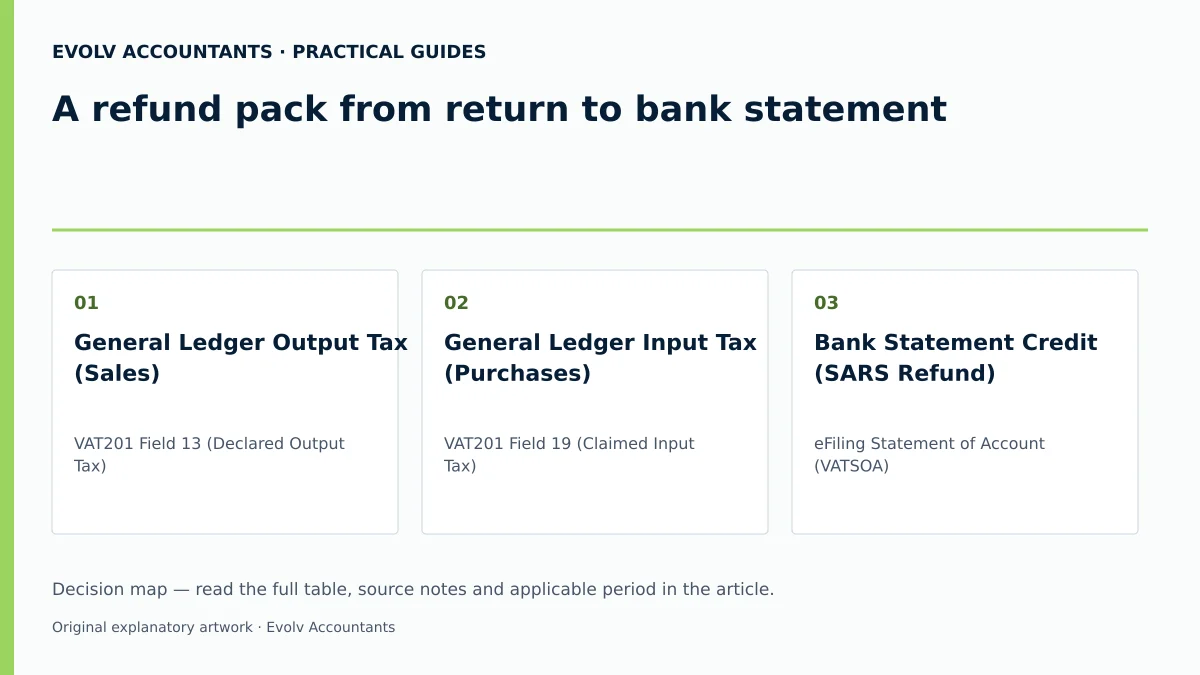
A refund pack from return to bank statement
To satisfy SARS verification standards, a vendor must establish strict alignment across three independent tiers of operational records: the VAT201 return submitted to SARS, the internal accounting records, and external bank statements 1 2 3 4.
— Practical point from this guide
Understanding independent records and factual agreement
- Tier 1: Filed VAT201 Return: The official self-assessment declaration submitted via eFiling or at a SARS branch, reflecting total output tax (Field 13), total input tax (Field 19), and net refund due (Field 20) 7 8 9 10 11.
- Tier 2: General Ledger VAT Control Accounts: Internal bookkeeping accounts recording output tax collected on sales, input tax incurred on purchases, and historical tax clearing balances 12 13.
- Tier 3: Bank Statements and Payment References: Commercial bank statements reflecting actual cash transactions, cross-referenced against the unique 19-digit Payment Reference Number (PRN) generated on eFiling 14 15.
Distinguishing law, regulator guidance, and Evolv recommendations
Under section 16(3) read with section 20 of the Value-Added Tax Act 89 of 1991, statutory entitlement to deduct input tax depends strictly on holding prescribed documentary proof, such as valid tax invoices or bills of entry 3 16 17. SARS regulator guidance (VAT 404 Guide for Vendors) notes that mathematical agreement between ledgers does not prove factual validity; SARS auditors inspect underlying tax invoices to verify that allowable input tax was actually incurred for enterprise purposes 3 6 18.
Evolv recommends conducting a monthly three-way document cross-check prior to return submission, ensuring every ledger figure is backed by verified physical or electronic tax documentation 1 3 4.
Prepare the opening balances and period: a refund pack from return to bank statement
A reliable reconciliation begins by establishing clear opening balances, establishing strict period cut-offs, and confirming that mandatory vendor identifiers match across official records 2 19 20 21.
Opening balance and cutoff integrity
- Opening Balances: Confirm that opening balances of output, input, and control accounts in the general ledger equal closing balances from the preceding tax period 12 13.
- Period Cut-off: Returns must cover the allocated tax period (e.g., Category A odd months or Category B even months) 21 22 23. If operating under a 10-day rule approved by the Commissioner, ensure transactions cut off consistently on the specified fixed date 20.
- Currency and Identifiers: All declarations and supporting tax invoices must be in South African Rand (ZAR), except for zero-rated export supplies or qualifying electronic services 24 25. Confirm that the trading name, 10-digit VAT registration number, and pre-populated PRN match across eFiling and general ledger schedules 15 19 22.
- Completeness Check: Verify that no unposted sales, supplier invoices, or credit notes remain in temporary batch files for the period 7 8 26.
Match transactions and explain differences: documented completion and exceptions
The core of the refund pack is a transaction-level bridge that aligns ledger balances with VAT201 return fields and highlights all variances for review 8 13 27 28.
Reconciliation bridge
These are independent illustrative reconciliation items, not actual client records.
| Independent record A | Independent record B | Difference | Reason and evidence | Action and owner |
|---|---|---|---|---|
| General Ledger Output Tax (Sales) | VAT201 Field 13 (Declared Output Tax) | R13,04 | Abridged debit note issued missing from automated return import 7 29. | Post manual adjustment to Field 12 on eFiling; Financial Accountant 7 30. |
| General Ledger Input Tax (Purchases) | VAT201 Field 19 (Claimed Input Tax) | R2,400.00 | Prohibited input tax on passenger motor car purchase included in ledger 31 32 33. | Remove the prohibited amount from the input-tax claim before filing; Tax Specialist 31 32 34. |
| Bank Statement Credit (SARS Refund) | eFiling Statement of Account (VATSOA) | R4,424.86 | Refund set-off against outstanding corporate income tax debt by SARS 35 36. | Verify debt equalisation on VATSOA and clear tax clearing account; Senior Accountant 35 36. |
| Supplier Tax Invoice | General Ledger Input Tax Account | R150.00 | Supplier issued abridged invoice above R5,000 threshold lacking recipient VAT number 37. | Request full tax invoice from supplier before claiming input tax; Creditors Clerk 37. |
Distinguishing timing items from errors
Reconciliation variances fall into two categories:
- Timing Differences: Items recognised in accounting records in one period but declared in a different VAT return due to statutory accounting rules (such as payments basis timing or delayed receipt of supplier invoices) 38 39.
- Errors and Duplications: Unsupported claims, double-posted invoices, mathematical errors when applying the 15/115 tax fraction, or prohibited input tax claims (e.g., entertainment or passenger motor cars) 27 31 32 33.
Post only supported corrections: a refund pack from return to bank statement
When variances reveal accounting errors or omissions, corrective entries must align with statutory filing mechanisms and tax administration rules 30 40 41 42.
Statutory rules for return corrections
- eFiling Request for Correction (RFC): Under section 25(5) of the Tax Administration Act, a vendor can submit a Request for Correction on eFiling to rectify an undisputed error on a previously filed return, creating a new return version 5 30 43.
- Restriction on Increasing Past Input Tax: Regulator guidance confirms that a vendor is not permitted to increase input tax deductions on a past tax period when submitting a revision 41 42. Omitted input tax must be deducted in the current or a future tax period within five years from the date of first entitlement 13 41 42.
- Adjusting Output Tax: Output tax can be increased or decreased on an RFC for past periods where factual justification exists (e.g., corrected sales invoices or credit notes) 7 30 40.
- Journal Authorisation: Correcting journal entries must be backed by a written explanation, managerial sign-off, and supporting documentation (such as valid credit notes or revised calculation schedules) 7 26 44.
Review unresolved and old items: documented completion and exceptions
Unresolved variances, delayed refunds, and stale tax claims require systematic logging and monitoring to avoid forfeiture or missed dispute deadlines 14 35 36 45 46.
Aged exception log and tracking
Maintain an aged exception log detailing every un-cleared item, assigning an owner, reason, and action. Never hide unresolved differences in suspense accounts or unapproved write-offs 1 5 47.
Reproducible hypothetical example: SARS refund delay and verification
(Note: Monetary figures below are illustrative values labelled for demonstration purposes.)
- Scenario: Alpha Trading (Pty) Ltd (Category B vendor, invoice basis) submits its March/April 2026 VAT201 return on eFiling on 29 May 2026 4 48 49.
- Declared Values:
- Standard rated taxable sales (VAT inclusive): R1,150,000.00 (Field 1) 27.
- Output tax calculated (15/115): R1,150,000.00 × 15/115 = R150,000.00 (Field 4) 27.
- Standard-rated capital purchases: R1,610,000.00 including VAT; deductible tax R210,000.00 is entered in Field 14 16 34.
- Input tax claimed (15/115): R1,610,000.00 × 15/115 = R210,000.00 (Field 19) 8 16 34.
- Net VAT Refund Claimed (Field 20): R150,000.00 – R210,000.00 = (R60,000.00) 8 10.
- Reconciliation Event: SARS issues a verification letter requesting supporting documents for the capital input claim, placing the payout on hold pending verification; the statutory clock and interest exceptions must be checked 1 14 18 50.
- Resolution Action: The tax manager compiles the pack containing the capital purchase invoice, proof of payment, and bank statement, uploading them via eFiling by the deadline in the supporting-document request 1 50 51. Once verified, SARS pays the R60,000.00 refund to the bank account 1 14.
Next steps for VAT refunds
To finalise a refund submission and prepare for subsequent tax periods, follow a structured operational workflow 1 14 15 50.
SARS generally requires banking details in the vendor’s name. Specified third-party banking exceptions include foreign/non-resident companies and qualifying holding/subsidiary group companies, subject to VAT119i and the supporting evidence required by SARS.
Frequently Asked Questions
How long does SARS have to process a VAT refund before paying interest?
SARS may withhold a refund while verifying entitlement. Interest and the 21-business-day calculation depend on the applicable statutory exceptions, including defective returns, banking details and access to records; selection for verification alone should not be treated as proof of an unlimited interest-free suspension. Check the dates, notices and the specific withholding or recalculation ground. SARS refund guidance.
What is the compulsory VAT registration threshold for South African businesses?
Current SARS registration guidance administers new applications from 1 April 2026 at R2.3 million in taxable supplies over any consecutive 12 months for compulsory registration and R120 000 for the standard voluntary route, with specified alternative conditions. Older guides quote R1 million and R50 000. These older figures must not be presented as the current application thresholds, and the administrative guidance does not itself prove an amendment to section 23.
Can a vendor claim input tax on a tax invoice from a previous tax period?
Yes. If an input tax deduction was inadvertently omitted in a past tax period, the vendor may deduct it in the current or any future VAT return, provided the claim is made within five years from the date of first entitlement 13 41 42. Input tax deductions cannot be increased by submitting a Request for Correction for a prior period 41 42.
What documents are required to support a VAT input claim on imported goods?
To claim input tax on imported goods, the vendor must hold an EDI Customs Status 1 Release Message, a valid bill of entry (e.g., Form SAD 500), and the official eFiling receipt number proving payment of VAT to SARS Customs 17. If an agent acts on behalf of the vendor, the vendor must hold the agent's monthly statement issued within 21 days 17.
What happens if SARS issues a Section 95 estimated assessment?
If a vendor fails to submit requested supporting documents during a verification, SARS may issue a Section 95(1)(c) estimated assessment 5 66. The Tax Administration Act allows the vendor to request an extension of time or submit the required relevant material after the assessment notice (VAT217) is issued to request that SARS withdraw or revise the estimate 5 45.
Related guides
- Correcting a refund claim before verification finishes
- Why a VAT refund can be delayed
- The Proactive SARS Audit Guide: Keeping Your Business Ledger Sanitised
Sources
- VAT Refunds for vendors | South African Revenue Service
- https://www.sars.gov.za/wp-content/uploads/Ops/Guides/GEN-ELEC-04-G01-Guide-for-completing-the-Value-Added-Tax-VAT201-Declaration-External-Guide.pdf
- https://www.sars.gov.za/wp-content/uploads/Ops/Guides/Legal-Pub-Guide-VAT404-VAT-404-Guide-for-Vendors.pdf
- https://www.sars.gov.za/wp-content/uploads/Ops/Guides/VAT-REG-02-G01-Guide-for-Completion-of-VAT-Application-External-Guide.pdf
- Register for VAT | South African Revenue Service