
Matching one bank payment to several invoices
11 September 2026

Matching one bank payment to several invoices requires a structured allocation schedule that verifies individual supplier records against bank entries.
An allocation schedule reconciles a single lump-sum bank payment against multiple outstanding supplier invoices, establishing a verified audit trail for bookkeeping and financial reporting. South African legislation obliges entities to keep accurate accounting records 1 and preserve supporting documentation for specified periods 2 3.
The detailed mechanics of apportioning payments across multiple supplier invoices represent operational recommendations developed by Evolv Accountants—a firm providing bookkeeping/accounting, tax advisory, payroll and company/statutory compliance—to maintain internal financial control, rather than statutory procedures mandated by law.
Allocation schedule across multiple supplier invoices
Distinguishing Independent Records from Factual Validity
When a business issues a single bank transfer to settle multiple invoices from a supplier, the transaction involves several independent records. These include the bank statement debit entry, the payment confirmation or electronic funds transfer (EFT) instruction, the supplier's statement of account, and individual supplier tax invoices 4.
— Practical point from this guide
Establishing mathematical agreement between a bank payment and an allocation schedule verifies that the total funds disbursed equal the sum of the selected invoice balances. However, achieving a match between a bank entry and internal accounting ledgers does not automatically validate the factual accuracy or commercial enforceability of the underlying invoices. Bookkeepers must confirm that the goods or services were delivered according to agreed terms before finalising the payment allocation.
Regulatory Boundaries and Operational Guidelines
Under South African company law, every company must keep accurate and complete accounting records in one of the official languages 1. Furthermore, tax legislation requires taxpayers to maintain records that enable the revenue authority to verify compliance with tax Acts 5. While compliance with record-keeping rules is a statutory obligation, the choice of reconciliation methodology—such as using an allocation schedule—is an operational practice recommended by Evolv Accountants.
Prepare the opening balances and period: allocation schedule across multiple supplier invoices
Setting Core Accounting Parameters
Preparing an allocation schedule requires establishing clear parameters at the start of the reconciliation process:
- Opening Balance Verification: Confirm the starting balance of the supplier's account in the accounts payable ledger, ensuring all prior payments and credit notes have been posted correctly.
- Cut-off Period Definition: Fix the exact start and end dates for the reconciliation period. Transactions occurring after the cut-off date must be excluded to prevent period-end distortions.
- Currency Standardization: Record all amounts in South African Rand (ZAR). Where foreign currency supplier invoices exist, convert values using the spot exchange rate on the transaction date.
- Unique Identifiers: Capture explicit reference numbers for every document, including invoice numbers, supplier VAT registration numbers (mandatory on tax invoices exceeding R5 000) 4, and bank clearance references.
- Evidence Completeness: Collate all primary documents, ensuring valid tax invoices or abridged tax invoices (for supplies not exceeding R5 000) are present prior to allocation 6.
Document Verification Checklist
Before matching transactions, finance teams should complete the following verification steps:
- Verify that the total bank payout matches the sum of target invoices listed on the supplier remittance advice.
- Inspect each supplier invoice to ensure it meets valid tax invoice criteria, including supplier details, serial numbers, and VAT calculations 4.
- Confirm that any prompt payment discounts or early settlement terms comply with agreed credit agreements.
- Ensure that any debit notes or return credits included in the calculation are approved by authorised management.
- Check that transaction dates fall within the defined accounting period prior to posting.
Match transactions and explain differences: documented completion and exceptions
Constructing the Transaction-Level Bridge
A transaction-level reconciliation bridge systematically maps the single bank payment against each individual open item on the supplier ledger. Differences often arise between the bank disbursement amount and the total face value of target invoices. Reconciling items must be categorised into distinct operational categories rather than combined into arbitrary balancing figures.
Categorizing Reconciliation Variances
- Timing Differences: These occur when a payment is processed near period-end or when an early settlement discount is claimed prior to formal supplier acknowledgment.
- Operational Mistakes: These include data-entry errors, incorrect invoice selection, bank fee deductions from total payment transfers, or miscalculated VAT amounts.
- Duplicated Records: These happen when an invoice is entered twice into the accounting system or when a credit note is erroneously recorded as an invoice.
Illustrative Reconciliation Bridge
The following hypothetical example illustrates a payment of R50 000 made to a trade supplier to settle three outstanding invoices alongside an unposted credit note and a prompt settlement discount. All figures are hypothetical illustrative values.
| Independent record A | Independent record B | Difference | Reason and evidence | Action and owner |
|---|---|---|---|---|
| Bank Payment: R50 000 | Invoice #101: R25 000 | R0 | Fully matched to bank payment against remittance advice | Clear item in accounts payable ledger; Senior Bookkeeper |
| Bank Payment: R50 000 | Invoice #102: R18 000 | R0 | Fully matched to bank payment against remittance advice | Clear item in accounts payable ledger; Senior Bookkeeper |
| Bank Payment: R50 000 | Invoice #103: R10 000 | (R2 000) | Invoice total is R10 000; payment allocated is R8 000 due to credit note #CN-04 | Apply credit note CN-04 to Invoice #103; Accounts Payable Clerk |
| Bank Payment: R50 000 | Early Settlement Discount | (R1 000) | 2% prompt payment discount taken as per credit terms | Post settlement discount journal upon supplier confirmation; Finance Manager |
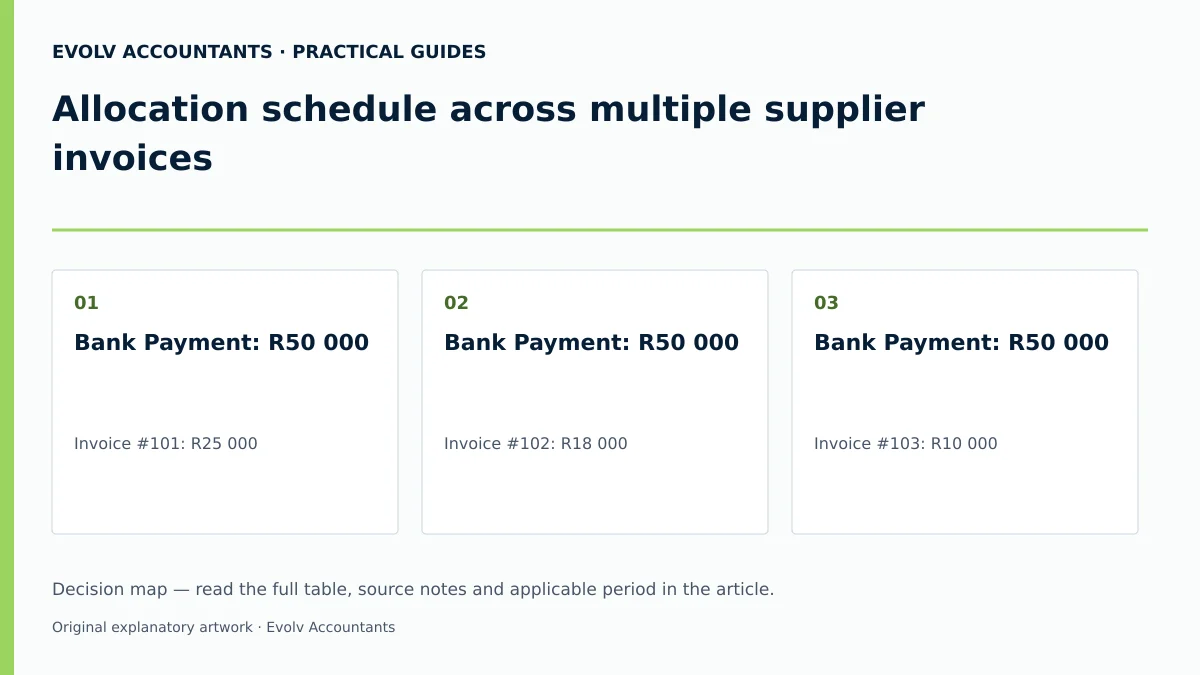
Note: All monetary figures in the table above are illustrative hypothetical values generated for demonstration purposes.
Post only supported corrections: allocation schedule across multiple supplier invoices
Evidentiary Standards for Adjusting Journals
Corrections to financial ledgers must be supported by verifiable primary documentation. Adjusting entries should never be posted solely to force a bank balance to agree with accounts payable sub-ledgers.
- Discount Adjustments: If a discount was taken, the adjustment must be supported by the supplier contract or a revised statement reflecting the discount.
- Credit Note Postings: Where a partial payment relates to damaged goods or returned stock, a valid credit note from the supplier must be attached to the journal voucher.
- Bank Fee Allocations: If the bank deducted transaction charges from the disbursement, the fee must be expensed to bank charges rather than left as an unallocated variance on the supplier account.
Statutory Ledger Integrity
The Companies Act prohibits the falsification of accounting records and establishes that failing to maintain accurate records with intent to deceive constitutes an offence 7. Ensuring that every journal entry is backed by underlying documentary evidence preserves ledger integrity and satisfies statutory audit standards 1 8.
Review unresolved and old items: documented completion and exceptions
Managing the Aged Exception Log
Unresolved differences that cannot be cleared during the primary reconciliation must be logged in an aged exception log. Leaving unexplained variances inside active accounts payable ledgers distorts financial position figures and complicates future reconciliations.
An effective exception log captures:
- Transaction identification date and reference number.
- Unreconciled Rand value.
- Root cause description (e.g. disputed invoice rate, missing credit note).
- Assigned internal owner responsible for resolution.
- Specific target resolution date.
Eliminating Suspense Account Usage
Evolv strongly advises against transferring unresolved allocation differences into general suspense accounts. Hiding variances in suspense accounts obscures operational errors and creates compliance risks during SARS tax audits or external statutory reviews 5.
Next steps for Bank reconciliation
Supervisory Review and Sign-off
Upon completing the allocation schedule and reconciliation bridge, a formal supervisory review must take place. The reviewer verifies that:
- Total allocated payments equal the bank statement withdrawal.
- All supporting tax invoices meet statutory form requirements 4.
- Adjusting journal entries carry proper documentary authorisation.
- Unresolved variances are accurately documented in the aged exception log.
Document Preservation and Retention Rules
Completed allocation schedules, along with bank statements and supporting supplier invoices, must be archived securely. Under section 24 of the Companies Act, accounting records must be retained for seven years 2. Under section 29 of the Tax Administration Act, a person who has submitted a tax return must retain relevant records for five years from the date of submission 3 9. If a return has not been submitted, the retention obligation remains indefinite until the return is filed, after which the five-year period applies 9 10.
If a date specified for compliance falls on a Saturday, Sunday, or public holiday, the required action must be taken on the last business day preceding that day 11.
Opening the Subsequent Accounting Period
Once reviewer approval is documented and records are archived, closing balances on the accounts payable sub-ledger are carried forward as verified opening balances for the next reporting period.
Frequently Asked Questions
Does matching a bank payment to multiple supplier invoices fulfill statutory record-keeping duties?
Matching payments to invoices supports internal accounting accuracy, but statutory compliance requires retaining complete supporting records. Under the Companies Act, companies must keep accurate accounting records for seven years 1 2, while tax legislation requires retaining records for five years from the return submission date 3. Matching is an operational procedure recommended by Evolv to ensure those records remain verifiable.
What happens if a supplier invoice lacks full tax invoice details?
For supplies exceeding R5 000, a valid tax invoice must contain the words "Tax Invoice", supplier and recipient names, addresses, VAT registration numbers, serial number, date, full description, quantity, and VAT amounts 4. If an invoice lacks these details, the business cannot claim input VAT deductions until a corrected tax invoice is provided by the supplier.
How should an SME handle early settlement discounts when allocating a payment?
An early settlement discount should only be posted to the accounting ledger if supported by the supplier’s payment terms or written agreement. The payment allocation schedule should list the gross invoice amount, deduct the settlement discount as a separate line item, and match the net amount to the actual bank disbursement.
Can unallocated payment differences be temporarily parked in a suspense account?
Evolv strongly advises against parking unallocated differences in suspense accounts. Indiscriminate use of suspense accounts obscures reconciliation errors and increases non-compliance risks during SARS audits 5. Unresolved differences should remain in an aged exception log with an assigned owner until fully investigated and corrected.
What retention period applies to bank reconciliation records and allocation schedules?
Under section 24 of the Companies Act, company accounting records must be kept for seven years 2. Under tax legislation, records must be retained for five years from the date the relevant tax return was submitted 3 9. If an audit or dispute is ongoing, records must be retained until the matter is finalised 9 10. Ask Evolv about allocation schedule across multiple supplier invoices. Share the relevant records so the support required can be scoped.
Related guides
- Reconciling a business bank account step by step
- Matching several payments to one customer invoice
- Reading the Financials: Cash Flow and the Balance Sheet for Directors
Sources
- https://www.cipc.co.za//wp-content/uploads/Legal/Regulations/CompaniesAct71_2008.pdf
- https://www.sars.gov.za/wp-content/uploads/Ops/Guides/LAPD-TAdm-G01-Short-Guide-to-the-Tax-Administration-Act-2011.pdf
- https://www.sars.gov.za/wp-content/uploads/Ops/Guides/Legal-Pub-Guide-Gen09-Tax-Guide-for-Small-Businesses.pdf