
Matching several payments to one customer invoice
20 January 2025

Matching several payments to one customer invoice requires systematic allocation of each partial receipt against the primary debt record to maintain accurate accounts.
For South African small and medium enterprises (SMEs), receiving customer payments in multiple partial instalments across different bank dates creates administrative complexity in accounts receivable. Properly allocating these instalments requires maintaining a formal sub-ledger bridge between incoming bank credits and the master sales invoice. Under South African statutory frameworks, businesses must maintain accurate accounting records that reflect the true state of commercial transactions 1 2.
While statutory provisions dictate record retention and tax reporting timelines 3 4, the operational procedures for splitting and matching bank deposits across single sales invoices are administrative best practices recommended by Evolv Accountants to ensure ledger integrity and seamless Value-Added Tax (VAT) compliance 5 6.
Receipt allocations across customer instalments
Managing receipt allocations across customer instalments requires comparing independent financial records to establish accurate account balances. Bookkeepers must treat bank statement credit entries and customer remittance notes as separate, independent records. Concluding that a set of bank receipts matches an invoice total purely because the mathematical sum aligns is an operational error; bookkeepers must verify the factual agreement between the records.
— Practical point from this guide
Agreement between records means that the payment reference, banking origin, customer identification, and contractual instalment terms correspond directly to the specific debt 7 8. A mathematical match alone does not confirm factual validity or prove that the correct debtor settled the account.
When evaluating receipt allocations, SMEs must distinguish between statutory mandates, regulator guidance, and advisory recommendations:
- Statutory Law: Section 28(1) of the Companies Act 71 of 2008 obliges every registered company to keep accurate and complete accounting records in an official language to enable the preparation of compliant financial statements 1. Section 28(3) establishes that failing to keep accurate records with an intent to deceive, or falsifying accounting records, constitutes a statutory offence 9. Furthermore, Section 29(1) dictates that financial statements must present fairly the state of affairs and business position of the company 2.
- Regulator Guidance: Official guides published by the South African Revenue Service (SARS) stipulate that registered VAT vendors must issue valid tax invoices containing specific statutory details, including serialised invoice numbers and registration numbers 10. For vendors accounting for VAT on the invoice basis, output tax accrues at the earlier of when an invoice is issued or when any payment is received 6. SARS guidance emphasizes that electronic funds transfer (EFT) payments must be referenced correctly to ensure valid allocation across taxpayer accounts 8.
- Evolv Recommendations: Evolv Accountants recommends implementing a multi-point verification protocol before splitting bank credits. Bookkeepers should match the customer’s Taxpayer Reference Number (TRN) or trade name, confirm the remittance advice, and record every partial payment sequentially against the open sub-ledger invoice line item 7.
Prepare the opening balances and period: receipt allocations across customer instalments
Before executing transaction matching, the bookkeeper must establish verified opening balances, define the accounting period cut-off, and confirm that all supporting primary evidence is complete. The opening balance represents the outstanding accounts receivable balance brought forward from the preceding financial period. Establishing a clean cut-off ensures that receipts deposited after period-end are excluded from current reconciliations, preserving period integrity.
Record-keeping compliance under South African law involves distinct retention periods across different statutes:
- Companies Act Retention: Section 24(1) read with Section 24(3) of the Companies Act 71 of 2008 mandates that accounting records and annual financial statements must be retained for seven years 3 11.
- Tax Administration Act Retention: Section 29 of the Tax Administration Act 28 of 2011 (TAA), as outlined in SARS guidance, requires taxpayers to retain records, books of account, and supporting documents for five years from the date a return is submitted 4 12. If a required return has not been submitted, records must be retained indefinitely until the return is furnished, after which the five-year period applies 4 12. In cases of an audit, investigation, or formal dispute, retention extends until the matter is finalised 12 13.
Bookkeepers should execute the following numbered checklist before matching partial customer receipts:
- Confirm that the opening sub-ledger balance agrees with the audited closing balance of the prior financial period.
- Verify the customer’s legal entity name, Taxpayer Reference Number (TRN), and master invoice number 7 10.
- Establish strict accounting period cut-off dates based on bank transaction dates rather than internal entry dates.
- Confirm the transaction currency and verify that bank transaction feeds display unedited credit descriptions 8.
- Check whether the business accounts for VAT on the invoice basis or payments basis under SARS regulations 6 14.
- Assemble complete source documentation, including bank statements, deposit slips, tax invoices, and customer remittance advices 15 16.
Match transactions and explain differences: documented completion and exceptions
Transaction-level bridge and timing differences
Matching multiple partial receipts to a single sales invoice requires a transaction-level reconciliation bridge. Differences between customer sub-ledgers and bank records generally fall into two categories: timing differences and fundamental errors. Timing differences arise when customer payments are initiated before period-end but clear the banking system after the cut-off date. Fundamental errors include bank fee deductions, overpayments, underpayments due to unauthorized settlement discounts, and duplicated entries.
Timing items require temporary bridging explanations, whereas fundamental errors require formal investigation and documented adjustment vouchers.
Reproducible hypothetical example
Consider a hypothetical SME, Tableland Logistics (Pty) Ltd, which issued a valid tax invoice (Invoice #TL-2026-401) to a corporate client on 10 April 2026 for a total value of R115,000 (comprising R100,000 net supply plus 15% VAT of R15,000) 5 10.
The customer settles Invoice #TL-2026-401 in three separate electronic instalments:
- Instalment 1 (15 April 2026): R40,000 deposited via EFT 8.
- Instalment 2 (28 April 2026): R45,000 deposited via EFT 8.
- Instalment 3 (12 May 2026): R30,000 deposited via EFT 8.
Under the VAT invoice basis, Tableland Logistics accounts for the full R15,000 output tax in the April tax period because the tax invoice was issued in April 6.
The bookkeeper records the following journal entries:
- 10 April 2026 (Invoice Issuance):
- Debit: Accounts Receivable (Client Account) — R115,000
- Credit: Sales Revenue — R100,000
- Credit: Output Tax Payable (SARS) — R15,000
*(To record tax invoice #TL-2026-401 on invoice basis 6 10.)*
- 15 April 2026 (First Instalment Received):
- Debit: Bank Current Account — R40,000
- Credit: Accounts Receivable (Client Account — Instalment 1) — R40,000
*(To allocate partial payment 1 against Invoice #TL-2026-401 8.)*
- 28 April 2026 (Second Instalment Received):
- Debit: Bank Current Account — R45,000
- Credit: Accounts Receivable (Client Account — Instalment 2) — R45,000
*(To allocate partial payment 2 against Invoice #TL-2026-401; remaining balance at April month-end is R30,000 8.)*
- 12 May 2026 (Third Instalment Received):
- Debit: Bank Current Account — R30,000
- Credit: Accounts Receivable (Client Account — Instalment 3) — R30,000
*(To allocate final partial payment, fully clearing Invoice #TL-2026-401 8.)*
Reconciliation bridge
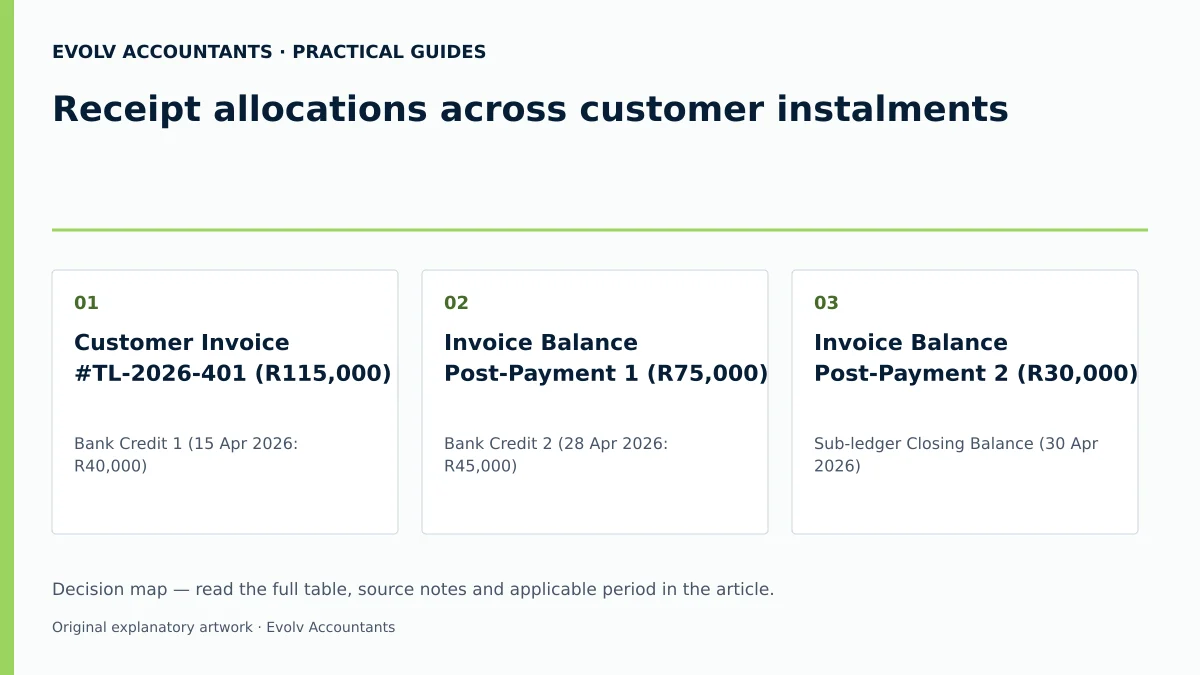
The following Markdown table illustrates the transaction-level reconciliation bridge at April month-end before the final May instalment is received:
| Independent record A | Independent record B | Difference | Reason and evidence | Action and owner |
|---|---|---|---|---|
| Customer Invoice #TL-2026-401 (R115,000) | Bank Credit 1 (15 Apr 2026: R40,000) | R75,000 | Partial payment 1 received; supported by bank credit advice 8 | Allocate R40,000 to sub-ledger; Bookkeeper |
| Invoice Balance Post-Payment 1 (R75,000) | Bank Credit 2 (28 Apr 2026: R45,000) | R30,000 | Partial payment 2 received; supported by bank credit advice 8 | Allocate R45,000 to sub-ledger; Bookkeeper |
| Invoice Balance Post-Payment 2 (R30,000) | Sub-ledger Closing Balance (30 Apr 2026) | R30,000 | Outstanding instalment 3 due in May; agreed payment schedule | Monitor May cash flow; Finance Manager |
Post only supported corrections: receipt allocations across customer instalments
Journal vouchers and sub-ledger corrections must only be posted when supported by verifiable primary evidence. If a customer pays less than the invoice amount due to deducted bank charges or short-payments, bookkeepers must not arbitrarily adjust sales revenue. Under SARS guidelines and the TAA, self-assessed tax returns (such as VAT201 returns) constitute original assessments 17 18.
Once an original assessment exists, corrections must follow statutory procedures, such as requesting a reduced assessment where a readily apparent error occurred or making permitted adjustments in subsequent tax returns 17.
Evolv recommends that bookkeepers enforce strict internal documentation controls:
- Short-Payments for Bank Charges: Obtain the bank credit advice reflecting the gross transfer and specific international or inter-bank charges. Debit the bank charge expense account and credit accounts receivable with appropriate supporting vouchers.
- Unapproved Discounts: If a customer underpays by taking an unauthorized discount, keep the balance in accounts receivable and issue a payment query notice rather than writing off the amount.
- Credit Notes: Issue a formal credit note only when supported by commercial evidence, such as returned goods or an agreed price reduction, ensuring the credit note references the original tax invoice number 19.
Review unresolved and old items: documented completion and exceptions
Unallocated customer receipts and unresolved partial balances must be maintained in an aged exception log containing the item date, customer details, outstanding balance, root cause, assigned owner, and target resolution date. Under the IFRS Conceptual Framework, an asset is defined as a present economic resource controlled by the entity as a result of past events 20. Accounts receivable balances must be reviewed periodically to verify that they satisfy asset recognition criteria and have not suffered impairment 20.
Bookkeepers must avoid hiding unallocated partial deposits in general liability or suspense accounts. Hiding items in suspense distorts liquidity ratios and violates the fundamental accounting principle of faithful representation 20 21. Furthermore, under Section 15(2) of the Value-Added Tax Act 89 of 1991, as detailed in SARS guidance, if a vendor registered on the invoice basis claims input tax on a purchase but fails to pay the supplier within 12 months, the vendor must account for an output tax adjustment 22.
While this rule applies to vendor purchases, maintaining aged accounts receivable records ensures that SMEs properly track outstanding customer claims and prevent premature income recognition or invalid debt write-offs 22.
Next steps for Bank reconciliation
To finalise the bank reconciliation period and ensure seamless operational continuity, management must complete structured sign-off procedures:
- Reviewer Checks: A designated senior financial reviewer must inspect the bank reconciliation workspace, verifying that all credit entries matched across customer instalments are tied to valid bank statements and tax invoices 10 15.
- Archiving Reconciliations: Save the final reconciliation schedule, aged sub-ledger listing, and supporting bank statements in an organised, secure electronic directory 23. Compliance with Section 24 of the Companies Act 71 of 2008 requires retaining these financial records for seven years 3, while the TAA requires a five-year retention period from the return submission date 4 12.
- Next Period Commencement: Roll forward the verified closing bank and sub-ledger balances as the opening baselines for the subsequent reporting month, ensuring zero unassigned variance.
Frequently Asked Questions
How does receiving a customer payment in multiple instalments impact VAT output tax declaration for an SME on the invoice basis?
Under SARS guidelines for the invoice basis, VAT output tax is declared in full during the tax period in which the tax invoice is issued, regardless of whether the customer pays in instalments or when payment is received 6. Receiving partial payments across subsequent months does not defer the initial VAT liability created upon invoice issuance 6.
What is the statutory retention period for customer payment allocations and reconciliation files in South Africa?
Under Section 24 of the Companies Act 71 of 2008, company accounting records and financial statements must be kept for seven years 3. Under Section 29 of the Tax Administration Act 28 of 2011, tax-related records and supporting documents must be retained for five years from the date the relevant tax return is submitted 4 12.
Can an SME temporarily post unallocated customer receipts into a general bank suspense account?
Evolv strongly advises against using general suspense accounts. Hiding partial deposits in suspense obscures debtor balances, distorts financial statement accuracy, and violates qualitative characteristics of financial reporting 20 21. Unallocated credits should be logged in an aged exception register with assigned ownership until cleared.
What primary evidence does SARS require to substantiate an abridged tax invoice versus a full tax invoice?
According to SARS small business guidelines, supplies exceeding R5,000 require a full tax invoice displaying the recipient's name, address, VAT number, and serialised invoice number 10 24. Supplies under R5,000 may use an abridged tax invoice, which omits the recipient's details but must still reflect the supplier’s details and VAT charged 24 25.
What steps should be taken if a customer deducts bank charges from an instalment transfer?
The bookkeeper should obtain the official bank advice showing the gross payment and fee deduction. Post the net cash received to the bank account, allocate the fee amount to bank charges expense, and credit the customer sub-ledger for the full agreed instalment amount to keep the invoice matching accurate. Ask Evolv about receipt allocations across customer instalments. Share the relevant records so the support required can be scoped.
Related guides
- Reconciling a business bank account step by step
- Why the bank balance differs from the accounting balance
- Reading the Financials: Cash Flow and the Balance Sheet for Directors
Sources
- https://www.cipc.co.za//wp-content/uploads/Legal/Regulations/CompaniesAct71_2008.pdf
- https://www.sars.gov.za/wp-content/uploads/Ops/Guides/LAPD-TAdm-G01-Short-Guide-to-the-Tax-Administration-Act-2011.pdf
- https://www.sars.gov.za/wp-content/uploads/Ops/Guides/Legal-Pub-Guide-Gen09-Tax-Guide-for-Small-Businesses.pdf
- IFRS - Conceptual Framework for Financial Reporting