
Reconciling a business bank account step by step
24 May 2026

Reconciling a business bank account is the systematic process of matching internal cash records against external bank statements to confirm operational balance accuracy.
For South African small and medium-sized enterprises (SMEs), maintaining a rigorous bank reconciliation routine ensures that financial accounting records present fairly the state of affairs and business position 1, satisfying statutory company law requirements 2 and tax administration record-keeping mandates 3.
Evolv recommends establishing a structured, recurring reconciliation process to verify ledger entries, identify timing differences, adjust for unposted bank charges, and maintain an auditable evidence trail prior to annual tax submissions.
Statement ledger and outstanding item reconciliation
Understanding independent financial records
Reconciling a business bank account requires comparing two independent primary records: the internal statement ledger and the external bank statement. The internal statement ledger reflects all cash inflows, outflows, and journal adjustments recorded within the business bookkeeping system. Conversely, the external bank statement is an independent document generated by the commercial bank detailing settled deposits, direct debits, electronic transfers, and service fees.
— Practical point from this guide
Agreement between these two records means that every transaction processed during the accounting period is either matched across both sources or explicitly accounted for as an outstanding timing item or adjustment. A mathematical agreement between balances does not automatically establish the underlying factual validity or commercial legitimacy of every transaction. Under section 28(1) of the Companies Act 71 of 2008, "A company must keep accurate and complete accounting records in one of the official languages of the Republic" 2.
Financial reporting standards set out by the International Accounting Standards Board require financial reporting to faithfully represent the economic phenomena it purports to depict 4 5.
Distinguishing legal duties from operational recommendations
South African SMEs must distinguish statutory compliance obligations from operational bookkeeping preferences:
- Statutory company law: Under sections 24 and 28 of the Companies Act 71 of 2008, companies are legally obligated to maintain accurate accounting records accessible from their registered office for the current year and the previous seven completed financial years 6 7 8. Falsifying or permitting the falsification of accounting records constitutes a criminal offence under section 214(1)(a) 9.
- Tax administration requirements: Under section 29 of the Tax Administration Act 28 of 2011, taxpayers must retain books of account, bank statements, deposit slips, paid cheques, and ledgers in an orderly fashion and safe place for five years from the date a tax return is submitted 3 10 11 12. Failure to retain records can trigger administrative non-compliance penalties under Chapter 15 13.
- Evolv operational recommendations: Specific transaction matching workflows, weekly bank clearing routines, and cash flow forecasting methods represent Evolv's recommended best practices to ensure internal control and financial clarity. These practical workflows complement, but are distinct from, statutory statutory provisions.
Prepare the opening balances and period: statement ledger
Establishing the baseline and evidence perimeter
Before performing transaction matching, the reconciler must establish a firm accounting baseline and gather all required evidence for the target period.
- Verify the opening balance: The opening balance of the statement ledger for the new period must exactly equal the reconciled closing balance of the preceding period. Any variance in the opening balance indicates a retrospective ledger edit or deleted transaction from a prior closed period, which must be corrected before proceeding.
- Define the cutoff date: Establish the exact reporting period end (for example, 31 March 2026, aligned with the company's financial year end) 14 15. The financial year of a company represents its annual accounting period 2.
- Confirm currency and account identifiers: Ensure that the bank account number, branch code, company name, and currency (South African Rand, ZAR) on the statement ledger match the external bank statement details 16.
- Assemble complete source evidence: Gather all physical or electronic bank statement pages, deposit books, electronic funds transfer (EFT) remittance advice notes, supplier tax invoices, and sales receipts 17 18.
Document retention and statutory alignment
South African tax and corporate regulations prescribe strict retention timelines for underlying bank reconciliation evidence:
| Governing Framework | Statutory Provision | Minimum Retention Period | Form of Retention |
|---|---|---|---|
| Companies Act 71 of 2008 | Section 24(1) & Section 24(3)(c) 6 7 | 7 completed financial years 6 7 | Written or convertible electronic form 6 |
| Tax Administration Act 28 of 2011 | Section 29 & Table 3 3 11 12 | 5 years from date of return submission 11 12 | Original, orderly, and safe form 10 |
| SARS Small Business Guidelines | General tax guide 2025/2026 18 19 | 5 years from submission date 12 19 | Physical or verified electronic form 18 19 |
Where a return has not been submitted, or where an audit, objection, or appeal is underway, tax records must be retained indefinitely or until the audit or legal dispute becomes final 11 12.
Match transactions and explain differences: outstanding item reconciliation
Applying a transaction-level bridge
Transaction matching involves systematically checking off each debit and credit entry on the bank statement against the corresponding entry in the internal statement ledger. Differences between the statement ledger and the bank statement generally fall into three distinct operational categories:
- Timing items: Valid business transactions recorded in the statement ledger that have not yet cleared through the banking system (such as unpresented cheques or outstanding customer EFT deposits made near period end).
- Unposted bank transactions: Actual cash movements reflected on the bank statement that have not yet been captured in the statement ledger (such as monthly service fees, interest charges, automated debit orders, or direct customer deposits).
- Accounting errors or duplicates: Discrepancies caused by transposed digits, duplicate entries in the ledger, or incorrect payment allocations.
Artefact: Reconciliation bridge
The structured Markdown table below illustrates a standard reconciliation bridge used to analyse and resolve variances between independent records.
| Independent record A | Independent record B | Difference | Reason and evidence | Action and owner |
|---|---|---|---|---|
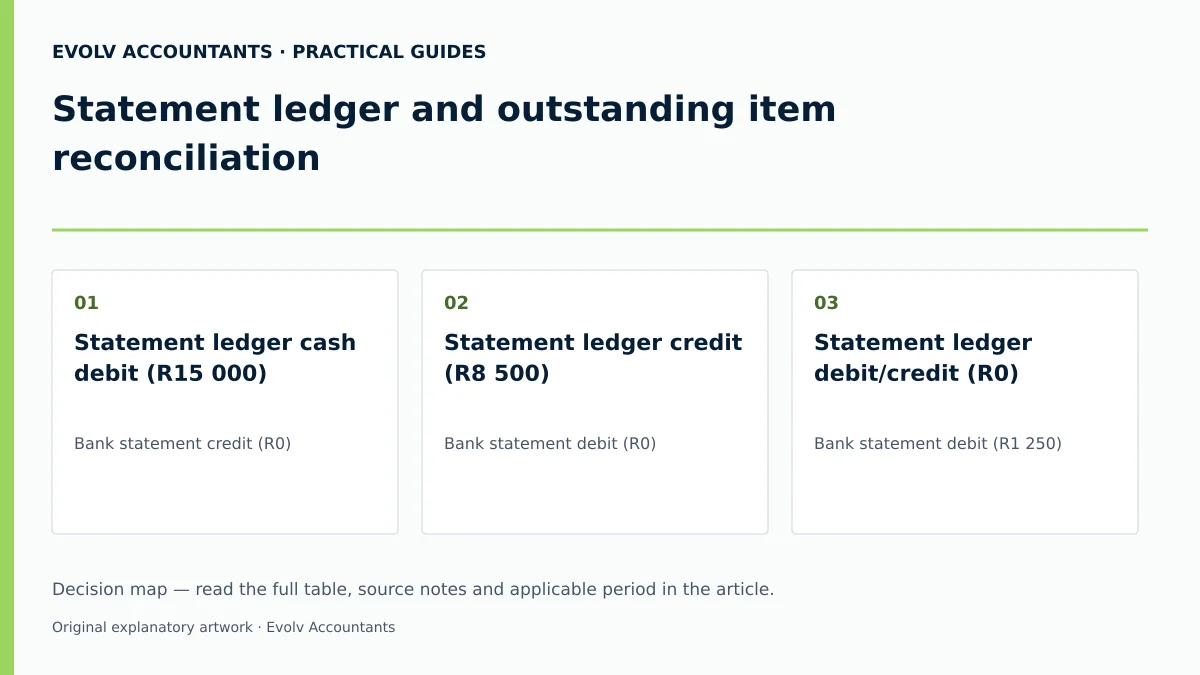
| Statement ledger cash debit (R15 000) | Bank statement credit (R0) | R15 000 | Outstanding customer deposit made on period-end date; receipt slip attached. | Monitor clearing in next bank statement; Bookkeeper. |
| Statement ledger credit (R8 500) | Bank statement debit (R0) | R8 500 | Unpresented supplier cheque / pending EFT payment; remittance advice issued. | Verify supplier bank clearing status; Accounts Payable Clerk. |
| Statement ledger debit/credit (R0) | Bank statement debit (R1 250) | -R1 250 | Monthly commercial bank service fees and debit order charges; bank advice statement. | Post adjusting expense journal to statement ledger; Assistant Accountant. |
| Statement ledger debit (R5 000) | Bank statement debit (R5 000) | R10 000 error | Transposition error in ledger recording deposit as debit instead of expenditure. | Reverse incorrect entry and post correct debit journal; Senior Accountant. |
Post only supported corrections: statement ledger
Authorised adjustments and journal entries
Adjustments to the statement ledger must only be executed when supported by verified primary evidence, such as formal bank advices, tax invoices, or written debit order authorizations 3 17. Reconcilers must never post arbitrary journal entries to force the statement ledger to agree with the bank balance.
When processing supported adjustments:
- Verify primary documentation: Ensure that every expense adjustment is backed by a valid invoice or receipt 17. Under SARS Value-Added Tax (VAT) guidance, an abridged tax invoice is permissible for supplies not exceeding R5 000, whereas full tax invoices are required for larger amounts 20.
- Apply correct tax accounting: Separate bank service fees and interest from VAT-inclusive operational expenses.
- Classify by entity category: Small Business Corporations (SBCs) under section 12E (gross income threshold up to R20 000 000) 21 and Micro Businesses under the Sixth Schedule turnover tax regime (qualifying turnover up to R1 000 000) 22 23 must ensure that expense postings strictly align with allowable statutory tax deductions 24 25.
Numbered checklist for supported ledger postings
- Obtain primary source evidence: Secure the original bank statement, fee schedule, or deposit advice 3 17.
- Check for duplication: Confirm that the bank charge, direct debit, or interest item has not been posted previously.
- Draft the journal entry: Record the exact debit to the relevant expense or asset account and credit to the business bank account (or vice versa for income).
- Attach supporting documents: Digitalize and cross-reference the supporting document with the unique journal voucher number 10.
- Approve and post: Obtain senior reviewer authorisation before committing the journal to the general ledger.
Review unresolved and old items: outstanding item reconciliation
Managing the aged exception log
Unresolved reconciling items—such as long-outstanding customer deposits, unpresented cheques older than six months, or unrecognized direct debits—must be escalated to an aged exception log.
An aged exception log must record:
- Transaction date and original entry reference.
- Amount (ZAR) and transaction type (debit or credit).
- Assigned owner and current investigation status.
- Specific reason for delay and defined next action.
Anti-pattern prohibition: Suspense accounts
Writing off unexplained bank reconciliation differences to a general expense, revenue, or temporary suspense account is a severe bookkeeping anti-pattern. Hiding variances in suspense accounts violates statutory requirements for accurate record-keeping 2 and distorts the connection between accounting net profit and taxable income 24. Unexplained variances or unsupported write-offs can trigger SARS verification checks, field audits, or formal information requests under Chapter 5 of the Tax Administration Act 28 of 2011 26 27 28.
Next steps for Bank reconciliation
Reviewer checks and sign-off routine
Once all transaction matching is complete and supported adjustments are posted, the final bank reconciliation package must undergo formal review and approval.
- Independent review: A senior accountant or financial manager must verify that the adjusted statement ledger balance matches the reconciled bank statement total.
- Archiving the audit package: Save the signed reconciliation schedule, bank statement, aged exception log, and adjusting journal vouchers in an orderly electronic or physical binder 10 18.
- Period roll-forward: Establish the final reconciled ending balance as the permanent opening baseline for the subsequent reconciliation cycle.
Reproducible hypothetical example
The following illustrative example demonstrates a monthly bank reconciliation calculation for Evolv Trading (Pty) Ltd for the period ending 31 March 2026. All values are purely hypothetical illustrative figures:
- Unadjusted statement ledger balance (31 March 2026): R150 000 (illustrative value)
- Unadjusted bank statement balance (31 March 2026): R162 500 (illustrative value)
Reconciling adjustment items:
- Unposted bank charges (supported adjustment required): -R2 500 (bank statement fee not yet in ledger)
- Outstanding customer deposit (timing item): +R10 000 (deposited 31 March, not on bank statement)
- Unpresented supplier EFTs (timing item): -R20 000 (processed 30 March, not yet cleared by bank)
Calculation bridge:
Adjusted Statement Ledger Balance = R150 000 - R2 500 = R147 500
Adjusted Bank Balance = R162 500 + R10 000 - R20 000 = R147 500
Both adjusted balances reconcile perfectly to R147 500.
Frequently Asked Questions
What is the primary difference between the statement ledger and the bank statement?
The statement ledger is the internal accounting record maintained by the business, whereas the bank statement is an external record issued by the commercial bank detailing actual cash movements.
How long must a South African SME retain bank reconciliation records?
Under section 24 of the Companies Act 71 of 2008, accounting records must be kept for seven completed financial years 6 7. Under section 29 of the Tax Administration Act 28 of 2011, tax records must be kept for five years from the return submission date 11 12.
Can a small business write off unexplained reconciliation differences to a suspense account?
No. Writing off unexplained discrepancies to a suspense or expense account distorts financial statements 29 and violates statutory obligations to maintain accurate records 2, increasing the risk of SARS audit penalties 13.
What should be done with stale unpresented cheques or pending EFTs?
Unpresented items older than six months should be investigated via the aged exception log. If confirmed un-cleared or expired, the original entry should be reversed in the statement ledger back to the relevant accounts payable or cash account.
Are specific bank reconciliation procedures dictated by statutory tax law?
No. Statutory tax and corporate laws mandate accurate record retention and fair presentation 2 3 6, but specific transaction matching and reconciliation bridge procedures are Evolv operational recommendations designed to ensure compliance. Ask Evolv about statement ledger and outstanding item reconciliation. Share the relevant records so the support required can be scoped. Ask Evolv
Related guides
- Why the bank balance differs from the accounting balance
- Recording bank charges and interest accurately
- Reading the Financials: Cash Flow and the Balance Sheet for Directors
Sources
- https://www.cipc.co.za//wp-content/uploads/Legal/Regulations/CompaniesAct71_2008.pdf
- https://www.sars.gov.za/wp-content/uploads/Ops/Guides/LAPD-TAdm-G01-Short-Guide-to-the-Tax-Administration-Act-2011.pdf
- IFRS - Conceptual Framework for Financial Reporting
- https://www.sars.gov.za/wp-content/uploads/Ops/Guides/Legal-Pub-Guide-Gen09-Tax-Guide-for-Small-Businesses.pdf