
Recording bank charges and interest accurately
10 September 2025

Recording bank charges and interest accurately requires separating financial service fees from interest expenses while capturing source documents for tax compliance.
Bank supplied charges interest and posting entries
Economic Substance and the Entity Boundary
Accounting for bank charges and interest begins with establishing the entity boundary and recognizing economic substance 1. Under the IFRS Conceptual Framework, financial reporting must represent economic reality rather than legal form 1 9. Evolv recommends maintaining a strict separation between entity finances and owner personal transactions 1. Bank service fees or overdraft interest debited by a bank represent operational expenses or finance costs attributable to the enterprise 2 3.
Primary Supporting Documents and Source Records
Bookkeeping requires linking ledger entries to primary source records 5 10. Evidence includes bank statements, fee schedules, facility agreements, and bank tax invoices 11 12. Under section 29 of the Tax Administration Act 28 of 2011, taxpayers must retain books of account, bank statements, deposit slips, and paid cheques in original or authorised electronic form 13 14. Evolv recommends archiving electronic bank statements immediately upon issue 5 13.
— Practical point from this guide
Identify the correct accounts and timing: bank supplied charges interest
Capital versus Revenue and Asset versus Liability Distinctions
Account selection requires distinguishing capital expenditure from revenue expenditure, and asset/liability from income/expense items 1 2. Bank service charges and overdraft interest are operational revenue expenses reducing net profit 2 3. Fee-based bank charges are classified under operating administrative costs, whereas interest charges represent finance costs 2 4. Loan principal repayments reduce loan liabilities on the balance sheet and are not expense entries 2 7.
Owner versus Business Distinctions and Expense Timing
Mixing owner personal expenses with business transactions violates entity boundary principles 1. Personal bank fees paid from a business account must be allocated to owner drawings or director loan accounts 1 2. Expenses must be recognised in the period actually incurred under section 11(a) of the Income Tax Act 58 of 1962 and section 24J for interest 3 4. Evolv recommends processing monthly bank charges and interest in the exact period reflected on the bank statement 3 5.
Show the entries with a business example: posting entries
Business Example and Ledger Allocations
Consider a South African private company operating in the 2025/2026 year of assessment that receives its monthly bank statement containing service charges and interest charges 15. Evolv recommends executing balanced double-entry journal postings reflecting economic substance 1.
Assume the monthly bank statement reflects:
- Monthly bank service fee: R500.00 (illustrative hypothetical value)
- Input VAT on fee-based charges at 15%: R75.00 (illustrative hypothetical value, calculated using standard 15% VAT rate 8)
- Total bank charge cash outflow: R575.00 (illustrative hypothetical value)
- Overdraft interest charged by bank: R1,200.00 (illustrative hypothetical value)
Accounting Treatment versus Tax Adjustments
In accounting records, bank fees and interest reduce gross sales to net profit 2. For income tax, bank charges are deductible under section 11(a) as trade expenses 3. Interest is governed by section 24J 4 16. Fee-based bank charges attract VAT at 15% allowing an input tax deduction if supported by a valid tax invoice 8 17 18. Financial interest is an exempt supply for VAT, so no input tax is claimed 19.
Balanced Journal and Support Schedule
| Date or event | Account | Debit | Credit | Evidence and explanation |
|---|---|---|---|---|
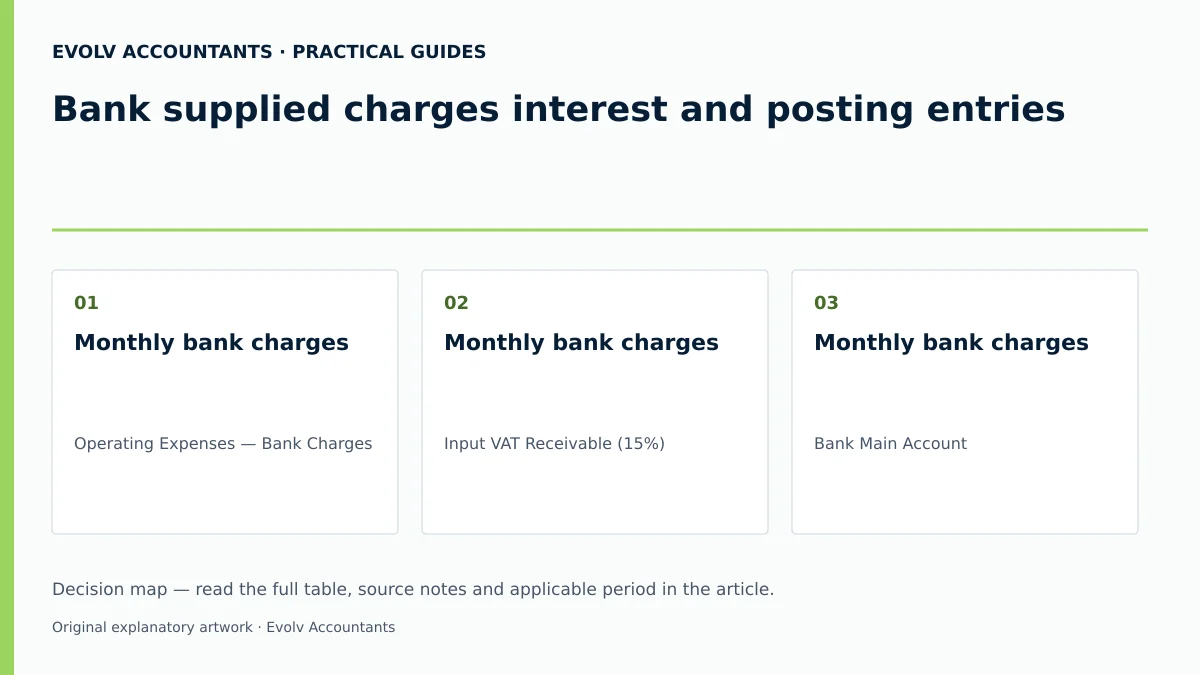
| Monthly bank charges | Operating Expenses — Bank Charges | R500.00 | R0.00 | Bank service fee per statement 2 11. |
| Monthly bank charges | Input VAT Receivable (15%) | R75.00 | R0.00 | Input tax at 15% rate per tax invoice 8 18. |
| Monthly bank charges | Bank Main Account | R0.00 | R575.00 | Direct bank debit per statement 11. |
| Monthly interest charge | Finance Costs — Interest Expense | R1,200.00 | R0.00 | Overdraft finance cost under section 24J 4. |
| Monthly interest charge | Bank Main Account | R0.00 | R1,200.00 | Direct debit; exempt financial supply for VAT 19. |
Reconcile the supporting schedule: bank supplied charges interest
Linking Balances to Physical Evidence
Bank reconciliation requires matching general ledger bank balances against evidence from bank statements 5 11. Evolv recommends preparing a monthly reconciliation schedule detailing unposted items, direct debits, fees, and interest 5.
Bank Reconciliation Checklist
Evolv recommends completing these checked actions during each monthly cycle:
- Obtain bank statement and verify opening balances against prior closing records 5 11.
- Extract bank charges and confirm whether VAT at 15% is itemised on the statement 8 18.
- Identify interest debits and ensure no VAT input tax is claimed on interest 19.
- Post double-entry journals, allocating fees to operating expenses and interest to finance costs 1 2.
- Cross-reference interest charges against facility agreements to verify interest calculations 4 11.
- Archive reconciliation schedule, bank statements, and tax invoices per retention periods 20 21.
Tax and reporting judgements to review: posting entries
Statutory Reporting Frameworks
Under section 28(1) of the Companies Act 71 of 2008, every company must "keep accurate and complete accounting records in one of the official languages" of South Africa 5. Financial statements must be prepared within six months after year end under section 30(1) 22 to present fairly the company's state of affairs 7 23. Under section 24(1)(b) and section 24(3)(c), records and financial statements must be retained for seven years 20 24.
Tax Administration Act Obligations
Tax compliance is governed by the Tax Administration Act 28 of 2011 25. Under section 29 and Table 3, taxpayers submitting returns must retain records, bank statements, and reconciliation schedules for five years from return submission date 14 21 26. Unfiled returns require indefinite retention until filed, after which the five-year rule applies 21 26. Disputed records must be retained until resolved or the five-year period ends 26 27.
Failure to retain records constitutes an offence under Chapter 17 and triggers administrative penalties under Chapter 15 6. Evolv recommends maintaining records for seven years to satisfy Companies Act requirements alongside tax rules 20 21.
Next steps for Bank reconciliation
Authorisation Controls
Internal controls over bank reconciliations require formal management oversight 5 28. Reconciliations should be reviewed and approved by an authorised director or manager 5 29. Source documents must be stored securely at the registered office or in an accessible electronic repository 13 30.
Correction History
When discrepancies arise, Evolv recommends maintaining a transparent correction history rather than executing unsupported write-offs 5 6. Falsifying accounting records with intent to deceive constitutes an offence under section 28(3) of the Companies Act and section 234 of the Tax Administration Act 6 31. Adjustments must be supported by bank correspondence or statement documentation 6 11.
Frequently Asked Questions
Are all bank charges subject to Value-Added Tax (VAT) in South Africa?
No. Fee-based bank charges attract VAT at 15% if supported by a tax statement 8 18. Interest charged on loans or overdrafts is an exempt financial service supply, so no VAT applies 19.
What is the required statutory record retention period for bank reconciliations?
Under section 29 of the Tax Administration Act 28 of 2011, tax records must be retained for five years from return submission 14 21. Section 24(1)(b) of the Companies Act 71 of 2008 requires accounting records to be kept for seven years 20 24. Evolv recommends retaining records for seven years to satisfy both laws 20 21.
How does accounting net profit differ from taxable income regarding bank expenses?
Net profit is gross revenue less operating expenses and finance costs 2 32. Taxable income is determined under the Income Tax Act 58 of 1962 by applying tax adjustments to accounting profit 32 33. Bank charges and interest are deductible under section 11(a) and section 24J 3 4, whereas non-deductible or non-arm's length costs must be adjusted 33.
Can personal bank fees paid from a business account be claimed as a business expense?
No. Under IFRS entity boundary principles, business records must reflect only the enterprise's economic transactions 1. Personal bank charges paid from a business account must be allocated to owner drawings or director loan accounts and cannot be claimed as business deductions under section 11(a) 1 2 3.
What penalties apply if a business fails to maintain proper bank accounting records?
Failure to maintain accurate accounting records is an administrative offence under Chapter 15 and Chapter 17 of the Tax Administration Act, and section 28(3) of the Companies Act 6 31. SARS may issue administrative penalties or estimated tax assessments 6 34. Ask Evolv about bank supplied charges interest and posting entries. Share the relevant records so the support required can be scoped.
Related guides
- Reconciling a business bank account step by step
- Matching one bank payment to several invoices
- Reading the Financials: Cash Flow and the Balance Sheet for Directors
Sources
- IFRS - Conceptual Framework for Financial Reporting
- https://www.sars.gov.za/wp-content/uploads/Ops/Guides/Legal-Pub-Guide-Gen09-Tax-Guide-for-Small-Businesses.pdf
- https://www.cipc.co.za//wp-content/uploads/Legal/Regulations/CompaniesAct71_2008.pdf
- https://www.sars.gov.za/wp-content/uploads/Ops/Guides/LAPD-TAdm-G01-Short-Guide-to-the-Tax-Administration-Act-2011.pdf