
Why the bank balance differs from the accounting balance
6 October 2025

A discrepancy between a bank balance and an accounting balance requires systematic reconciliation to distinguish timing differences from recording errors.
A bank balance reflects cash transactions processed and cleared by a financial institution as of a specific cut-off date, whereas an accounting balance reflects cash movements recorded in the general ledger under accrual or cash bookkeeping frameworks 1 2. Variances between these two figures occur due to temporary timing differences—such as outstanding cheques or deposits in transit—or recording errors, including omitted bank fees, duplicate entries, or mathematical mistakes 3 4.
Distinguishing and resolving these variances through formal bank reconciliation is essential for South African small and medium enterprises (SMEs) to maintain statutory accounting compliance, safeguard solvency, and ensure accurate corporate tax reporting 5 6.
Timing differences versus recording errors
This technical guidance is designed for directors, owners, and financial managers of South African SMEs operating under South African company law and tax administration frameworks. Applicable reporting periods align with the statutory financial year and tax year of assessment—such as the 2025/2026 tax year ending 28 February 2026 for natural persons and trusts, or ending 31 March 2026 for private companies 7.
Successful completion of this task means establishing a fully balanced bank reconciliation statement where the adjusted bank statement balance exactly equals the adjusted general ledger cash account balance, supported by verifiable primary evidence.
— Practical point from this guide
Understanding the root cause of a bank variance requires a clear distinction between two fundamental categories:
- Timing differences: Temporary discrepancies that arise when a transaction is correctly recognised in the accounting records but has not yet been processed or cleared by the banking institution, or vice versa 2. Examples include unpresented electronic funds transfers (EFTs), uncleared cheque payments, and deposits in transit submitted near the reporting cut-off date.
- Recording errors: Omissions, misstatements, or incorrect entries present in either the business accounting records or the bank statement 3 4. Examples include omitted bank debit orders, unrecorded bank charges, direct debits, interest allocations, duplicate posting of supplier payments, and numerical transposition mistakes made during manual journal entries.
To ensure corporate integrity and regulatory compliance, SMEs must distinguish between statutory legal obligations, administrative regulator guidance, and professional accounting practice recommendations:
- Statutory law: Section 28 of the Companies Act 71 of 2008 mandates that every company must keep accurate and complete accounting records in an official language of South Africa 5. Furthermore, Section 24 of the Companies Act obliges companies to retain accounting records and annual financial statements for seven years 8 9. For tax administration, Section 29 of the Tax Administration Act 28 of 2011 requires taxpayers to retain books of account, ledgers, bank statements, paid cheques, and invoices for five years from the date a tax return is submitted 4 10 11.
- Regulator guidance: Publications issued by the South African Revenue Service (SARS)—such as the Tax Guide for Small Businesses and the Short Guide to the Tax Administration Act—provide administrative operational rules for determining net profit versus taxable income and details on record-keeping standards 2 12 13. These guides clarify SARS requirements but do not carry statutory law status 12 13.
- Evolv recommendations: Implementing weekly or monthly bank reconciliations, maintaining structured double-entry general ledgers, establishing strict dual-authorisation controls for bank payments, and keeping a formal reconciliation register are practical Evolv recommendations. These internal control measures represent accounting best practice rather than direct statutory commands.
Prepare the information and authority: timing differences
Completing a successful bank reconciliation and identifying timing differences requires gathering specific primary documentation, establishing proper organizational authority, and applying precise regulatory definitions.
Primary documents and data inputs
Before initiating the reconciliation process, the financial preparer must assemble the following primary evidence:
- Official bank statements: Complete, sequential bank statements covering the full accounting period, displaying opening balances, itemised transactions, closing balances, and bank stamps or digital verification metadata 4.
- General ledger cash book: The business cash receipts and payments journals, including debit and credit ledgers for all active commercial bank accounts 2 4.
- Prior period bank reconciliation statement: The immediately preceding reconciled statement to verify which historical outstanding cheques or deposits in transit cleared during the current period.
- Transaction vouchers: Physical or electronic deposit slips, supplier remittance advices, EFT transaction confirmations, paid cheques, and credit/debit notes 4 14.
- Bank debit and credit advices: Direct notifications regarding bank service charges, merchant fee deductions, credit card processing charges, debit order returns, and interest earned or charged 2 15.
Organizational permissions and statutory authority
Executing financial adjustments and bank reconciliations requires clear organizational authority and regulatory status:
- Public Officer or Representative Taxpayer: Under Section 246 of the Tax Administration Act 28 of 2011, every company carrying on business in South Africa must be represented by an appointed Public Officer residing in the Republic who holds authority over tax compliance matters 16.
- Designated Compliance Officer: Section 33(3) of the Companies Act 71 of 2008 mandates that companies designate a director or employee responsible for ensuring company compliance with statutory financial reporting and return filings 17.
- Delegated bookkeeping authority: Internal delegation mandates must define who holds permission to post cash book journal entries, authorize payment batches, and sign off monthly bank reconciliations.
Regulatory definitions and evidence boundaries
Under the IFRS Conceptual Framework, an asset is defined as a present economic resource controlled by the entity as a result of past events 18. Cash held in a commercial bank account represents a primary financial asset, and its faithful representation in financial statements requires accurate alignment with physical bank records 1 18.
For tax verification, Section 1 of the Tax Administration Act 28 of 2011 defines relevant material as any information, document, or thing that is foreseeably relevant for SARS to verify compliance or administer a tax law 19 20. While the Companies Act 71 of 2008 requires accounting records to be preserved for seven years 8, SARS tax legislation enforces a general retention period of five years from the date of return submission 10 11.
Where an audit, dispute, or objection is pending, records must be retained indefinitely until the matter is fully resolved 10 11.
As Section 28(1) of the Companies Act 71 of 2008 explicitly states, "A company must keep accurate and complete accounting records in one of the official languages of the Republic" 5.
Complete the task step by step: recording errors
To systematically isolate and correct recording errors, financial personnel should follow this structured, sequential workflow:
- Cross-examine opening balances: Verify that the opening balance of the general ledger cash book matches the closing cash book balance from the prior period, and confirm that the opening bank statement balance matches the ending bank balance of the previous statement 4.
- Match cash book entries against bank statement lines: Compare each transaction entry in the general ledger cash book against the bank statement line items. Mark off every item that appears in identical amounts on both records.
- Isolate unrecorded bank items (omissions): Identify all items appearing on the bank statement that are absent from the cash book. Common omitted debits include monthly account maintenance fees, cash handling charges, point-of-sale terminal levies, automated debit order payments, and debit interest 2 15. Common omitted credits include direct customer EFT payments, merchant settlements, and credit interest earned 2.
- Identify ledger posting errors: Examine unmatched entries in the cash book to detect human recording errors. Check for:
- Transposition errors: Reversal of digits during data entry (e.g., logging a supplier payment of R5,410 as R5,140).
- Reversal errors: Posting a cash credit as a debit or vice versa.
- Duplicate entries: Recording a single payment or receipt twice in the cash journal.
- Incorrect account allocation: Posting a bank transaction to an incorrect subsidiary ledger or cash account.
- Separate timing differences from errors: Group remaining unmatched cash book items into legitimate timing differences—specifically unpresented payments (EFTs or cheques issued but not yet debited by the bank) and uncleared deposits (funds received and logged but not yet cleared by the bank).
- Post adjusting journal entries: Prepare and post correcting journal entries in the general ledger for all identified recording errors and unrecorded bank items:
- Debit operating expense accounts (e.g., bank charges) and credit the cash book for unrecorded bank charges 2.
- Debit the cash book and credit trade receivables for direct customer receipts.
- Debit/Credit the cash book to correct identified transposition or duplicate entry errors.
- Calculate adjusted cash book balance: Compute the revised ending balance of the general ledger cash account after incorporating all adjusting journal entries.
- Draft the formal bank reconciliation statement: Apply the final mathematical reconciliation formula:
Adjusted Bank Balance = Ending Bank Statement Balance - Unpresented Payments + Uncleared Deposits
Verify that the Adjusted Bank Balance exactly matches the Adjusted Cash Book Balance.
Check the result against the evidence: timing differences
Completing the reconciliation calculation is not the final step; the resulting figures must be verified against independent evidence before the task can be considered complete. Assuming that a transaction is accepted merely because an EFT was generated or a return was submitted is a critical governance flaw.
Independent verification standards
To ensure financial validity, the reconciled bank statement must be verified through the following independent checks:
- Bank confirmation and statement continuity: Ensure that bank statements are continuous without date gaps, and obtain direct bank confirmations or electronic bank feeds where required for statutory reviews 4 21.
- Subsequent period bank clearing: Verify that timing differences listed on the bank reconciliation actually clear on subsequent bank statements. Outstanding deposits should clear within 1 to 3 business days, while unpresented EFTs should clear promptly according to commercial clearing rules.
- Solvency and liquidity testing: Under Section 4 of the Companies Act 71 of 2008, a company satisfies the solvency and liquidity test only if its fairly valued assets exceed its liabilities and it can pay its debts as they become due in the ordinary course of business for 12 months 22 23. Because Section 4(2)(a) explicitly requires solvency and liquidity evaluations to be based on Section 28 accounting records and Section 29 financial statements, uncorrected cash book errors directly compromise legal solvency determinations 5 22 23 24.
- SARS Tax Compliance Status (TCS) alignment: Taxpayers must ensure that bank reconciliations align with income tax and VAT returns filed on SARS eFiling 25 26. Under Section 29 of the Tax Administration Act 28 of 2011, SARS conducts automated validation checks against bank records and third-party declarations; discrepancies between declared income and bank deposits can trigger compliance reviews or administrative penalties 25 27 28.
Handle exceptions and unresolved cases: recording errors
In practical bookkeeping, reconciling items do not always resolve neatly. SMEs frequently encounter complex edge cases, missing documentation, and unresolved bank errors that require structured escalation protocols.
Common exception scenarios and resolution paths
- Unidentified bank statement debits or credits: Direct bank debits or incoming payments that lack recognizable references must not be arbitrarily allocated to general expense accounts or miscellaneous revenue. They should be placed in a temporary bank suspense account while written queries are submitted to the bank or customer. Suspense items must be cleared prior to monthly financial sign-off.
- Stale unpresented payments: Payments or cheques that remain unpresented for extended periods (e.g., exceeding six months) must be investigated. If the underlying debt remains valid, the payment should be reissued; if the payment obligation has lapsed or was duplicated, the original entry must be reversed to credit the cash book.
- Bank errors: Occasionally, the financial institution may debit or credit an account in error (e.g., processing a wrong direct debit or misrouting funds). Because the business cannot post a general ledger entry for a bank's internal mistake, the item must be recorded as a "Bank Error" on the bank reconciliation statement, and a formal dispute ticket must be opened with the bank for correction.
- Missing bank statements or lost vouchers: If physical or digital statements are missing, duplicate official copies must be requested from the bank. Under Section 29 of the Tax Administration Act 28 of 2011, failure to maintain complete supporting vouchers constitutes an administrative offense subject to statutory penalties 3 28 29.
Specialist boundaries and professional escalation
When exceptions exceed standard bookkeeping controls, management must escalate the issue to qualified professionals:
- Tax Advisory: Escalation is required when bank discrepancies reveal unrecorded taxable turnover, undeclared VAT liabilities, or potential payroll tax (PAYE) misallocations 30 31.
- Statutory Accounting and Audit: Discrepancies affecting annual financial statements, potential fraud, or material misstatements must be referred to registered auditors or independent reviewers under Section 30 of the Companies Act 71 of 2008 21 32.
Reproducible hypothetical example
To illustrate the mathematical and procedural application of bank reconciliation, consider the following hypothetical example for ExaTech Solutions (Pty) Ltd as of 28 February 2026 (all values are illustrative in South African Rand):
- Unadjusted General Ledger Cash Book Balance: R146,000 (Debit)
- Unadjusted Bank Statement Ending Balance: R162,500 (Credit)
Upon detailed cross-examination of the records, the following four variance items were identified:
- Item A (Recording Error / Omission): Bank service fees and monthly account maintenance charges appearing on the bank statement were not recorded in the cash book: R1,500.
- Item B (Recording Error / Omission): Credit interest earned on the call account was credited by the bank but omitted from the cash book: R1,000.
- Item C (Recording Error / Transposition): A customer payment of R17,000 was correctly processed by the bank, but was entered in the cash receipts journal as R8,000 (under-recorded receipt error of R9,000).
- Item D (Timing Difference / Outstanding Payment): An EFT payment made to a trade supplier on 27 February 2026 was recorded in the cash book but had not cleared the bank statement by 28 February: R20,000.
- Item E (Timing Difference / Deposit in Transit): A customer payment received and logged in the cash book late on 28 February 2026 was deposited but did not reflect on the February bank statement: R12,000.
Step-by-Step Mathematical Reconciliation
Step 1: Adjust the General Ledger Cash Book
| Description | Amount |
|---|---|
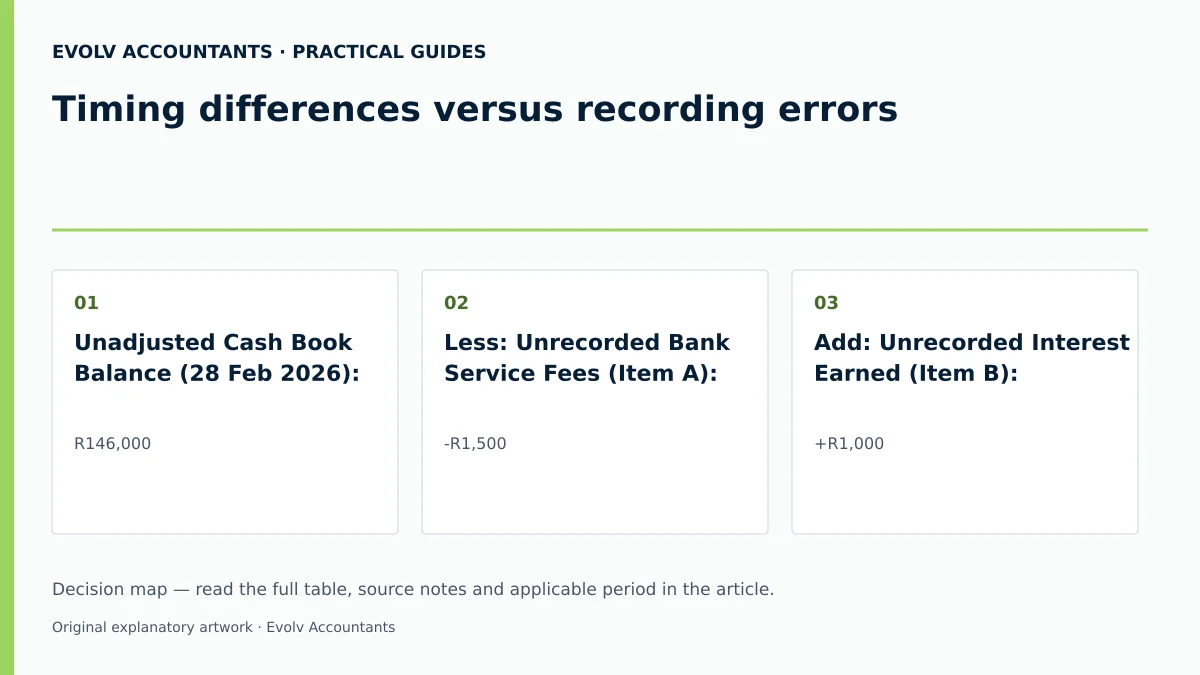
| Unadjusted Cash Book Balance (28 Feb 2026): | R146,000 |
| Less: Unrecorded Bank Service Fees (Item A): | -R1,500 |
| Add: Unrecorded Interest Earned (Item B): | +R1,000 |
| Add: Correction of Transposition Error (Item C: R17,000 - R8,000): | +R9,000 |
| Adjusted Cash Book Balance: | R154,500 |
Step 2: Prepare the Bank Reconciliation Statement
| Description | Amount |
|---|---|
| Unadjusted Bank Statement Balance (28 Feb 2026): | R162,500 |
| Less: Unpresented EFT Payment to Supplier (Item D): | -R20,000 |
| Add: Deposit in Transit (Item E): | +R12,000 |
| Adjusted Bank Balance: | R154,500 |
Conclusion: The Adjusted Cash Book Balance (R154,500) perfectly matches the Adjusted Bank Balance (R154,500), successfully resolving all timing differences and recording errors.
Next steps for Bank reconciliation
To maintain ongoing financial accuracy and regulatory compliance, South African SMEs should establish a repeatable monthly reconciliation control process.
Task and completion checklist
| Step | Input or evidence | Responsible person | Completion check | Exception or next action |
|---|---|---|---|---|
| 1. Primary Record Gathering | Official bank statements, cash journals, prior reconciliation 4. | Bookkeeper / Accounts Clerk | Confirm statement sequence and continuous date coverage. | Request missing statement copies or digital downloads from bank. |
| 2. Transaction Matching | Cash receipts/payments ledgers vs bank statement line items. | Bookkeeper / Accounts Clerk | Tick off all matching debits and credits on both records. | Highlight unmatched items for further investigation. |
| 3. Error Adjustment | Bank debit advices, fee schedules, transposition checks 15. | Financial Accountant | Post adjusting journals for unrecorded fees, interest, and errors 2. | Escalate unidentified debits to suspense account and query bank. |
| 4. Timing Variance Calculation | Outstanding EFT lists, uncleared deposit vouchers 14. | Financial Accountant | Compile unpresented payment and deposit-in-transit schedules. | Investigate stale unpresented payments older than 6 months. |
| 5. Final Review & Archival | Formally signed bank reconciliation statement 5. | Finance Manager / Public Officer 16 | Verify Adjusted Cash Book equals Adjusted Bank Balance. | Store reconciliation pack in compliance archive (5-7 year retention) 8 10. |
Frequently Asked Questions
How long must a South African SME retain bank reconciliation records and bank statements?
Under Section 24 of the Companies Act 71 of 2008, companies must retain accounting records—including general ledgers and financial statements—for seven years 8 9. For tax purposes, Section 29 of the Tax Administration Act 28 of 2011 mandates that taxpayers retain all books of account, bank statements, deposit slips, and paid cheques for five years from the date the relevant tax return was filed 4 10 11. If an audit or dispute is open, records must be retained until the audit or appeal is finalised 10 11.
What is the key legal difference between a timing difference and an accounting recording error?
A timing difference is a temporary lag between two correctly processed records (e.g., an EFT payment recorded in the cash book that clears the bank a few days later) 2. A recording error is an actual inaccuracy or omission in the accounting records or bank statement (e.g., an unrecorded bank charge, duplicate entry, or wrong amount logged) 3 4. Section 28 of the Companies Act requires prompt correction of errors to maintain accurate accounting records 5.
Can SARS impose penalties if recording errors cause inaccuracies in tax returns?
Yes. Under Chapter 15 of the Tax Administration Act 28 of 2011, failure to maintain accurate records or submitting returns containing errors can trigger fixed administrative non-compliance penalties or percentage-based understatement penalties 6 28 33. Maintaining monthly bank reconciliations prevents unrecorded bank items from distorting income tax or VAT submissions 4 25.
Does an annual financial audit or review eliminate the need for monthly bank reconciliations?
No. An annual audit or independent review under Section 30 of the Companies Act 71 of 2008 evaluates financial statements after the reporting period ends 21 32. Monthly bank reconciliations are an essential operational control required to maintain continuous accounting accuracy throughout the year, support solvency management under Section 4, and prevent internal fraud 5 22.
What should an SME do if a bank statement reflects an unauthorized or fraudulent debit?
An unauthorized debit is a bank-level recording error or fraudulent breach. The SME must immediately report the unauthorized transaction to its banking institution to initiate a dispute and dispute ticket 34. In the business accounting records, the item should be placed in a suspense account rather than written off to expenses, pending bank investigation and reimbursement. Describe the bank transaction or reconciliation gap and ask Evolv to scope the next steps.
Related guides
- Reconciling a business bank account step by step
- Recording bank charges and interest accurately
- Reading the Financials: Cash Flow and the Balance Sheet for Directors
Sources
- IFRS - Conceptual Framework for Financial Reporting
- https://www.sars.gov.za/wp-content/uploads/Ops/Guides/Legal-Pub-Guide-Gen09-Tax-Guide-for-Small-Businesses.pdf
- https://www.sars.gov.za/wp-content/uploads/Ops/Guides/LAPD-TAdm-G01-Short-Guide-to-the-Tax-Administration-Act-2011.pdf
- https://www.cipc.co.za//wp-content/uploads/Legal/Regulations/CompaniesAct71_2008.pdf