
Personal service businesses and the SBC rules
9 September 2025

A Small Business Corporation (SBC) requires full compliance with Section 12E and Fourth Schedule employee rules to secure progressive tax relief in South Africa.
Qualifying South African small businesses operating within professional and technical service sectors can access lower progressive corporate tax rates rather than the standard flat company tax rate 1 2. Access to this relief depends on whether the business is classified as rendering a personal service or operating as a Personal Service Provider (PSP) 3 4 5.
Incorporating three or more full-time, non-connected employees engaged in rendering the service throughout the year of assessment creates a crucial statutory exception that protects SBC tax eligibility 6 7 8.
Personal service classification and employee exceptions
This guide is written for South African SME owners, directors, close corporation members, and financial managers operating under South African Revenue Service (SARS) jurisdiction 9 10. It applies specifically to the 2024/2025, 2025/2026, and 2026/2027 years of assessment 1 11.
Task completion means correctly determining whether your entity meets the statutory definition of a Small Business Corporation under Section 12E of the Income Tax Act 58 of 1962, verifying that personal service or PSP exclusions do not apply, and completing the Income Tax Return for Companies (ITR14) with verified supporting evidence 9 10 12.
— Practical point from this guide
Legislation enacted in the Income Tax Act sets binding legal obligations, whereas SARS Interpretation Notes (such as Interpretation Note 9) and eFiling external guides provide administrative guidance 2 13 14. Historical tax guides provide background context, but current numerical thresholds and tax brackets published by SARS must be applied for each specific year of assessment 1 2 11.
For standard companies, corporate income tax is levied at a flat rate of 27% for years of assessment ending on or after 31 March 2023 through 31 March 2027 1. In contrast, qualifying SBCs benefit from progressive tax brackets 2 11:
- 2025/2026 Year of Assessment (ending between 1 April 2025 and 31 March 2026) 11:
- Taxable income R1 – R95 750: 0% of taxable income 11.
- Taxable income R95 751 – R365 000: 7% of taxable income above R95 750 11.
- Taxable income R365 001 – R550 000: R18 848 + 21% of taxable income above R365 000 11.
- Taxable income R550 001 and above: R57 698 + 27% of the amount above R550 000 11.
- 2026/2027 Year of Assessment (ending between 1 April 2026 and 31 March 2027) 11:
- Taxable income R1 – R99 000: 0% of taxable income 11.
- Taxable income R99 001 – R365 000: 7% of taxable income above R99 000 11.
- Taxable income R365 001 – R550 000: R18 620 + 21% of taxable income above R365 000 11.
- Taxable income R550 001 and above: R57 470 + 27% of the amount above R550 000 11.
It is vital to distinguish SBC tax relief from Turnover Tax and Provisional Tax. Turnover Tax is an alternative simplified system for micro businesses with qualifying turnover up to R1 million 15 16, whereas SBC status applies under normal corporate income tax for juristic entities with gross income up to R20 million 17 18. Provisional tax governs the timing of interim tax payments rather than the underlying tax calculation method.
Prepare the information and authority: personal service classification
To establish whether your entity qualifies for SBC tax rates, you must assemble specific corporate records, ownership declarations, and payroll documentation 6 10 19:
- Legal Entity Records: CIPC registration certificates proving the entity is a private company, close corporation, personal liability company, or co-operative 10 20.
- Share Register and Beneficial Ownership Disclosures: Records demonstrating that all shareholders or members were natural persons throughout the entire year of assessment 19 21 22.
- External Shareholding Declarations: Proof that shareholders do not hold shares or equity in any other private company or close corporation, barring permitted exceptions such as listed companies, unit trusts, or body corporates 23 24.
- Gross Income Records: Financial accounts confirming gross income does not exceed R20 million for the 12-month period (or a proportionately reduced threshold if trading commenced mid-year) 18 25.
- Payroll Records and Employment Contracts: EMP201 monthly submissions, IRP5 certificates, job descriptions, and contracts of employment establishing employee count and work status 6 26 27.
Section 12E(4)(d) defines a "personal service" as any service in the fields of accounting, actuarial science, architecture, auctioneering, auditing, broadcasting, consulting, draftsmanship, education, engineering, financial service broking, health, information technology, journalism, law, management, real estate broking, research, sport, surveying, translation, valuation, or veterinary science 4 28.
SARS Interpretation Note 9 states that personal service refers to a service where "the income derived is mainly a reward for the personal efforts or skills of an individual" 29.
If a company provides a listed service, that service is classified as a personal service if it is performed personally by a shareholder (or a connected person to a shareholder) AND the entity does not employ three or more full-time, non-shareholder, non-connected employees throughout the year of assessment 4 7 30. If personal service income combined with investment income exceeds 20% of total non-capital receipts plus capital gains, the entity is disqualified from SBC status 31 32.
Complete the task step by step: employee exceptions
To apply the employee exception correctly and complete your company income tax declaration, follow this structured process:
- Verify Juristic Form and Natural Ownership: Confirm that the entity is a qualifying juristic person and that 100% of the shareholding or member interest was held by natural persons for every day of the assessment year 10 21.
- Audit External Shareholdings: Verify that no shareholder holds shares in another private business or close corporation, preserving compliance with Section 12E(4)(a)(ii) 23 24.
- Confirm Gross Income Limits: Calculate gross income to ensure it remains at or below R20 million 18. If the entity traded for less than 12 months, adjust the limit proportionately (R20 million multiplied by full trading months divided by 12) 25.
- Audit Full-Time Staffing for the Employee Exception: Count the number of full-time employees engaged directly in rendering the personal service throughout the year of assessment 7 26. Exclude any employee who is a shareholder, member, or connected person (such as a spouse or child) to a shareholder 7 30 33.
- Test the Three-Employee Requirement: If three or more qualifying non-connected, full-time employees are employed throughout the assessment year, the personal service rendered by shareholders is excluded from being treated as a personal service for SBC purposes 7 30.
- Assess Fourth Schedule Personal Service Provider (PSP) Rules: Confirm the business is not a PSP 3 5. Under the Fourth Schedule, an entity is a PSP if services are rendered personally by a connected person and the worker would be deemed an employee of the client, or duties are performed under client control/supervision, or more than 80% of service income comes from one client 3 5 34. However, employing three or more full-time, non-connected employees throughout the year provides an explicit statutory exception that removes the entity from PSP classification 6 8.
- Complete the ITR14 Return Wizard on eFiling: On the ITR14 form wizard, select "Yes" to "Is the company a Small Business Corporation as defined in s12E?" 12 35. Answer the mandatory wizard declarations confirming gross income, natural ownership, absence of prohibited shareholdings, and compliance with the 20% tainted income limit 36 37 38.
Reproducible Hypothetical Example
Consider Apex Engineering (Pty) Ltd, a consulting engineering firm with a financial year ending 28 February 2026 (2025/2026 year of assessment) 11.
- Financial Details: Gross income = R4 200 000; Taxable income = R500 000 11 18.
- Ownership and Staffing: Owned equally by two professional engineers (shareholders) 4. The company employs three full-time CAD draughtspeople who are not shareholders and not connected persons to either shareholder 7 30. These three staff members were employed on full-time contracts throughout the entire 12-month period 7 26.
- Classification: Because Apex Engineering employs three qualifying full-time employees in rendering its engineering service throughout the assessment year, the service is not treated as a personal service under Section 12E(4)(d) 7 30. The engineering income is therefore not subject to the 20% tainted income restriction 30 31.
Tax Computation Comparison (2025/2026 Year of Assessment):
- Standard Corporate Rate (27% flat rate):
R500 000 × 27% = R135 000 1.
- SBC Progressive Tax Rate (Section 12E):
- R1 – R95 750 at 0% = R0 11.
- R95 751 – R365 000 (R269 250 @ 7%) = R18 847.50 11.
- R365 001 – R500 000 (R135 000 @ 21%) = R28 350.00 11.
- Total SBC Tax = R18 847.50 + R28 350.00 = R47 197.50 11.
- Net Tax Relief:
R135 000 – R47 197.50 = R87 802.50 tax saved 1 11.
Check the result against the evidence: personal service classification
Submitting an ITR14 on eFiling does not equal final SARS acceptance 39 40. Independent verification requires validating the output against official assessment notices and maintaining a complete compliance pack 40 41:
- Notice of Assessment (ITA34): Review the issued ITA34 assessment from SARS to confirm that tax has been computed using the progressive SBC tax brackets rather than the 27% standard corporate rate 1 2 11.
- Verification / Audit Retained File: SARS frequently selects SBC returns for verification 40. You must retain a complete audit pack for five years 41, containing signed Annual Financial Statements (compulsory for small business returns) 42, share registers, payroll reports (EMP201/EMP501 reconciliations), IRP5 certificates, and contracts of employment 6 26.
- Reviewing System Validation Warnings: Ensure that eFiling wizard responses are consistent. If wizard questions regarding personal service or PSP status are answered incorrectly, eFiling will auto-grey SBC fields or issue validation error messages 43.
Handle exceptions and unresolved cases: employee exceptions
Title-Specific Edge Cases and Unresolved Scenarios
- Mid-Year Employee Resignations: The statute strictly requires employing three or more full-time staff throughout the year of assessment 7 8 26. If an employee resigns during the year and headcount falls to two for even a brief period before a replacement is hired, SARS considers the condition broken for that assessment year 7 26.
- Connected Persons as Employees: Spouses, children, siblings, or other connected persons to shareholders cannot be counted toward the three full-time employees 7 30 33. If an entity employs two unrelated full-time staff and one shareholder’s spouse, the qualifying count is only two, failing the exception 7 33.
- Part-Time, Casual, or Subcontracted Workers: Independent contractors, temporary freelancers, and part-time workers working reduced hours do not meet the definition of full-time employees under Section 12E 27 44.
- PSP Expense Disallowances (Section 23(k)): If an entity is classified as a Personal Service Provider under the Fourth Schedule and fails the employee exception, Section 23(k) prohibits deducting expenses such as legal fees, bad debts, employer pension contributions, premises expenses, and asset maintenance costs 6 45 46 47 48.
Next steps for Small business corporation tax
Task and Completion Checklist
| Step | Input or evidence | Responsible person | Completion check | Exception or next action |
|---|---|---|---|---|
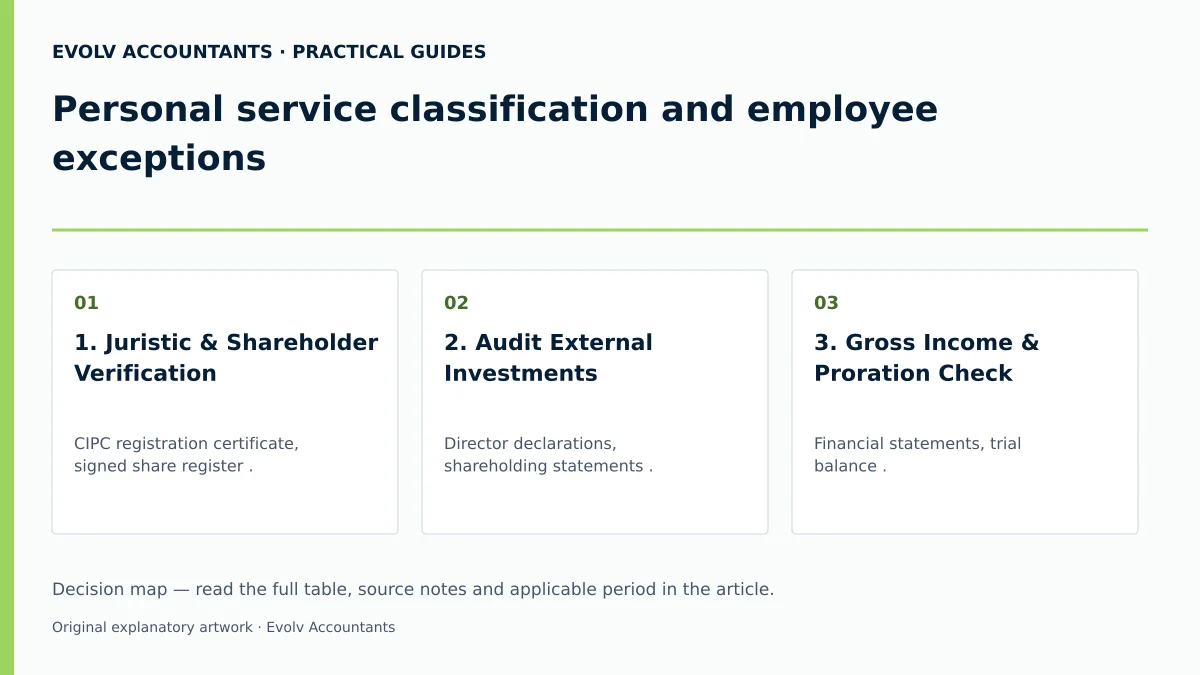
| 1. Juristic & Shareholder Verification | CIPC registration certificate, signed share register 10 21. | Public Officer / Tax Advisor | 100% natural person shareholding confirmed for full tax year 21. | Disqualified from SBC if juristic shareholders exist 21. |
| 2. Audit External Investments | Director declarations, shareholding statements 23. | Company Secretary / Director | No unlisted shareholdings held by shareholders 23 24. | Review Permitted Exceptions under s12E(4)(a)(ii) 24 50. |
| 3. Gross Income & Proration Check | Financial statements, trial balance 18 42. | Bookkeeper / Accountant | Gross income <= R20m (prorated if trading < 12 months) 18 25. | Reclassify return type if income exceeds limit 17 51. |
| 4. Staffing & Payroll Audit | Employment contracts, IRP5s, EMP501 reconciliations 6 26. | Payroll Manager / HR | At least 3 full-time non-connected employees confirmed throughout year 7 30. | Calculate 20% tainted income ratio if staff count < 3 31 32. |
| 5. Fourth Schedule PSP Review | Client contracts, working location records 3 5 34. | Tax Specialist / Director | Verified not a PSP or covered by 3-employee rule 3 6 8. | Apply s23(k) deduction disallowances if classified as PSP 6 46. |
| 6. ITR14 Submission & Audit Pack | eFiling ITR14 wizard, AFS, ITA34 notice 2 35 42. | Tax Practitioner / Public Officer | ITA34 reflects progressive SBC rates; audit pack retained 2 41 42. | Address SARS audit queries or request correction if needed 40. |
Ask Evolv about personal service classification and employee exceptions. Share the relevant records so the support required can be scoped.
Frequently Asked Questions
Can a spouse or relative of a shareholder count as one of the three full-time employees?
No. Section 12E(4)(d)(ii) and paragraph 1 of the Fourth Schedule explicitly exclude any employee who is a shareholder or a connected person in relation to a shareholder from the three-employee count 7 8 30.
What happens if an employee resigns mid-year and is not replaced immediately?
To qualify for the employee exception, the entity must employ three or more full-time qualifying staff throughout the entire year of assessment 7 26. A lapse in staffing disqualifies the entity from relying on the employee exception for that tax year 7 26.
Are independent contractors or external freelancers included in the employee count?
No. Independent contractors and external service providers work under a contract for services rather than an employment contract and are not full-time employees for Section 12E purposes 44.
How can a personal service business qualify as an SBC if it has fewer than three full-time employees?
If an entity has fewer than three qualifying employees, it can still qualify as an SBC if its combined investment income and personal service income does not exceed 20% of its total receipts and accruals (excluding capital items) plus capital gains 31 32.
What is the primary difference between rendering a personal service under Section 12E and being a Personal Service Provider under the Fourth Schedule?
Rendering a personal service under Section 12E relates to whether service income is treated as "tainted" for the 20% business activity test 4 31. A Personal Service Provider under the Fourth Schedule is an entity subject to mandatory employee tax withholding and severe deduction restrictions under Section 23(k) 3 6 46 48. Both definitions contain employee exception provisions 6 7 8.
Related guides
- Small Business Corporation tax: who qualifies in South Africa
- Small business corporation tax rates and worked examples
- The Proactive SARS Audit Guide: Keeping Your Business Ledger Sanitised
Sources
- Companies, Trusts and Small Business Corporations (SBC) | South African Revenue Service
- https://www.sars.gov.za/wp-content/uploads/Legal/Notes/LAPD-IntR-IN-2012-09-Small-Business-Corporations.pdf
- https://www.sars.gov.za/wp-content/uploads/IT-GEN-04-G01-How-to-complete-the-Income-Tax-Return-ITR14-for-Companies-External-Guide.pdf