
Small business corporation tax rates and worked examples
30 November 2025

Small business corporation tax is a progressive tax framework in South Africa that requires qualifying entities to apply tiered marginal rates based on their annual taxable income.
Under South African tax legislation, a Small Business Corporation (SBC) benefits from progressive tax rate bands that start at a 0% exempt threshold, offering substantial tax relief compared to the flat corporate income tax rate 1 2 3. Qualification for SBC status is subject to strict statutory requirements regarding legal entity type, natural person shareholding, gross income limits, and the nature of business activity 4.
Entities must evaluate their SBC eligibility annually, apply the specific tax rate bands designated for their applicable year of assessment, and maintain verified documentation to substantiate their tax position 3 5 6.
Current rate bands with taxable income examples
SARS rate bands for years of assessment ending 1 April 2026 to 31 March 2027
For the year of assessment ending between 1 April 2026 and 31 March 2027, the South African Revenue Service (SARS) enforces the following progressive rate bands for Small Business Corporations 1 7:
- R1 – R99 000: 0% of taxable income 1.
- R99 001 – R365 000: 7% of taxable income above R99 000 1.
- R365 001 – R550 000: R18 620 + 21% of taxable income above R365 000 1.
- R550 001 and above: R57 470 + 27% of the amount above R550 000 1.
Rate bands for years of assessment ending 1 April 2025 to 31 March 2026
For years of assessment ending between 1 April 2025 and 31 March 2026 (as well as 1 April 2023 to 31 March 2024), the progressive rate bands applied by SARS are 1 8:
- R1 – R95 750: 0% of taxable income 1 8.
- R95 751 – R365 000: 7% of taxable income above R95 750 1 8.
- R365 001 – R550 000: R18 848 + 21% of taxable income above R365 000 1 8.
- R550 001 and above: R57 698 + 27% of the amount above R550 000 1 8.
Historical rate bands for comparative assessment periods
For financial years ending between 1 April 2022 and 30 March 2023, the tax bands were structured as 9:
- R1 – R91 250: 0% of taxable income 9.
- R91 251 – R365 000: 7% of taxable income above R91 250 9.
- R365 001 – R550 000: R19 163 + 21% of taxable income above R365 000 9.
- R550 001 and above: R58 013 + 28% of the amount above R550 000 9.
For financial years ending between 1 April 2021 and 31 March 2022 9:
- R1 – R87 300: 0% of taxable income 9.
- R87 301 – R365 000: 7% of taxable income above R87 300 9.
- R365 001 – R550 000: R19 439 + 21% of taxable income above R365 000 9.
- R550 001 and above: R58 289 + 28% of the amount above R58 289 9.
In contrast, standard non-SBC corporate income tax is levied at a flat rate of 27% for years of assessment ending on or after 31 March 2023 (and 28% for years ending prior to 31 March 2023) 10.
Inputs rates periods and exclusions: current rate bands with taxable income examples
Statutory qualification inputs and Section 12E criteria
To qualify for the SBC tax structure, an entity must satisfy four core statutory conditions laid down in law under Section 12E(4)(a) of the Income Tax Act 58 of 1962 4 5:
- Legal Entity Requirement: The taxpayer must be a juristic person incorporated in South Africa as a private company, close corporation, co-operative, or personal liability company 6 11.
- Shareholder Requirement: As a matter of law, all shareholders or members must, as stated in SARS Interpretation Note 9, be natural persons "at all times during the relevant year of assessment" 12 13. Shareholding by trusts or other corporate entities disqualifies the company 12.
- Gross Income Limitation: The gross income of the business for the year of assessment must not exceed R20 million 14 15 16.
- Business Activity Limitation: Not more than 20% of total receipts, accruals (other than capital receipts), and capital gains may consist collectively of investment income (such as dividends, interest, royalties, and property rental) and personal service income 17 18 19. Personal service rendering is exempted from this 20% restriction if the company employs three or more full-time, non-shareholder employees engaged in rendering that service throughout the assessment year 20 21 22.
Distinguishing SBC tax from ordinary corporate tax, turnover tax and provisional tax
It is essential to distinguish SBC tax from other tax frameworks:
- Law vs Guidance on Entity Type: Under statutory law, SBC tax applies progressive rates to qualifying juristic entities 3 11. Regulator guidance from SARS confirms that personal service providers as defined in the Fourth Schedule are strictly prohibited from SBC status 23 24.
- Turnover Tax Exclusion: Turnover tax is a simplified tax system available to micro businesses with an annual qualifying turnover not exceeding R1 million and assets not exceeding R5 million 25 26. SBC tax, by contrast, is calculated on taxable income (gross income less allowable deductions) rather than turnover 1 15.
- Provisional Tax Distinction: Provisional tax is not a separate tax rate or regime; it is a statutory payment mechanism used to collect income tax liabilities in advance across two or three provisional periods during the financial year 7 27.
- Evolv Recommendation: Evolv Accountants recommends conducting an annual pre-filing eligibility audit to verify that shareholder registers, employee contracts, and income classifications satisfy Section 12E requirements before electing SBC status on form ITR14 3 12 22. Missing inputs, such as unverified beneficial ownership details or unclassified income streams, must be resolved prior to return submission 28 29.
The calculation in a worked example: documented completion and exceptions
Step-by-step arithmetic for an SBC taxable income computation
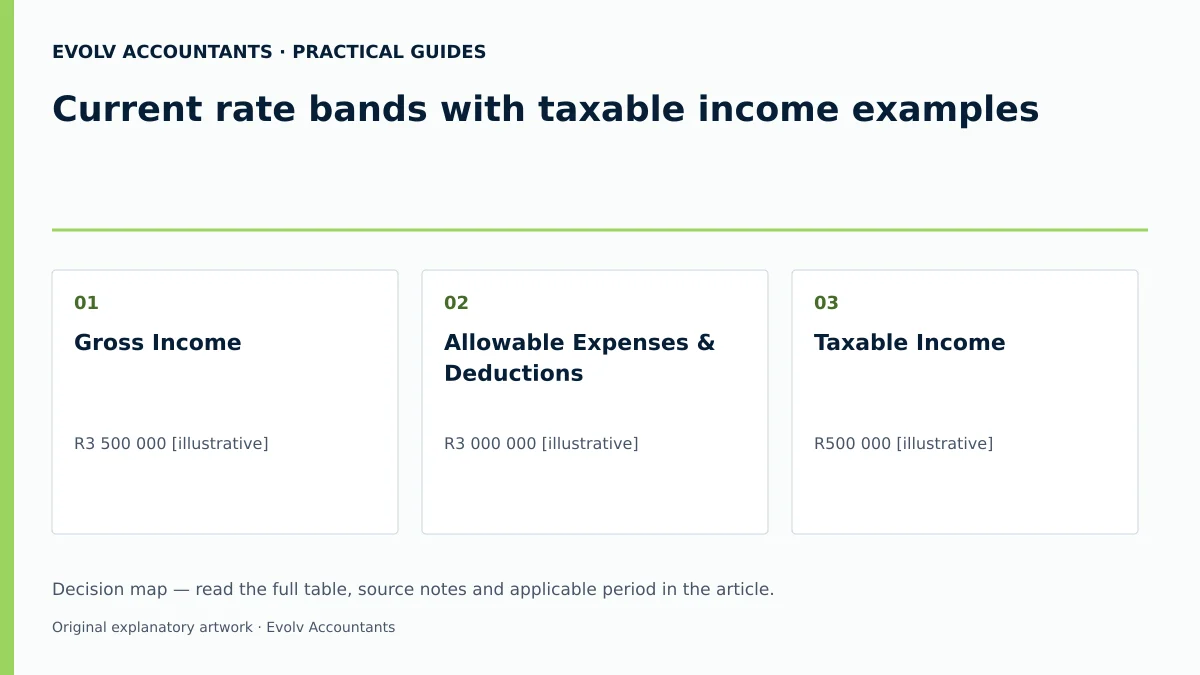
To illustrate the practical calculation of SBC tax, consider a hypothetical South African private company with a financial year ending 28 February 2027. The company reports an illustrative gross income of R3 500 000 [illustrative] and allowable tax deductions of R3 000 000 [illustrative], yielding a net taxable income of R500 000 [illustrative].
Applying the 2026/2027 SBC rate bands 1:
- Band 1 (R1 to R99 000): Taxed at 0% = R0 1.
- Band 2 (R99 001 to R365 000): Portion in band = R365 000 - R99 000 = R266 000. Tax at 7% = R18 620 1.
- Band 3 (R365 001 to R500 000): Portion in band = R500 000 - R365 000 = R135 000. Tax at 21% = R28 350 1.
- Total SBC Normal Tax: R0 + R18 620 + R28 350 = R46 970 1.
By comparison, under the standard flat corporate income tax rate of 27% 10, normal tax on R500 000 taxable income would be R135 000 (R500 000 × 27%). The illustrative SBC relief reduces normal tax liability by R88 030 for that assessment period.
Reproducible worked example table
| Input | Value or verified-source placeholder | Formula or step | Result | Independent check |
|---|---|---|---|---|
| Gross Income | R3 500 000 [illustrative] | Total revenue and accruals declared on ITR14 | R3 500 000 | Confirmed <= R20 000 000 statutory limit 14 16 |
| Allowable Expenses & Deductions | R3 000 000 [illustrative] | Operating costs and s12E capital allowances | R3 000 000 | Supported by financial statements & tax schedules 30 31 |
| Taxable Income | R500 000 [illustrative] | Gross Income minus Allowable Deductions | R500 000 | R3 500 000 - R3 000 000 = R500 000 |
| Band 1 (R1 – R99 000) | R99 000 | 0% on taxable income up to R99 000 | R0 | Exempt threshold verified in SARS table 1 |
| Band 2 (R99 001 – R365 000) | R266 000 | 7% on (R365 000 - R99 000) | R18 620 | R266 000 × 7% = R18 620 1 |
| Band 3 (R365 001 – R500 000) | R135 000 | 21% on (R500 000 - R365 000) | R28 350 | R135 000 × 21% = R28 350 1 |
| Total SBC Normal Tax (2026/2027) | R500 000 Taxable Income | Sum of Band 1 + Band 2 + Band 3 | R46 970 | R0 + R18 620 + R28 350 = R46 970 1 |
| Standard Corporate Tax Comparison | R500 000 Taxable Income | Flat rate of 27% on taxable income | R135 000 | R500 000 × 27% = R135 000 10 |
| Illustrative Tax Differential | R500 000 Taxable Income | Standard CIT (R135 000) minus SBC Tax (R46 970) | R88 030 | R135 000 - R46 970 = R88 030 relief 1 10 |
Reconcile the answer to the underlying records: current rate bands with taxable income examples
Reconciling accounting profit to taxable income on form ITR14
When preparing form ITR14, accounting profit reflected in the annual financial statements must be reconciled to taxable income by processing tax adjustments 27 32.
— Practical point from this guide
- Section 12E Capital Allowances: SBCs can claim an accelerated 100% deduction under Section 12E(1) for plant or machinery brought into use directly in a process of manufacture 31 33 34. Other qualifying depreciable assets under Section 12E(1A) qualify for a 50:30:20 write-off over three years 31 34 35. Accounting depreciation is added back, and the Section 12E allowance is deducted 27 36.
- Provisional Tax Credits & PAYE: Payments made via provisional tax returns and verified pre-populated IRP5 tax certificates are credited against the final SBC assessment to determine the net balance due or refundable 27 37.
Verification checklist for SBC return preparation
Evolv Accountants recommends completing the following structured verification checklist prior to submitting form ITR14 3 27:
- Verify juristic entity status (private company, close corporation, co-operative, or personal liability company) 6 11.
- Confirm natural person shareholding across 100% of issued equity shares for the entire assessment period 12 13.
- Inspect gross income to ensure total revenue does not exceed the statutory R20 million threshold (or proportionate limit for short periods) 15 16 38.
- Perform the 20% calculation on investment income and personal service receipts against total receipts and capital gains 18 19.
- Validate employee records to confirm three or more full-time non-shareholder employees where personal services are performed 21 22 39.
- Reconcile accounting depreciation to Section 12E accelerated capital allowances on plant and equipment schedules 27 31 34.
- Compare pre-populated provisional tax and PAYE credits against SARS ledger accounts 27 37.
Edge cases that change the calculation: documented completion and exceptions
Part-year trading and proportionate gross income reduction
Where a qualifying SBC carries on trade for a period of less than 12 months during a year of assessment (such as a newly incorporated business or a company liquidating), Section 12E(4)(a)(i) requires a proportionate reduction of the R20 million gross income limit 16 38. Part of a month is reckoned as a full month 16 38.
- Formula: Proportionate Limit = R20 000 000 × (Full Months Traded / 12) 40.
- Example: If a company trades for 6.5 months (reckoned as 7 months), the reduced ceiling is R20 000 000 × (7 / 12) = R11 666 667 40. If gross income exceeds R11 666 667, SBC status is forfeited for that period 40.
Multi-entity shareholding and fluctuating status
Holding shares in another unlisted company by any shareholder disqualifies the SBC, subject to statutory exemptions such as holding shares in friendly societies, venture capital companies, or inactive shelf companies 12 41 42. Additionally, if an entity qualifies as an SBC in Year 1 when an asset is acquired, but fails to qualify in Year 2 when brought into use, Section 12E(1A) accelerated allowances cannot be elected 35 43.
Frequently Asked Questions
How does a company declare SBC status with SARS?
SBC status is elected annually on form ITR14 by answering the primary Small Business Corporation wizard question "Yes" and completing the dedicated Section 12E qualification schedule 25 44 45 46.
What happens if an SBC trades for less than 12 months in a tax year?
The statutory R20 million gross income threshold must be reduced proportionately based on the number of trading months divided by 12, treating any partial month as a full month 16 38 40.
Can a company qualify for SBC tax if a trust or company holds shares in it?
No. All holders of shares or members must be natural persons at all times during the year of assessment 12 13. Shareholding by a trust or corporate entity disqualifies the company 12.
How does SBC tax differ from Turnover Tax?
Turnover tax applies a low rate to gross turnover for micro businesses earning up to R1 million 25 26. SBC tax is levied on taxable income (profit after allowable deductions) using progressive rate bands 1 15.
What capital allowances can an SBC claim on manufacturing assets?
An SBC can claim a 100% write-off under Section 12E(1) in the year plant or machinery is brought into use directly in a process of manufacture 31 33 34. Ask Evolv about current rate bands with taxable income examples. Share the relevant records so the support required can be scoped.
Related guides
- Small Business Corporation tax: who qualifies in South Africa
- The SBC gross income limit and how to test it
- The Proactive SARS Audit Guide: Keeping Your Business Ledger Sanitised
Sources
- Companies, Trusts and Small Business Corporations (SBC) | South African Revenue Service
- Small business relief | South African Revenue Service
- https://www.sars.gov.za/wp-content/uploads/Legal/Notes/LAPD-IntR-IN-2012-09-Small-Business-Corporations.pdf
- https://www.sars.gov.za/wp-content/uploads/IT-GEN-04-G01-How-to-complete-the-Income-Tax-Return-ITR14-for-Companies-External-Guide.pdf