
The SBC gross income limit and how to test it
29 November 2024
Testing the Small Business Corporation gross income limit requires calculating total non-capital revenue and applying mandatory proportional reductions for short assessment years.
Under Section 12E(4)(a)(i) of the Income Tax Act 58 of 1962, a South African business seeking Small Business Corporation (SBC) status must ensure its gross income for the year of assessment does not exceed R20 million 1 2 3. For the purpose of completing the eFiling Income Tax Return for Companies (ITR14), SARS defines gross income as the sum of sales or turnover declared under Gross Profit/Loss plus all income line items declared under Income Items in the Income Statement 4 5.
Receipts of a capital nature are excluded from Section 1 gross income, but capital gains and investment or personal service income are subject to secondary 20% ratio limits 1 6 7. Where a company carries on a trade for less than 12 full months during an assessment year, the statutory R20 million threshold must be proportionally reduced based on the number of trading months 3 8.
Gross income definition and exclusions
This practical guide is designed for South African SME directors, financial managers, and tax public officers operating within the jurisdiction of the Republic of South Africa under the South African Revenue Service (SARS) administration. It covers the current corporate assessment periods, specifically years of assessment ending between 1 April 2023 and 31 March 2027 (encompassing the 2024, 2025, 2026, and 2027 years of assessment) 9 10 11.
Successfully completing this task means verifying that total corporate gross income remains within legal thresholds, establishing a clear audit trail, and accurately completing the ITR14 return wizard on eFiling to secure progressive SBC tax rates 1 4 12.
To maintain strict compliance, taxpayers must distinguish between statutory law, regulator guidance, and professional advice:
- Statutory Law: Section 12E of the Income Tax Act 58 of 1962 sets the legal criteria for SBC qualification, including legal entity structures, shareholder restrictions, the gross income ceiling, and business activity limits 13 14 15.
- Regulator Guidance: SARS Interpretation Note 9 (Issue 7, dated 25 June 2018) provides legal interpretation on terms such as trade periods, personal services, and investment income 13 16. The SARS External Guide How to Complete the Income Tax Return (ITR14) for Companies (IT-GEN-04-G01) dictates current eFiling wizard field calculations and return classifications 17 18. Older interpretation notes provide structural context but do not prove that an old numerical threshold or tax rate remains current 9 13 14.
- Evolv Recommendations: Evolv Accountants recommends conducting quarterly gross income reviews, maintaining segregated general ledger accounts for capital versus revenue receipts, and documenting natural person shareholder status prior to year-end submission.
SMEs must also separate SBC tax rules from other tax regimes administered by SARS:
- Small Business Corporation (SBC): Offers progressive tax rates starting at 0% on initial taxable income tiers (e.g. 0% up to R95 750 for 2024–2026 YOA, and 0% up to R99 000 for 2027 YOA) up to 27% above R550 000 10 11, along with accelerated depreciation allowances under Section 12E(1) and 12E(1A) 15 19.
- Ordinary Corporate Income Tax (CIT): Applies a flat corporate rate of 27% to standard resident companies for financial years ending on or after 31 March 2023 9.
- Turnover Tax: Designed for micro businesses with qualifying turnover not exceeding R1 million and total assets not exceeding R5 million, replacing income tax, VAT, and provisional tax 20 21.
- Provisional Tax: A bi-annual payment system requiring estimates of annual taxable income, applicable to SBCs and standard companies alike.
Prepare the information and authority: gross income definition
Before performing the gross income test, the public officer or appointed tax practitioner must gather specific supporting documentation and establish eFiling authorisation 22 23.
Required Documents and Permissions
- Annual Financial Statements (AFS): Signed Income Statement, Balance Sheet, and notes 24.
- General Ledger Trial Balance: Itemized transaction listing showing sales, turnover, interest, dividends, rental income, and asset disposals 4.
- CIPC Registration Documents: Certificate of Incorporation confirming entity status as a private company, close corporation, co-operative, or personal liability company 25 26.
- Share Register: Complete share register proving that all share or member holders were natural persons throughout the entire year of assessment 27 28.
- eFiling Authority: Public officer profile access or a registered tax practitioner mandate 22 23.
Statutory Authority and Field Definitions
According to Section 12E(4)(a)(i) of the Income Tax Act 58 of 1962, a qualifying entity must ensure that "the gross income for the year of assessment does not exceed an amount equal to R20 million" 3.
For tax return completion, SARS defines gross income in the ITR14 return wizard as the sum of "Sales/Turnover" declared under Gross Profit/Loss plus all income line items declared under Income Items in the Income Statement 4 5. While Section 1 of the Income Tax Act excludes receipts of a capital nature from gross income 6 29, the ITR14 return wizard captures total accounting income first, requiring explicit allowable adjustments in the tax computation section 4 30.
Section 12E(4)(a)(ii) restricts shareholding in other companies, permitting only specified investments such as listed venture capital companies, dormant entities with total asset market values below R5 000, or primary savings co-operative banks 31 32 33.
Complete the task step by step: exclusions
Testing the SBC gross income limit requires a systematic workflow to ensure full compliance with primary SARS instructions before submitting the ITR14 return 4 34.
Step 1: Aggregate Accounting Gross Revenue
Extract the total revenue figures from the draft Income Statement. Combine Sales/Turnover with all secondary income streams, including interest, royalties, foreign dividends, local dividends, and property rentals 4 35.
Step 2: Separate Capital Receipts from Revenue
Exclude receipts or accruals of a capital nature from the Section 1 gross income calculation 6 7. Capital receipts include principal loan disbursements, capital injections from shareholders, and total gross proceeds from the sale of fixed assets 6 36.
Step 3: Test the Trading Assessment Period
Determine whether the entity traded for a full 12-month period during the assessment year 3 8. If the company commenced trading mid-year (for example, a new business) or ceased trading during the year, apply the statutory proviso to Section 12E(4)(a)(i) 3 8:
Reduced Gross Income Limit = R20 000 000 × (Number of Months Traded ÷ 12)
In this calculation, any fraction of a month must be counted as a full month 3 8.
Step 4: Compare Adjusted Gross Income Against the Limit
Compare total accounting gross income (excluding capital receipts) against R20 million (or the reduced limit calculated in Step 3) 1 8. If gross income exceeds the ceiling by any amount, the company is disqualified from SBC status for that assessment year 2 37.
Step 5: Perform the 20% Tainted Income Test
Calculate whether investment income (dividends, royalties, immovable property rental, annuities, interest) plus personal service income exceeds 20% of total non-capital receipts plus net capital gains 1 6 7.
Step 6: Apply the Personal Service Employee Exception
If the entity renders personal services in fields such as accounting, consulting, engineering, IT, law, or management, check whether it employed 3 or more full-time, non-shareholder, non-connected employees throughout the assessment year engaged in rendering that service 38 39 40. If this employee threshold is met, the income is not classified as personal service income for the 20% test 39 40.
— Practical point from this guide
Step 7: Screen Personal Service Provider (PSP) Status
Confirm that the company is not classified as a Personal Service Provider under the Fourth Schedule, which automatically disqualifies an entity from SBC tax relief 1 7 41.
Check the result against the evidence: gross income definition
Independent completion evidence must be verified before relying on SBC status, as eFiling submission does not imply final SARS acceptance 22 23.
Evidence Verification Steps
- ITR14 Submission Summary: Confirm that the "Small Business Corporation" container in the eFiling wizard was answered "Yes" and that gross income was correctly captured 4 42.
- ITA34 Notice of Assessment: Review the formal assessment issued by SARS following return processing. Verify that tax was assessed using the progressive SBC rate brackets rather than the flat 27% CIT rate 9 10 12.
- Reconciliation Working Paper: Maintain a signed reconciliation showing how line items from the draft Income Statement link directly to the Gross Profit/Loss and Income Items fields on the ITR14 return 4 5.
- Audit File Retention: Retain signed AFS, share registers, payroll records supporting the 3+ employee count, and asset purchase agreements for a minimum of 5 years as mandated by SARS 24 28 43.
Handle exceptions and unresolved cases: exclusions
Part-Year Trading Edge Cases
When a company incorporates or commences trading mid-year, the gross income threshold must be adjusted 8 44. For example, if a private company with a 28 February financial year-end commences trade on 15 October, it trades for 4.5 months. Because a fraction of a month counts as a full month, the company is deemed to have traded for 5 months 8 37. Its reduced gross income limit is:
R20 000 000 × (5 ÷ 12) = R8 333 333,33
If actual gross income for that 5-month period exceeds R8 333 333,33, SBC status is disqualified for that year 8 37.
Mixed Revenue Streams and Personal Services
Where a business earns both trade income (e.g. sales of hardware) and professional service income (e.g. IT consulting), an hourly charge-out or job-apportionment system must be used to segregate personal service receipts 45 46.
Loss of SBC Status and Asset Allowances
If an SBC qualifies for accelerated depreciation under Section 12E(1A) (written off at 50%, 30%, and 20% over three years) and subsequently loses SBC status in year two due to gross income exceeding R20 million, the company may continue claiming the remaining 30% and 20% deductions in years two and three, provided the asset remains in trade use 47 48 49.
Specialist Boundaries and Escalate Points
Taxpayers must seek specialist advisory from Evolv Accountants when dealing with foreign domesticated entities, complex trust shareholdings, or overlaps between SBC relief and Special Economic Zone (SEZ) tax incentives under Section 12R 26 27 50.
Next steps for Small business corporation tax
Reusable Action Checklist
- Extract the draft Income Statement and trial balance at financial year-end 4.
- Identify and deduct receipts of a capital nature from gross revenue 6 7.
- Determine exact trading start/end dates and apply the part-year ratio formula if trading was under 12 months 3 8.
- Verify that total natural person shareholding was maintained at 100% throughout the YOA 27 28.
- Execute the 20% investment and personal service income test 1 6.
- Complete the ITR14 wizard on eFiling, attach compulsory signed AFS, and archive the audit file 4 24.
Reproducible Hypothetical Example
Entity: Apex Technology Solutions (Pty) Ltd Assessment Period: Year of assessment ended 28 February 2025 (2025 YOA) 11 Trading Status: Commenced trading on 1 October 2024 (5 trading months) 8 Shareholding: 100% owned by two natural persons 27 Full-Time Non-Shareholder Staff: 4 full-time IT technical employees engaged in service delivery 39
Financial Results (Illustrative Values)
- Sales / Service Turnover: R7 200 000
- Local Interest Income: R150 000
- Capital Receipt (Bank Loan Principal): R500 000 (Excluded from Section 1 Gross Income) 6
- Total Accounting Gross Income (Sales + Interest): R7 350 000 4 5
Compliance Calculations
- Part-Year Gross Income Limit:
R20 000 000 × (5 ÷ 12) = R8 333 333,33 3 8 Assessment: Actual Gross Income (R7 350 000) ≤ Reduced Limit (R8 333 333,33) \rightarrow PASS 37.
- Tainted Income Ratio Test:
Interest Income = R150 000. IT service revenue is excluded from personal service tainted income because Apex employed 4 full-time non-connected employees throughout the period 39 51. Tainted Ratio = (R150 000 ÷ R7 350 000) × 100 = 2,04% 6 52 Assessment: 2,04% ≤ 20% limit \rightarrow PASS 6.
Tax Outcome Comparison (2025 YOA Rates)
Assuming a net taxable income of R500 000 for the period:
- SBC Tax Liability (2025 YOA Rates) 10 11:
- R0 – R95 750 @ 0% = R0
- R95 751 – R365 000 @ 7% = R18 847,50
- R365 001 – R500 000 @ 21% = R28 350,00
- Total SBC Tax = R47 197,50
- Standard Corporate Income Tax (27% Flat Rate) 9:
- R500 000 × 27% = R135 000,00
- Net Tax Savings via SBC Status: R87 802,50
Task and Completion Checklist
| Step | Input or evidence | Responsible person | Completion check | Exception or next action |
|---|---|---|---|---|
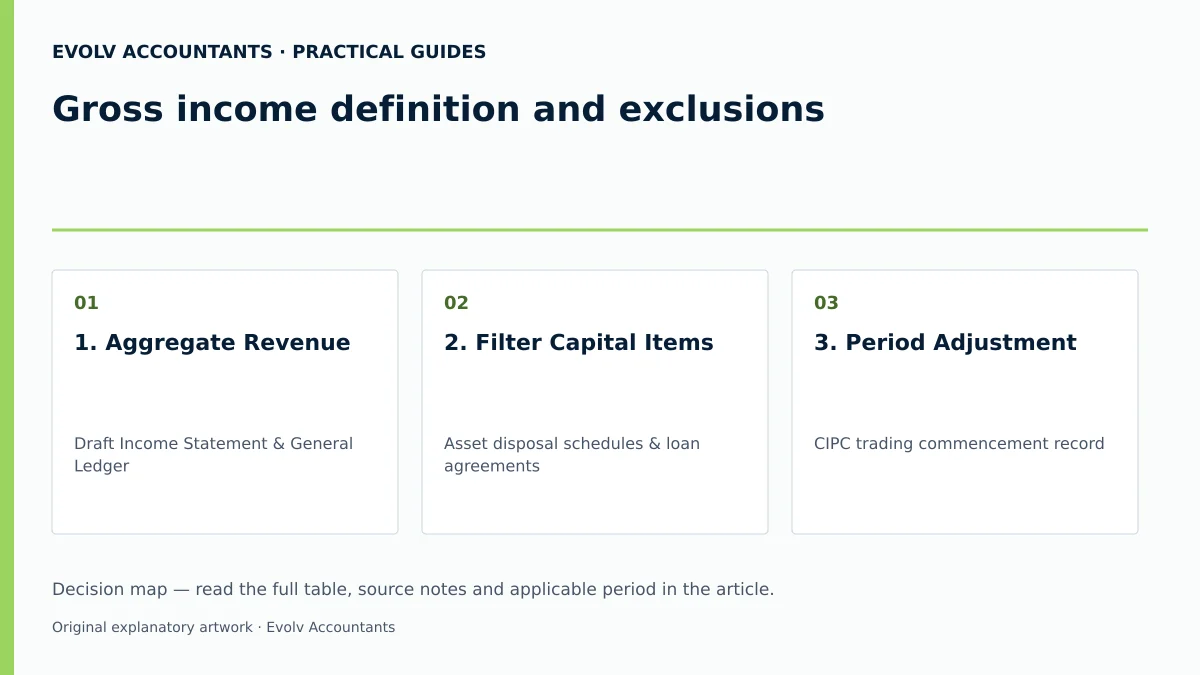
| 1. Aggregate Revenue | Draft Income Statement & General Ledger 4 | Financial Accountant | Sales and income items fully summed 4 5 | Reconcile unmapped ledger codes |
| 2. Filter Capital Items | Asset disposal schedules & loan agreements 6 | Tax Public Officer | Capital proceeds isolated from Section 1 income 6 | Transfer capital gains to CGT schedule 6 |
| 3. Period Adjustment | CIPC trading commencement record 44 | Public Officer | Proportional limit calculated if trading <12 months 8 | Recalculate limit using full trading months 8 |
| 4. Tainted Income Test | Interest, dividend, and service revenue breakdown 6 | Tax Advisory Specialist | Investment + personal service income ≤ 20% 1 6 | Verify 3+ employee exemption if personal service 39 |
| 5. Shareholder Audit | Certified Share Register & CIPC COR39 27 | Legal / Compliance Officer | 100% natural person shareholding confirmed 27 28 | Disqualify SBC if juristic holder exists 27 |
| 6. eFiling Submission | Final AFS & eFiling wizard data 4 24 | Tax Practitioner | ITR14 submitted & ITA34 issued with SBC rates 10 23 | File notice of objection if incorrect rate applied |
Frequently Asked Questions
What happens if our gross income exceeds R20 million by a small amount?
If gross income exceeds R20 million (or the reduced limit for part-year trading) by any margin, the entity is automatically disqualified from SBC status for that entire year of assessment 2 37. It will be assessed under ordinary Corporate Income Tax at the flat rate of 27% 9.
Are capital receipts or asset sales included in the R20 million gross income limit?
Receipts of a capital nature (such as bank loan principal or capital asset sales proceeds) are excluded from Section 1 gross income and do not count toward the R20 million ceiling 6 7. However, net capital gains are included in the denominator when calculating the 20% tainted investment income limit 6 7.
How is the part-year gross income limit calculated for a newly registered company?
If a company trades for less than 12 months, the R20 million ceiling is reduced proportionally based on the number of trading months divided by 12 3 8. Any fraction of a month spent trading is treated as a full month 3 8.
Can our company qualify for SBC rates if 1% of its shares are held by a family trust?
No. Section 12E(4)(a) strictly mandates that all holders of shares or member interests must be natural persons at all times throughout the year of assessment 27 28. If a trust or company holds shares for even a single day, SBC status is disqualified for that year 27.
If an SBC loses its qualification in year two, do accelerated depreciation allowances get cancelled?
No. If an asset was acquired and brought into use when the company qualified as an SBC under Section 12E(1A), the company can continue claiming the remaining 30% (year two) and 20% (year three) write-offs in subsequent years, provided the asset remains in trade use 47 48 49. Ask Evolv about gross income definition and exclusions. Share the relevant records so the support required can be scoped.
Related guides
- Small Business Corporation tax: who qualifies in South Africa
- SBC shareholding restrictions for business owners
- The Proactive SARS Audit Guide: Keeping Your Business Ledger Sanitised
Sources
- https://www.sars.gov.za/wp-content/uploads/IT-GEN-04-G01-How-to-complete-the-Income-Tax-Return-ITR14-for-Companies-External-Guide.pdf
- https://www.sars.gov.za/wp-content/uploads/Legal/Notes/LAPD-IntR-IN-2012-09-Small-Business-Corporations.pdf
- Companies, Trusts and Small Business Corporations (SBC) | South African Revenue Service