
SBC shareholding restrictions for business owners
16 February 2026

Small business corporation tax status requires all company shareholders to be natural persons who hold no equity in other unlisted entities.
To qualify for South African Small Business Corporation (SBC) progressive income tax rates rather than the standard flat corporate rate, a private company, close corporation, personal liability company, or co-operative must ensure that every shareholder is a natural person throughout the entire year of assessment 1 2. Furthermore, shareholders are strictly prohibited from holding shares or equity interests in any other unlisted company, subject to narrow statutory exceptions 3 4.
Qualifying entities must verify beneficial ownership registers and corporate structures before declaring SBC status on their annual ITR14 company income tax return 5 6 7.
Natural person ownership and additional shareholdings
South African small and medium enterprises (SMEs) operating as private companies, close corporations, personal liability companies, or co-operatives often seek tax relief through the Small Business Corporation (SBC) regime under Section 12E of the Income Tax Act 58 of 1962 1. Business owners must distinguish between corporate incorporation with the Companies and Intellectual Property Commission (CIPC) and tax eligibility determined by the South African Revenue Service (SARS) 1 7.
Incorporating a private company does not automatically grant SBC tax status; eligibility is assessed independently for every year of assessment 7 8.
For the tax year of assessment ending between 1 April 2025 and 31 March 2026, as well as the tax year ending between 1 April 2026 and 31 March 2027, qualifying SBCs benefit from a progressive tax structure starting at 0% on initial taxable income, rather than paying the standard flat corporate income tax (CIT) rate of 27% 9 10.
SBC tax eligibility must also be kept distinct from Turnover Tax, which is a simplified turnover-based tax system under the Sixth Schedule for micro-businesses with qualifying turnover up to R1 million 11 12, and Provisional Tax, which is merely the advance payment mechanism for income tax obligations 13.
Historical guidance issued by SARS, such as Interpretation Note 9 (Issue 7), provides useful background on statutory interpretations but does not establish current numerical brackets or rates 7 14. Taxpayers must rely on statutory provisions and applicable tax rate updates for each financial year 7 10 13.
The qualification tests to check: natural person ownership
To qualify as an SBC under Section 12E(4)(a), an enterprise must satisfy six independent statutory requirements simultaneously throughout the year of assessment 6 15:
- Legal Entity Requirement: The business must be incorporated as a private company, personal liability company, close corporation, or co-operative under South African law 1 16. Foreign companies are excluded unless registration has been formally transferred to South Africa 17.
- Natural Person Ownership Test: All holders of shares or members' interests must, at all times during the year of assessment, be natural persons (human beings) 2 16. If any share capital is held by a juristic entity—such as another company, a corporate entity, or a trust without vested natural person beneficiaries—for even a single day, SBC status is forfeited for that entire tax year 2 18.
- Additional Shareholding Restriction: No shareholder or member may, at any time during the year of assessment, hold any shares or equity interest in any other company 3 4. Statutory exceptions permitted under Section 12E(4)(a)(ii) include holdings in 4 19 20 21:
- Listed public companies 4;
- Portfolios in collective investment schemes 4;
- Section 10(1)(e)(i) bodies corporate, share block companies, or housing management associations 4 22;
- Less than 5% interest in social/consumer co-operatives, primary savings co-operative banks, or burial societies 19;
- Friendly societies 19;
- Approved Section 12J venture capital companies 20;
- Inactive dormant companies that have never traded and hold total assets valued at no more than R5,000 20 21;
- Companies in the process of liquidation or deregistration under Section 41(4) 21.
- Gross Income Limitation: Gross income (sales, turnover, and other income) must not exceed R20 million for the year of assessment 6 23. If trading was carried on for less than 12 months during the assessment period, the R20 million threshold is reduced proportionately based on the number of full months traded 24 25.
- Business Activity Limitation: Investment income (dividends, interest, royalties, rental from immovable property) and personal service income combined must not exceed 20% of total receipts and accruals (excluding capital receipts) plus capital gains 6 26 27. Personal services in fields such as accounting, consulting, engineering, health, IT, law, and management rendered personally by a shareholder are excluded from being classified as "personal service income" if the entity employs three or more full-time, non-shareholder, non-connected employees throughout the tax year engaged in rendering that service 28 29 30 31.
- Personal Service Provider Prohibition: The company must not be classified as a Personal Service Provider under the Fourth Schedule 6 32.
Business owners must note that being categorised as a "Small Business" on the SARS ITR14 return form wizard—which applies to companies with gross income up to R20 million and assets up to R10 million—is purely an administrative layout classification for tailoring return fields and does not grant or replace SBC qualification under Section 12E 33 34 35 36.
Evidence behind the eligibility decision: additional shareholdings
To support an SBC declaration on the ITR14 company income tax return, the business Public Officer must compile and maintain verifiable evidence for every qualification test 6 37 38. Since the 2024 year of assessment, SARS mandates explicit disclosure of beneficial ownership details on the ITR14 return to trace ultimate individual control 5 39 40.
— Practical point from this guide
Eligibility decision table
| Test | Facts to obtain | Evidence | Applicable source | Result or unresolved question |
|---|---|---|---|---|
| Legal Entity | Registered company type and incorporation status | CIPC registration certificate (COR14.3 / CK1) | Section 12E(4)(a) / Companies Act 1 | Confirms qualifying entity type |
| Natural Person Ownership | Direct and ultimate beneficial ownership of all shares | Securities register, share certificates, trust deeds | Section 12E(4)(a) / ITR14 Beneficial Ownership 2 5 18 | Verifies 100% natural person shareholder status |
| Additional Shareholdings | External equity holdings of all shareholders | Signed shareholder declarations, CIPC search reports | Section 12E(4)(a)(ii) 3 4 | Confirms no impermissible unlisted shareholdings exist |
| Gross Income Limit | Total sales, turnover, and non-capital receipts | Annual Financial Statements, trial balance, trading period record | Section 12E(4)(a)(i) 23 24 | Verifies gross income within R20m (or proportionate) limit |
| Business Activity | Breakdown of investment, personal service, and trading income | Income statement breakdown, payroll reports for full-time staff | Section 12E(4)(a)(iii) & (d) 26 29 | Verifies investment/personal service income ≤ 20% |
| PSP Prohibition | Client reliance percentage, supervision, and full-time employee count | Service contracts, client invoicing records, EMP201 payroll records | Fourth Schedule / Section 12E(4)(a)(iv) 6 32 | Confirms entity is not a Personal Service Provider |
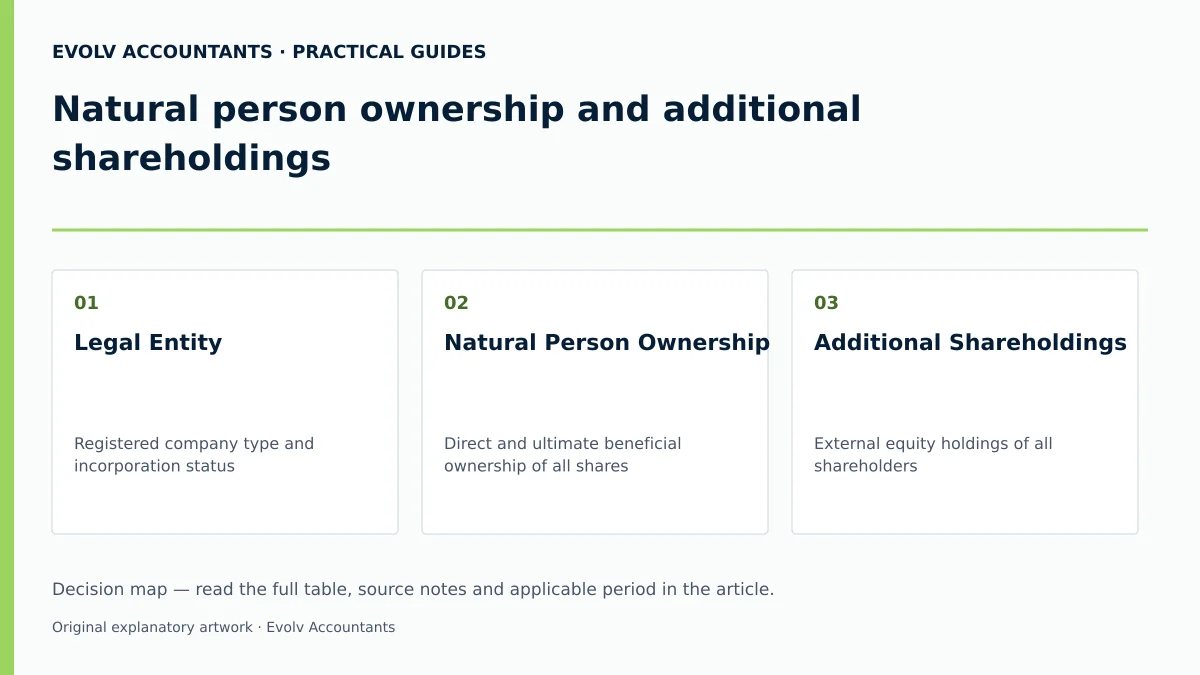
A qualifying case and an excluded case: natural person ownership
Consider a reproducible hypothetical example for the 2026/2027 year of assessment (financial year ending 28 February 2027) involving two South African engineering consultancies:
Qualifying case (Company A)
Company A (Pty) Ltd is owned 50/50 by two natural persons, Shareholder X and Shareholder Y. For the 2027 tax year, Company A generated R4,000,000 in gross trading income with taxable income of R4,000,000. Shareholder X holds no other shareholdings. Shareholder Y holds shares in a company listed on the JSE. Because listed shares are a permitted statutory exception under Section 12E(4)(a)(ii)(aa), Company A satisfies the shareholder requirement 4 22.
Company A calculates its corporate income tax liability as follows:
- Standard Corporate Income Tax (27% flat rate): R4,000,000 × 27% = R1,080,000 9.
- SBC Tax Brackets (2026/2027 year of assessment) 10:
- R1 – R99,000 @ 0% = R0 10
- R99,001 – R365,000 (R266,000 @ 7%) = R18,620 10
- R365,001 – R550,000 (R185,000 @ 21%) = R38,850 10
- Above R550,000 (R3,450,000 @ 27%) = R931,500 10
- Total SBC Tax: R57,470 + R931,500 = R988,970 10.
- Net Tax Saving: R1,080,000 - R988,970 = R91,030 in tax savings 9 10.
Excluded case (Company B)
Company B (Pty) Ltd operates an identical engineering business with R4,000,000 taxable income. Shareholders M and N are natural persons. On 15 November 2026, Shareholder N acquired a 10% equity stake in an unlisted private coffee shop company. Because an unlisted trading company is an impermissible shareholding under Section 12E(4)(a)(ii), Company B failed the shareholder requirement during the 2027 tax year 3 22.
Consequently, Company B is disqualified from SBC status for the entire 2027 year of assessment and must pay the standard flat corporate tax rate of 27% (R1,080,000 tax), losing R91,030 in tax relief 9 10.
What changes the answer: additional shareholdings
An entity's SBC qualification can change mid-year due to structural or operational modifications 8. Reassessment is mandatory whenever any of the following events occur:
- Share Transfer or Restructuring: Issuing or transferring shares to a company, close corporation, or family trust (where beneficiaries do not hold fully vested natural person rights) immediately disqualifies the entity for the full tax year 2 18.
- Unlisted Investment Acquisition: A shareholder acquiring an equity interest in any unlisted trading company forfeits SBC eligibility for all entities in which they hold shares 3 22.
- Corporate Delisting: If a shareholder owns shares in a listed company that gets delisted during the tax year, the shareholding becomes impermissible and disqualifies the SBC 22.
- Gross Income Growth: Exceeding R20 million in gross income (or exceeding the reduced proportionate threshold for partial trading years) disqualifies the company from SBC tax rates 23 24.
- Shift in Income Composition: Earning investment income (rent, interest, dividends) or personal service income that pushes total tainted receipts above 20% of gross receipts revokes SBC status 26.
- Employee Turnover in Personal Service Businesses: If a personal service entity drops below three full-time, non-shareholder, non-connected employees during the tax year, client income re-enters the 20% tainted income calculation and may trigger disqualification 29 41.
Next steps for Small business corporation tax
To maintain tax compliance and safeguard SBC tax benefits, business owners and Public Officers should follow this decision checklist prior to submitting the annual ITR14 return 6 37 38:
- Verify Legal Entity Status: Confirm CIPC registration as a private company, close corporation, personal liability company, or co-operative 1.
- Audit Share Registers: Review direct share registers and beneficial ownership registers to confirm 100% natural person ownership throughout the assessment period 2 5 39.
- Obtain Shareholder Declarations: Collect written annual declarations from every shareholder confirming they hold no impermissible equity interests in other unlisted companies 3 4.
- Calculate Gross Income Limit: Verify that gross trading income does not exceed R20 million (applying proportionate monthly reduction if trading started or ceased mid-year) 23 24.
- Test Tainted Income Streams: Confirm that investment income and personal service income collectively do not exceed 20% of total receipts 26. Verify payroll records for three full-time non-connected staff if operating a personal service business 29 41.
- Complete ITR14 Beneficial Ownership Container: Ensure accurate disclosure of beneficial owners on SARS eFiling before ticking "Yes" to the SBC declaration question 5 6 42.
Frequently Asked Questions
Can an SBC be owned by a family trust?
An SBC can only be owned by a trust if all beneficiaries who hold vested rights in the shares throughout the entire year of assessment are natural persons 18. If the trust itself holds discretionary beneficial interest in the shares, the company is disqualified from SBC tax rates 18.
What happens if a shareholder acquires shares in an unlisted company mid-year?
If a shareholder acquires an equity interest in an unlisted company at any point during the tax year, the company is disqualified from SBC status for that entire year of assessment, regardless of how briefly the shares were held 2 3.
Are unit trusts and listed shares permitted for SBC shareholders?
Yes. Holding shares in a JSE-listed public company or investments in a collective investment scheme portfolio are explicitly permitted statutory exceptions under Section 12E(4)(a)(ii) and do not disqualify an SBC 4.
Does selecting 'Small Business' on the ITR14 wizard grant SBC tax status?
No. Selecting "Small Business" on the ITR14 form wizard (gross income ≤ R20m and assets ≤ R10m) merely customizes the layout of the tax return 33 34. SBC tax rates only apply if the company specifically meets all statutory Section 12E criteria and answers "Yes" to the Section 12E declaration container 6 42.
How does personal service income impact SBC eligibility?
Income from personal services (such as consulting, engineering, law, or accounting) is classified as tainted income 28. If personal service and investment income combined exceed 20% of gross receipts, SBC status is lost—unless the business employs at least three full-time, non-shareholder, non-connected employees rendering that service throughout the tax year 26 29.
Related guides
- Small Business Corporation tax: who qualifies in South Africa
- Personal service businesses and the SBC rules
- The Proactive SARS Audit Guide: Keeping Your Business Ledger Sanitised
Sources
- https://www.sars.gov.za/wp-content/uploads/Legal/Notes/LAPD-IntR-IN-2012-09-Small-Business-Corporations.pdf
- https://www.sars.gov.za/wp-content/uploads/IT-GEN-04-G01-How-to-complete-the-Income-Tax-Return-ITR14-for-Companies-External-Guide.pdf
- Companies, Trusts and Small Business Corporations (SBC) | South African Revenue Service
- Small business relief | South African Revenue Service