
Preparing the annual EMP501 reconciliation
18 February 2025

Preparing the annual EMP501 reconciliation requires small and medium-sized enterprises to verify that monthly payroll tax declarations and actual payments match individual employee tax certificates.
Under South African tax law administered by the South African Revenue Service (SARS), employers must complete an annual employer reconciliation (form EMP501) balancing all monthly declarations (EMP201) and payments against employee tax certificates (IRP5/IT3(a)) 1 2.
Achieving mathematical reconciliation across Pay-As-You-Earn (PAYE), Skills Development Levy (SDL), and Unemployment Insurance Fund (UIF) contributions ensures statutory compliance, prevents administrative non-compliance penalties, and allows employees to file their annual personal income tax returns 2 3 4.
Annual employee certificate and liability reconciliations
Tax compliance in South Africa is governed by statutory law, regulator administrative guides, and expert accounting practices. Statutory obligations for payroll taxes arise under the Fourth Schedule to the Income Tax Act No. 58 of 1962, the Unemployment Insurance Contributions Act No. 4 of 2002 (UIC Act), and the Skills Development Levies Act No. 9 of 1999 (SDL Act) 1 5 6 7 8. Operational procedures are detailed in official regulator guidance, specifically SARS External Guide EMP-GEN-02-G01 9 10.
— Practical point from this guide
As SARS guidance specifies, "The values of tax on the IRP5/IT3(a) certificates compared to the total value of EMP201 returns and the actual payments made to SARS should balance" 2. Evolv Accountants recommends establishing independent monthly general ledger clearing accounts to track payroll tax deductions, payment allocations, and tax source codes prior to annual submission.
Completing the annual reconciliation requires verifying four independent records:
- Monthly EMP201 Declarations: Monthly self-assessment returns declaring total liabilities for PAYE, SDL, UIF, and Employment Tax Incentive (ETI) 1 11.
- SARS Payment Receipts: Actual funds remitted to SARS via electronic funds transfer (EFT) or eFiling credit push, linked by a unique 19-digit Payment Reference Number (PRN) 3 11 12 13.
- Employee Tax Certificates: Annual IRP5 certificates (issued when tax was deducted under codes 4101, 4102, or 4115) and IT3(a) certificates (issued when no tax was withheld, using code 4150 for the non-deduction reason) 5 14 15.
- Internal Payroll General Ledger: Core accounting records tracking gross remuneration, statutory deductions, and net wage disbursements.
A mathematical match across EMP201 returns, bank statements, and tax certificates confirms internal record agreement, but agreement must not be confused with factual validity 2 16. Balancing figures do not validate underlying calculations if remuneration definitions, statutory thresholds, or tax source codes were applied incorrectly 17 18 19 20.
Prepare the opening balances and period: annual employee certificate
Setting up the annual reconciliation environment requires defining opening balances, accounting periods, monetary standards, and statutory identifiers:
- Reconciliation Period and Cut-off: The annual reconciliation covers the 12-month tax year running from 1 March to the final day of February (designated as period 02) 21 22 23. Opening balances must tie directly to the preceding interim reconciliation period (period 08, covering March to August) 21 23 24.
- Monetary Units: All figures on the EMP501 return and tax certificates must be captured in South African Rands and cents 25 26.
- Statutory Identifiers: Declarations require valid employer registration parameters, including the 10-digit PAYE reference number, SDL reference number, and SARS UIF reference number 27 28. Each employee certificate must contain a valid tax reference number, South African identity number, or passport number 14 29. Employers are prohibited from using duplicate tax reference numbers across different employees 29.
- Evidence Completeness: SARS systems will not process an EMP501 return unless all 12 monthly EMP201 returns for the tax year have been submitted 25 30. If an employer ceases trading or operating as an employer during the tax year, an EMP501 return must be submitted within 14 days of closure 31.
Match transactions and explain differences: liability reconciliations
Reconciling payroll liabilities requires structured comparison across independent records to isolate timing differences, transaction errors, and duplicate postings.
Reconciliation Bridge
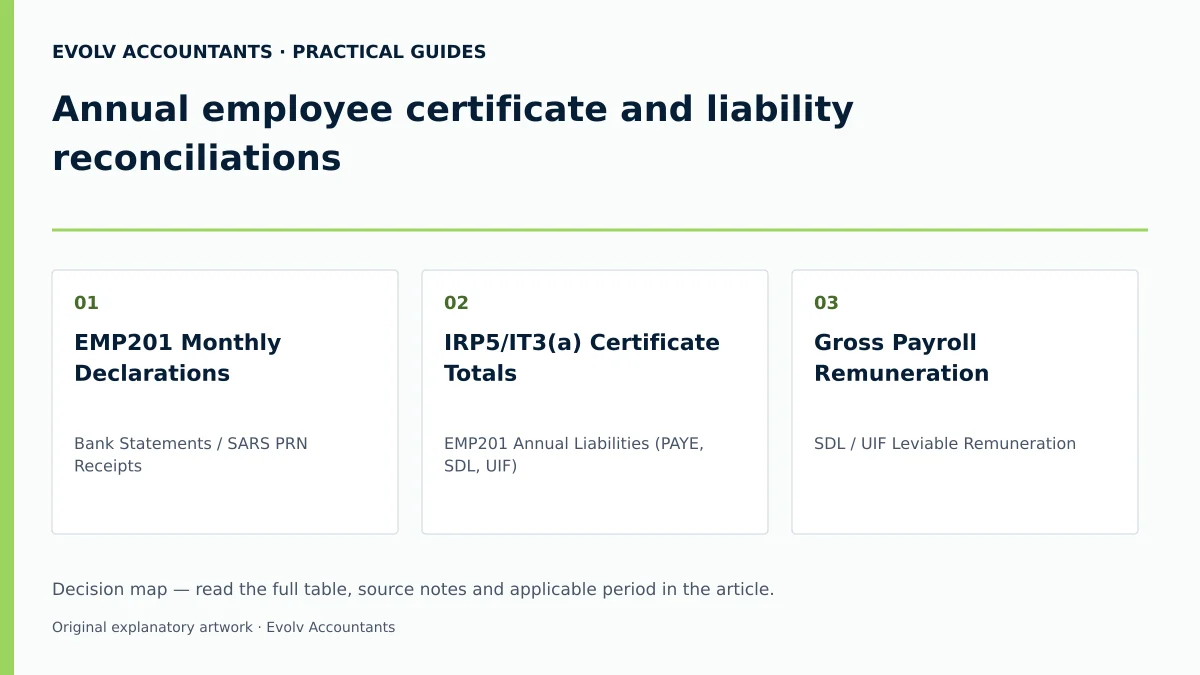
| Independent record A | Independent record B | Difference | Reason and evidence | Action and owner |
|---|---|---|---|---|
| EMP201 Monthly Declarations | Bank Statements / SARS PRN Receipts | Unallocated or short payment balance | Payment date falling on a weekend/public holiday processed on preceding business day; incorrect PRN allocation 3 11 12. | Reallocate clearing account balance using correct 19-digit PRN; Senior Payroll Accountant 3 12. |
| IRP5/IT3(a) Certificate Totals | EMP201 Annual Liabilities (PAYE, SDL, UIF) | Variance between certificate totals and declared liability | Under- or over-deduction during payroll runs or mid-year salary adjustments 2 32 33. | Submit Request for Correction (RFC) on EMP201 or adjust EMP501 figures; Tax Advisory Lead 30 34. |
| Gross Payroll Remuneration | SDL / UIF Leviable Remuneration | Excluded remuneration discrepancy | Non-taxable allowances, exempt director fees, or remuneration exceeding the monthly UIF ceiling 17 19 35. | Perform remuneration audit against statutory exclusion schedules; Payroll Manager 17 20. |
Reproducible Hypothetical Example
Alpha Solutions (Pty) Ltd is a South African small business employing five staff members during the 202402 annual tax period (March 2023 to February 2024) 22.
Statutory Rates and Thresholds Applied:
- PAYE: Deducted according to statutory income tax tables 5 26.
- SDL: 1% of total leviable remuneration (payable as annual leviable payroll exceeds R500,000) 7 36 37 38 39.
- UIF: 1% employee deduction plus 1% employer contribution (2% total) 18 40 41. Monthly remuneration subject to UIF is capped at R17,712 (R212,544 annually), limiting the maximum monthly employee deduction to R177.12 35 40 42 43.
Single Employee Calculation (Earning R25,000 per month):
- Gross Monthly Remuneration: R25,000.00.
- PAYE Deduction (per tax tables): R3,500.00.
- Monthly SDL Liability: 1% of R25,000.00 = R250.00 37 44.
- Monthly UIF Liability: Capped remuneration = R17,712.00 35 40. Employee 1% = R177.12; Employer 1% = R177.12. Total monthly UIF = R354.24 18 35 40. Earnings above R17,712.00 (R7,288.00) are excluded 35 42.
Annual Employee Totals (12 Months):
- Gross Remuneration (Code 3601): R300,000.00.
- Total PAYE (Code 4102): R42,000.00.
- Total Employer SDL (Code 4142): R3,000.00 15.
- Total Employee and Employer UIF (Code 4141): R4,250.88 15.
- Total Certificate Value (Code 4149): R49,250.88 15.
Annual Reconciliation Balancing:
- Sum of 12 EMP201 Declarations: PAYE R42,000.00 + SDL R3,000.00 + UIF R4,250.88 = R49,250.88 1 45.
- Sum of Bank PRN Payments Remitted: R49,250.88 3 12 45.
- IRP5 Certificate Total (Code 4149): R49,250.88 15 46.
- Final Reconciled Variance: R0.00 2 46.
Post only supported corrections: annual employee certificate
Adjustments to payroll tax records must be supported by verifiable documentation:
- Prohibition on Direct Employer Refunds: Employers are strictly prohibited from refunding over-deducted employees' tax directly to employees after the tax year has ended 32 47. Over-deducted tax must remain reflected on the employee's IRP5 certificate, allowing SARS to refund the individual upon assessment of their personal ITR12 return 32.
- Correcting Monthly Declarations: If a monthly declaration error is identified before submitting the EMP501, the employer should file a Request for Correction (RFC) directly on the affected EMP201 30. When liability corrections are made during EMP501 preparation, a revised EMP501 return must be submitted along with revised IRP5/IT3(a) certificates 34 48.
- Handling Under-deductions: An employer who fails to deduct the correct employees' tax is personally liable to SARS for the shortfall, along with potential late payment penalties and interest 32 49. The employer may recover the debt from the employee under a SARS directive 32.
- Invalid Certificates: SARS will reject EMP501 submissions if an IRP5 certificate reflects employees' tax exceeding the sum of taxable and non-taxable remuneration source codes 16.
Review unresolved and old items: liability reconciliations
Unsettled variances and historical exceptions require disciplined oversight:
- Aged Exception Log: Outstanding balances, unallocated PRN credits, or statement discrepancies must be tracked in an exception register with assigned owners, root causes, and resolution targets. Differences must never be hidden in general ledger suspense accounts.
- Statutory Penalties and Interest: Under the Tax Administration Act and relevant tax statutes, late payments trigger an automatic 10% penalty on outstanding SDL and UIF liabilities, alongside statutory interest 50 51.
- Dispute and Remission Requests: Where penalties result from administrative errors or SARS allocation delays, employers may lodge an electronic Request for Remission (RFR) via eFiling or at a SARS branch 52.
- Five-Year Record Retention: Paragraph 14 of the Fourth Schedule and SARS guides require employers to keep all EMP201 returns, EMP501 declarations, payment receipts, and IRP5/IT3(a) certificates for at least five (5) years 3 47.
Next steps for Employer reconciliations
Before final electronic transmission, complete the following reviewer checks and archiving steps:
- Verify that total tax certificate values (codes 4101, 4102, 4115, 4141, and 4142) match the EMP501 work page liabilities exactly 15 46.
- Respect filing channel constraints: Reconciliations with up to 50 IRP5/IT3(a) certificates can be submitted via eFiling, whereas submissions exceeding 50 certificates must use e@syFile™ Employer 53. Once a channel is selected for a tax period, all subsequent filings and revisions for that period must use the same channel 53 54.
- Archive saved reconciliation workbooks, signed EMP501 returns, PRN payment confirmations, and certificate data files for audit readiness 3 47.
Checked Next Actions Checklist
- Compile Monthly Records: Gather all 12 submitted EMP201 returns, bank PRN payment receipts, and monthly payroll reports for the tax year 1 2 11.
- Audit Employee Data: Confirm that all employee tax reference numbers, identity/passport numbers, and address details are complete and valid 14 29.
- Recalculate Statutory Liabilities: Re-perform annual calculations for PAYE, SDL (1% on leviable payroll above R500,000 exemption), and UIF (1%+1% capped at R17,712/month) 32 35 37 39 40.
- Bridge Certificate Totals: Match total IRP5/IT3(a) certificate values against declared EMP201 liabilities and PRN bank payments 2 46.
- Adjust Monthly Variances: File an EMP201 Request for Correction (RFC) or update EMP501 liability fields to resolve valid discrepancies 30 34.
- Submit Electronic Return: File the finalised EMP501 declaration and tax certificates on eFiling (<=50 certificates) or e@syFile (>50 certificates) 53 55.
- Issue Final Certificates: Provide employees with copies of their final IRP5/IT3(a) certificates (period 02) and archive all documentation for 5 years 3 56.
Frequently Asked Questions
Can an employer submit the annual EMP501 reconciliation on eFiling if they have 75 employees?
No. Electronic submission via eFiling is restricted to reconciliations containing a maximum of 50 IRP5/IT3(a) certificates 53. Employers submitting more than 50 certificates must use e@syFile™ Employer 53. Once a specific filing channel is selected for a tax period, that same channel must be used for any subsequent transactions or revisions for that period 53 54.
How should an employer correct a declaration error discovered from a previous month before filing the EMP501?
Prior to submitting the EMP501 return, the employer should file a Request for Correction (RFC) directly on the affected monthly EMP201 return 30. Employers do not need to wait for the annual EMP501 reconciliation to rectify monthly declaration errors 30.
How is UIF calculated for an employee earning R30,000 per month?
UIF contributions are calculated on remuneration up to the statutory monthly earnings ceiling of R17,712 (R212,544 annually) 35 40 42. For an employee earning R30,000 per month, the 1% employee deduction is capped at R177.12, matched by an employer contribution of R177.12, totalling R354.24 per month 18 35 40. Remuneration exceeding R17,712 is excluded 35 42.
Is a small company with an annual payroll of R400,000 required to pay Skills Development Levy (SDL)?
No. An employer is exempt from registering for and paying SDL if there are reasonable grounds for believing that the total leviable remuneration paid to all employees over the next 12-month period will not exceed R500,000 36 39 57.
What are the legal consequences if an employer submits the annual EMP501 reconciliation late?
Failure to submit the EMP501 return or employee tax certificates by the statutory deadline can result in administrative non-compliance penalties under paragraph 14(6) of the Fourth Schedule 4. In addition, late payment of underlying payroll taxes attracts a 10% late payment penalty plus statutory interest 50 51.
Related guides
- Submitting an EMP201 employer declaration
- Correcting an EMP201 with incorrect amounts
- Compliance and Regulations: Keeping Your Business on Track
Sources
- https://www.sars.gov.za/wp-content/uploads/Ops/Guides/EMP-GEN-02-G01-A-Guide-to-the-Employer-Reconciliation-Process-External-Guide.pdf
- COMPLETING THE MONTHLY EMPLOYER DECLARATION (EMP201) | South African Revenue Service
- Guide for Employers in Respect of Employees' Tax (2027) | South African Revenue Service
- Unemployment Insurance Fund | South African Revenue Service
- https://www.sars.gov.za/wp-content/uploads/Ops/Guides/SDL-GEN-01-G01-Guide-for-Employers-in-respect-of-Skills-Development-Levy-External-Guide.pdf
- https://www.sars.gov.za/wp-content/uploads/Ops/Guides/UIF-GEN-01-G01-Guide-for-Employers-in-respect-of-the-Unemployment-Insurance-Fund-External-Guide.pdf
- Skills Development Levy | South African Revenue Service