
Reconciling a COIDA assessment to payroll
26 August 2026

Reconciling a COIDA assessment to payroll requires systematic comparison of actual employee remuneration against declared statutory return figures.
A COIDA reconciliation compares payroll, the return of earnings, assessment notices, payments and supporting financial records for the applicable period. Document statutory exclusions, employee earnings ceilings and classification or timing differences.
A numerical match alone cannot prove that the assessment or underlying payroll treatment is correct. Fund evidence requirements; record-keeping provision.
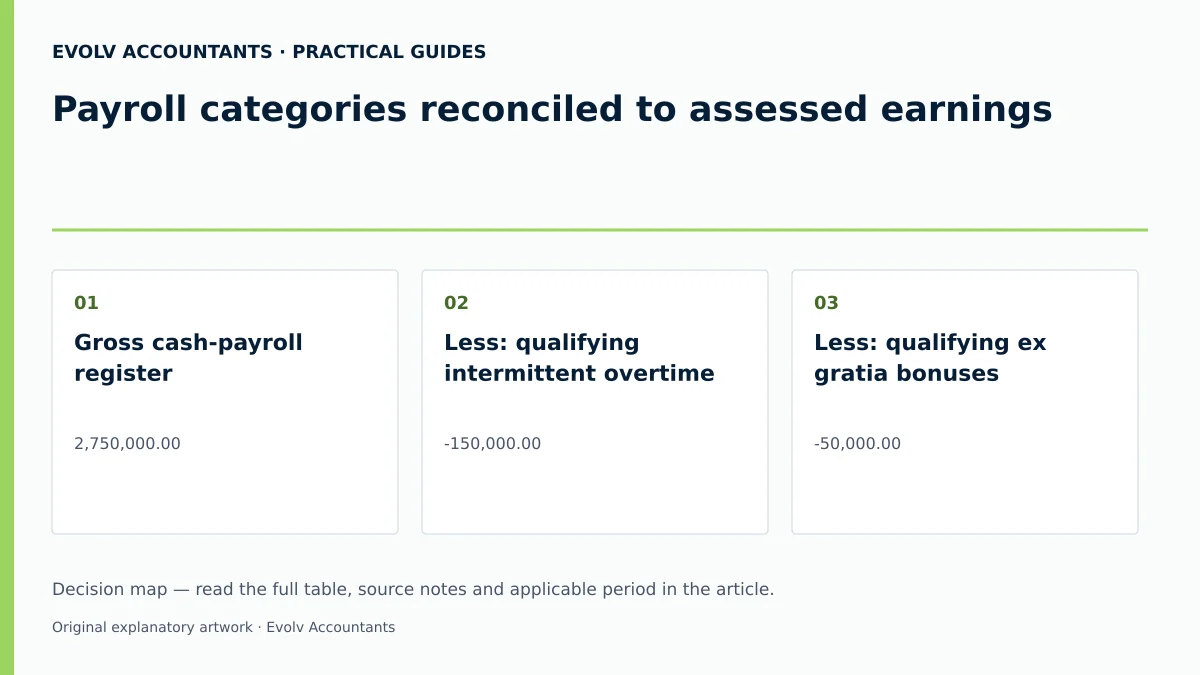
Payroll categories reconciled to assessed earnings
Independent Payroll Records and Agreement Criteria
Reconciling COIDA assessment figures against payroll requires cross-referencing three independent sources of financial evidence 1 8:
— Practical point from this guide
- Detailed Payroll Reports: Gross remuneration records generated by the payroll system, including employee wage registers, monthly pay slips, director earnings schedules, and SARS EMP501 annual employer reconciliations 1 9 10.
- Annual Financial Statements: Compiled, reviewed, or audited annual financial statements (AFS) showing gross salaries, wages, and director remuneration credited to profit and loss accounts 1 8.
- Statutory COIDA Filings and Notices: The completed Return of Earnings (ROE) submission form W.As.8 (detailing actual and provisional assessment earnings) and the corresponding Notice of Assessment / Invoice issued by the Compensation Commissioner 2 3 10.
In professional accounting practice, agreement between these records means that the gross earnings figures reported across payroll summaries, tax reconciliations, and financial statements mathematically align with the actual earnings figure assessed by the Compensation Fund 1 11. However, a numerical match between internal schedules and an assessment notice does not guarantee underlying legal or factual validity 12 13.
If excludable remuneration items were incorrectly included in the Return of Earnings declaration, the assessment remains mathematically matched but legally overstated 11 13.
Statutory Definitions of Remuneration
When categorising payroll items for COIDA reconciliation, employers must distinguish between statutory definitions in primary legislation, regulator guidance, and Evolv advisory practice:
- Primary Law (Act 130 of 1993): Under Section 63 of the Compensation for Occupational Injuries and Diseases Act 130 of 1993, earnings are defined as the monthly rate of remuneration at the time of an accident, including regular overtime, food, and quarters supplied by the employer 13 14. The statute explicitly excludes intermittent overtime, non-recurrent occasional services, special expense reimbursements paid to employees, and ex gratia payments 13.
- Amendment status: Section1(g) of Act 10 of 2022 contains a proposed alignment of earnings with Fourth Schedule remuneration. The official commencement page lists that provision as awaiting commencement. It must therefore not replace the applicable earnings rules for this reconciliation. Official commencement dates.
- Regulator Guidance: The Department of Employment and Labour Return of Earnings User Manual specifies that annual earnings declared on the ROE portal must be itemised into specific categories: Employees Earnings, Directors Earnings, and Accommodation and Meals 10.
- Evolv Recommendation: Evolv Accountants advises South African SMEs to maintain an ongoing payroll map that flags every earnings code as COIDA-includable (basic wages, executive director salaries, regular production overtime, employer-provided food/quarters) or COIDA-excludable (intermittent overtime, qualifying expense reimbursements and genuine ex gratia payments, subject to the applicable earnings rules) to ensure accurate annual reporting 10 13.
Prepare the opening balances and period: payroll categories reconciled to assessed earnings
Establishing the Assessment Period and Cut-Off
Use the earnings period specified for the employer’s return. Earlier guidance uses a March-to-February earnings cycle, while the commenced amendment changes the Fund’s own financial year to April-to-March; those are separate concepts 3 16 17. Every annual Return of Earnings submission reflects two distinct calculations 3 10:
- Final Assessment: Actual gross earnings paid to employees during the completed assessment period (1 March to end of February) 3 10.
- Provisional Assessment: Estimated gross earnings expected to be paid during the upcoming assessment period 3 10.
Opening balances should show the preceding provisional assessment and the credits already raised or paid. Cut payroll to the earnings period actually specified for the ROE, with supported treatment of pay processed around the boundary.
The Fund’s own financial year and an employer’s ROE earnings period are separate concepts; do not move payroll into a different period solely to match the Fund’s financial year. ROE workflow; Commencement schedule.
Employer Identifiers and Evidence Completeness
To establish a verified opening baseline, the employer must verify all legal and administrative identifiers across statutory systems 3 20:
- CF Registration Number & Contract Account Number: The primary employer identifier registered with the Compensation Fund, typically commencing with '99' 20 21.
- Currency: All figures must be calculated and recorded in South African Rand (ZAR) 10 22.
- Evidence Completeness: A complete reconciliation file requires the employer's registered trade name, physical address, SARS EMP501 tax certificate reconciliations, detailed payroll reports, proof of Unemployment Insurance Fund (UIF) registration, and compiled or audited Annual Financial Statements 1 3 8.
Amended section 81 requires the employer’s earnings register or other prescribed record to be retained for at least five years after its last entry. Older text showing four years must be read with the commenced amendment. Amended section 81; commencement dates.
Match transactions and explain differences: documented completion and exceptions
Transaction-Level Reconciliation Bridge
A transaction-level bridge maps monthly payroll summary totals to the final annual Return of Earnings figures. The reconciliation calculates variances between gross payroll registers and declared assessment earnings:
Gross Payroll Remuneration - Excludable Remuneration \pm Timing/Classification Adjustments = Assessed Annual Earnings
- PAYROLL RECONCILIATION BRIDGE
- [ Gross Payroll Register (EMP501 / Pay Runs) ]
- Less: Excludable Remuneration (Intermittent Overtime, Reimbursable Expenses)
- Add/Less: Classification Adjustments (Executive Directors, Meals/Quarters)
- [ Reconciled COIDA Annual Earnings ] ◄───► [ Assessed Earnings Notice / ROE ]
Categorising Reconciling Items and Exceptions
When variances arise between gross payroll registers and the declared Return of Earnings, accountants must separate legitimate timing items from errors and system exceptions 2 13 20:
- Timing Items: Differences caused by variations in payroll processing cut-off dates versus statutory month-ends. Establish the correct reporting period from the evidence. Some timing differences reconcile without correction, while a return filed for the wrong earnings period may require revision 3.
- Excludable Remuneration Misclassifications: Inadvertent inclusion of intermittent overtime, travel reimbursements, or ex gratia payments in the Return of Earnings submission 13. These represent factual errors that artificially inflate the assessment invoice 11 13.
- Omitted Executive Director Earnings: Failing to include executive directors' salaries in the Return of Earnings form 10. Under COIDA, corporate directors and members who have entered into contracts of service are defined as employees 15 26 and their remuneration must be declared under Directors Earnings 10.
- System Errors and Portal Exceptions: Technical exceptions encountered on the Department of Employment and Labour ROE portal, such as "Organisation details not found" (indicating an incorrect Contract Account number) or "Transaction rolled back" (indicating a duplicate user registration attempt) 20.
Post only supported corrections: payroll categories reconciled to assessed earnings
Evidence Requirements for Adjustment Filings
Evolv recommends posting accounting corrections only against verified evidence. Formal assessment revisions require the supporting documentation specified by the Fund 1 8. Under Section 83(5) of Act 130 of 1993, if actual earnings paid for a period differ from the current estimated earnings shown for that period in the return, the Commissioner must adjust the assessment accordingly 11 27.
Department of Employment and Labour user guidance explicitly stipulates that once an annual Return of Earnings has been submitted and processed online, the figures cannot be altered directly on the web portal 22. To correct an overstated or understated declaration, the employer must submit a formal application for revision of assessment within 30 calendar days from the date of the Notice of Assessment / Invoice 2 8 22.
The formal revision application bundle must contain 1 8:
- A sworn affidavit signed by the employer detailing the correct earnings figures and explaining the reason for the error 8.
- A signed manual Return of Earnings form W.As.8 reflecting the corrected breakdown 8.
- SARS EMP501 tax reconciliations or a Tax Clearance Certificate 1 8.
- Detailed monthly payroll reports and compiled/reviewed Annual Financial Statements 1 8.
- A formal Power of Attorney if an accounting firm or payroll consultant represents the employer 1 8.
Statutory Penalties for Misstatements
Filing unsupported or inaccurate earnings declarations exposes businesses to severe legal penalties 6 12:
- Act 130 of 1993: Under Section 82(3), if declared earnings are less than actual earnings paid, the Commissioner may impose a fine not exceeding 10 per cent of the difference 6.
- Amended penalty rules: Section83(6) addresses estimated assessments, including10% of the amount assessed and, where applicable, a penalty on an assessment difference. Section87 addresses non-payment using different specified bases. Check the actual notice and facts; do not apply one 10% formula to every earnings error or late payment. Amended assessment and payment provisions.
Review unresolved and old items: documented completion and exceptions
Maintaining an Aged Exception Log
The dated entries below are hypothetical examples of a recommended control.
Evolv recommends recording unresolved reconciliation variances in an aged exception log. Discrepancies must never be written off or hidden within suspense accounts 2 8. For this recommended control, each log entry should record the item description, Rand value, root cause, assigned owner, and target resolution date 1 2. AGED EXCEPTION LOG TEMPLATE
| Date | Item Description | Value (ZAR) | Root Cause | Action Owner | Next Action |
|---|---|---|---|---|---|
| 2026-03-15 | Unallocated Payment | R 12,500.00 | Missing Contract Account | Payroll Head | Submit PoP 21 |
| 2026-03-20 | Overstated Overtime | R 45,000.00 | Intermittent Overtime | Tax Manager | File Revision2 |
Managing Audit Blocks and Payment Allocations
When unresolved discrepancies persist, the Compensation Fund may place the employer account on an audit block 5. Employers blocked for audit are unable to generate an online Letter of Good Standing (LOGS), which severely restricts their ability to tender for contracts or comply with client vendor requirements 5 21.
To clear an audit block, the employer must submit the complete supporting document pack (SARS EMP501, detailed payroll, AFS, affidavit, and Power of Attorney) to the official audit email channel (2019ROE.Audits@labour.gov.za) 1. Furthermore, if assessment payments fail to reflect on the employer's statement due to system allocation errors or missing Contract Account numbers (99 numbers), proof of payment must be emailed immediately to Clarification@labour.gov.za 21.
Employers experiencing financial distress may negotiate an instalment payment plan by contacting cfdebtors@labour.gov.za 21.
Next steps for COIDA and compensation
Reviewer Checks and Saved Documentation
Prior to finalising the annual COIDA payroll reconciliation, senior financial management must complete a structured verification review:
- Verify that gross payroll balances in the general ledger agree with SARS EMP501 returns and Annual Financial Statements 1 8.
- Confirm that excludable remuneration items (intermittent overtime, reimbursements) are properly subtracted in accordance with statutory rules 13.
- Ensure executive director remuneration is fully declared under Directors Earnings on the ROE portal 10.
- Archive all reconciliation working papers, signed ROE forms, Notice of Assessment invoices, and proof of payment receipts in the statutory compliance register for at least 5 years 2 23 25. Amended COIDA section 81; 2026 commencement dates.
Initiating the Next Assessment Cycle
After reconciliation and payment, check the Fund statement and any remaining audit or filing query before requesting a current LOGS 21. The provisional assessment submitted for the new financial year establishes the opening baseline liability for the upcoming period 3 10, restarting the annual COIDA compliance lifecycle.
Artefact: Reconciliation bridge
| Illustrative independent record A | Independent record B | Difference | Explanation and action |
|---|---|---|---|
| Annual gross payroll R3,500,000 | Annual ROE earnings R3,200,000 for the same period | R300,000 | Assume R300,000 is genuinely excludable intermittent overtime and all relevant ceilings have been applied; retain the classification schedule |
| Qualifying employed-director earnings R450,000 | Directors earnings field R0 | R450,000 | Investigate an omission; request a supported revision if confirmed |
| Closing GL COIDA liability R45,000 | Fund statement balance R58,000 | R13,000 | Assume a R13,000 payment is credited in the GL but not at the Fund; raise an allocation query with actual proof and reference |
| Payroll total in EMP501 R2,800,000 | Corresponding financial-statements payroll note R2,800,000 | R0 | Numerical agreement is only a starting check; separately reconcile the COIDA period, earnings definition and ceilings |
Official guidance; Official COIDA provisions; Official guidance.
Reproducible hypothetical example
*Note: The following scenario uses illustrative figures to demonstrate the reconciliation mathematical methodology. The1.5% tariff is an assumed example rate. Assume each employee’s applicable annual earnings ceiling has already been applied, and that the stated overtime, reimbursements and ex gratia items meet the relevant legal definitions 6 10 11 13.*
SME Scenario Setup: Metal Manufacturing (Pty) Ltd
- Period: Assessment period 1 March to end of February 3 17.
- Gross Payroll Register Total: ZAR 2,750,000.00 1.
Assume the R2,750,000 gross cash-payroll figure includes the directors’ R250,000 and the specified overtime and bonuses, but excludes the separately valued R20,000 meals/accommodation. This prevents counting the same benefit twice in the reconciliation.
- Executive Director Salaries: ZAR 250,000.00 (2 directors) 10.
- Intermittent Overtime Payments: ZAR 150,000.00 (irregular production rush) 13.
- Ex Gratia Year-End Bonuses: ZAR 50,000.00 13.
- Employer-Provided Meals/Accommodation Value: ZAR 20,000.00 10 13.
- Initially Declared Return of Earnings (Form W.As.8): ZAR 2,750,000.00 (declared without deducting excludable overtime/bonuses) 10.
Step 1: Calculate Statutory Assessable Earnings
To determine the correct COIDA assessable earnings, Metal Manufacturing (Pty) Ltd applies statutory inclusions and exclusions under Section 63 of Act 130 of 1993 13:
| Reconciliation item | Illustrative amount (R) |
|---|---|
| Gross cash-payroll register | 2,750,000.00 |
| Less: qualifying intermittent overtime | -150,000.00 |
| Less: qualifying ex gratia bonuses | -50,000.00 |
| Add: separately valued accommodation and meals | +20,000.00 |
| Correct assessable earnings | 2,570,000.00 |
Of this ZAR 2,570,000.00 total, the Return of Earnings form requires line-item breakdown 10:
- Employees Earnings (excluding the separately listed meals/accommodation): ZAR 2,300,000.00 10.
- Directors Earnings: ZAR 250,000.00 10.
- Accommodation and Meals: ZAR 20,000.00 10.
Step 2: Determine Assessment Variance and Financial Impact
- Initial Assessment (at illustrative 1.5% tariff on ZAR 2,750,000.00): ZAR 41,250.00 4.
- Corrected Assessment (at illustrative 1.5% tariff on ZAR 2,570,000.00): ZAR 38,550.00 4.
- Overstated Liability Variance: ZAR 2,700.00 11.
Step 3: Required Action
Because the initial declaration was submitted online and overstated earnings by ZAR 180,000.00, Metal Manufacturing (Pty) Ltd cannot edit the portal directly 22. Within 30 days of receiving the Notice of Assessment, the company must submit a formal revision bundle (affidavit, corrected W.As.8 form, SARS EMP501, payroll summary, AFS) to request a Notice of Adjustment 2 8.
Numbered checklist for COIDA payroll reconciliation
- Extract Gross Payroll Files: Pull the final 12-month gross payroll reports and SARS EMP501 annual employer reconciliations covering 1 March to the last day of February 1 3 17.
- Identify Executive Director Compensation: Isolate executive director salaries and verify that they are flagged for inclusion under Directors Earnings on the ROE form 10 26.
- Isolate Statutory Exclusions: Review payroll earnings codes and subtract intermittent overtime, non-recurrent occasional payments, travel expense reimbursements, and ex gratia bonuses pursuant to Section 63 of Act 130 of 1993 13.
- Include Non-Cash Benefits: Calculate the value of employer-provided accommodation and meals supplied during the assessment period and add them to assessable earnings 10 13.
- Cross-Check Annual Financial Statements: Compare the calculated assessable payroll total against the payroll expenses disclosed in the compiled or reviewed Annual Financial Statements 1 8.
- Compare Against Return of Earnings (Form W.As.8): Verify that Employees Earnings, Directors Earnings, and Accommodation and Meals fields on the ROE form match the reconciled payroll breakdown 10.
- Inspect Notice of Assessment Invoice: Cross-examine the Notice of Assessment issued by the Compensation Commissioner against internal liability calculations 2 22.
- Prepare Revision Bundle if Discrepancies Exist: If an error is detected on a processed return, compile a formal revision bundle (affidavit, manual W.As.8, EMP501, AFS) and submit within 30 calendar days 2 8.
- Verify Payment Allocation & LOGS: Confirm that assessment payments quote the correct 99 Contract Account number and apply for an updated Letter of Good Standing 5 21.
- Archive Working Papers: Securely store all reconciliation schedules, tax returns, and statutory notices for a minimum of 5 years 2 23 25. Amended COIDA section 81; 2026 commencement dates.
Frequently Asked Questions
What is the statutory retention period for COIDA payroll reconciliation records?
Under Section 81(2) of Act 130 of 1993, employers are required to retain wage registers, payroll records, and COIDA declarations for at least 5 years from the date of the last entry 9 23. Section 50 of Amendment Act 10 of 2022 extends this mandatory record retention period to 5 years 24 25. Records must be produced upon demand to an authorised inspector 9 24. Amended COIDA section 81; 2026 commencement dates.
How should an SME handle an error on a previously submitted Return of Earnings?
Once a Return of Earnings has been submitted and processed on the Department of Employment and Labour website, it cannot be corrected online 22. The employer must lodge a formal application for revision of assessment within 30 calendar days from the date of the Notice of Assessment 2 8. The submission requires a sworn affidavit explaining the error, a signed manual ROE form W.As.8, SARS EMP501 tax returns, detailed payroll reports, and Annual Financial Statements 1 8.
Which payroll components are included in or excluded from COIDA earnings?
Under Section 63 of Act 130 of 1993, assessable earnings include regular cash salaries, wages, regular production overtime, executive director earnings, and the value of employer-provided food and accommodation 10 13 14. Excluded items comprise intermittent overtime, non-recurrent occasional payments, reimbursements for special work expenses, and ex gratia bonuses 13. The section 1(g) change to the earnings definition remains awaiting commencement on the official Act page; do not replace the applicable earnings definition with it 15.
What happens if a COIDA assessment payment is not allocated to the employer's account?
If a payment is made without referencing the correct 99 Contract Account number, system allocation errors may occur, leaving the account in arrears 21. Employers must immediately email proof of payment to Clarification@labour.gov.za 21. Unpaid or unallocated balances may result in a 10 per cent penalty plus interest 29 30 and prevent the issuance of a Letter of Good Standing 5 21.
Can an SME obtain a Letter of Good Standing if its account is selected for audit?
No. When an employer is blocked for an audit by the Compensation Fund, the portal will prevent the generation of a Letter of Good Standing (LOGS) 5. To clear the block, the employer must submit supporting audit documentation—including SARS EMP501 certificates, detailed payroll reports, compiled AFS, proof of UIF registration, and a sworn affidavit—to 2019ROE.Audits@labour.gov.za 1 5. Ask Evolv about payroll categories reconciled to assessed earnings. Share the relevant records so the support required can be scoped.
Related guides
- Paying a Compensation Fund assessment with the right reference
- When an employer must register with the Compensation Fund
- Compliance and Regulations: Keeping Your Business on Track
Sources
- Compensation Fund: obligations of the employer
- https://www.gov.za/sites/default/files/gcis_document/202304/48431-17-4-compensationoccupinjuriesdiseasesamendact10of2022a.pdf
- https://www.labour.gov.za/DocumentCenter/Publications/Compensation%20for%20Occupational%20Injuries%20and%20Diseases/Return%20of%20Earnings%20User%20Manual%2C%20August%202019.pdf
- Compensation for Occupational Injuries and Diseases Act 130 of 1993 — original Act
- How To Submit Earnings Statements to the Compensation Fund
- Compensation for Occupational Injuries and Diseases Amendment Act 10 of 2022 (English / Afrikaans) | South African Government