
Reconciling EMP501 to monthly EMP201 declarations
13 June 2026

Reconciling EMP501 employer declarations to monthly EMP201 submissions requires matching payroll liabilities, tax certificates and actual payments made to SARS across each tax period.
South African small and medium-sized enterprises (SME employers) must submit monthly EMP201 declarations to account for Pay-As-You-Earn (PAYE), Skills Development Levy (SDL), Unemployment Insurance Fund (UIF) contributions, and Employment Tax Incentive (ETI) figures 1 2.
At the close of the bi-annual (interim, period 08) and annual (period 02) reconciliation cycles, employers file an EMP501 return to verify that all monthly self-assessment declarations, tax certificates [IRP5/IT3(a)], and actual payments made to the South African Revenue Service (SARS) balance exactly 3 4 5. Aligning these independent payroll and tax records supports accurate filing and helps identify errors; matching totals alone does not establish statutory compliance or correct employee records 6 7 8.
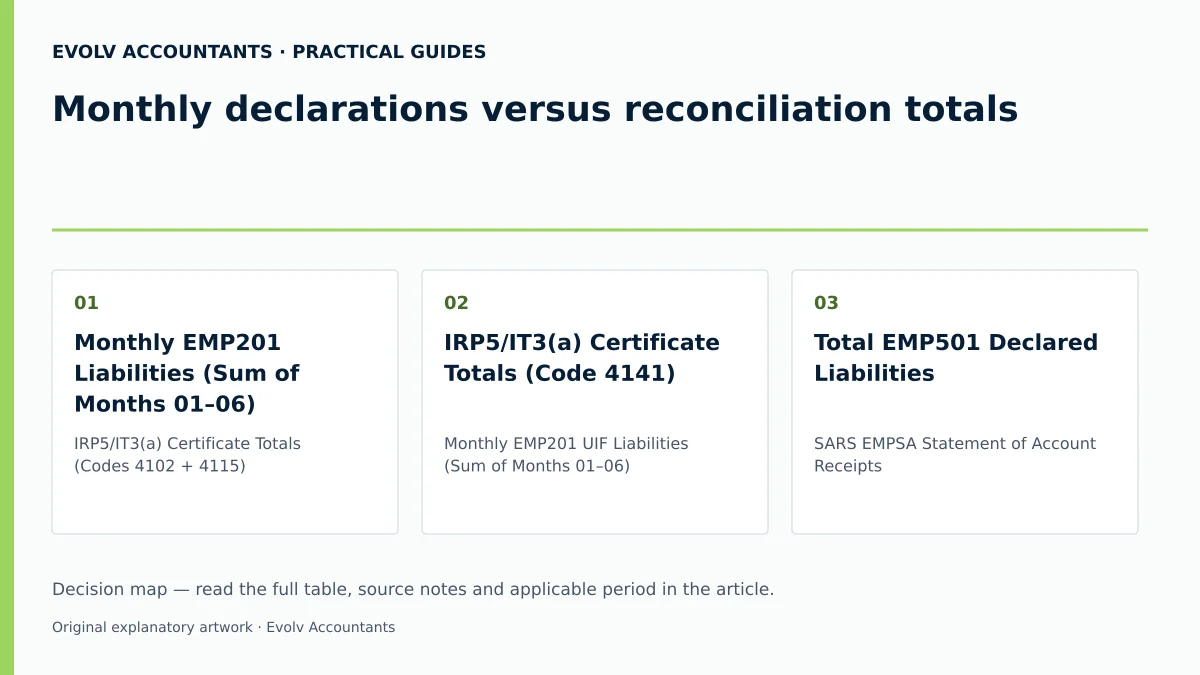
Monthly declarations versus reconciliation totals
Maintaining accurate employer tax compliance relies on reconciling three distinct, independent sets of records:
— Practical point from this guide
- Monthly EMP201 Declarations: Self-assessment tax returns submitted electronically within 7 days after the end of each month (or the preceding business day if the 7th falls on a weekend or public holiday) declaring monthly PAYE, SDL, UIF, and ETI liabilities 1 2. Each declaration systematically generates a unique 19-digit Payment Reference Number (PRN) to link payment allocations 6.
- EMP501 Return and IRP5/IT3(a) Certificates: The statutory reconciliation return submitted for the interim period (March to August, period 08) and annual period (March to February, period 02) 4 5. The EMP501 consolidates individual employee tax certificates, aggregating PAYE under source codes 4102/4115, SDL under code 4142, and UIF under code 4141 9 10.
- SARS Statement of Account (EMPSA) and Payment Records: The official ledger maintained by SARS recording actual cash receipts allocated against monthly liabilities via the 19-digit PRN 6 11.
Agreement between these records means complete mathematical parity: total liabilities declared on monthly EMP201 returns must equal the sum of tax values disclosed across all issued IRP5/IT3(a) certificates, which in turn must match the total payments credited on the EMPSA 3. However, employers must never confuse mathematical parity with factual or legal validity 3 12.
An EMP501 declaration may balance mathematically while containing underlying factual errors—such as incorrect tax source codes, invalid employee tax reference numbers, unallowed deductions, or miscalculated SDL leviable amounts—which SARS automated validation checks will reject or flag for audit 12 13 14.
To maintain compliance, employers must distinguish statutory law, regulator guidance, and advisory recommendations:
- Statutory Law: The Income Tax Act (Fourth Schedule), Unemployment Insurance Contributions Act (UIC Act), Skills Development Levies Act (SDL Act), and Tax Administration Act (TA Act) mandate monthly tax withholding, remitting within 7 days, and filing accurate reconciliations 1 15 16 17. Paragraph 7 of the Fourth Schedule explicitly provides that any agreement between an employer and employee not to deduct PAYE or UIF is legally void 18.
- Regulator Guidance: SARS external guides (including EMP-GEN-02-G01, SDL-GEN-01-G01, and UIF-GEN-01-G01) outline procedural validation rules, portal requirements, and electronic formatting standards 17 19 20.
- Evolv Recommendations: Evolv Accountants recommends performing monthly pre-reconciliation checks on payroll software prior to submitting each EMP201, maintaining structured electronic workpapers, and reviewing the EMPSA monthly rather than waiting for bi-annual filing deadlines.
Prepare the opening balances and period: monthly declarations
To prepare for a seamless reconciliation, employers must establish precise opening balances, cut-off dates, currency standards (South African Rand and cents), and verified identifier records 6 21.
- Tax Year and Transaction Period: The South African tax year (year of assessment) runs from 1 March to the last day of February 22. Interim reconciliations cover period 08 (March to August) submitted in September/October, while annual reconciliations cover period 02 (March to February) 4 5. Distinguish the transaction year from the year of assessment: variable remuneration under section 7B and other exceptional accrual cases can put withholding in a later transaction year 23.
- Identifiers and Evidence Completeness: Employers must maintain verified SARS tax reference numbers (10-digit PAYE reference number, SDL reference number starting with 'L', and SARS UIF reference number starting with 'U') alongside 19-digit PRNs for every monthly payment 6 24 25 26. Copies of all submitted declarations, certificates, and proof of payment must be retained for five (5) years as required by tax law 6.
- Payroll Frequencies & Statutory Rules:
- PAYE: Calculated on remuneration using Fourth Schedule tax tables or official SARS tax directives 27 28 29.
- SDL: Payable at a rate of 1% of the leviable amount (balance of remuneration after allowable retirement and donation deductions) 30 31. Employers are exempt from paying and registering for SDL if there are reasonable grounds to believe total leviable remuneration across all employees will not exceed R500,000 in the following 12-month period 32 33 34 35. Public service entities, qualifying public benefit organisations (PBOs), and exempt municipalities are also exempt from paying SDL 33 35 36 37.
- UIF: Total contribution of 2% of qualifying remuneration (1% deducted from the employee, 1% contributed by the employer) 38 39 40 41. Effective 1 June 2021, the maximum monthly earnings ceiling is R17,712 per month (R212,544 annually), capping the maximum monthly contribution at R177.12 each for employer and employee (R354.24 combined) 39 42 43. Remuneration in excess of R17,712 per month is excluded from the UIF leviable amount 42 43. Statutory exclusions apply to employees working fewer than 24 hours a month for an employer and specified public office holders 44 45 46.
- Submission Channels & System Boundaries:
- eFiling: Suitable for small businesses filing a maximum of 50 IRP5/IT3(a) certificates per reconciliation period 47.
- e@syFile Employer: Required for more than 50 certificates; eFiling supports a maximum of 50 certificates and the guide also allows certificate import 47.
Crucial boundary rule: Once a channel is selected for a specific reconciliation period, the employer must use that same channel for any subsequent adjustments or resubmissions for that period 47 48. A new channel can only be selected when initiating a reconciliation for a subsequent tax period 47.
Match transactions and explain differences: reconciliation totals
Matching transactions requires a systematic bridge between monthly EMP201 figures and final IRP5/IT3(a) certificate totals 3 49. Discrepancies generally fall into three categories:
- Timing Items: Mid-year tax table updates, backdated salary increases, or payroll adjustments processed in a subsequent month 50.
- Mistakes & Calculation Errors: Under- or over-deduction of PAYE, failure to apply the UIF earnings ceiling, omitted fringe benefits, or misclassified non-taxable allowances 12 50.
- Duplications & System Errors: Duplicate certificate numbers, incorrect IRP5/IT3(a) type or reason-for-non-deduction entries (code 4150), or unallocated PRN payments on the EMPSA 6 51.
Employers must compile a formal transaction-level Reconciliation Bridge to categorise every variance prior to filing.
Reconciliation bridge
| Independent record A | Independent record B | Difference | Reason and evidence | Action and owner |
|---|---|---|---|---|
| Monthly EMP201 Liabilities (Sum of Months 01–06) | IRP5/IT3(a) Certificate Totals (Codes 4102 + 4115) | Positive (EMP201 > Certificates) | Over-declaration on EMP201 in Month 03 due to manual entry error on payroll run. | Submit EMP201 Request for Correction (RFC) for Month 03; Payroll Officer. |
| IRP5/IT3(a) Certificate Totals (Code 4141) | Monthly EMP201 UIF Liabilities (Sum of Months 01–06) | Positive (Certificates > EMP201) | New employee joined in Month 04; UIF ceiling of R17,712 was not applied in payroll setup, causing over-deduction. | Correct the payroll calculation, refund any confirmed excess employee UIF deduction, and amend affected certificates and declarations; payroll reviewer. |
| Total EMP501 Declared Liabilities | SARS EMPSA Statement of Account Receipts | Positive (Declared > Paid) | Late payment for Month 05 processed on 10th instead of 7th; PRN payment allocated to penalty account. | Inspect the payment allocation and raise a payment query through the applicable SARS channel; request remission separately if the penalty is disputed, and settle any remaining balance; Financial Manager. |
| Monthly EMP201 SDL Liabilities | IRP5/IT3(a) Certificate Totals (Code 4142) | Zero | Leviable amount matches 1% rate across the employer’s leviable payroll, after testing the employer-level R500,000 exemption. | Verified and locked for submission; Senior Bookkeeper. |
Reproducible hypothetical example
Consider a South African SME employing 5 full-time staff members, each earning a fixed monthly salary of R20,000 during the 6-month interim period (March to August):
- Monthly Gross Payroll: 5 x R20,000 = R100,000 per month (Annualised payroll = R1.2m, exceeding the R500,000 SDL threshold) 32 52.
- Monthly Statutory Breakdown:
- PAYE: For this reconciliation illustration only, assume PAYE of R2,500 per employee; this is an input, not a tax-table result = R12,500 per month 28.
- SDL: 1% of R100,000 leviable remuneration = R1,000 per month 30 53 54.
- UIF: Monthly remuneration per employee (R20,000) exceeds the statutory ceiling of R17,712 39 42 43. Qualifying remuneration is capped at R17,712 per employee 42 43. Contribution per employee = 1% employee (R177.12) + 1% employer (R177.12) = R354.24 per month 39 42. Total monthly UIF for 5 employees = 5 x R354.24 = R1,771.20 39 42.
- Total Monthly EMP201 Declared Liability: R12,500 (PAYE) + R1,000 (SDL) + R1,771.20 (UIF) = R15,271.20 per month 55.
- 6-Month Interim Reconciliation Summary:
- Sum of Monthly EMP201 Declarations (6 x R15,271.20): R91,627.20 56.
- Sum of IRP5 Certificates (5 certificates): Code 4102 (PAYE) = R75,000; Code 4142 (SDL) = R6,000; Code 4141 (UIF) = R10,627.20 9 10. Total Tax Certificate Value (Code 4149) = R91,627.20 10.
- Reconciliation Variance: R91,627.20 (Certificates) - R91,627.20 (EMP201 Declarations) = R0.00 (Balanced) 3 57.
Post only supported corrections: monthly declarations
Accounting entries and tax return adjustments must be posted ONLY when supported by verifiable primary facts 49 58.
- Request for Correction (RFC) on EMP201: If an error is discovered in a monthly EMP201 declaration prior to submitting the EMP501, the employer should submit an RFC directly on the specific EMP201 return via eFiling or e@syFile 58. It is not necessary to wait for the EMP501 submission 58.
- Prohibition on Direct PAYE Refunds: Employers are strictly prohibited from refunding over-deducted Employees' Tax directly to an employee under any circumstances 59. Only SARS can refund employees' tax upon formal assessment of the individual's annual Income Tax Return (ITR12) 59. Employers may adjust PAYE withholdings in subsequent payroll months within the same tax year, provided the adjustment does not reduce the employee's net PAYE liability below Rnil 59. No adjustments may be made across different tax years 59.
- Under-Deduction & Employer Personal Liability: Where an employer fails to deduct or pay the required PAYE to SARS, the employer becomes personally liable for the tax shortfall under the Fourth Schedule 59. SARS will levy a 10% late payment penalty under paragraph 6(1) and interest under section 89bis 59 60. The employer retains a statutory right to recover the taxes paid from the employee's future remuneration, subject to applying to SARS for a directive specifying the recovery method 59. If the employer fails to recover the shortfall from the employee, the unrecovered amount is deemed to be a non-deductible penalty in the hands of the employer under section 23(d) of the Income Tax Act 59.
- Overpaid UIF Contributions: If an employer discovers an overpayment of UIF contributions, the employer MUST refund the excess employee portion to the employee immediately, even if SARS has not yet refunded the employer 61.
Review unresolved and old items: reconciliation totals
Unresolved variances and aged items must never be hidden in suspense accounts or written off without audit justification 13 62.
- Notice of Excessive Liability Change (ELC): When an employer submits an EMP501 with substantial changes between prepopulated monthly EMP201 liabilities and final certificate values, SARS automatically issues a Notice of Excessive Liability Change (ELC) 13 63. The submission is routed for manual verification, and the employer must upload supporting evidence via the SARS Online Query System (SOQS) within the turnaround time specified on the notice 62 63. Failure to respond within the timeframe may cause SARS to reject the revised figures and revert to the original account balances 62.
- Administrative Penalties & Official Notices:
- Penalty Assessment Notice (EMP301): Issued for late EMP201 payments (10% penalty) or failure to submit the final annual EMP501 return (recurring monthly penalty capped at 10% of aggregate tax liability) 60 64 65.
- Assessment Notice (EMP217): Check the assessment notice for the basis of a SARS estimate. EMPSA is the separate Employer Statement of Account showing liabilities, payments and allocations 66 67.
- Dispute Framework: If an employer disagrees with a SARS penalty or assessment, the employer must initiate the dispute workflow on eFiling 65:
- Request for Remission (RFR): Lodge an electronic RFR detailing valid grounds for late payment or non-submission 68.
- Notice of Objection (NOO): Submit a formal NOO within the applicable objection period stated by the current dispute rules and notice 69.
- Notice of Appeal (NOA): File an NOA within the applicable appeal period after an objection decision 69.
Disputes apply to PAYE, SDL, and UIF liability values, late payment penalties, and administrative penalties 65.
Next steps for Employer reconciliations
To complete the employer reconciliation process, execute the following structured checklist:
- Perform Final Payroll Audit: Recalculate PAYE, SDL, and UIF for every employee across all pay periods to verify that earnings ceilings and exemption thresholds were applied correctly 70.
- Verify Certificate Particulars: Confirm that all IRP5/IT3(a) certificates contain valid employee tax reference numbers, complete identity details, correct tax directive numbers, and active source codes 12 14 29 51.
- Download EMPSA Statement of Account: Request an updated EMPSA on eFiling to verify that all monthly payments were received and allocated correctly to PAYE, SDL, and UIF accounts 11 71 72.
- Access EMP501 on Selected Channel: Open the EMP501 return on eFiling (for up to 50 certificates) or e@syFile Employer (for more than 50 certificates) 47. Refresh historic data to pull recent payment allocations 49 69.
- Reconcile Monthly Figures: Compare prepopulated monthly liabilities against payroll totals. Complete the mandatory "Reason for Over/Understatement" field if variances exceed SARS thresholds 49 57.
- Submit Declaration & Certificates: Accept the formal declaration and submit the EMP501 return along with all linked tax certificates 71 73.
- Distribute Certificates to Employees (Annual Recon): Following successful annual reconciliation (period 02) processing, issue final IRP5/IT3(a) certificates to employees for their personal tax filing 5 8. (Interim period 08 certificates are transmitted to SARS only and must not be distributed to staff) 5.
- Archive Records: Retain copies of the EMP501 return, EMP201 declarations, payroll summary reports, EMPSA, and proof of payment in an electronic archive for the mandatory 5-year retention period 6 49.
Frequently Asked Questions
Can an employer refund over-deducted PAYE directly to an employee?
No, employers are strictly prohibited from refunding over-deducted Employees' Tax directly to employees under any circumstances 59. Adjustments can only be made in subsequent payroll months within the same tax year by reducing future PAYE withholdings, provided the net tax deducted does not drop below Rnil 59. If the tax year has closed, the employee must claim any refund directly from SARS by submitting their individual Income Tax Return (ITR12) 59.
What is the maximum monthly earnings ceiling for UIF contributions?
Effective 1 June 2021, the statutory maximum earnings ceiling for UIF contributions is R17,712 per month (R212,544 annually) 39 42 43. For employees earning above R17,712 per month, the 1% employee deduction and 1% employer contribution are calculated strictly on the capped amount of R17,712, resulting in a maximum monthly deduction of R177.12 for the employee and R177.12 for the employer (R354.24 combined total) 39 42. Remuneration above R17,712 is excluded from the UIF calculation 42 43.
When is a business exempt from registering for and paying the Skills Development Levy (SDL)?
An employer is exempt from paying SDL and is not required to register for SDL with SARS if there are reasonable grounds for believing that the total leviable remuneration paid or payable to all employees during the following 12-month period will not exceed R500,000 32 33 34 35. Specific public service entities, public benefit organisations (PBOs) with tax exemption letters, and exempt municipalities are also exempt from paying SDL 33 35 36 37. However, SDL exemption does not relieve an employer of the duty to register for PAYE if employee earnings exceed tax thresholds 32 35.
What submission channel should an SME choose for filing the EMP501?
Employers with 50 or fewer IRP5/IT3(a) certificates may complete and submit their EMP501 reconciliation directly through SARS eFiling 47. Employers submitting more than 50 certificates must use e@syFile Employer; employers at or below 50 may use the supported eFiling capture or import functions 47. Once a specific channel is selected for a reconciliation period, all subsequent revisions or resubmissions for that period must be made through that exact same channel 47 48.
What should an employer do if SARS issues a Notice of Excessive Liability Change (ELC)?
A Notice of Excessive Liability Change (ELC) is issued when SARS identifies substantial variances between prepopulated monthly EMP201 liabilities and final figures on the EMP501 return 13 63. The employer must review the affected tax periods, gather supporting payroll evidence (such as payroll summaries and re-calculations), and submit these documents via the SARS Online Query System (SOQS) within the timeframe specified on the notice 62 63. If the variance was due to an error, problematic monthly periods must be corrected and resubmitted 62. Describe your declaration, payment-allocation or reconciliation question and the payroll records available. Ask Evolv about monthly declarations versus reconciliation totals. Share the relevant records so the support required can be scoped.
Related guides
- Reconciling payroll totals to the general ledger
- Submitting an EMP201 employer declaration
- Compliance and Regulations: Keeping Your Business on Track
Sources
- COMPLETING THE MONTHLY EMPLOYER DECLARATION (EMP201) | South African Revenue Service
- https://www.sars.gov.za/wp-content/uploads/Ops/Guides/EMP-GEN-02-G01-A-Guide-to-the-Employer-Reconciliation-Process-External-Guide.pdf
- Guide for Employers in Respect of Employees' Tax (2027) | South African Revenue Service
- Unemployment Insurance Fund | South African Revenue Service
- https://www.sars.gov.za/wp-content/uploads/Ops/Guides/SDL-GEN-01-G01-Guide-for-Employers-in-respect-of-Skills-Development-Levy-External-Guide.pdf
- https://www.sars.gov.za/wp-content/uploads/Ops/Guides/UIF-GEN-01-G01-Guide-for-Employers-in-respect-of-the-Unemployment-Insurance-Fund-External-Guide.pdf
- Skills Development Levy | South African Revenue Service