
Reconciling payroll totals to the general ledger
24 January 2025

Reconciling payroll totals to the general ledger requires matching payroll liabilities and tax payments against independent records before submitting employer declarations.
A monthly reconciliation compares gross-to-net payroll reports, employer expenses, liability accounts, EMP201 declarations, payments and the SARS statement. PAYE and the employee UIF portion are deductions; SDL and the employer UIF portion are employer costs. Explain timing and classification differences before correcting records.
Matching totals help identify errors but do not prove that every underlying calculation is legally correct. SARS reconciliation guide; UIF contribution rules.
Payroll cost liability and payment reconciliation
Understanding independent records versus factual validity
A thorough payroll reconciliation compares independent records across three distinct environments: payroll software outputs, accounting general ledger journals, and SARS portal statements 1 2 3. Under South African tax administration guidance, statutory payroll tax liabilities are declared monthly via the EMP201 declaration 1 2. The primary records involved include:
— Practical point from this guide
- The Payroll Summary Register: The gross remuneration, allowable deductions, PAYE withheld (source code 4102), SDL calculated (source code 4142), combined employee and employer UIF contributions (source code 4141) 4 5 6 7.
- The General Ledger Control Accounts: The liability accounts for PAYE, SDL, and UIF, along with net salary clearing accounts and bank disbursement records.
- SARS Employer Statement of Account (EMPSA): The official statement issued by SARS reflecting declared liabilities, pre-populated Payment Reference Numbers (PRNs), allocated credit push or electronic funds transfer (EFT) payments, and any interest or penalty assessments 1 8 9 10.
Agreement between two records (such as matching your payroll report to your submitted EMP201) does not automatically guarantee factual validity 2 3. A matching payroll report and EMP201 could both contain an underlying calculation error, such as failing to apply the monthly UIF remuneration cap of R17,712 6 11.
Legal compliance requires that deductions conform strictly to the Income Tax Act, the Skills Development Levies Act, and the Unemployment Insurance Contributions Act, while regulator guidance governs how these amounts are declared and pre-populated on tax returns 12 13 14. Evolv recommends verifying the underlying statutory rules before relying on system outputs.
Prepare the opening balances and period: payroll cost liability
Opening balance verification and cutoff principles
Before reconciling current-period payroll transactions, the opening balances in all payroll liability control accounts must be verified against the closing balances of the preceding tax period 3 15. Reconciliations must operate within defined financial cutoffs, matching the employer's tax year (which runs from 1 March to 28/29 February) and the corresponding payroll frequency (monthly, weekly, or fortnightly) 16 17.
Under the Fourth Schedule to the Income Tax Act, employers are required to "deduct or withhold employees' tax from remuneration" and remit payments to SARS within seven calendar days following the end of the month during which the deduction occurred 1 18 19. If the seventh day falls on a weekend or public holiday, payment must be received by SARS on the last business day prior to that date 1 18.
Numbered checklist for period preparation and opening balance checks
- Confirm opening balance rollover: Ensure opening GL balances for PAYE, SDL, and UIF liability accounts match the prior month's ending balances and SARS EMPSA closing figures 3 15.
- Establish strict transaction cutoff: Verify that all payroll runs paid or accrued within the calendar month are included in the month-end gross-to-net report 2 16.
- Verify functional currency: Confirm all payroll ledger entries and bank settlements are recorded in South African Rand (ZAR) 20 21.
- Gather independent evidence: Download the monthly gross-to-net summary, general ledger trial balance, submitted EMP201 return, bank payment confirmation, and SARS EMPSA 1 2 8 22.
- Match transaction identifiers: Ensure the 19-digit Payment Reference Number (PRN) generated on the EMP201 is attached to the bank payment and visible on the EMPSA 8 9 23.
Match transactions and explain differences: payment reconciliation
Building a transaction-level reconciliation bridge
A transaction-level reconciliation bridge systematically identifies every variance between payroll liability accruals, ledger journal postings, and SARS payments 3 15. Differences typically arise from timing items (such as payments processed on the last business day before a weekend), manual journal postings, or clerical mistakes on tax returns 1 15 24.
Reproducible hypothetical example (illustrative values)
Consider an SME with a monthly gross payroll remuneration of R100,000 for ten employees earning R10,000 each, all below the statutory UIF cap 5 6.
- PAYE Calculation: Assume total PAYE of R15,000 solely to demonstrate reconciliation; calculate actual PAYE separately using the applicable tables 12 25.
- SDL Calculation: The employer's projected annual payroll exceeds the R500,000 exemption threshold 26 27. The SDL rate is 1% of leviable remuneration: R100,000 × 1% = R1,000 4 23.
- UIF Calculation: The UIF contribution rate is 1% employee deduction plus 1% employer contribution (2% total) on remuneration up to R17,712 per employee monthly 5 6. For R100,000 total eligible remuneration, employee UIF is R100,000 × 1% = R1,000 and employer UIF is R100,000 × 1% = R1,000, giving a combined UIF liability of R2,000 5 6.
- Total EMP201 Monthly Liability: R15,000 (PAYE) + R1,000 (SDL) + R2,000 (UIF) = R18,000 1 28.
If the employer accidentally captures R1,500 for PAYE on the EMP201 submission instead of R15,000, the bank payment and EMP201 liability will reflect R4,500, whereas the general ledger and payroll register reflect R18,000. This creates a R13,500 discrepancy on the reconciliation bridge that requires formal correction 15 24.
Reconciliation bridge
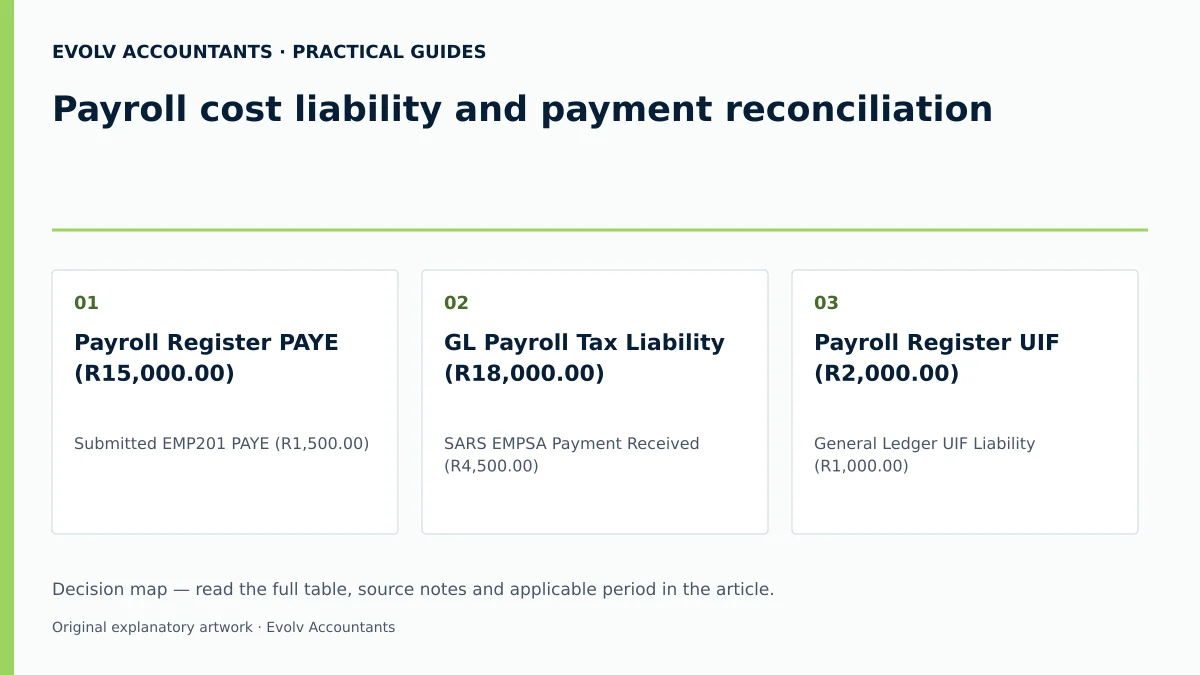
The following amounts are hypothetical and illustrate separate reconciliation checks.
| Independent record A | Independent record B | Difference | Reason and evidence | Action and owner |
|---|---|---|---|---|
| Payroll Register PAYE (R15,000.00) 25 | Submitted EMP201 PAYE (R1,500.00) 1 | R13,500.00 15 | Data entry omission on eFiling return 24 29. Supported by payroll summary 2. | Submit Request for Correction (RFC) on EMP201; Payroll Accountant 24. |
| GL Payroll Tax Liability (R18,000.00) 8 | SARS EMPSA Payment Received (R4,500.00) 22 | R13,500.00 15 | Underpayment resulting from EMP201 capturing error 10 24. Bank statement attached. | Release top-up payment to SARS using pre-populated PRN; Financial Manager 8 9. |
| Payroll Register UIF (R2,000.00) 5 6 | General Ledger UIF Liability (R1,000.00) 5 | R1,000.00 15 | Omission of 1% employer UIF matching contribution journal 5 6. Payroll run extract. | Check the employer expense and combined liability posting; add the omitted employer portion where supported; General Bookkeeper 5. |
| Closing GL PAYE liability (illustrative R0.00) | Closing SARS PAYE balance for the same reconciled items (illustrative R0.00) | R0.00 | After the supported correction and full payment allocation; investigate any other statement items separately. | Sign off monthly liability account reconciliation; Financial Director 3. |
Post only supported corrections: payroll cost liability
Journal adjustments and SARS filing corrections
Corrections to payroll cost liabilities or payment records must only be posted when supported by verifiable documentary evidence 3 30. Under SARS employer reconciliation rules, if an error is discovered on a monthly EMP201 declaration prior to submitting the EMP501 reconciliation return, the employer should submit a Request for Correction (RFC) directly on the relevant EMP201 24. It is not necessary to wait for the biannual or annual EMP501 submission to correct monthly declaration errors 24.
When adjusting PAYE deductions:
- Under-deduction: Where an employer under-deducts PAYE, the employer is personally liable to SARS for the shortfall, along with statutory late payment penalties (10%) and interest 10 31. The employer retains the statutory right to recover the tax paid from future employee remuneration, subject to obtaining a SARS directive 31.
- Over-deduction: Employers are strictly prohibited from refunding over-deducted PAYE directly to employees 31 32. Instead, the employer may adjust PAYE deductions in subsequent months within the same tax year, provided the adjustment does not reduce monthly PAYE below zero 31. If the tax year has ended, the employee must claim any refund directly from SARS via their personal income tax return (ITR12) 31 32.
Review unresolved and old items: payment reconciliation
Aged exception logging and suspense accounts
Unresolved differences between payroll registers, general ledger accounts, and SARS EMPSAs must be recorded in an aged exception log 3 15. Evolv strongly advises that variance items should never be hidden in suspense accounts, written off to general expenditure, or netted off against unrelated tax credits 3 30.
An effective aged exception log documents:
- Transaction Date and Tax Period: Identifying the specific month (e.g. Period 202608 for August) 33.
- Tax Type Affected: Specifying whether the item relates to PAYE (code 4102), SDL (code 4142), or UIF (code 4141) 7.
- Root Cause: Detailing whether the item stems from an unallocated payment, a pending SARS Relevant Material Request (RMR), or a timing delay in EFT settlement 8 34.
- Assigned Owner and Next Action: Designating an accountable team member and setting a target resolution date before the upcoming biannual EMP501 filing window 3 35.
Where SARS issues an estimated assessment due to missing or inadequate returns, or levies a 10% late payment penalty under Paragraph 6(1) of the Fourth Schedule, these amounts appear separately on the EMPSA 2 10 36. Penalty and interest amounts must be posted to specific expense accounts in the general ledger and cannot be offset against statutory employee deductions 10 37.
Next steps for Employer reconciliations
Reviewer controls, saved audit trails, and period roll-forward
Completing the monthly reconciliation sets the foundation for the bi-annual (interim period ending August, submitted September–October) and annual (period ending February) EMP501 employer reconciliation process 3 33 35. During EMP501 submissions, the total tax liabilities declared across monthly EMP201s, total payments made to SARS, and total values reflected on employee tax certificates [IRP5/IT3(a)] must balance exactly 3.
To ensure audit readiness and operational continuity:
- Reviewer Verification: A designated senior manager or external tax practitioner must review the monthly reconciliation bridge, supporting schedules, bank extracts, and SARS EMPSA 3 38.
- Document Retention: Retain all reconciled gross-to-net reports, EMP201 receipts, PRN payment advices, and eFiling submission confirmations for audit purposes as required by SARS guidelines 3 39.
- Period Roll-Forward: Once verified, roll forward the reconciled ending balances to serve as the opening balances for the new payroll period 3 15.
Frequently Asked Questions
What is the statutory deadline for submitting the monthly EMP201 declaration and payment to SARS?
Employers must submit the EMP201 declaration and pay the full statutory amount for PAYE, SDL, and UIF within seven calendar days following the end of the month during which the deductions were made 1 18. If the seventh day falls on a Saturday, Sunday, or public holiday, payment and submission must be completed by the last business day prior to that day 1 18.
How do SDL registration thresholds apply to small and medium enterprises?
An employer is liable to register for and pay the Skills Development Levy (SDL) if there are reasonable grounds to believe that total leviable remuneration paid to all employees over the next 12-month period will exceed R500,000 26 27. Employers below this threshold are exempt from paying SDL, even if registered for PAYE 26 40.
What is the maximum monthly earnings ceiling for UIF contribution calculations?
The maximum remuneration ceiling for UIF contributions is R17,712 per month (or R212,544 annually) 6 11. For employees earning above this cap, the 1% employee deduction and 1% employer contribution are calculated on R17,712, resulting in a maximum employee deduction of R177.12 per month 6 11.
How should an employer correct an error identified on a previously submitted EMP201?
Prior to submitting the biannual or annual EMP501 reconciliation, an employer can correct errors on a previously submitted EMP201 by lodging a Request for Correction (RFC) directly on SARS eFiling or e@syFile 8 24. The system will pre-populate previously declared figures for adjustment 8.
What is the difference between an interim EMP501 reconciliation and an annual EMP501 reconciliation?
The interim EMP501 reconciliation covers the first six months of the tax year (March to August, period 08) and is submitted in September/October to ensure employee records and monthly declarations are aligned 33 35 41. The annual EMP501 covers the full 12-month tax year (March to February, period 02) 16 33. Interim tax certificates are submitted to SARS only and must not be issued to employees, whereas annual IRP5/IT3(a) certificates must be provided to employees 3 42 43. Describe your declaration, payment-allocation or reconciliation question and the payroll records available. Ask Evolv about payroll cost liability and payment reconciliation. Share the relevant records so the support required can be scoped.
Related guides
- UIF obligations for foreign employees
- Submitting an EMP201 employer declaration
- Compliance and Regulations: Keeping Your Business on Track
Sources
- https://www.sars.gov.za/wp-content/uploads/Ops/Guides/EMP-GEN-02-G01-A-Guide-to-the-Employer-Reconciliation-Process-External-Guide.pdf
- https://www.sars.gov.za/wp-content/uploads/Ops/Guides/UIF-GEN-01-G01-Guide-for-Employers-in-respect-of-the-Unemployment-Insurance-Fund-External-Guide.pdf
- COMPLETING THE MONTHLY EMPLOYER DECLARATION (EMP201) | South African Revenue Service
- Guide for Employers in Respect of Employees' Tax (2027) | South African Revenue Service
- Unemployment Insurance Fund | South African Revenue Service
- https://www.sars.gov.za/wp-content/uploads/Ops/Guides/SDL-GEN-01-G01-Guide-for-Employers-in-respect-of-Skills-Development-Levy-External-Guide.pdf
- Skills Development Levy | South African Revenue Service
- https://www.labour.gov.za/DocumentCenter/Publications/Unemployment%20Insurance%20Fund/uFiling%20System%20User%20Guide.pdf