
UIF obligations for foreign employees
12 February 2025

UIF compliance requires South African employers to include foreign employees who receive remuneration in monthly contributions and declarations regardless of their nationality.
The statutory framework governing Unemployment Insurance Fund (UIF) contributions in South Africa applies universally to all qualifying natural persons employed within the country, irrespective of citizenship, foreign nationality, or visa type.
Under active legislation, employers operating within the South African jurisdiction must deduct employee contributions from remuneration, match them with employer contributions up to the statutory earnings ceiling, submit monthly payment declarations, transmit employee declarations to the Unemployment Insurance Commissioner, and complete statutory reconciliations. Historical assumptions regarding foreign worker exemptions are legally obsolete, making non-compliance a direct source of statutory interest, penalties, and criminal liability.
Current legislation versus obsolete foreign worker exclusions
For South African small and medium enterprises (SMEs) employing foreign nationals, completing UIF compliance requires establishing the precise legal boundary between active statutory duties and obsolete legal exclusions. The unemployment insurance system in South Africa is governed primarily by two principal statutes: the Unemployment Insurance Act 63 of 2001 (UI Act), which regulates benefits, and the Unemployment Insurance Contributions Act 4 of 2002 (UIC Act), which regulates the imposition and collection of contributions 1.
Both Acts came into operation on 1 April 2002 1.
Legal definition of an employee and statutory scope
Under Section 1 of the UIC Act, an employee is defined as "any natural person who receives any remuneration or to whom remuneration accrues in respect of services rendered" 2. The legal obligation to contribute to the UI Fund is compulsory for every employer and every employee to whom the UIC Act applies 3.
The statute explicitly sets out specific, narrow exclusions from the duty to contribute. Under Sections 4 and 5 of the UIC Act, an employee is excluded from contributing only if he or she 4 5:
- Is employed by the employer for less than 24 hours a month 4 5;
- Is employed as an officer or employee in the national or provincial sphere of government 4 5;
- Is the President, Deputy President, a Minister, Deputy Minister, a member of the National Assembly, a permanent delegate to the National Council of Provinces, a Premier, a member of an Executive Council, or a member of a provincial legislature 4 5; or
- Is a member of a municipal council, a traditional leader, a member of a provincial House of Traditional Leaders, or a member of the Council of Traditional Leaders 4 5.
Obsolete exclusions versus current legal reality
Historically, outdated administrative practices or superseded provisions led some payroll administrators to assume that foreign employees—particularly those on temporary work permits or non-resident status—were exempt from UIF deductions on the assumption that they might not claim benefits upon returning to their home countries. Active legislation contains no exclusion based on nationality, citizenship, or passport type 4 5.
Regulators and tax authorities strictly enforce contribution collection on all natural persons receiving remuneration in South Africa 2 3.
Distinguishing between statutory law, regulator guidance, and Evolv recommendations ensures structured compliance:
— Practical point from this guide
- Statutory Law: The UIC Act and Tax Administration Act 28 of 2011 (TA Act) mandate compulsory 1% employee deductions and 1% employer contributions on remuneration up to the statutory ceiling 6 7 8.
- Regulator Guidance: Official guides issued by the South African Revenue Service (SARS), such as External Guide UIF-GEN-01-G01, set out operational procedures for registering, calculating deductions, paying via Monthly Employer Declarations (EMP201), and submitting employee details 9 10 11.
- Evolv Recommendations: Evolv advises SMEs to audit all active payroll records immediately to confirm that every foreign national working 24 hours or more per month is registered, correctly subjected to UIF calculations, and reflected in monthly UI-19 submissions to avoid severe statutory penalties.
Prepare the information and authority: current legislation
Before executing payroll deductions or submitting UI declarations for foreign employees, employers must gather required documentation, confirm user authority across official digital portals, and establish clear accounting boundaries.
Required documentation and data inputs
Employers must compile and verify the following records for each foreign employee prior to payroll processing:
- Identification Details: Valid passport details, foreign passport numbers, or refugee/asylum documentation where a South African identity number is not held 12 13.
- Work Authorisation & Employment Contracts: Formal employment contracts establishing the commencement date, agreed remuneration structure, and monthly hours worked 13 14.
- Remuneration Components: Breakdown of monthly remuneration components, isolating basic salary, allowances, and statutory exclusions 10 15.
- Registration Numbers: The employer's SARS Pay-As-You-Earn (PAYE) / UIF reference number and the official UI Commissioner reference number 16 17 18.
System authority and digital credentials
Operational compliance requires maintaining valid primary user authority across official administrative platforms:
- SARS eFiling / e@syFile: Access permissions to request, complete, and submit monthly EMP201 declarations and payment instructions 11 19.
- uFiling Account Authority: Activated user profiles for commercial employers or registered Labour Practitioners/Tax Practitioners to manage employee declarations directly with the UI Commissioner 20 21 22 23.
Distinct compliance boundaries: PAYE, SDL, and UIF
Employers must maintain strict administrative separation between different payroll statutory obligations:
- PAYE (Employees' Tax): Governed by the Fourth Schedule to the Income Tax Act 58 of 1962, calculated on taxable remuneration according to statutory tax tables 2 24.
- SDL (Skills Development Levy): Governed by the Skills Development Levies Act 9 of 1999, payable by eligible employers to fund sector education 18 25.
- UIF (Unemployment Insurance): Governed by the UIC Act and UI Act, split equally between employer and employee 1 3.
Registration for paying UIF contributions depends strictly on PAYE and SDL status:
- Registration with SARS: Employers required to pay PAYE or SDL, or who have voluntarily registered with SARS, must register with SARS for paying UIF contributions 16 17 18.
- Registration with UI Commissioner: Employers not required to register with SARS for PAYE and not liable for SDL must register with the UI Commissioner's office to pay UIF contributions 16 18.
- Mandatory UI Commissioner Registration for Employee Details: Regardless of whether UIF payment is made to SARS or the UI Commissioner, all employers must be registered with the UI Commissioner to submit monthly employee declaration details (UI-19 information) 19 26 27.
Complete the task step by step: obsolete foreign worker exclusions
Employers must follow a structured, sequential process to ensure full statutory compliance for foreign employees, eliminating obsolete practices and applying current statutory parameters.
Sequenced compliance checklist
- Audit Employee Eligibility: Verify that the foreign employee works 24 hours or more per month and does not fall under specific public office exclusions 4 5.
- Determine Remuneration for UIC Purposes: Calculate gross remuneration under Section 1 of the UIC Act 10 15. Deduct statutory exclusions, specifically 10:
- Pension, superannuation, or retiring allowances 10;
- Amounts qualifying under paragraphs (a), (cA), (d), (e), or (eA) of the definition of gross income in Section 1 of the Income Tax Act 10; and
- Amounts paid by way of commission 10.
- Apply Contribution Rates and Statutory Ceilings:
- Employee Contribution: 1% of remuneration 6 8.
- Employer Contribution: 1% of remuneration 6 8.
- Total Contribution: 2% of remuneration paid over to SARS or the UI Commissioner 6 28.
- Statutory Earnings Ceiling: Capped at R17 712 per month (R212 544 annually), effective from 1 June 2021 6 15 29. The maximum monthly deduction for an employee earning at or above the ceiling is R177,12 per month, matched by an employer contribution of R177,12 (total monthly contribution of R354,24) 29.
- Execute Payroll Deductions: Withhold the 1% employee contribution at remuneration intervals (e.g., weekly, fortnightly, or monthly) coinciding with pay dates 30 31. Employers cannot deduct excess amounts, charge administrative fees, or recover arrear contributions from previous financial years 31.
- Submit Monthly EMP201 Declaration and Payment: Submit the EMP201 return reflecting PAYE, SDL, and UIF allocations to SARS within seven days after the end of the month 29 31 32. If the seventh day falls on a weekend or public holiday, payment must be made on the last business day prior 31 32.
- Submit Monthly UI-19 Employee Declarations: Submit monthly employee declaration information detailing remuneration, hours worked, and employment status directly to the UI Commissioner by no later than the seventh of every month via uFiling or electronic payroll file upload 14 27 33 34.
Reproducible hypothetical example
To illustrate the application of statutory rates and earnings ceilings, consider two foreign national employees working for a South African SME during the active tax period:
- Assumed Parameters (Illustrative Values):
- Statutory Employee Rate: 1.0% 6 8.
- Statutory Employer Rate: 1.0% 6 8.
- Statutory Monthly Ceiling Threshold: R17 712.00 6 15 29.
- Maximum Monthly Deduction per Individual: R177.12 29.
- Calculation for Employee A (Remuneration below ceiling):
- Monthly Gross Remuneration: R12 000.00
- Remuneration Subject to UIF: R12 000.00
- Employee Contribution Deduction (1%): R120.00 6 8
- Employer Matching Contribution (1%): R120.00 6 8
- Total Monthly UIF Contribution: R240.00 6 28
- Calculation for Employee B (Remuneration above ceiling):
- Monthly Gross Remuneration: R25 000.00
- Statutory Capped Remuneration Ceiling: R17 712.00 6 15 29
- Excess Excluded Remuneration (R25 000.00 - R17 712.00): R7 288.00 29
- Employee Contribution Deduction (1% of capped amount): R177.12 29
- Employer Matching Contribution (1% of capped amount): R177.12 29
- Total Monthly UIF Contribution: R354.24 29
Check the result against the evidence: current legislation
Fulfilling employer duties requires establishing objective, verifiable evidence of compliance rather than assuming that transmitting data equates to formal statutory acceptance.
Verifiable evidence of compliance
Employers must audit and archive the following evidence streams for every monthly submission cycle:
- Payment Reference Number (PRN) Validation: Ensure each EMP201 payment declaration generates a pre-populated 19-digit PRN linking the bank transfer or eFiling payment to SARS records 11 29.
- Bank Payment Confirmations: Obtain official bank transaction receipts demonstrating that payment was released prior to the statutory cutoff date 32 35.
- uFiling Return Status Confirmations: Verify on the uFiling Declarations Manager that monthly declaration statuses reflect as "Submitted" or "Paid" rather than "Pending" or "Declaration Issues" 33 36 37.
- Bi-Annual Reconciliation Statements (EMP501): Submit mandatory bi-annual and annual employer reconciliation returns (EMP501) 38 39 40. The EMP501 reconciles total monthly UIF contributions declared on EMP201 returns against the individual UIF values reported on employee IRP5/IT3(a) tax certificates 39 40.
- UI-19 Employee Database Updates: Confirm that employee employment histories on the UI Commissioner database accurately reflect start dates, active status, and monthly remuneration 14 41.
Handle exceptions and unresolved cases: obsolete foreign worker exclusions
Managing edge cases and system discrepancies requires understanding statutory remedies, penalty structures, and specialist operational boundaries.
Specific edge cases and handling procedures
- Part-Time Employees: Foreign workers working fewer than 24 hours per month are statutorily exempt 4 5. If hours fluctuate above 24 hours in a given month, contributions become mandatory for that period 3 4.
- Non-Monthly Payment Frequencies: For weekly or fortnightly payrolls, deduct employee contributions at intervals matching pay dates, but remit total accumulated monthly contributions to SARS or the UI Commissioner by the monthly deadline 30 31.
- Over-Deductions and Refunds: If an employer inadvertently over-deducts UIF contributions from an employee, the employer is legally obligated to refund the employee directly, regardless of whether SARS has refunded the employer 42 43.
- Unpaid Leave or Status Changes: Changes in employment status, unpaid leave periods, or terminations must be declared on the monthly UI-19 submission to update the national database 14 27 44.
Interest, penalties, and statutory offences
Failure to comply with UIC Act obligations triggers administrative and criminal consequences under the Tax Administration Act 25 45 46 47:
- Late Payment Interest: Outstanding contribution amounts accrue interest at the statutory prescribed rate from the day following the due date until full payment is received 46.
- Late Payment Penalty: A compulsory 10% penalty is automatically imposed on unpaid contribution amounts remaining after the due date 47.
- Estimated Assessments: SARS may issue estimated assessments where an employer fails to submit returns or provides incorrect data, placing the onus of proof on the employer via formal objection and appeal processes 42 48.
- Statutory Offences: Failing to submit returns, failing to deduct or pay over contributions, neglecting to maintain records, or submitting false statements constitutes an offence under Chapter 17 of the TA Act, punishable upon conviction by a fine or imprisonment for up to two years 25 27 45 49.
Next steps for UIF employer duties
To maintain compliance across payroll operations, SMEs should execute the structured task checklist below and verify records against primary statutory evidence.
Task and completion checklist
| Step | Input or evidence | Suggested owner | Completion check | Exception or next action |
|---|---|---|---|---|
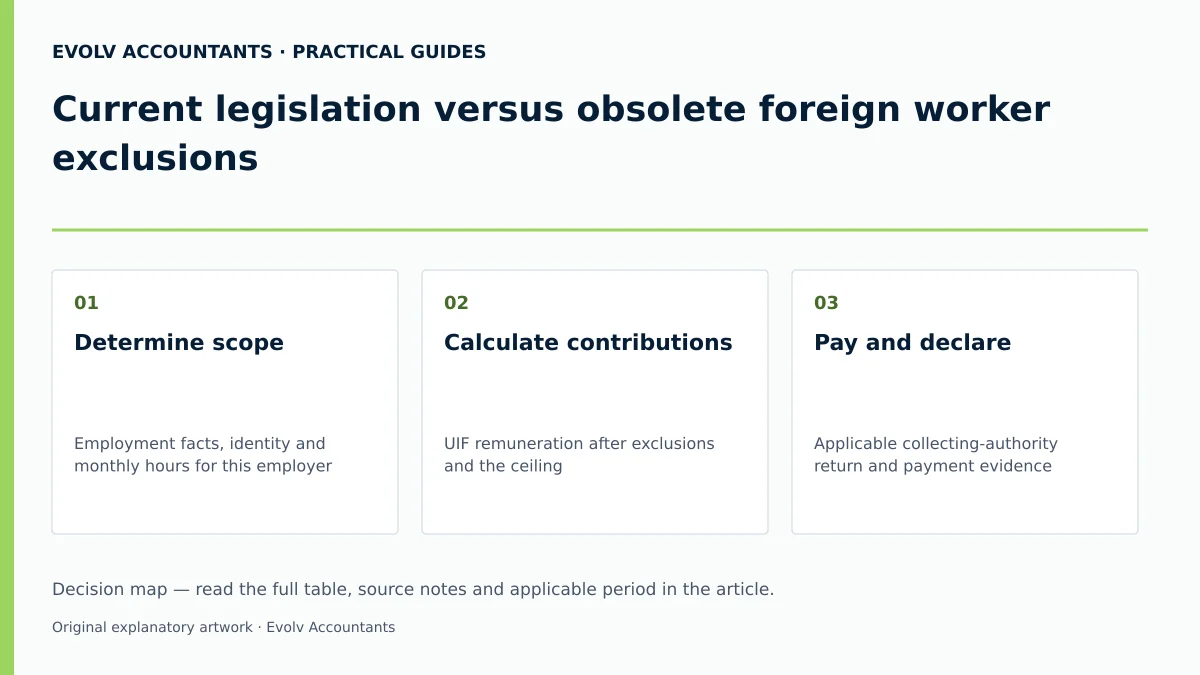
| Determine scope | Employment facts, identity and monthly hours for this employer | Payroll administrator | Applicable exclusions tested | Foreign nationality alone is not an exemption |
| Calculate contributions | UIF remuneration after exclusions and the ceiling | Payroll administrator | 1% employee plus 1% employer correctly calculated | Distinguish statutory pension or lump-sum exclusions from a generic payroll allowance label |
| Pay and declare | Applicable collecting-authority return and payment evidence | Finance manager | Correct period and allocation checked | SARS payment does not replace UI Commissioner employee declarations |
| Submit employee records | Passport or ID, service dates and remuneration | Authorised declarant | Submission confirmation retained | Follow UIF support instructions for unresolved identity-capture errors |
| Reconcile | Payroll, EMP201 and certificates where SARS reconciliation applies | Accountant | Differences investigated and supported | Correct the relevant source record and affected returns |
Official guidance; Official guidance; Official guidance.
Frequently Asked Questions
Are foreign national employees exempt from UIF contributions in South Africa?
No. Foreign national employees working 24 hours or more per month for a South African employer are legally subject to compulsory UIF deductions and employer contributions under the UIC Act 2 3 4. Historical assumptions claiming foreign workers are exempt are legally obsolete 4 5.
What is the maximum monthly UIF contribution for a foreign employee earning above the ceiling?
For employees earning above the statutory monthly ceiling of R17 712 (effective 1 June 2021), contributions are capped at 1% of the ceiling 6 15 29. The maximum monthly employee deduction is R177,12, matched by a R177,12 employer contribution, resulting in a maximum total monthly payment of R354,24 29.
Where must an employer submit monthly UI-19 employee declarations?
Monthly UI-19 employee details must be submitted directly to the UI Commissioner via uFiling or electronic payroll uploads 27 34. Even if monthly contribution payments are remitted to SARS on EMP201 declarations, employee declaration records must go to the UI Commissioner 19 26 27.
What happens if an employer fails to deduct or pay over UIF contributions on time?
Late payments incur an automatic 10% penalty on the unpaid amount, alongside statutory interest calculated at the prescribed rate 46 47. Failure to deduct or remit contributions also constitutes an offence punishable by fine or imprisonment for up to two years 25 45 49.
Can an employer recover arrear employee UIF contributions from a previous tax year?
No. Section 7 of the UIC Act explicitly prohibits employers from deducting arrear employee contributions after the end of the financial year in which they were payable 31. If an employer failed to deduct contributions in a prior financial year, the employer must settle the outstanding balance without recovering it from the employee 31.
Related guides
- UIF treatment of directors and owners
- When a small business must register for UIF
- Compliance and Regulations: Keeping Your Business on Track
Sources
- Unemployment Insurance Fund | South African Revenue Service
- https://www.sars.gov.za/wp-content/uploads/Ops/Guides/UIF-GEN-01-G01-Guide-for-Employers-in-respect-of-the-Unemployment-Insurance-Fund-External-Guide.pdf
- https://www.labour.gov.za/DocumentCenter/Publications/Unemployment%20Insurance%20Fund/uFiling%20System%20User%20Guide.pdf
- Unemployment Insurance Fund
- Unemployment Insurance Fund