
UIF treatment of directors and owners
11 March 2025

Determining the UIF treatment of company directors requires establishing whether a natural person receives remuneration under a valid employment relationship.
First establish whether the director or owner is an employee receiving remuneration under the applicable UIF definitions. An owner’s title alone does not settle that question.
For an employee within scope, test the statutory exclusions, including fewer than 24 hours a month for that employer, and calculate the employee and employer portions on UIF remuneration up to the applicable ceiling. SARS UIF scope; contribution rules.
Owner role and employment relationship evidence
Audience, Jurisdiction and Statutory Scope
This technical guide is structured for South African SME owners, managing directors, financial controllers and payroll practitioners operating within South Africa 5. The legal framework applies to current tax periods (including 2026/2027) governed by the Unemployment Insurance Act, 2001 (UI Act) and the Unemployment Insurance Contributions Act, 2002 (UIC Act) 6 7.
Completion of this task means the employer has verified whether owner-managers qualify as employees, established the correct registration profiles with the South African Revenue Service (SARS) and the UI Commissioner, calculated monthly deductions accurately against statutory ceilings, and verified monthly declarations 3 8 9.
Evidence Boundaries and Technical Distinctions
Payroll practitioners must strictly distinguish between Pay-As-You-Earn (PAYE), Skills Development Levy (SDL) and Unemployment Insurance Fund (UIF) obligations 10 11. While these liabilities are declared jointly on the monthly EMP201 return submitted to SARS, their statutory registration triggers and governing rules differ 9 10.
Submitting monthly EMP201 tax returns to SARS does not update the worker database maintained by the Department of Employment and Labour; employee information declarations (UI-19) must be lodged directly with the UI Commissioner via uFiling or payroll file uploads 12 13 14. Historical portal manuals or interface screenshots reflect specific system states at their date of publication and do not substitute for current statutory provisions or live portal verification 15 16.
Prepare the information and authority: owner role
Statutory Definitions and Legal Framework
The statutory duty to contribute applies broadly across commercial enterprises. Under the UIC Act, an employee is a natural person receiving remuneration, or to whom it accrues, for services rendered or to be rendered, excluding an independent contractor 1. Applying this definition, a working director or shareholder receiving remuneration for services must be assessed as an employee unless a statutory exclusion or genuine independent-contractor relationship applies 1 17.
The law excludes only specific categories, such as persons working fewer than 24 hours a month for that employer, public office holders, and independent contractors 1 2 18.
Regulator guidance from SARS reinforces that an employer is any person who pays remuneration to an employee, including a "representative employer" such as a company public officer, manager, secretary or director 1 19 20.
Evolv Accountants recommends that SME boards maintain clear corporate evidence—including CIPC director appointment certificates, board resolutions authorising executive salaries and formal employment contracts—to substantiate the employment relationship and distinguish executive remuneration from non-employee share dividends or non-executive advisory fees.
— Practical point from this guide
Platform Permissions and User Access Setup
To execute declarations and manage owner data, administrative access must be configured on regulatory portals. On the Department of Employment and Labour’s uFiling system, commercial employers or appointed practitioners can delegate specific roles 21 22. Available portal delegation permissions include Administrator, View Only, Pay, Capture Declarations, Submit Declarations, and Capture Declaration Adjustments 22.
Adding an existing commercial company on uFiling triggers an automated authorisation request sent to the registered company directors or owners for verification before access is activated 23 24.
Complete the task step by step: employment relationship evidence
Sequenced Operational Workflow
Employers must follow a structured, sequential process grounded in current statutory and regulator instructions 8 9 10:
- Evaluate Owner Remuneration: Review corporate records to confirm whether the director receives remuneration for services rendered 1 17. Exclude non-remuneration payments such as dividends, retirement allowances, or bona fide independent contract fees 17 25.
- Confirm Dual Registration Channels: Ensure the company is registered with SARS for UIC collection if liable for PAYE/SDL or voluntarily registered 8 10 11. In accordance with statutory requirements effective 1 February 2020, all employers must also be registered directly with the UI Commissioner to submit monthly employee information returns 12 26.
- Calculate Monthly Statutory Contributions: Compute statutory contributions coinciding with the company's payroll frequency 3 27. Deduct 1% from the employee's remuneration and match with a 1% employer contribution (total 2%) 3 4 28. Apply the statutory earnings ceiling of R17 712 per month (R212 544 annually) effective from 1 June 2021 3 29 30.
- Submit Monthly Tax Declaration (EMP201) to SARS: By the 7th day of the following month, submit the EMP201 declaration via SARS eFiling or e@syFile 9 31 32. Use the pre-populated 19-digit Payment Reference Number (PRN) to execute payment via eFiling, approved EFT, or bank branch channels 9 29 31.
- Lodge Monthly Employee Information (UI-19) to the UI Commissioner: Submit monthly employee records and salary declarations directly to the UI Commissioner using uFiling or payroll file bulk upload 13 14 15.
- Perform Bi-Annual and Annual Employer Reconciliations (EMP501): Submit the EMP501 reconciliation statement to SARS as published in the Government Gazette, matching total EMP201 declarations against IRP5/IT3(a) tax certificates issued to owner-employees 33 34.
Check the result against the evidence: owner role
Independent Verification Criteria
Completing a submission on a portal does not automatically guarantee statutory compliance or regulatory acceptance 24 35. Evolv Accountants recommends verifying each stage against objective financial and administrative proof:
- SARS Payment and Return Status: Verify on SARS eFiling that the monthly EMP201 status reflects "Submitted" and that the bank payment confirmation matches the exact 19-digit PRN 9 29.
- UIF Employee Database Status: Access the uFiling "Declarations Manager" or "View Returns" dashboard to confirm that employee declarations show a status of "Submitted" and that worker record histories accurately reflect director start dates and remuneration levels 35 36 37.
- Reconciliation Audit Trail: Maintain an internal payroll summary reconciling gross salary figures, capped UIF remuneration, employee 1% deductions, employer 1% contributions, and ledger accounts 3 4 38. Under Paragraph 14(1) of the Fourth Schedule and TAA Chapter 4, employers must retain all payroll registers and declaration documents for 5 years 38 39.
Handle exceptions and unresolved cases: employment relationship evidence
Edge Cases, System Errors and Specialist Boundaries
- Non-executive roles, dividends and proprietor drawings: Assess whether the payment is remuneration for services and whether the person is an employee or a genuine independent contractor under the UIC Act. A director title or the absence of a written employment contract does not by itself decide UIF status. Genuine shareholder dividends and a sole proprietor’s own drawings must be distinguished from employee remuneration; investigate payments labelled “drawings” if they are actually remuneration. SARS UIF definitions.
- Part-Time or Multi-Employer Directors: If an owner works fewer than 24 hours in a month for a specific entity, that entity is exempt from UIF contributions for that owner 2 18. If an owner works 24 hours or more per month for each of multiple companies, each employer must independently calculate and deduct UIF up to the R17 712 monthly limit 3 27 29.
- uFiling Portal Vetting Failures: When registering or updating profiles on uFiling, demographic data is validated against Department of Employment and Labour records 40 41. If vetting fails, follow the portal prompt to contact uFiling Support through “UIF Services Support”. Send identity documents only through the route and with the safeguards specified by the support team. uFiling user guide.
- Late Payments and Statutory Penalties: Failure to pay monthly contributions by the 7th day triggers an automatic 10% penalty on the outstanding amount plus interest calculated at the prescribed rate from the day after due date until payment 31 43 44. Offences under Tax Administration Act Chapter 17 carry penalties of fines or imprisonment for up to two years 14 45 46.
- Specialist Advisory Boundaries: Where director contractual status, remuneration structuring, or historic non-compliance is uncertain, SME management should engage Evolv Accountants for specialised tax advisory, payroll structuring, and legal compliance review.
Next steps for UIF employer duties
Actionable SME Checklist
- Review all company director and owner arrangements to confirm employee status under the UIC Act 1.
- Verify dual registration status on both SARS eFiling and the UI Commissioner uFiling portal 8 12 26.
- Audit payroll software configuration to ensure UIF calculations cap at R17 712 per month (R177.12 employee / R177.12 employer) 3 29 30.
- Establish monthly calendar controls for EMP201 submission and PRN payment by the 7th of every month 9 31 32.
- Ensure monthly UI-19 employee details are submitted to the UI Commissioner 13 14.
- Archive all payroll records and declarations securely for the mandatory 5-year retention period 38 39.
Reproducible Hypothetical Example
Scenario: An SME owner-director receives a monthly gross executive salary of R30 000.
- Gross Remuneration: R30 000.00 25 30.
- Statutory Monthly Earnings Ceiling: R17 712.00 (effective 1 June 2021) 3 29 30.
- UIF Remuneration Subject to Contribution: R17 712.00 (excess R12 288.00 is excluded) 3 29.
- Employee Contribution (1%): R17 712.00 × 1% = R177.12 3 4 29.
- Employer Contribution (1%): R17 712.00 × 1% = R177.12 3 4 29.
- Total Monthly Payment to SARS (EMP201): R177.12 + R177.12 = R354.24 3 28 29.
Task and completion checklist
| Step | Input or evidence | Suggested owner | Completion check | Exception or next action |
|---|---|---|---|---|
| Determine employee status | Contract, services and remuneration facts | Employer or adviser | Reasoned classification documented | Do not infer employee status solely from a director or owner title |
| Test exclusions | Monthly hours and other statutory exclusions | Payroll administrator | Scope determined for this employer | Record the basis for any exclusion |
| Register and calculate | Applicable SARS/UI Commissioner references and UIF remuneration | Employer | Correct payment authority; 1% employee and 1% employer portions subject to ceiling | Correct registration or calculation errors |
| Pay contributions | EMP201 and PRN where SARS collection applies; otherwise the prescribed UIF payment record | Finance manager | Payment allocated to the correct employer and period | Resolve any shortfall or allocation error |
| Submit employee declarations | Monthly service and remuneration records | Authorised declarant | UI Commissioner submission confirmation retained | Use prescribed support or correction route for failures |
| Reconcile where required | EMP201, certificates, payments and EMP501 | Accountant | Reconciliation differences explained and corrected | Keep the correction trail |
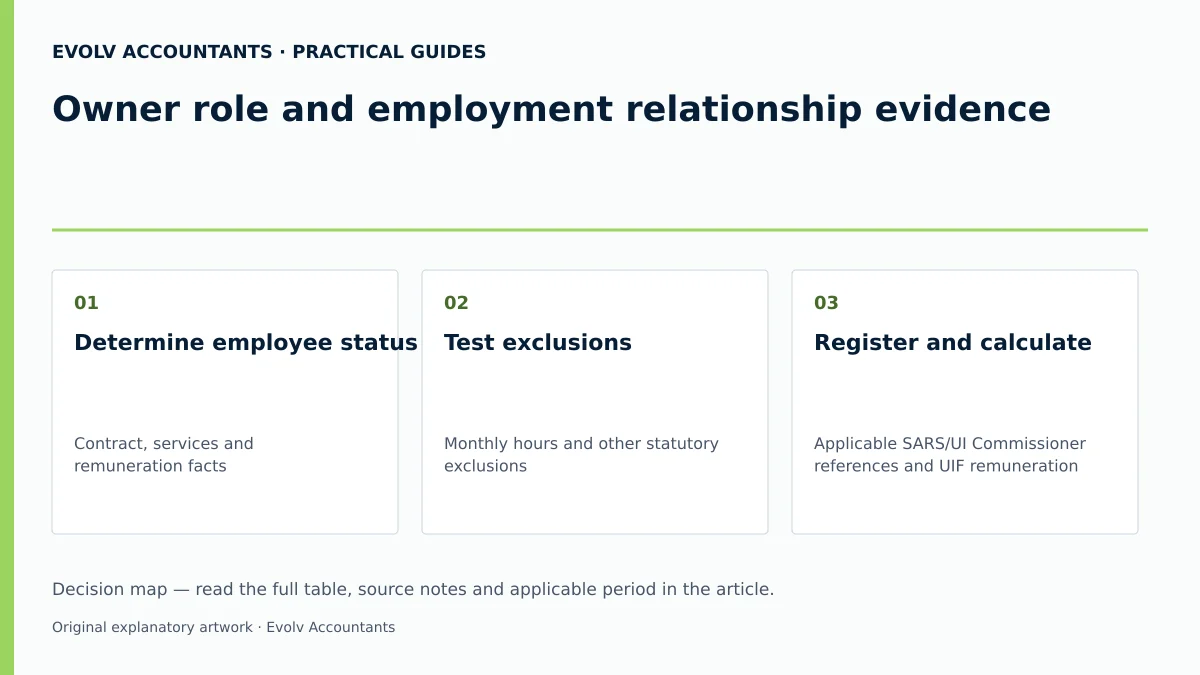
Official guidance; Official guidance; Official guidance.
Frequently Asked Questions
Are company directors automatically exempt from UIF contributions in South Africa?
Answer: No. Under Section 1 of the Unemployment Insurance Contributions Act (UIC Act), any natural person who receives remuneration for services rendered under an employment relationship is defined as an employee 1. Active working directors and owner-managers who receive a salary are subject to mandatory UIF deductions unless specifically excluded by statutory provisions (such as working under 24 hours per month) 2 18.
How is the monthly UIF contribution calculated for a director earning above the statutory threshold?
Answer: For employees earning above the statutory ceiling effective 1 June 2021 (R17 712 per month or R212 544 per annum), UIF contributions are calculated strictly on the maximum ceiling amount 3 29 30. The maximum employee deduction is capped at R177.12 per month (1% of R17 712), matched by an employer contribution of R177.12, resulting in a total monthly contribution of R354.24 3 29. Remuneration in excess of R17 712 is excluded from UIF calculations 3 29.
Does submitting an EMP201 declaration to SARS automatically update employee records on the UIF database?
Answer: No. While SARS collects UIF contributions for registered employers via the monthly EMP201 return, the Unemployment Insurance Commissioner maintains a separate worker database 10 12 50. Employers must submit monthly UI-19 employee declarations directly to the UI Commissioner via uFiling or payroll file uploads to ensure employee service records and benefit entitlements are updated 13 14 15.
How should UIF treat dividends and an owner’s drawings?
Answer: Establish what the payment represents. Genuine dividends are returns on shareholding, while a sole proprietor’s own drawings are distinct from wages paid to an employee. An owner-employee’s remuneration for services must be tested under the UIF rules even if it is labelled “drawings”. Apply the UIF employee and remuneration definitions to the actual arrangement. SARS UIF definitions.
What are the penalties for late payment or non-declaration of director UIF contributions?
Answer: If an employer fails to pay monthly UIF contributions by the statutory deadline (the 7th day of the following month), an automatic penalty of 10% is charged on the outstanding amount 31 44. In addition, interest accrues at the prescribed rate from the day following the due date until full payment is received 43 44. Non-compliance or false declarations also constitute statutory offences under Chapter 17 of the Tax Administration Act, punishable by fines or imprisonment for up to two years 14 45 46.
Related guides
- Completing a UI19 when employment ends
- When a small business must register for UIF
- Compliance and Regulations: Keeping Your Business on Track
Sources
- https://www.sars.gov.za/wp-content/uploads/Ops/Guides/UIF-GEN-01-G01-Guide-for-Employers-in-respect-of-the-Unemployment-Insurance-Fund-External-Guide.pdf
- Unemployment Insurance Fund | South African Revenue Service
- https://www.labour.gov.za/DocumentCenter/Publications/Unemployment%20Insurance%20Fund/uFiling%20System%20User%20Guide.pdf
- Unemployment Insurance Fund
- Unemployment Insurance Fund