
Reconciling employee certificates after a payroll migration
17 March 2026

Reconciling employee certificates after a payroll migration requires verifying opening year to date totals and matching employee identifiers across systems.
When migrating payroll systems, South African small and medium enterprises (SMEs) must preserve historical accuracy and regulatory integrity across Employees' Tax (PAYE), Skills Development Levy (SDL), and Unemployment Insurance Fund (UIF) records 1. Transitioning between payroll platforms during an active tax year creates significant compliance risks if opening year-to-date (YTD) cumulative figures or demographic identifiers are incorrectly mapped 2.
To ensure seamless statutory reporting, businesses must execute a controlled migration protocol: establish a strict cut-off date, verify employee tax reference numbers and 30-digit certificate structure, reconcile opening control totals against submitted monthly EMP201 declarations, and validate destination balances prior to issuing final IRP5/IT3(a) certificates 3 4.
Under South African tax legislation, employers remain personally liable for tax under-deductions, while statutory channels enforce strict validation rules and channel-locking rules across eFiling and e@syFile Employer platforms 5 6.
Opening year to date totals and employee identifiers
Defining migration scope and governance
Setting a clear scope and establishing robust governance are critical first steps when migrating payroll platforms mid-year 1. Small and medium-sized employers must designate a single decision owner—typically the senior accountant or payroll lead—to control data extraction, field mapping, and validation. The migration scope must explicitly separate statutory tax types: Employees' Tax (PAYE), Skills Development Levy (SDL), and Unemployment Insurance Fund (UIF) contributions 1.
— Practical point from this guide
Each tax type is governed by distinct legal provisions, deduction thresholds, and reporting rules 7 8.
Establishing cut-off dates and read-only historic archives
A precise cut-off date aligned with a completed pay period prevents transactional overlap and duplicate entries 2. Before importing data into the destination platform, historic payroll files in the legacy system must be set to read-only status to prevent unauthorised post-migration modifications 3. The designated reporting period must align with the South African tax year, which runs from 1 March to the last day of February 9.
Maintaining immutable read-only access to legacy records is necessary to substantiate prior monthly EMP201 declarations and support future statutory audits conducted by the South African Revenue Service (SARS) 10 11.
Statutory boundaries and framework distinction
It is vital to maintain clear boundaries between statutory obligations and administrative guidance:
- Statutory Law: Under the Fourth Schedule to the Income Tax Act No. 58 of 1962, employers are legally required to deduct PAYE from remuneration and remit payments to SARS within 7 calendar days following the end of the month 1 10.
- Regulator Guidance: SARS external guides (such as guide EMP-GEN-02-G01) specify procedural validation rules, including mandatory 30-digit IRP5/IT3(a) certificate structure and eFiling limits 4 5 12.
- Evolv Recommendations: Evolv Accountants recommends completing a full trial reconciliation of opening YTD totals before running the first live destination payroll run to prevent downstream certificate errors.
Map the source data to the destination: opening year to date totals
Structural mapping of accounts and employee identifiers
Mapping source payroll data to destination structures requires meticulous field-by-field verification 2. Every employee master record must map core demographic identifiers, including full legal names, South African identity or passport numbers, residential addresses, and Income Tax reference numbers 13. Regulator guidance mandates that an employee's Income Tax reference number cannot consist solely of zeros 13.
Unique employee payroll numbers from the source system must be cross-referenced with destination codes to prevent broken historical linkages 12.
Tax settings and opening schedule alignment
Opening schedules must capture cumulative year-to-date income and deduction source codes 14. Key mapping requirements include:
- Gross Remuneration Source Codes: Taxable salary (code 3601), bonuses, allowances, and fringe benefits must be mapped to their specific SARS-defined source codes 14 15.
- Statutory Deduction Mapping: PAYE withheld (code 4102), total employee and employer UIF contributions (code 4141), and employer SDL contributions (code 4142) must match cumulative source totals exactly 15 16 17.
- Tax Rates and Statutory Thresholds:
- SDL Threshold & Rate: Employers with a projected total leviable remuneration exceeding R500,000 over a 12-month period must pay SDL at a statutory rate of 1% on the leviable amount 18 19 20.
- UIF Earnings Ceiling & Rate: Mandatory UIF contributions are 1% for the employee and 1% for the employer (2% total) 21 22. Effective 1 June 2021, the statutory maximum remuneration ceiling for UIF calculation is R17,712 per month (R212,544 annually), capping individual monthly contributions at R177.12 each 22 23.
Handling certificate structures and historical periods
Tax certificates generated for employees are designated as IRP5 (where tax was deducted) or IT3(a) (where no tax was withheld due to thresholds or tax-exempt status) 4. Each tax certificate uses a standardised 30-digit certificate number 4:
- Digits 1–10: Employer PAYE reference number (or Income Tax reference number) 4.
- Digits 11–14: Transaction Year (e.g., 2027) 4.
- Digits 15–16: Period of Reconciliation (08 for interim bi-annual period ending August; 02 for final annual period ending February) 4 24.
- Digits 17–30: Unique 14-digit alphanumeric string generated by the payroll software 4.
Rehearse with a controlled sample: employee identifiers
Selecting representative authentic test cases
Prior to full platform cutover, employers should test data migration using a controlled sample of authentic employee records 12. The sample must include diverse employment scenarios: full-time salaried staff, hourly workers with variable remuneration, employees reaching the monthly UIF contribution ceiling, staff subject to tax directives, and terminated employees 22 25.
Isolation and security protocols
Testing must be conducted in an isolated staging environment without modifying live production databases or exposing active login credentials 12. Do not copy portal credentials into test scripts or upload mock files to live SARS eFiling profiles 26. Testing confirms that the destination software correctly formats text layouts, applies mathematical calculations across earnings and deductions, and enforces mandatory field validations 27.
Validation of sample certificates
SARS performs strict Employment Taxes Validation (ETV) checks upon return submission 28. Rehearsing with a sample verifies that:
- Total employees' tax on any certificate does not exceed the sum of taxable and non-taxable source codes 29.
- Income Tax reference numbers pass format verification 28.
- Tax directive numbers and associated tax deductions match SARS-issued directives 25.
Reconcile balances and open transactions: opening year to date totals
Independent control totals and ledger reconciliation
Reconciling opening balances requires independent control totals 2. Financial figures exported from the source system must balance perfectly against destination opening balances and underlying general ledger payroll clearing accounts 2. There must be zero duplication or omission of gross remuneration, PAYE, SDL, UIF, or net salary figures 2.
Reconciling monthly EMP201 declarations against EMP501 totals
Employers declare monthly liabilities and remit payments via the Monthly Employer Declaration (EMP201) within 7 calendar days after month-end 10. If the 7th falls on a weekend or public holiday, submission and payment must occur by the last business day prior 10.
During payroll migration, cumulative opening YTD totals must equal the sum of previously submitted monthly EMP201 declarations for the tax year 2 30:
- Interim Reconciliation (Period 08): Submitted during September/October, covering the 6-month period from 1 March to 31 August 24 30.
- Annual Reconciliation (Period 02): Covers the full 12-month tax year from 1 March to 28/29 February 24 30.
The total liability declared across IRP5/IT3(a) certificates must equal the sum of monthly EMP201 liabilities and actual payments made to SARS 2.
System channel selection rules
Regulator guidance enforces strict channel rules for reconciliation submissions 5 31:
- eFiling Platform: Suitable for small and medium businesses submitting a maximum of 50 IRP5/IT3(a) certificates 5.
- e@syFile Employer Application: Mandatory for employers submitting more than 50 certificates 5.
- Channel Locking: Once a specific submission channel (eFiling or e@syFile) is chosen for a reconciliation period, all subsequent corrections or revisions for that exact period must be processed through the same channel 5 31.
Resolve exceptions before acceptance: employee identifiers
Exception handling and governance
Balancing total monetary amounts alone does not guarantee payroll accuracy 2. Individual field-level exceptions—such as missing tax numbers, incorrect demographic details, or mismatched source codes—must be flagged and logged in a Migration Acceptance Register 28 32. Every identified exception must be assigned to a designated decision owner for resolution before formal system acceptance 28.
Legal prohibitions on tax refunds
Under Paragraph 28 of the Fourth Schedule to the Income Tax Act, employers are strictly prohibited from refunding over-deducted Employees' Tax directly to employees in subsequent pay periods or upon migration 6. Over-deducted PAYE can only be adjusted in tax calculations within the same year of assessment prior to year-end, provided the adjustment does not reduce monthly PAYE below zero 6. Otherwise, tax refunds are processed exclusively by SARS upon assessment of the individual's annual income tax return (ITR12) 6.
Where tax was under-deducted, the employer remains personally liable to SARS for the shortfall, subject to a statutory 10% late payment penalty and interest 6 33.
Migration acceptance register
The following migration totals and acceptance labels are hypothetical review examples.
| Data set | Source total | Destination total | Exception and evidence | Owner and acceptance |
|---|---|---|---|---|
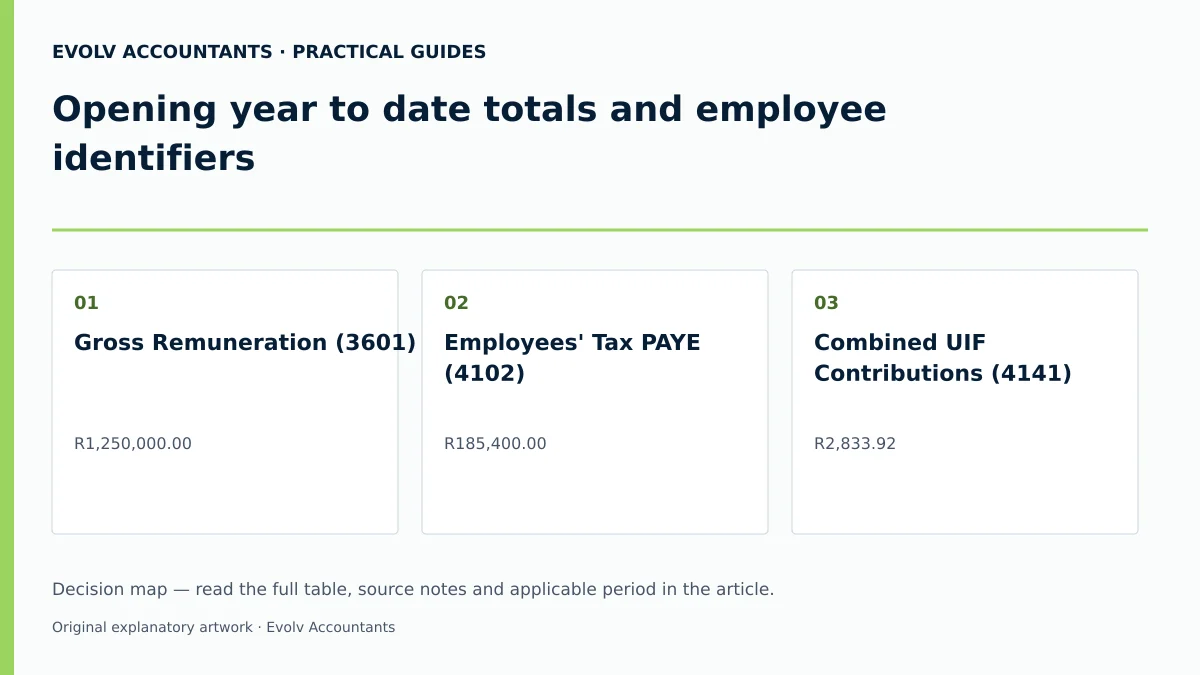
| Gross Remuneration (3601) | R1,250,000.00 | R1,250,000.00 | Nil variance. Payroll summary matched to general ledger 2. | Senior Payroll Accountant (Accepted) |
| Employees' Tax PAYE (4102) | R185,400.00 | R185,400.00 | Nil variance. Total matches EMP201 returns submitted to SARS 2 10. | Tax Advisory Lead (Accepted) |
| Combined UIF Contributions (4141) | R2,833.92 | R2,833.92 | Illustrative eligible remuneration base R141,696; 2% combined contribution = R2,833.92; verify each employee’s monthly cap 17 22. | Payroll Compliance Manager (Accepted) |
| Skills Development Levy (4142) | R12,500.00 | R12,500.00 | Illustrative 1% of R1,250,000 leviable remuneration, assuming the employer is SDL-liable after testing the expected annual employer-level exemption 17 19 20. | Financial Director (Accepted) |
| Employee Tax Reference Numbers | 25 Active Records | 24 Matched / 1 Pending | 1 employee missing tax number; SARS eFiling TRN query initiated 13 34. | HR Systems Administrator (Pending) |
Next steps for Employer reconciliations
Sign-off evidence and governance sign-off
Formal sign-off requires complete documentation verifying that opening YTD balances, employee master data, and tax configuration settings match source archives 2. The sign-off evidence pack must include:
- Reconciled general ledger control accounts 2.
- Signed Migration Acceptance Register 32.
- Cumulative EMP201 payment receipts and SARS Statements of Account (EMPSA) 26 35.
- Exported IRP5/IT3(a) validation reports from eFiling or e@syFile 28.
Rollback triggers and contingency planning
A formal rollback trigger must be established before go-live. If unresolvable systemic errors are discovered—such as corrupted opening YTD totals, failure of ETV validation checks, or duplicate certificate generation—the migration must be halted immediately 28 32. The organisation must revert to the read-only source system for the current payroll run while issues are corrected in staging 3.
User permissions and accessible exports
Post-migration security controls must restrict editing access in the destination platform to authorised payroll administrators. Archive files, CSV export files, and PDF certificate files must be securely backed up 12. Employers must retain all payroll records, declarations, and tax certificates for a minimum statutory period for audit purposes 11.
Recommended migration checklist
- Establish Scope & Cut-off: Appoint a project owner, set a firm payroll cut-off date, and lock historic legacy records to read-only status 2 3.
- Extract & Map Source Data: Export opening YTD balances and map employee identifiers, gross income source codes (e.g. 3601), and tax deductions (PAYE 4102, UIF 4141, SDL 4142) 13 15 17.
- Rehearse in Staging: Import a representative sample into an isolated environment to verify mathematical accuracy and ETV validation compliance 12 28.
- Reconcile Control Totals: Verify that opening YTD figures equal previously submitted monthly EMP201 declarations and bank remittances 2 10.
- Resolve & Log Exceptions: Document missing tax numbers or code variances in the Migration Acceptance Register and obtain owner sign-off 13 32.
- Select Submission Channel: Confirm eFiling (up to 50 certificates) or e@syFile (>50 certificates) and note channel-locking requirements for EMP501 filings 5 31.
Practical Reproducible Hypothetical Example
Scenario parameters and employee profile
An SME employer with 10 employees migrates payroll platforms on 1 October 2026 (mid-way through the 2027 tax year). To verify opening YTD totals, the payroll manager reconciles data for Employee A:
- Employment Period: 1 March 2026 to 30 September 2026 (7 months in source system).
- Monthly Gross Remuneration: R25,000.00 per month 19.
- Applicable Statutory Rates & Thresholds:
- PAYE: Calculated per SARS monthly deduction tables 7 36.
- SDL: 1% of leviable remuneration (annual remuneration exceeds R500,000 threshold) 19 20.
- UIF: 1% employee contribution + 1% employer contribution (2% total), subject to the monthly earnings ceiling of R17,712.00 (maximum monthly contribution of R177.12 for employee and R177.12 for employer) 21 22 23.
Step-by-step mathematical calculation
- Gross Remuneration (Source Code 3601):
Monthly Salary = R25,000.00 7-Month YTD Total = R25,000.00 × 7 = R175,000.00 14 19
- Skills Development Levy (Source Code 4142):
Monthly Leviable Amount = R25,000.00 19 Monthly SDL (1%) = R25,000.00 × 1% = R250.00 19 7-Month YTD SDL = R250.00 × 7 = R1,750.00 17 19
- Unemployment Insurance Fund (Source Code 4141):
Monthly Remuneration = R25,000.00 (Exceeds R17,712.00 ceiling) 22 23 Capped Monthly Remuneration for UIF = R17,712.00 22 23 Monthly Employee UIF (1%) = R17,712.00 × 1% = R177.12 22 23 Monthly Employer UIF (1%) = R17,712.00 × 1% = R177.12 22 23 Total Monthly Combined UIF (2%) = R177.12 + R177.12 = R354.24 22 23 7-Month YTD UIF Total (Code 4141) = R354.24 × 7 = R2,479.68 17 22
Migration mapping check
When Employee A's record is imported into the destination system on 1 October 2026, the destination system opening YTD balance must reflect exactly R175,000.00 under Code 3601, R1,750.00 under Code 4142, and R2,479.68 under Code 4141 15 17. A failure to cap UIF remuneration at R17,712.00 per month would incorrectly calculate YTD UIF as R25,000.00 × 2% × 7 = R3,500.00, creating a R1,020.32 exception on the IRP5 certificate validation 22 37.
Frequently Asked Questions
What happens if an employee's Income Tax Reference Number is missing during payroll migration?
Regulator guidance specifies that tax certificate validation will fail if an Income Tax reference number is missing or consists entirely of zeros 13 28. Employers should use the Tax Reference Number (TRN) Enquiry Service on SARS eFiling to retrieve employee tax numbers prior to final submission 34. If an employee does not have an active tax registration, the employer must register the employee via eFiling 34.
Can an employer refund over-deducted PAYE directly to an employee during a migration cleanup?
No. Under Paragraph 28 of the Fourth Schedule to the Income Tax Act, employers are not permitted to refund over-deducted Employees' Tax directly to employees 6. Over-deductions can only be adjusted in subsequent pay periods within the same tax year, provided the monthly PAYE deduction is not reduced below zero 6. If the tax year has ended, the employee must claim any refund directly from SARS when submitting their annual ITR12 return 6.
Which submission channel should an SME use for employer reconciliations?
Employers submitting a total of 50 or fewer IRP5/IT3(a) certificates may use either SARS eFiling or the e@syFile Employer application 5 12. Employers submitting more than 50 certificates are legally required to use e@syFile Employer 5. Once a channel is chosen for a specific reconciliation period, all subsequent submissions and adjustments for that period must use the same channel 5 31.
How are SDL exemptions handled during opening balance mapping?
An employer is exempt from paying SDL if there are reasonable grounds to believe that the total leviable remuneration paid to all employees over the next 12-month period will not exceed R500,000 18 20. While exempt employers are not required to register for SDL, if they are registered, SDL values for exempt periods must be mapped as zero 20 38.
What is the statutory penalty for failing to submit an accurate EMP501 reconciliation on time?
A recurring administrative non-compliance penalty may accrue by month or part-month, subject to an aggregate cap of 10% of the relevant employees’ tax liability if an employer fails to submit the final EMP501 return by the published statutory due date 33. Furthermore, non-compliant employers may forfeit Employment Tax Incentive (ETI) refunds and face locked ETI tax credits 33 39 40. Ask Evolv about opening year to date totals and employee identifiers. Share the relevant records so the support required can be scoped.
Related guides
- Submitting IRP5 certificates to SARS
- Submitting an EMP201 employer declaration
- Compliance and Regulations: Keeping Your Business on Track
Sources
- https://www.sars.gov.za/wp-content/uploads/Ops/Guides/EMP-GEN-02-G01-A-Guide-to-the-Employer-Reconciliation-Process-External-Guide.pdf
- Guide for Employers in Respect of Employees' Tax (2027) | South African Revenue Service
- https://www.sars.gov.za/wp-content/uploads/Ops/Guides/SDL-GEN-01-G01-Guide-for-Employers-in-respect-of-Skills-Development-Levy-External-Guide.pdf
- COMPLETING THE MONTHLY EMPLOYER DECLARATION (EMP201) | South African Revenue Service
- Skills Development Levy | South African Revenue Service
- Unemployment Insurance Fund | South African Revenue Service