
Reconciling UIF payments to declarations
30 September 2025

Reconciling UIF payments to declarations requires checking payroll contributions against payments to the applicable collecting authority and employee records submitted to the UI Commissioner.
UIF reconciliation has separate financial and employee-record checks. Match combined employee and employer contributions to the applicable SARS or UI Commissioner payment record, then check each employee’s identity, service dates, actual remuneration and UIF contribution base in the employee declarations.
Explain differences rather than treating matching cash totals as proof of correct worker records. SARS UIF guide; uFiling guide.
Payment reconciliation to employee declaration totals
Reconciling Unemployment Insurance Fund obligations requires regular comparison across four primary, independent records maintained within an employer's payroll and accounting workflow:
— Practical point from this guide
- Internal Payroll Register: The monthly payroll summary detailing gross remuneration, statutory exclusions (such as commission income) 17 18, capped deductible salaries 4 6, individual 1% employee withholdings, and matching 1% employer contributions 4 5.
- General Ledger Financial Accounts: The double-entry accounting records reflecting monthly UIF expense accruals, liability accounts, and bank cash disbursements.
- SARS EMP201 Declarations and Bank Remittance Receipts: The monthly tax returns submitted to SARS reflecting declared UIF liabilities alongside bank proof of payments linked via the pre-populated 19-digit Payment Reference Number (PRN) 6 7.
- UI Commissioner Employee Declarations: The individual employee status, remuneration, and monthly service records submitted via UI-19 filings, electronic payroll file transfers, or the uFiling Declarations Manager 8 10 11 19.
Defining Record Agreement versus Factual Validity
Law and Regulator Guidance: Under Section 6 of the Unemployment Insurance Contributions Act 4 of 2002 (UIC Act) and Paragraph 14 of the Fourth Schedule to the Income Tax Act 58 of 1962, employers must accurately withhold contributions and submit complete employee returns 5 20 21. Agreement between records means that total financial disbursements equal declared SARS monthly obligations and mirror the aggregated sum of individual employee remuneration records credited to the UI Commissioner's database 7 9 16.
Evolv Recommendations: Employers must distinguish numerical agreement from factual validity. A payroll register may match a bank payment exactly, but if the underlying calculation included exempt commission income or failed to apply the statutory monthly earnings ceiling of R17,712 4 6 17 18, the return remains factually incorrect. Numerical alignment across schedules does not waive statutory penalties if individual employee details or deduction rules violate statutory criteria 12 14 22.
Prepare the opening balances and period: payment reconciliation to employee declaration totals
A structured reconciliation begins with establishing clear accounting parameters and period boundaries:
- Opening Balances: Identify unsettled prior-period timing differences, uncleared SARS credit balances, or pending manual payment allocations brought forward from previous tax months 23 24.
- Reconciliation Cut-off: Align the reconciliation strictly to calendar month payroll cycles. Statutory payments must be received by SARS within seven days following the end of the month in respect of which contributions are payable 22 25. If the seventh day falls on a weekend or public holiday, payment must be completed on the last business day prior 22 25.
- Currency and Units: All calculations, ledgers, and filings must be executed in South African Rand (ZAR).
- Mandatory Identifiers: Verify that records reference identical statutory identifiers:
- SARS PAYE / UIF Registration Number 2 3.
- 19-digit SARS Payment Reference Number (PRN) 6 7.
- Department of Employment and Labour UI Reference Number 26.
- Employee Identity Numbers or Passport Numbers 27 28.
- Evidence Completeness: Ensure all supporting evidence is assembled before matching, including bank statements, stamped bank deposit slips, SARS EMP201 filing receipts 6 25, uFiling return summary logs 29, and UI-19 submission confirmations 10.
Match transactions and explain differences: documented completion and exceptions
Statutory Calculation Rules and Exclusions
To establish the benchmark calculation across independent records, employers must apply statutory rules governed by Section 1 and Section 6 of the UIC Act 5 17 18:
- Employee Contribution: 1% of deductible remuneration 4 5.
- Employer Contribution: 1% of deductible remuneration 4 5.
- Total Contribution Remitted to SARS: 2% of deductible remuneration 4 5 30.
- Statutory Remuneration Ceiling: With effect from 1 June 2021, the maximum earnings threshold for UIF contribution calculations is R17,712 per month (R212,544 annually) 4 6 31.
- Maximum Deduction Limit: For employees earning above R17,712 per month, the maximum monthly employee deduction is capped at R177.12, matched by a R177.12 employer contribution (R354.24 total) 6.
- Statutory Exclusions: Under Section 1 of the UIC Act, remuneration for UIF purposes excludes:
- Earnings of employees working less than 24 hours a month for an employer 32 33.
- Remuneration of national and provincial public servants and elected public office holders 32 33.
- Payments made by way of pension, superannuation allowance, or retiring allowance 17 18.
- Amounts excluded under paragraphs (a), (cA), (d), (e), or (eA) of the definition of gross income in Section 1 of the Income Tax Act 17 18.
- Remuneration paid by way of commission 17 18.
Transaction-Level Reconciliation Bridge
Employers should construct a formal transaction bridge categorising variances between payroll summaries, SARS EMP201 payment receipts, and uFiling declaration totals into distinct operational classes:
- Timing Items: Occur when payments released on the seventh day clear bank accounts on subsequent dates, or when uFiling system processing updates lag behind SARS payment confirmation 22 25 29.
- Calculation and Mapping Mistakes: Arise when payroll software includes exempt commission earnings 17 18, omits the monthly R17,712 ceiling 4 6, or when uFiling capturing errors overwrite monthly deductible salaries 34.
- Duplicated Records: Occur when an employer submits manual UI-19 returns while simultaneously executing automated bulk payroll uploads, creating duplicate employee profiles on the UI Commissioner database 10 35.
Post only supported corrections: payment reconciliation to employee declaration totals
Legal Limits on Payroll and Deduction Adjustments
Law and Regulator Guidance: Section 7 of the UIC Act dictates strict rules regarding contribution adjustments 22 36:
- Employers are legally prohibited from deducting amounts in excess of the statutory contribution 22.
- Employers may not charge any administrative fee to employees for complying with the UIC Act 22.
- Employers are strictly forbidden from deducting arrear contributions from an employee after the end of the financial year during which those contributions were payable 22.
- Under Section 7(5) of the UIC Act and Chapter 13 of the Tax Administration Act 28 of 2011 (TA Act), if an employer over-deducts UIF from an employee, the employer must refund the employee immediately, regardless of whether SARS has refunded the employer 24.
Executing System and Filing Adjustments
- uFiling System Adjustments: Guidance from the UI Commissioner specifies that monthly uFiling declarations cannot be edited directly on the declaration form 34. To adjust a declared total, the employer or practitioner must update the underlying employee salary or employment details within the Declarations Manager, which automatically recalculates and updates the corresponding monthly return 34.
- SARS Filing Adjustments: Financial corrections to statutory returns submitted to SARS must be executed through official EMP201 adjustment requests or during the annual EMP501 reconciliation process, supported by verified payroll records 7 21.
Review unresolved and old items: documented completion and exceptions
Unresolved reconciliation differences must be recorded in an aged exception log containing the item date, description, monetary value, root cause, assigned owner, and target resolution date. Suspense accounts must never be used to conceal underlying variances.
Statutory Consequences of Unresolved Discrepancies
- Late Payment Penalties: Under Section 13 of the UIC Act and Chapter 15 of the TA Act, any contribution remaining unpaid after the statutory due date incurs an immediate 10% penalty 14.
- Interest Charges: Section 12 of the UIC Act mandates interest on late payments at the prescribed rate, calculated daily from the day following the due date until full payment is received by SARS or the UI Commissioner 13.
- Estimated Assessments: Under Chapter 8 of the TA Act, SARS may issue estimated assessments if an employer fails to submit returns or provides incorrect information, creating an immediate enforceable liability 15.
- Statutory Offences: Under Chapter 17 of the TA Act, failing to submit returns, failing to deduct or remit contributions, refusing to supply information, or making false statements constitutes a criminal offence punishable by a fine or imprisonment for up to two years 11 12 37 38.
- Record Retention Mandate: Paragraph 14(1) of the Fourth Schedule and Chapter 4 of the TA Act require employers to retain all remuneration registers, contribution deduction records, declarations, and proof of payments for five years 39 40.
- Notification Obligations: Employers must inform SARS in writing of changes to registered particulars within 21 business days 41, and notify SARS within 14 days if they cease to carry on business or employ staff 42 43.
Next steps for UIF employer duties
Comprehensive Monthly Reconciliation Checklist
Employers should follow this step-by-step checklist every month to maintain complete statutory alignment:
- Extract Monthly Payroll Data: Run the final payroll register after period-end, separating basic salary, commission, and exempt income 17 18.
- Apply Statutory Ceiling: Confirm that all employee deductible salaries are capped at R17,712 per month, ensuring individual employee withholdings do not exceed R177.12 4 6 31.
- Verify Employer Matching: Confirm that the company matching contribution equals exactly 1% of total deductible payroll 4 5.
- Request and Issue SARS EMP201: Request the monthly EMP201 via SARS eFiling or e@syFile, obtaining the pre-populated 19-digit Payment Reference Number (PRN) 6 7.
- Remit Cash Payment: Pay the exact total declared on the EMP201 via approved banking channels before the seventh day of the month 22 25.
- Submit UI Commissioner Declarations: Upload monthly employee data to uFiling or submit electronic UI-19 declarations directly to the UI Commissioner 8 10 11 19.
- Perform Three-Way Match: Reconcile General Ledger accounts, SARS payment receipts, and uFiling return summary logs 6 7 19.
- Archive Records: Save all submission receipts, PRN payment confirmations, and reconciliation schedules in the five-year compliance archive 39 40.
Reconciliation Bridge Artefact
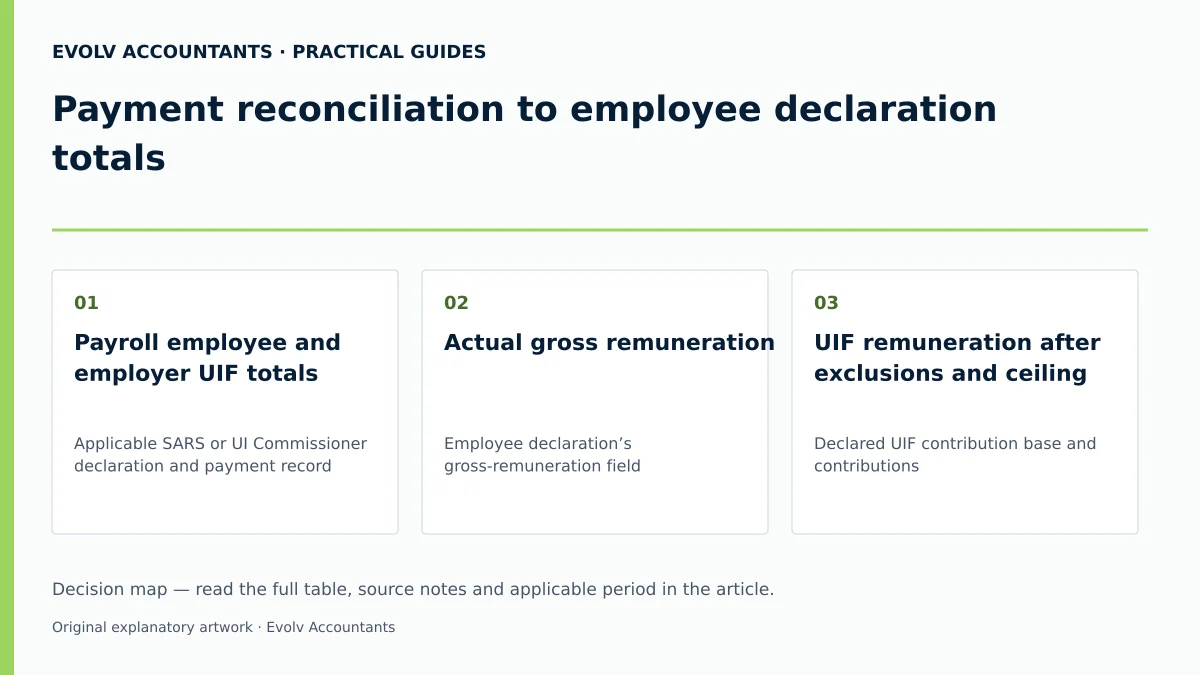
The table below illustrates a standard operational reconciliation bridge for evaluating monthly UIF variances across independent compliance systems:
| Record A | Record B | Check | Action and suggested owner |
|---|---|---|---|
| Payroll employee and employer UIF totals | Applicable SARS or UI Commissioner declaration and payment record | Combined amount, employer, period and actual allocation | Finance manager investigates any difference |
| Actual gross remuneration | Employee declaration’s gross-remuneration field | Report actual gross pay separately from the contribution base | Payroll administrator corrects the relevant employee master details |
| UIF remuneration after exclusions and ceiling | Declared UIF contribution base and contributions | Explain excluded commission or other statutory adjustments; do not compare gross pay with a capped base as if they were identical | Payroll administrator keeps the reconciliation schedule |
| Bank payment | Collecting authority’s statement or payment record | A bank release alone does not prove allocation | Finance manager raises an allocation query with the receipt and correct reference |
| Service dates and employment records | Submitted UI Commissioner employee records | Starters, leavers and reasons agree with evidence | HR corrects actual errors and retains the submission result |
Official guidance; Official guidance; Official guidance.
Reproducible Hypothetical Example: Alpha Solutions (Pty) Ltd
To illustrate exact statutory calculations and reconciliation procedures, consider Alpha Solutions (Pty) Ltd, a South African SME employing three staff members during September 2026:
Employee Payroll Profile and Statutory Deductions
- Employee A (Junior Administrator):
- Monthly Gross Salary: R12,000.00.
- Exempt / Excluded Income: R0.00.
- Deductible Salary: R12,000.00 (below R17,712 ceiling) 4 6 31.
- Employee Withholding (1%): R120.00 4 5.
- Employer Matching Contribution (1%): R120.00 4 5.
- Total Monthly Contribution: R240.00 4 5.
- Employee B (Senior Specialist):
- Monthly Gross Salary: R25,000.00.
- Deductible Salary: Capped at statutory ceiling of R17,712.00 per month 4 6 31.
- Employee Withholding (1% of R17,712.00): R177.12 (statutory maximum) 6.
- Employer Matching Contribution (1% of R17,712.00): R177.12 (statutory maximum) 6.
- Total Monthly Contribution: R354.24 6.
- Employee C (Sales Consultant):
- Monthly Earnings: R30,000.00 (comprising R10,000.00 basic salary and R20,000.00 sales commission).
- Statutory Exclusion: Commission income of R20,000.00 is excluded under Section 1 of the UIC Act 17 18.
- Deductible Salary: R10,000.00 basic salary 17 18.
- Employee Withholding (1% of R10,000.00): R100.00 4 5.
- Employer Matching Contribution (1% of R10,000.00): R100.00 4 5.
- Total Monthly Contribution: R200.00 4 5.
Employer Aggregated Totals
- Total Gross Payroll: R12,000.00 + R25,000.00 + R30,000.00 = R67,000.00.
- Excluded Commission Income: R20,000.00 17 18.
- Capped Salary Excess (Employee B earnings above ceiling): R25,000.00 - R17,712.00 = R7,288.00 6 31.
- Total Deductible Payroll for UIF Purposes: R12,000.00 + R17,712.00 + R10,000.00 = R39,712.00.
- Total Employee Deductions (1%): R397.12 4 5.
- Total Employer Contribution (1%): R397.12 4 5.
- Total Monthly UIF Liability payable to SARS on EMP201: R794.24 (2% of R39,712.00) 4 5 6 7.
Reconciliation Discrepancy and Resolution Scenario
- SARS Remittance: Alpha Solutions (Pty) Ltd remits R794.24 to SARS via eFiling using PRN 1029384756102938475 on 5 October 2026, fully clearing the SARS liability 6 7 25.
- uFiling Capturing Discrepancy: During monthly uFiling data entry, an administrator mistakenly entered Employee C's gross earnings as R30,000.00 without excluding commission. The uFiling system applied the R17,712 ceiling, calculating Employee C's contribution as R354.24 instead of R200.00. This caused the uFiling declaration total to reflect R948.48 instead of R794.24 17 18 34.
- Reconciliation Variance: uFiling Declaration (R948.48) less EMP201 Cash Payment (R794.24) = +R154.24 over-declaration on uFiling.
- Corrective Action: Per uFiling system guidance, the practitioner opened the Declarations Manager, updated Employee C's deductible salary to R10,000.00, and saved the record. uFiling automatically recalculated the return to R794.24, achieving complete three-way alignment across payroll, SARS, and UI Commissioner records 19 34.
Frequently Asked Questions
Where do South African commercial employers pay monthly UIF contributions?
Commercial employers registered with SARS for PAYE or SDL purposes must pay monthly UIF contributions directly to SARS 2 3 44. Payments are declared on the monthly EMP201 form and remitted via SARS eFiling, EFT, or approved commercial bank branches using the pre-populated 19-digit Payment Reference Number (PRN) 6 7 25. Employers who are not liable for PAYE or SDL register and pay directly to the UI Commissioner 2 44.
What are the current statutory UIF contribution rates and earnings ceilings?
Under Section 6 of the UIC Act, the contribution rate is 2% of deductible remuneration, split equally as 1% withheld from the employee's pay and 1% contributed by the employer 4 5. Effective 1 June 2021, the statutory maximum earnings threshold is R17,712 per month (R212,544 per annum) 4 6 31. For any employee earning above R17,712 per month, the maximum deduction is capped at R177.12 per month for the employee and R177.12 for the employer (R354.24 total) 6.
Why must monthly UI-19 employee declarations be submitted if payment is made to SARS?
SARS collects financial contributions and transfers the funds to the Unemployment Insurance Fund 45. However, SARS does not maintain individual employee service histories. Employers must submit UI-19 returns or uFiling electronic declarations directly to the UI Commissioner so that individual employment details, monthly remuneration, and service periods are credited to the national worker database 9 10 11 16. This database enables the UIF to pre-qualify workers and process unemployment, maternity, or illness benefit claims 16 46.
How can an employer correct an incorrect declaration on uFiling?
Under the uFiling system rules, submitted monthly declarations cannot be edited directly on the return summary 34. To correct a declared amount, the employer or registered tax practitioner must navigate to the Declarations Manager, select the relevant employer, and update the specific employee's salary or employment details. Saving the updated employee information automatically recalculates and updates the monthly declaration return 19 34.
What penalties and interest apply to late or unpaid UIF contributions?
If an employer fails to pay the full contribution within seven days following month-end, a statutory penalty of 10% is automatically imposed on the unpaid amount under Section 13 of the UIC Act 14 22 25. Additionally, interest accrues at the statutory prescribed rate from the day following the due date until the outstanding balance is paid in full 13. Failure to deduct or remit contributions also constitutes a criminal tax offence under Chapter 17 of the Tax Administration Act 12 37 38. Tell Evolv which UIF registration, declaration or payment question you need help to resolve. Ask Evolv about payment reconciliation to employee declaration totals. Share the relevant records so the support required can be scoped.
Related guides
- UIF contributions when a business closes
- When a small business must register for UIF
- Compliance and Regulations: Keeping Your Business on Track
Sources
- https://www.sars.gov.za/wp-content/uploads/Ops/Guides/UIF-GEN-01-G01-Guide-for-Employers-in-respect-of-the-Unemployment-Insurance-Fund-External-Guide.pdf
- https://www.labour.gov.za/DocumentCenter/Publications/Unemployment%20Insurance%20Fund/uFiling%20System%20User%20Guide.pdf
- Unemployment Insurance Fund | South African Revenue Service