
Reconciling VAT201 to the general ledger
30 August 2026

Reconciling the VAT201 return to the general ledger requires verifying that declared output and input tax balances align with underlying accounting records.
An accurate reconciliation bridges the financial general ledger with the statutory VAT201 declaration submitted to the South African Revenue Service (SARS) 1 2. South African business vendors must regularly match output tax collected on sales and input tax claimed on expenses against the trial balance control account 1 3.
Distinguishing between statutory law, regulator administrative guidance, and Evolv recommendations ensures that tax disclosures are backed by proper audit evidence, verifiable source documents, and valid tax invoices maintained for the mandatory five-year retention period 4 5 6.
VAT return control account reconciliation
A VAT return control account reconciliation compares two independent operational records: the general ledger VAT accounts maintained within the business accounting system and the periodic VAT201 vendor declaration generated for SARS 1 3 7.
— Practical point from this guide
Agreement between the general ledger balance and the VAT201 return demonstrates arithmetic alignment, but a numerical match does not establish factual or legal validity 4 8. Factual validity requires that output tax is correctly declared on all taxable supplies at the standard rate of 15% or zero rate, and input tax deductions are supported by prescribed documentary proof held prior to filing 4 5 8 9.
Legal framework, regulator guidance and Evolv recommendations
To maintain audit readiness, businesses must distinguish between statutory obligations, administrative guidance, and accounting best practice:
- Statutory Law: The Value-Added Tax Act 89 of 1991 and the Tax Administration Act 28 of 2011 impose legal duties on vendors to collect output tax, claim permissible input tax deductions, submit accurate VAT201 declarations, and retain supporting records for five years 4 5 6.
- Regulator Guidance: Official SARS guides (such as the VAT404 Guide for Vendors and the GEN-ELEC-04-G01 Guide for completing the VAT201) define operational workflows, eFiling field completions, and administrative payment rules 5 10 11.
- Evolv Recommendations: Evolv recommends conducting monthly or bi-monthly control account reconciliations prior to filing, establishing a standardized reconciliation bridge schedule, and logging aged exceptions separately rather than posting lump-sum adjustments to suspense accounts.
Prepare the opening balances and period: vat return control account reconciliation
Setting up the reconciliation requires validating opening balances, establishing tax period cut-offs, and confirming complete primary documentation.
Opening balances and tax period cut-off
The opening balance of the VAT control account for the current period must equal the closing balance from the preceding tax period. Any discrepancy between the accounting opening balance and the prior period SARS Statement of Account (VATSOA) must be resolved before processing current transactions 12 13.
Transaction cut-off dates must strictly match the vendor's assigned SARS tax period category 14 15:
- Category A: Bi-monthly tax periods ending on the last day of January, March, May, July, September, and November 14 16.
- Category B: Bi-monthly tax periods ending on the last day of February, April, June, August, October, and December 14 16.
- Category C: Monthly tax periods, mandatory for vendors whose total value of taxable supplies exceeds or is likely to exceed R30 million in any consecutive 12-month period 15 17.
- Category D: Six-monthly tax periods for qualifying farming enterprises with taxable supplies under R1.5 million or registered micro-businesses 18 19.
- Category E: Annual tax periods ending on the year of assessment, applicable only to qualifying connected companies or trust funds 20 21.
Currency, identifiers and evidence completeness
All values must be recorded in South African Rand (ZAR) 22 23. Every return must reference the vendor's 10-digit VAT registration number and the unique 19-digit Payment Reference Number (PRN) systematically generated by SARS 7 24 25.
Vendors must confirm whether they account for VAT on the invoice (accrual) basis or the payments (cash) basis 26 27. The payments basis is restricted to qualifying natural persons or partnerships with an annual taxable turnover not exceeding R2.5 million, public authorities, and specific exempt entities 28. Vendors on the invoice basis must hold valid tax invoices before claiming input tax 29 30.
A full tax invoice is required where consideration is more than R5,000, whereas an abridged tax invoice is permissible for supplies R5,000 or less 31.
Match transactions and explain differences: documented completion and exceptions
Matching requires mapping general ledger transaction totals to specific fields on the VAT201 return and categorising variances.
Mapping general ledger transactions to VAT201 fields
Output tax and input tax balances must be mapped to their corresponding VAT201 return fields 32 33:
- Output Tax (Part A):
- Field 1 & Field 4: Standard-rated local sales consideration (Field 1) and output tax calculated at the 15/115 tax fraction (Field 4) 23.
- Field 1A & Field 4A: Capital supplies consideration (Field 1A) and output tax (Field 4A) 22 34.
- Fields 2 & 2A: Zero-rated local supplies (Field 2) and exported goods (Field 2A) 22.
- Field 3: Exempt and non-supplies 22.
- Field 12: Output adjustments, including debit notes issued, credit notes received, imported services, and bad debt recoveries 35 36.
- Field 13: Total Output Tax (sum of Fields 4, 4A, 9, 11, and 12) 35.
- Input Tax (Part B):
- Field 14 & Field 14A: Permissible input tax on local capital goods (Field 14) and imported capital goods (Field 14A) 29.
- Field 15 & Field 15A: Local standard-rated operational goods and services (Field 15) and imported non-capital goods (Field 15A) 29.
- Field 16: Input adjustments for change in use from non-taxable to taxable purposes 37.
- Field 17: Bad debts written off on standard-rated supplies 37.
- Field 18: Other input deductions, including credit notes issued and debit notes received 36 38.
- Field 19: Total Input Tax (sum of Fields 14 through 18) 38.
- Field 20: Net VAT Payable or Refundable (Total Output Tax minus Total Input Tax) 38.
Separating timing differences from errors
Reconciliation variances fall into two categories:
- Timing Differences: Items that are correctly recorded in the general ledger but properly excluded from the current VAT201 return (e.g., supplier invoices received near period-end where physical tax invoices were not held prior to filing, or cash receipts on the payments basis) 27 30.
- Accounting Errors: Discrepancies resulting from incorrect tax coding, posting unapproved estimates, unrecorded credit notes, or duplicate invoice postings.
Reconciliation bridge schedule
The following figures and transactions are illustrative.
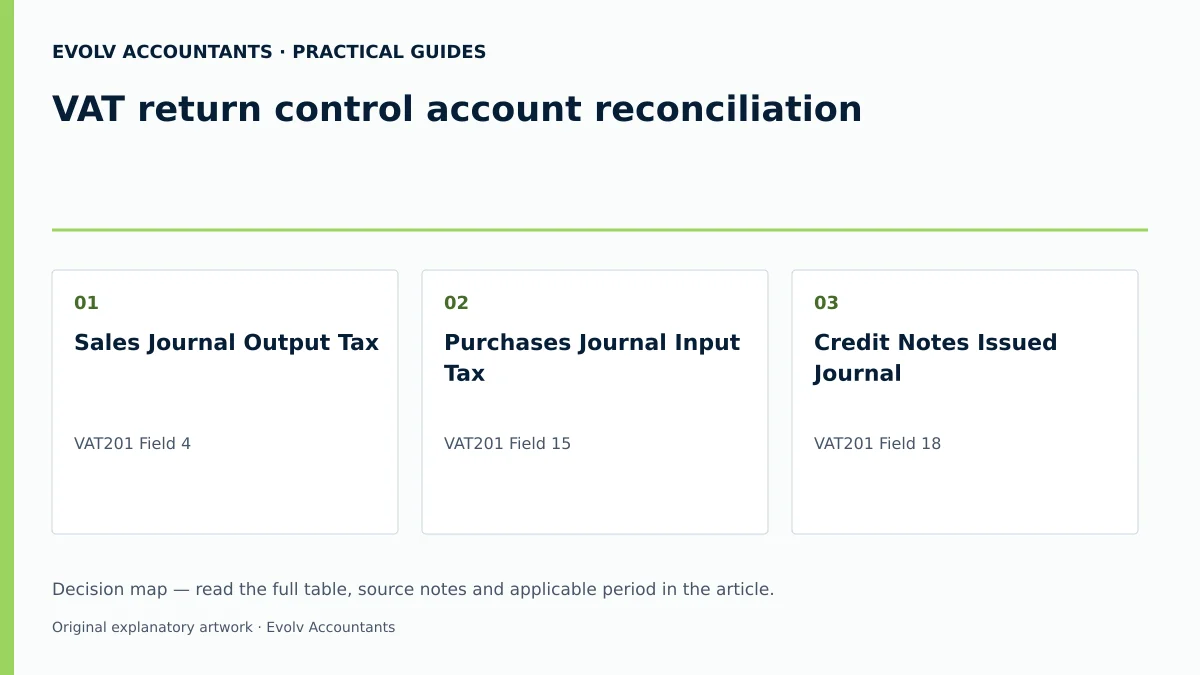
| Independent record A | Independent record B | Difference | Reason and evidence | Action and owner |
|---|---|---|---|---|
| Sales Journal Output Tax | VAT201 Field 4 | R0 | Fully agreed; general ledger output tax matches sales invoices issued 23 39. | File schedule; Senior Accountant. |
| Purchases Journal Input Tax | VAT201 Field 15 | R1,500 | Supplier invoice of R11,500 (VAT R1,500) posted in GL but tax invoice copy not held at filing date 29 30. | Request copy invoice from vendor; Accounts Payable Lead. |
| Credit Notes Issued Journal | VAT201 Field 18 | R0 | Credit note of R2,300 (VAT R300) issued for returned goods correctly claimed in Field 18 36 38. | Approved; Tax Manager. |
| Bank Payment Register | SARS Statement of Account | R0 | Payment of R9,000 made via eFiling credit push using 19-digit PRN cleared on last business day 25 40. | Verified against bank statement; Finance Director. |
Post only supported corrections: vat return control account reconciliation
Adjusting entries in the general ledger and corrections on SARS eFiling must strictly follow statutory rules.
Posting ledger journals
General ledger adjustment journals must only be posted when supported by valid documentary evidence, such as tax invoices, debit notes, credit notes, or customs clearance bills of entry 4 36 41. Unsubstantiated manual journals to the VAT control account are strictly prohibited.
SARS Request for Correction (RFC) rules
When correcting a previously submitted VAT201 return via eFiling Request for Correction (RFC), specific statutory restrictions apply 42 43:
- Part A (Output Tax): Declared amounts under Part A can be increased or decreased on a revised return 42.
- Part B (Input Tax): Declared input tax deductions under Part B can only be decreased on a revised return for a past tax period 42 44.
- Omitted Input Tax: A vendor is not permitted to increase input tax deductions on a past period return via RFC 44. Omitted input tax attributable to a past period must be claimed on a subsequent VAT201 return, provided the claim is made within five years from the date of first entitlement 44 45.
Review unresolved and old items: documented completion and exceptions
Unresolved variances must be actively managed through a structured review process.
Aged exception register
All outstanding reconciliation differences must be transferred to an Aged Exception Register detailing:
- Transaction date and unique source reference.
- Root cause of the discrepancy.
- Specific primary evidence required to resolve the item.
- Designated owner and resolution target date.
Prohibition of suspense account write-offs
Under no circumstances should unresolved VAT reconciliation variances be written off to general ledger suspense accounts, unallocated revenue, or general operational expenses. Hiding unresolved differences distorts management accounts and creates substantial exposure to administrative penalties and interest during a SARS compliance verification or audit 4 5.
The five-year period is a minimum, not an automatic destruction date. SARS record-keeping guidance requires the relevant records to remain available; retain them beyond the ordinary minimum where an ongoing audit, investigation, objection or appeal or another applicable rule requires it.
Next steps for VAT returns
Completing the reconciliation requires structured sign-off, adherence to filing deadlines, and systematic rollover to the next tax period.
Reviewer checks and submission deadlines
Before submitting the VAT201 return, a designated reviewer must execute the following checklist:
- [ ] Verify that opening balances match the closing balances of the prior tax period 12 13.
- [ ] Recalculate output tax on standard-rated supplies using the 15/115 tax fraction 9 23.
- [ ] Confirm that full tax invoices (more than R5,000) or abridged tax invoices (R5,000 or less) are held for all input tax claimed 29 31.
- [ ] Verify that debit notes and credit notes are correctly reflected in Field 12 or Field 18 35 36 38.
- [ ] Confirm that the unique 19-digit Payment Reference Number (PRN) is pre-populated on eFiling 24 25 46.
- [ ] Confirm submission and payment channel deadlines:
- Manual / Standard EFT: Return and payment must reach SARS by or before the 25th day of the month following the end of the tax period 47 48 49.
- eFiling: Return submission and electronic credit push payment must be completed by the last business day of the month 40 48 49.
- [ ] Retain all reconciliation workpapers, general ledger extracts, and tax invoices for at least five years 4 5 6.
Reproducible hypothetical example
Consider a Category A vendor operating on the invoice basis for the two-month period ending March 2026:
- Gross Standard-Rated Sales: R230,000 (VAT inclusive).
Output Tax = R230,000 × (15 ÷ 115) = R30,000 Declared in Field 1 (R230,000 consideration) and Field 4 (R30,000 tax) 23.
- Gross Standard-Rated Operational Expenses: R115,000 (VAT inclusive).
Input Tax = R115,000 × (15 ÷ 115) = R15,000 Declared in Field 15 29.
- Capital Equipment Purchase: R46,000 (VAT inclusive).
Input Tax = R46,000 × (15 ÷ 115) = R6,000 Declared in Field 14 29.
VAT201 Net Liability Calculation
- Total Output Tax (Field 13): R30,000 35.
- Total Input Tax (Field 19): R15,000 + R6,000 = R21,000 38.
- Net VAT Payable (Field 20): Field 13 - Field 19 = R30,000 - R21,000 = R9,000 38.
General Ledger Journal and Clearing
- Credit Output Tax Account: R30,000.
- Debit Input Tax Account: R21,000.
- Net Credit Balance in VAT Control Account: R9,000.
- Settlement Entry: Upon paying R9,000 via eFiling credit push using the 19-digit PRN, debit VAT Control Account R9,000 and credit Bank Account R9,000, leaving a zero closing balance for the period 25 50.
Frequently Asked Questions
What is the statutory threshold for compulsory VAT registration in South Africa?
Under Section 23 of the Value-Added Tax Act, compulsory registration applies if the total value of taxable supplies made by a person exceeds R1 million in any consecutive 12-month period, or under a written contractual obligation 51 52. Current SARS web guidance administers an updated administrative threshold of R2.3 million; however, this reflects administrative positioning rather than a statutory amendment to Section 23 51 52.
Can a vendor increase input tax on a past period return using eFiling Request for Correction?
No. SARS eFiling rules mandate that on a revised VAT201 return for a past tax period, input tax deductions under Part B can only be decreased 42 44. Omitted input tax must be claimed on a subsequent VAT201 return within five years from the date of first entitlement 44 45.
What are the official due dates for VAT201 returns and payments?
For manual submissions or standard EFT payments, the return and payment must reach SARS by the 25th day of the month following the tax period 47 48 49. Vendors who submit returns and pay via eFiling have until the last business day of the month 40 48 49.
What is the difference between a full tax invoice and an abridged tax invoice?
A full tax invoice is required when consideration is more than R5,000 and must contain the recipient's name, address, and VAT registration number 31. An abridged tax invoice is permissible for supplies R5,000 or less and does not require recipient details 31.
How long must general ledger records and VAT supporting documentation be retained?
Under Section 55 of the VAT Act and Chapter 4 of the Tax Administration Act, vendors are legally required to maintain all accounting records, tax invoices, debit/credit notes, and bank statements for at least five years 4 5 6. Ask Evolv about vAT return control account reconciliation. Share the relevant records so the support required can be scoped.
Related guides
- Correcting a VAT201 return after submission
- Completing a VAT201 return step by step
- The Proactive SARS Audit Guide: Keeping Your Business Ledger Sanitised
Sources
- Obligations of a VAT vendor | South African Revenue Service
- https://www.sars.gov.za/wp-content/uploads/Ops/Guides/Legal-Pub-Guide-VAT404-VAT-404-Guide-for-Vendors.pdf
- https://www.sars.gov.za/wp-content/uploads/Ops/Guides/GEN-ELEC-04-G01-Guide-for-completing-the-Value-Added-Tax-VAT201-Declaration-External-Guide.pdf
- Tax periods for VAT | South African Revenue Service