
Registering a micro business for turnover tax
21 December 2025

Registering a micro business for turnover tax requires qualifying South African enterprises to submit a completed TT01 form to SARS before trading commences or within two months of start-up 1 2 3.
Current period and year-end: SARS’s Budget 2026 guidance states that the tax year-end restriction is removed. Use the enterprise’s own year of assessment: the first TT02 payment is due six months after its tax year begins and the second at that year-end. August/February dates in a worked example assume a February year-end.
Check the entity’s current SARS payment and filing notices; older guides do not establish a current February-only eligibility test current SARS guidance.
Turnover tax provides a simplified, consolidated tax system for eligible South African micro businesses with an annual qualifying turnover not exceeding R2.3 million from 1 April 2026 4 5 6. By replacing standard Corporate Income Tax, Capital Gains Tax, Dividends Tax, and Provisional Tax with a single progressive levy on gross receipts, the regime reduces administrative overheads and record-keeping burdens 5 7 8.
Successful registration depends on strict adherence to SARS submission timelines, passing positive and negative eligibility tests, and maintaining verifiable submission evidence 9 10 11.
— Practical point from this guide
Registration timing process and evidence
South African micro business owners operating as sole proprietors, partnerships, close corporations, co-operatives, or private companies must understand the statutory registration timing rules administered by the South African Revenue Service (SARS) 9 12 13. For the 2027 year of assessment (running from 1 March 2026 to 28 February 2027), the qualifying turnover eligibility limit is R2.3 million, effective from 1 April 2026 4 6 14 15.
Completion of the registration timing process occurs only when SARS issues a formal written registration outcome letter confirming that the enterprise is officially registered as a micro business under the Sixth Schedule to the Income Tax Act 58 of 1962 11 13 16.
It is essential to distinguish turnover tax from other tax dispensations under South African law:
- Turnover Tax (Sixth Schedule): A elective regime calculated on gross non-capital receipts rather than profit, replacing normal income tax, capital gains tax, dividends tax, and provisional tax 5 7 13.
- Small Business Corporation (SBC) Tax (Section 12E): A separate income tax dispensation for incorporated entities with gross income up to R20 million, offering progressive tax rates on net taxable profit and accelerated depreciation allowances 17 18.
- Ordinary Corporate Income Tax (CIT): The standard flat tax rate of 27% levied on net taxable accounting profit for years of assessment ending between 1 April 2026 and 31 March 2027 19.
- Provisional Tax: The bi-annual advance payment system (IRP6) for standard income taxpayers, from which registered turnover taxpayers are explicitly exempt 5 7 20.
Prepare the information and authority: registration timing process
Before initiating an application, micro business owners must compile mandatory statutory documentation and verify specific legal definitions to avoid automatic rejection 21 22:
- CIPC registration and authority: Confirm the company or close corporation’s registration, authorised filer and actual assessment year. The current SARS guidance removes the former February-only year-end restriction current eligibility guidance.
- Identification and Banking Particulars: South African ID documents (or valid foreign passports for non-residents) for sole proprietors, partners, or company public officers, alongside an active business bank account in the applicant's name 24 25 26.
- Quick Test Eligibility Verification: Documented proof that the enterprise passes SARS positive and negative qualification criteria 9 10 27:
- Qualifying Turnover: Projected gross turnover must not exceed R2.3 million for the 12-month year of assessment 4 9.
- Professional Services Exclusions: Natural persons must ensure professional service receipts do not exceed 20% of total receipts 9 28 29. Companies must ensure combined professional service receipts and investment income do not exceed 20% of total receipts 9 28 30.
- Ownership Structure: Shareholders or members must be natural persons; companies holding shares in other unlisted companies or operating as personal service providers or labour brokers without exemption certificates are disqualified 9 31 32 33.
- Capital Disposals: Receipts from disposing of business capital assets must not exceed R1.5 million over a rolling three-year period 31 34.
Complete the task step by step: evidence
Taxpayers must execute the registration process through official SARS channels, preserving full audit evidence at each stage 12 35 36:
- Execute the Quick Test Screening: Complete the initial screening questionnaire on the Turnover Tax Application Form (TT01) to confirm eligibility 27.
- Complete the TT01 Application Form: Populate all mandatory fields, including legal entity type, tax reference numbers, CIPC registration details, main income source code, physical address, and bank account particulars 24 27 37.
- Sign the Legal Declaration: Print and sign the formal declaration on page 1 of the TT01 form, affirming under oath that all details are accurate and that the quick test was passed 38 39.
- Submit via Approved Channels:
- SARS Online Query System (SOQS): Access SOQS via the SARS website, select "Turnover Tax Registration", capture taxpayer details, attach the signed TT01 and supporting documents, and complete submission 12 36 40.
- Email Submission: Send scanned documents directly to contactus@sars.gov.za (for individual taxpayers) or pcc@sars.gov.za (for registered tax practitioners) 21 35 41.
- Branch eBooking: Schedule an in-person or virtual appointment via the SARS eBooking system and present the completed file to a consultant 12 21 42.
- Secure Receipt Confirmation: Retain the automated SMS or email notification containing the official SARS case number for tracking 43.
Check the result against the evidence: registration timing process
Submitting an application does not constitute active tax registration 11 44. Under Section 22(4) of the Tax Administration Act 28 of 2011, any application submitted without all required particulars and supporting documents is deemed not to have been submitted to SARS 44 45. This statutory deeming rule can result in SARS postponing the effective date of turnover tax registration to the subsequent year of assessment 44 45.
Independent verification requires obtaining a formal SARS written registration outcome letter 11. Upon approval, taxpayers must inspect their SARS eFiling profile and Tax Compliance Status (TCS) dashboard to verify that the turnover tax sub-profile is active and reflects the correct effective tax date 11 40.
Handle exceptions and unresolved cases: evidence
Specialist scenarios require careful adherence to statutory edge-case rules:
- Part-Year Trading Apportionment: If a business commences trading during a year of assessment, the annual qualifying turnover threshold must be reduced proportionately based on the number of full months not traded using the fixed amount method 46 47 48 49. Under the R2.3 million threshold, the limit is reduced by R191 666.67 per full month not traded.
- Nominal and temporary excess: Do not treat a percentage above the ceiling as an automatic safe harbour. Where the turnover ceiling is exceeded, obtain prompt advice on notification, a possible application to remain registered and any resulting deregistration. The 2% to 3% illustrations in older guides related to their older threshold; they are not a current entitlement under the R2.3 million ceiling. Confirm SARS’s applicable requirements and obtain its written decision current threshold guidance.
- Compulsory Deregistration Boundaries: If disqualification occurs, SARS deregisters the entity effective from the first day of the month following the disqualifying event 53 55 56. The entity is migrated to the normal tax system and is permanently prohibited from re-entering the turnover tax regime 57 58.
- Statutory Record-Keeping Mandate: Registered micro businesses must retain records of all receipts, dividends declared, and asset/liability lists exceeding R10 000 for five years from the return submission date 8 59 60 61.
Next steps for Turnover tax
- Conduct a pre-registration quick test assessment against current annual receipts 12 27.
- Record the company’s actual tax year and applicable SARS payment/filing notices; do not change its year-end solely to meet the removed restriction current year-end guidance.
- Complete and sign form TT01 21 39.
- Upload documents via SARS Online Query System (SOQS) and record the case number 36 43.
- Confirm receipt of the official SARS written registration letter before altering tax payment schedules 11.
Task and completion checklist
| Step | Input or evidence | Responsible person | Completion check | Exception or next action |
|---|---|---|---|---|
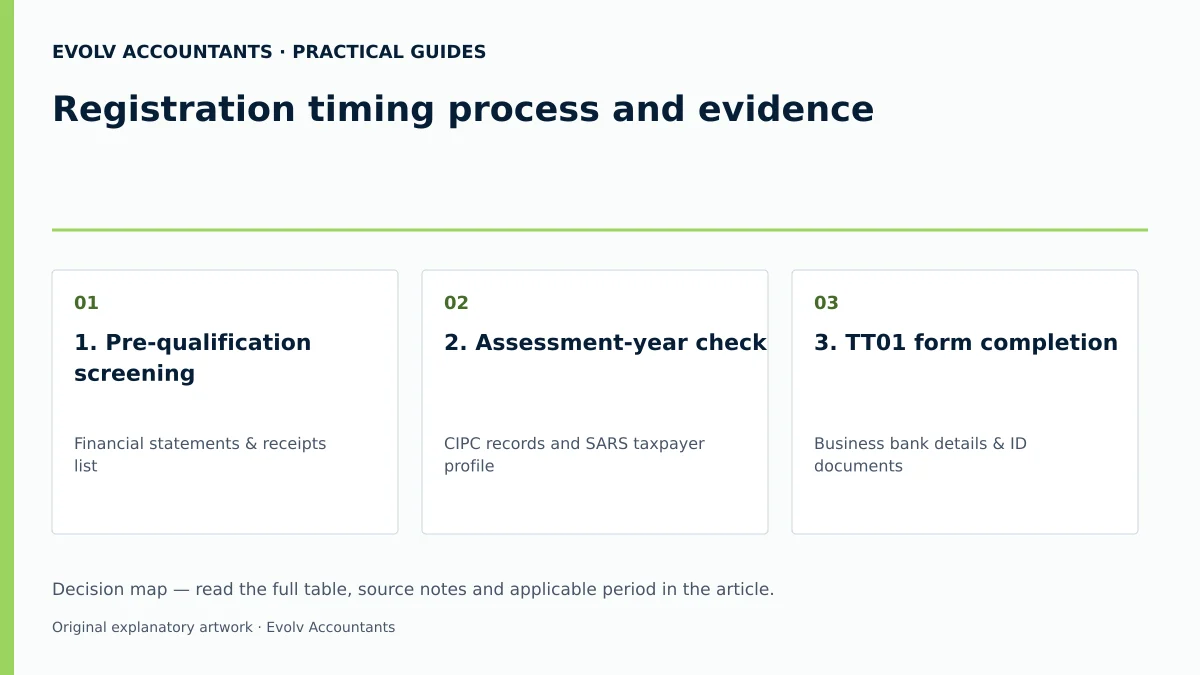
| 1. Pre-qualification screening | Financial statements & receipts list 27 | Business Owner / Director | Quick test passed with zero "No" answers 27 62 | If failed, assess Section 12E SBC tax eligibility 17 18 |
| 2. Assessment-year check | CIPC records and SARS taxpayer profile | Public officer / tax practitioner | Record the enterprise’s actual assessment year | Current SARS guidance removes the former February-only restriction current year-end guidance |
| 3. TT01 form completion | Business bank details & ID documents 25 | Applicant / Public Officer | All mandatory fields and declaration signed 21 39 | Incomplete forms cause deeming under TAA s22(4) 44 45 |
| 4. Channel submission | SOQS upload or email dispatch 35 36 | Tax Practitioner / Applicant | SARS SMS or email case number generated 43 | Re-submit via branch eBooking if system error occurs 12 21 |
| 5. Registration verification | Written SARS registration letter 11 | Business Owner / Evolv Advisor | Turnover tax active on eFiling profile 11 | Submit formal query to SARS if letter is delayed 11 |
Worked business example: 2027 year of assessment
To demonstrate the calculation mechanics under the 2027 year of assessment (1 March 2026 to 28 February 2027), consider "Cape Artisan Craft (Pty) Ltd", an incorporated small enterprise 14 63: This illustration assumes a 28 February 2027 year-end; other enterprises use their own applicable assessment-year dates current year-end guidance.
- Gross Receipts from SA Business Activities: R1 600 000 22 64
- Proceeds from Disposal of Business Equipment: R100 000 (sold asset used 100% for business) 65 66 67
- Investment Interest Received on Business Account: R20 000 68 69
- Exempt Government Grant (Section 12P, 11th Schedule): R30 000 64 70 71
- Supplier Refunds Received for Faulty Stock: R10 000 64 70 71
Qualifying Turnover Test (Eligibility)
Qualifying turnover excludes capital receipts and s12P government grants 72 73: Qualifying Turnover = R1 600 000 (Trading) + R20 000 (Interest) = R1 620 000 Because R1 620 000 is below the R2.3 million qualifying limit effective 1 April 2026, the company is eligible 4 9 74. Investment income (R20 000) represents 1.16% of gross receipts, remaining well under the 20% restriction 9 28 30.
Taxable Turnover Calculation
Taxable turnover includes gross non-capital receipts, 50% of capital asset disposals, and company investment income, less statutory exclusions 64 65 68 70:
- Gross Business Receipts: R1 600 000
- Add: 50% of Capital Asset Sale (50% of R100 000): R50 000 65 67
- Add: Investment Interest: R20 000 68 69
- Less: Exempt Section 12P Government Grant: (R30 000) 64 70
- Less: Supplier Refund Received: (R10 000) 64 70
Taxable Turnover = R1 600 000 + R50 000 + R20 000 - R30 000 - R10 000 = R1 630 000
Turnover Tax Liability Calculation (2027 Rates)
Applying the statutory 2027 rates for taxable turnover exceeding R1 400 000 4 14 63:
- Base Tax on R1 400 000: R12 500 4 14 63
- Tax on Amount Exceeding R1 400 000 (R1 630 000 - R1 400 000 = R230 000 at 3%): R6 900 4 14 63
Total 2027 Turnover Tax Liability = R12 500 + R6 900 = R19 400
Interim Payment Schedule (TT02)
- First Interim Payment (due 31 August 2026): 50% of estimated annual tax (R19 400 × 50% = R9 700) 75 76 77.
- Second Interim Payment (due 28 February 2027): Balance of estimated tax (R9 700) 75 78 79.
- Annual Return (TT03): Submitted after year-end to declare actual taxable turnover and reconcile interim payments 75 80 81.
Frequently Asked Questions
What is the new turnover tax eligibility threshold from 1 April 2026?
Effective 1 April 2026, the Minister of Finance increased the turnover tax qualifying turnover threshold from R1 million to R2.3 million per annum, allowing significantly more small enterprises to register 4 6 74.
What is the difference between qualifying turnover and taxable turnover?
Qualifying turnover is the screening calculation used to determine eligibility for registration and continued compliance (excluding capital receipts and government grants) 72 73 82. Taxable turnover is the statutory figure used to compute actual tax owed, incorporating 50% of capital asset disposal receipts 64 65 82.
Can a micro business be registered for both turnover tax and VAT?
Yes 83 84. A micro business registered under turnover tax may elect to register voluntarily for VAT or maintain compulsory VAT registration if taxable supplies exceed the increased VAT threshold of R2.3 million effective 1 April 2026 6 83 85 86.
What happens if a business temporarily exceeds the R2.3 million threshold?
If turnover exceeds the ceiling, do not assume that a nominal percentage excess preserves registration. Seek prompt advice on the applicable notification and application requirements, and obtain SARS’s written decision. Older percentage illustrations are not an automatic safe harbour under the current R2.3 million ceiling current threshold guidance.
What specific records must a registered micro business keep for SARS?
Micro businesses must retain records of all amounts received, dividends declared, and lists of assets and liabilities valued above R10 000 at year-end for five years from the return submission date 8 59 60 61. Ask Evolv about registration timing process and evidence. Share the relevant records so the support required can be scoped. [anchor: #article-enquiry]
Related guides
- Who qualifies for turnover tax in South Africa
- Turnover tax versus ordinary income tax for a sole proprietor
- The Proactive SARS Audit Guide: Keeping Your Business Ledger Sanitised
Sources
- Budget 2026 Frequently Asked Questions | South African Revenue Service
- https://www.sars.gov.za/wp-content/uploads/Ops/Guides/Legal-Pub-FAQs-TT01-FAQs-on-Turnover-Tax.pdf
- https://www.sars.gov.za/wp-content/uploads/Ops/Guides/Legal-Pub-Guide-TT01-Tax-Guide-for-Micro-Businesses.pdf
- Turnover Tax | South African Revenue Service
- https://www.sars.gov.za/wp-content/uploads/Ops/Guides/TT-GEN-01-G01-Administration-of-Turnover-Tax-External-Guide.pdf
- Turnover Tax | South African Revenue Service