
Who qualifies for turnover tax in South Africa
27 December 2025

Turnover tax is available to qualifying South African micro businesses that meet the current SARS turnover ceiling and every other eligibility test.
Current period and year-end: SARS’s Budget 2026 guidance states that the tax year-end restriction is removed. Use the enterprise’s own year of assessment: the first TT02 payment is due six months after its tax year begins and the second at that year-end. August/February dates in a worked example assume a February year-end.
Check the entity’s current SARS payment and filing notices; older guides do not establish a current February-only eligibility test current SARS guidance.
South African micro-businesses—including sole proprietors, partnerships, close corporations, companies, and co-operatives—may elect to enter the turnover tax system provided their annual qualifying turnover does not exceed R2.3 million effective 1 April 2026 1 2 3. Eligibility requires passing both positive structure criteria and negative activity tests, such as remaining under a 20% limit on professional services and investment income 2 4 5.
Turnover tax eligibility and excluded activities
Small and medium enterprise (SME) owners, sole proprietors, partners in a partnership, and directors of close corporations or private companies must carefully distinguish between tax eligibility and tax registration 2 6 7. Registration is a voluntary administrative election completed by submitting form TT01 to the South African Revenue Service (SARS) 2 8. In contrast, eligibility is an ongoing legal condition governed by the Sixth Schedule to the Income Tax Act 58 of 1962 7 9.
An entity may successfully register for turnover tax, but if it fails any eligibility test at any point during a year of assessment, its micro-business status immediately lapses by operation of law 10 11.
The effective period covered in this guide applies to the 2027 year of assessment (1 March 2026 to 28 February 2027), reflecting the legislative changes announced in Budget 2026 where the qualifying turnover ceiling was increased to R2.3 million effective 1 April 2026 1 12 13. Historical tax guides published by SARS pegged this eligibility limit at R1 million per year of assessment 14 15; those earlier limits remain historical references applicable only to older assessment years 16 17.
To maintain sound corporate governance, SMEs must differentiate among three regulatory tiers:
- Statutory Law: The Sixth Schedule to the Income Tax Act 58 of 1962, which establishes the binding legal framework for micro-business taxation 7 9.
- Regulator Guidance: Official SARS external guides, public notices, and frequently asked questions that outline administrative procedures and operational interpretations 9 18.
- Evolv Recommendations: Strategic advice from Evolv Accountants on record-keeping, risk management, and compliance structuring to protect business qualification.
The qualification tests to check: turnover tax eligibility
Eligibility for turnover tax cannot be determined by a generic company size label 15 19. An enterprise must systematically pass every independent qualification test detailed below 19 20:
- Positive Entity Structure Test: The business must operate as a natural person (sole proprietor or partner in a partnership), a deceased or insolvent estate of a natural person who was a registered micro-business, or a company (including a close corporation or co-operative) 2 6 7 21.
- Qualifying Turnover Threshold Test: The entity's annual "qualifying turnover" must not exceed R2.3 million for the year of assessment (effective 1 April 2026) 1 2. Qualifying turnover is defined as total actual business receipts from South African operations, excluding capital receipts and tax-exempt government grants or small business funding entity (SBFE) receipts 22 23 24. If trading commences mid-year, this threshold is proportionately reduced using the fixed amount method (dividing the threshold by 12 and subtracting R191,666.67 for each full month not traded) 25 26 27 28. Under historical 2025/2026 rules, the ceiling was R1 million (R83,333.33 per month) 14 23 26.
- Professional Services Limitation Test (Natural Persons): For natural persons (sole proprietors and partners), no more than 20% of total receipts during the year of assessment may derive from rendering a "professional service" 2 4 29. SARS defines professional services to include accounting, actuarial science, architecture, auctioneering, auditing, broadcasting, consulting, draftsmanship, education, engineering, financial service broking, health, information technology, journalism, law, management, real estate broking, research, sport, surveying, translation, valuation, or veterinary science 29 30.
- Investment Income and Professional Services Aggregate Test (Companies): For companies, close corporations, and co-operatives, the sum of professional service receipts and "investment income" (annuities, interest, rental from immovable property, royalties, and financial instrument proceeds) must not exceed 20% of total receipts 2 4 5 31.
- Shareholding and Equity Interest Restrictions: Neither the entity nor its natural person owners/shareholders may hold any shares or equity interest in any other company during the assessment year 4 32 33.
- Permissible Exceptions: Shareholdings are permitted in South African listed companies, collective investment schemes, body corporates/share block companies, venture capital companies (section 12J), social/consumer co-operatives (<5%), co-operative burial societies (<5%), friendly societies, and dormant companies with assets not exceeding R5,000 or companies in active liquidation/deregistration 34 35 36 37.
- Personal Service Provider and Labour Broker Exclusion: Companies classified as personal service providers under the Fourth Schedule and natural persons operating as labour brokers without a valid SARS exemption certificate are strictly excluded 2 38 39.
- Capital Disposals Ceiling Test: Total gross receipts from the disposal of capital assets (immovable property and other business equipment used >50% for business purposes) must not exceed R1.5 million over a rolling three-year period (comprising the current and two preceding assessment years) 38 40 41.
- Year-end and entity status: SARS’s 2026 guidance says the former February year-end restriction is removed; do not apply it as a current eligibility test current year-end guidance. Public benefit organisations (section 30), recreational clubs (section 30A), associations (section 30B), and small business funding entities (section 30C) are listed as excluded entity types in the older detailed guide; check the applicable legislation and entity classification 42 44.
Evidence behind the eligibility decision: excluded activities
To defend a turnover tax election during a SARS audit, business owners must compile a verifiable evidence record for each eligibility test 45 46.
— Practical point from this guide
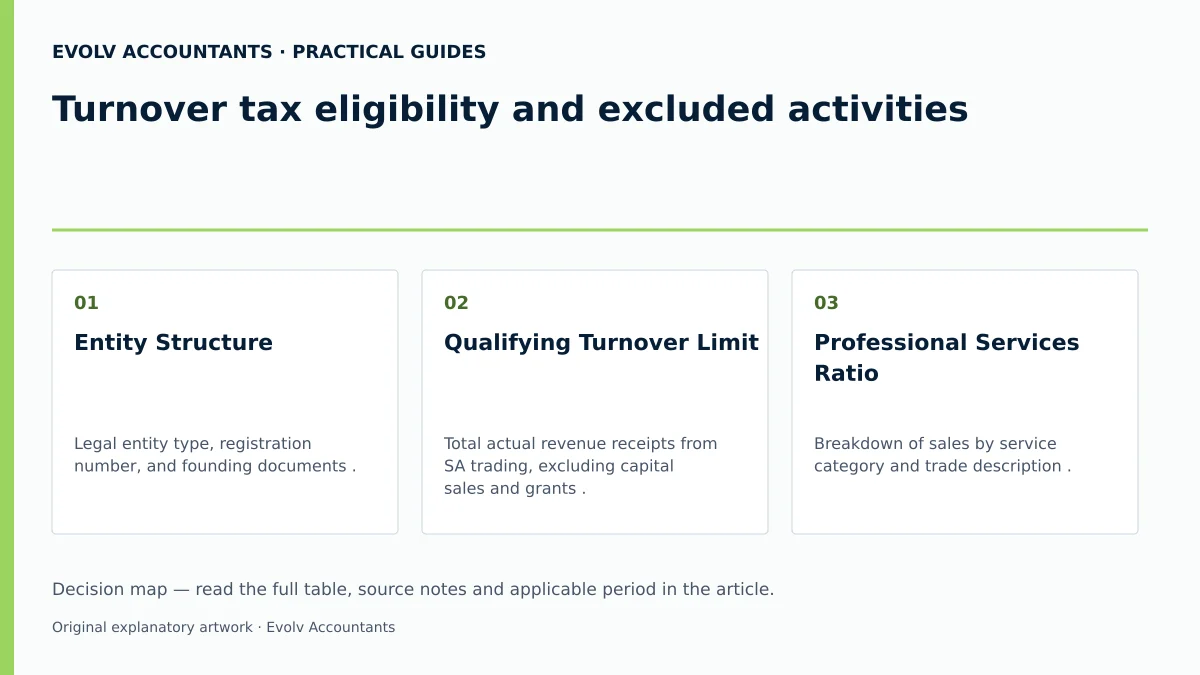
Eligibility decision table
| Test | Facts to obtain | Evidence | Applicable source | Result or unresolved question |
|---|---|---|---|---|
| Entity Structure | Legal entity type, registration number, and founding documents 6 47. | CIPC registration certificate, MOI, or partnership agreement 47. | Sixth Schedule Para 2 7 21; SARS External Guide 47. | Confirms basic corporate or individual trading status 6 7. |
| Qualifying Turnover Limit | Total actual revenue receipts from SA trading, excluding capital sales and grants 22 23. | Annual financial statements, bank statements, and sales ledgers 48 49. | Budget 2026 FAQ 1 2; SARS Turnover Tax Page 3. | Must reflect ≤ R2.3m for 2027 assessment year 1 3. |
| Professional Services Ratio | Breakdown of sales by service category and trade description 29 30. | Detailed customer invoices, fee notes, and contract scopes 30. | Sixth Schedule Para 1 29; Micro Business Guide 30. | Verify professional receipts do not exceed 20% of total receipts 2 4. |
| Investment Income Ratio | Interest, immovable rental, royalty, and financial instrument receipts 5 31. | Bank interest certificates, lease contracts, and dividend slips 5 31. | Sixth Schedule Para 3(b) 4; Micro Business Guide 5. | Mandatory <20% aggregate check for corporate entities 2 4. |
| Equity Ownership Check | Full directorship and shareholding records of all members/shareholders 4 33. | Share registers, directorship search reports, and member affidavits 33. | Sixth Schedule Para 3(a)/(f) 4 33; SARS Guide 37. | Ensures zero impermissible external equity holdings 4 35. |
| PSP & Labour Broker Status | Labour broker exemption certificates or client dependency metrics 38 50. | SARS Exemption Certificate or client concentration analysis 38 50. | Fourth Schedule 39; Sixth Schedule Para 3(d) 38. | Confirms entity is not a personal service provider 2 39. |
| Capital Asset Disposals | Total gross receipts from selling business property and equipment over 3 years 38 40. | Asset disposal registers, sale agreements, and bank deposit slips 40. | Sixth Schedule Para 3(e) 38; Micro Business Guide 40. | Must remain ≤ R1.5m over 3-year rolling period 38 40. |
Each evidence record should be reviewed and signed off by the company's Public Officer, Financial Director, or Sole Proprietor prior to filing form TT01 or TT03 47 51.
A qualifying case and an excluded case: turnover tax eligibility
The practical application of turnover tax eligibility rules can be illustrated through two hypothetical business scenarios for the 2027 year of assessment (1 March 2026 to 28 February 2027).
Case 1: Qualifying micro-business (Kasi Retail Supplies CC)
Kasi Retail Supplies CC is a close corporation owned equally by two natural persons, trading in general retail merchandise 6 52. For the 2027 assessment year, the business recorded the following receipts:
- Gross retail sales in South Africa: R1,800,000 53.
- Interest earned on business savings account: R15,000 54 55.
- Capital receipt from selling a delivery vehicle (used 100% for business): R20,000 54 55.
Qualifying Turnover Analysis: Qualifying turnover equals total business receipts excluding capital receipts 22 23. The retail sales of R1,800,000 fall comfortably below the R2.3 million threshold 1 2.
Investment Income & Professional Services Check: Total receipts equal R1,835,000 (R1,800,000 + R15,000 + R20,000) 56. Professional service income is R0 30. Investment income (interest) is R15,000 31 54. The investment income ratio is R15,000 / R1,835,000 = 0.82%, which is far below the 20% limit 2 4 57.
Taxable Turnover & 2027 Tax Calculation: Taxable turnover for a company includes business receipts, 50% of capital receipts from business assets, and investment income (excluding local dividends) 54 58 59 60.
- Retail sales: R1,800,000
- 50% of capital receipt (R20,000 × 50%): R10,000 58 60
- Interest income: R15,000 58 61
- Total Taxable Turnover: R1,825,000 62 63
Applying the 2027 Turnover Tax rates (1 March 2026 – 28 February 2027) 13 64:
- Bracket: R1,400,001 and above → R12,500 + 3% of taxable turnover above R1,400,000 13 64.
- Calculation: R12,500 + 3% × (R1,825,000 - R1,400,000) = R12,500 + (3% × R425,000) = R12,500 + R12,750 = R25,250 turnover tax liability 1 13 64.
Case 2: Excluded business (Apex Tech Solutions Pty Ltd)
Apex Tech Solutions (Pty) Ltd is a private company supplying computer hardware while providing software development and IT consulting services 52 65. For the 2027 assessment year, it received:
- Computer hardware sales: R1,200,000 65.
- Software development and IT consulting services: R450,000 65.
- Interest on bank deposits: R50,000 65.
- Total Receipts: R1,700,000 56 65.
Qualifying Turnover Analysis: Qualifying turnover is R1,650,000 (R1,200,000 + R450,000), which is below the R2.3 million qualifying limit 1 2 56.
Investment Income & Professional Services Check: Under the Sixth Schedule, IT consulting and software development fall under the definition of professional services 29 30 57.
- Professional service receipts: R450,000 29 65
- Investment income (interest): R50,000 31 65
- Combined professional + investment income: R500,000 4 56
- Ratio: R500,000 / R1,700,000 = 29.41% 56 57
Because the combined professional service and investment income exceeds the 20% limit, Apex Tech Solutions (Pty) Ltd is strictly disqualified from turnover tax 2 4 57. It must remain under normal Corporate Income Tax (CIT) at 27% on taxable income 57 66 67.
What changes the answer: excluded activities
A business that initially qualifies for turnover tax can lose its eligibility at any time due to operational or structural changes 10 11. Reassessment is triggered by:
- Ownership Changes: If any share or member interest is transferred to a non-natural person (such as a company or trust), the entity is immediately disqualified 4 33 42.
- External Investments: If a shareholder or partner acquires an equity interest in another unlisted trading company, the micro-business loses its status 4 32 42.
- Income Stream Shifts: Expanding professional service lines or earning increased passive interest/rental income that pushes aggregate professional/investment receipts above 20% invalidates qualification 2 4 5.
- Exceeding the Turnover Threshold: If qualifying turnover exceeds R2.3 million during a year of assessment, compulsory deregistration takes effect from the first day of the month following the disqualifying event 10 68 69.
- Nominal and temporary excess: Do not treat a percentage above the ceiling as an automatic safe harbour. Where the turnover ceiling is exceeded, obtain prompt advice on notification, a possible application to remain registered and any resulting deregistration. The 2% to 3% illustrations in older guides related to their older threshold; they are not a current entitlement under the R2.3 million ceiling. Confirm SARS’s applicable requirements and obtain its written decision current threshold guidance.
- Capital Asset Disposals: Selling business assets resulting in cumulative gross capital receipts exceeding R1.5 million over a three-year period disqualifies the business 38 40.
Next steps for Turnover tax
To determine eligibility and execute a compliant turnover tax election, follow this six-step decision checklist:
- Perform Quick Test Screening: Complete the official SARS Quick Test to identify any immediate disqualifiers 6 73.
- Calculate Qualifying Turnover Projections: Verify that total business receipts for the tax year will not exceed R2.3 million (applying pro-rata reductions for partial trading years) 1 2 25 27.
- Audit Income Categories: Analyse sales ledgers to confirm professional services and investment income remain below 20% of total receipts 2 4 5.
- Verify Ownership Integrity: Confirm all shareholders/partners are natural persons with no impermissible external equity holdings 4 32 42.
- Submit Registration (Form TT01): Apply via the SARS Online Query System (SOQS), schedule a branch eBooking appointment, or submit form TT01 via email (contactus@sars.gov.za for taxpayers or pcc@sars.gov.za for practitioners) within 2 months of starting trade for new businesses or before the tax year begins for existing businesses 6 74 75 76.
- Establish Statutory Record-Keeping: Set up accounting controls to retain records of all receipts, declared dividends, and asset/liability registers exceeding R10,000 for at least 5 years 45 48 49.
Frequently Asked Questions
Can a business be registered for both Turnover Tax and VAT?
Yes. Micro-businesses registered for turnover tax may voluntarily register for VAT if they meet statutory voluntary VAT requirements 3 77 78. Effective 1 April 2026, Budget 2026 aligns the compulsory VAT registration threshold with the turnover tax limit at R2.3 million 12 79.
How are investment income and capital receipts treated for sole proprietors versus companies?
For sole proprietors and partners, investment income (interest, dividends, property rental) is excluded from turnover tax and reported separately on the annual ITR12 return under normal income tax rules to access individual interest exemptions 17 59 80 81. For companies, investment income (excluding dividends) is included in taxable turnover 58 59 60. Capital receipts are excluded from qualifying turnover for all taxpayers 22 23, but 50% of capital receipts from business assets are included in taxable turnover 58 60.
What occurs if a micro-business exceeds the R2.3 million limit mid-year?
The business must notify SARS in writing within 21 days 68 69. Compulsory deregistration takes effect from the first day of the month following the disqualifying event 10 68. Assessment for that year will combine turnover tax for the qualified months and normal tax for the remainder 10. Transitional rules under section 48C protect the business from underpayment penalties solely resulting from compulsory threshold deregistration 82 83.
How is qualifying turnover apportioned if trading commences mid-year?
If trading starts during a year of assessment, the R2.3 million threshold is reduced proportionately using the fixed amount method 25 26 27 28. The annual ceiling is divided by 12 (R191,666.67 per month), and this monthly amount is multiplied by the number of full months not traded and subtracted from R2.3 million 26 28.
What specific records must a turnover tax business retain?
A registered micro-business is legally required to retain records of all amounts received, records of dividends declared, and lists of all assets and liabilities exceeding R10,000 at the end of each tax year for 5 years from return submission 45 48 49. Ask Evolv about turnover tax eligibility and excluded activities. Share the relevant records so the support required can be scoped. [#article-enquiry]
Related guides
- Turnover tax rates and a worked business example
- Registering a micro business for turnover tax
- The Proactive SARS Audit Guide: Keeping Your Business Ledger Sanitised
Sources
- Budget 2026 Frequently Asked Questions | South African Revenue Service
- Turnover Tax | South African Revenue Service
- https://www.sars.gov.za/wp-content/uploads/Ops/Guides/Legal-Pub-FAQs-TT01-FAQs-on-Turnover-Tax.pdf
- https://www.sars.gov.za/wp-content/uploads/Ops/Guides/Legal-Pub-Guide-TT01-Tax-Guide-for-Micro-Businesses.pdf
- Turnover Tax | South African Revenue Service
- https://www.sars.gov.za/wp-content/uploads/Ops/Guides/TT-GEN-01-G01-Administration-of-Turnover-Tax-External-Guide.pdf