
Turnover tax rates and a worked business example
10 July 2026

Turnover tax is a simplified tax regime administered by SARS that replaces multiple standard taxes for qualifying micro businesses.
Current period and year-end: SARS’s Budget 2026 guidance states that the tax year-end restriction is removed. Use the enterprise’s own year of assessment: the first TT02 payment is due six months after its tax year begins and the second at that year-end. August/February dates in a worked example assume a February year-end.
Check the entity’s current SARS payment and filing notices; older guides do not establish a current February-only eligibility test current SARS guidance.
The turnover tax framework offers eligible South African micro businesses a streamlined alternative to standard corporate and individual tax structures 1 2. Effective 1 April 2026, SARS guidance increases the qualifying turnover ceiling from R1 million to R2.3 million per year of assessment 3 4. The system consolidates normal income tax, capital gains tax, provisional tax, and dividends tax on distributions up to R200 000 per annum into a single levy based on gross business receipts rather than taxable profit 1 5 6 7.
For the 2027 year of assessment (1 March 2026 – 28 February 2027), tax rates feature a tax-free band up to R600 000 and progressive rates up to 3% on taxable turnover exceeding R1 400 000 3 8 9. Successful compliance depends on distinguishing qualifying turnover from taxable turnover, applying statutory inclusions and exclusions, and meeting bi-annual interim payment deadlines on form TT02 alongside the annual TT03 declaration 10 11 12 13.
Current bands and taxable turnover example
The turnover tax regime is designed for micro enterprises operating as sole proprietors, partnerships, close corporations, co-operatives, or private companies 2 14. Its primary output is a simplified tax liability expressed in South African Rand (ZAR) 8 15. The assessment period is the enterprise’s applicable tax year; current SARS guidance removes the former February-only year-end restriction current year-end guidance.
A fundamental principle of the turnover tax regime is the complete separation of accounting profit from taxable turnover 1 13. Under standard tax accounting, commercial profit is calculated by deducting allowable operating expenses, depreciation, and cost of sales from gross revenue 13. Under turnover tax, expenses are not deductible 13 18. Instead, SARS applies significantly reduced progressive tax rates directly to the business's gross receipts (taxable turnover) 6 19.
Statutory law governs the turnover tax framework through Part IV (sections 48 to 48C) and the Sixth Schedule to the Income Tax Act 58 of 1962, alongside the Tax Administration Act 28 of 2011 17 20 21. The South African Revenue Service (SARS) provides operational guidance through external guides and budget announcements 20 22. Evolv Accountants recommends that micro businesses perform quarterly reconciliations between cash receipts ledgers and bank statements to ensure compliance before submitting interim declarations.
— Practical point from this guide
Inputs rates periods and exclusions: current bands
Statutory tax rate bands for the 2027 year of assessment
For years of assessment ending between 1 March 2026 and 28 February 2027, SARS applies the following progressive rate bands to taxable turnover 3 8 9:
- R1 – R600 000: 0% of taxable turnover 3 8 9.
- R600 001 – R950 000: 1% of the amount above R600 000 3 8 9.
- R950 001 – R1 400 000: R3 500 + 2% of the amount above R950 000 3 8 9.
- R1 400 001 and above: R12 500 + 3% of the amount above R1 400 000 3 8 9.
Assessment-year-labelled historical definitions
For historical assessment years (covering 1 March 2015 to 28 February 2026), the rate bands were structured as follows 23 24 25 26:
- R1 – R335 000: 0% 23 24 25 26.
- R335 001 – R500 000: 1% of the amount above R335 000 23 24 25 26.
- R500 001 – R750 000: R1 650 + 2% of the amount above R500 000 23 24 25 26.
- R750 001 and above: R6 650 + 3% of the amount above R750 000 23 24 25 26.
Historical SARS guides referencing a R1 million qualifying turnover limit reflect statutory definitions prior to the Budget 2026 update, which elevated the eligibility ceiling to R2.3 million from 1 April 2026 3 4 11 17 27.
Qualifying turnover versus taxable turnover
- Qualifying turnover is the metric used to determine initial registration eligibility and continued entitlement to remain in the regime 11 28. It comprises total gross business receipts excluding capital receipts, section 12P government grants, and section 10(1)(zK) small business funding entity (SBFE) receipts 29 30.
- Taxable turnover is the base upon which the tax levy is calculated 13 31.
Inclusions and exclusions in taxable turnover
Taxable turnover includes all gross business receipts derived from business activities conducted within South Africa 13 31 32, plus 50% of gross proceeds from the disposal of capital assets used mainly (>50%) for business purposes (excluding trading stock and financial instruments) 33 34 35. For corporate entities (companies and close corporations), investment income (interest, rentals, royalties) is also included in taxable turnover 36 37 38.
The following items must be specifically excluded from taxable turnover 39 40 41:
- Investment income earned by natural persons (sole proprietors or partners) 39 40 42.
- Exempt government grants under section 12P and Eleventh Schedule listings 39 40 43.
- Funding received from approved SBFEs under section 10(1)(zK) 39 40 41.
- Receipts from business activities conducted entirely outside South Africa 32 41 43.
- Amounts previously subject to normal income tax prior to turnover tax registration 39 40 42.
- Refunds paid to clients or received from suppliers for returned goods or services 39 41 42 44.
Disqualification criteria (negative test)
A business is disqualified from turnover tax if any of the following apply during the year of assessment 14 45 46 47:
- Qualifying turnover exceeds R2.3 million (from 1 April 2026) 3 4 14.
- More than 20% of total receipts stem from professional services (for natural persons) 14 16 48 or a combination of professional services and investment income (for companies) 14 16 49.
- The entity is classified as a personal service provider or a labour broker without a SARS exemption certificate 14 46 50.
- Total receipts from capital asset disposals exceed R1.5 million over a rolling three-year period 46 51 52.
- In the case of a company, any shareholder is a non-natural person or holds equity in another unlisted corporate entity 14 47 53 54.
The calculation in a worked example: taxable turnover example
To illustrate the practical application of the 2027 rate bands, consider a hypothetical South African private company, Kasi Logistics (Pty) Ltd, during the year of assessment ending 28 February 2027.
Input data for Kasi Logistics (Pty) Ltd (2027 year of assessment)
- Gross receipts from local logistics services: R1 120 000 13 55.
- Gross receipts from transport contracts executed outside South Africa: R50 000 32 43.
- Proceeds from the sale of an old delivery van (capital asset used 100% for business): R20 000 33 34.
- Interest earned on the business operational bank account: R10 000 36 37.
- Approved section 12P government grant (Agro-Processing Support Scheme): R30 000 39 40 56.
- Refund received from a vehicle parts supplier for returned defective components: R5 000 39 44.
- Receipt of an outstanding trade debt accrued and taxed under normal tax in 2026: R15 000 39 40.
Eligibility check (Qualifying Turnover)
Qualifying turnover = Local sales (R1 120 000) + Foreign sales (R50 000) + Interest (R10 000) = R1 180 000 29 30. Capital proceeds (R20 000) and exempt grants (R30 000) are excluded 29 30. Because R1 180 000 is below the R2.3 million threshold, Kasi Logistics maintains turnover tax eligibility 3 4 30.
| Input | Value or verified-source placeholder | Formula or step | Result | Independent check |
|---|---|---|---|---|
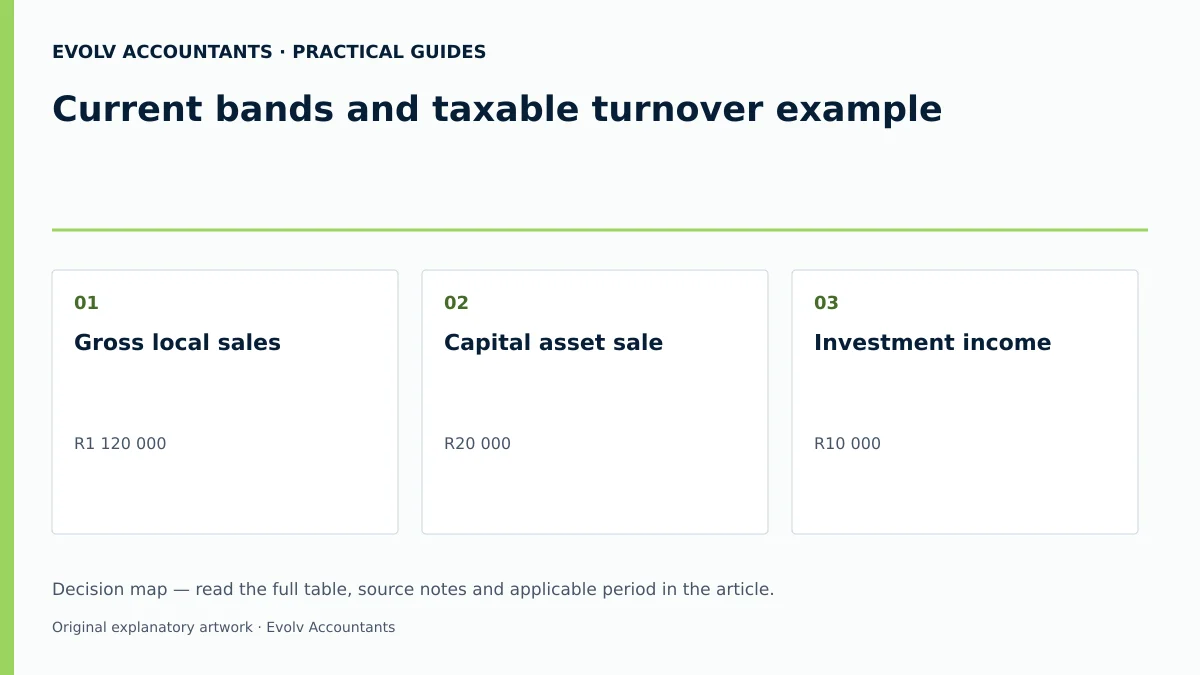
| Gross local sales | R1 120 000 | Core trading receipts in SA 13 55 | R1 120 000 | Invoiced cash receipts |
| Capital asset sale | R20 000 | Add 50% of gross proceeds 33 34 35 | R10 000 | R20 000 × 50% |
| Investment income | R10 000 | Add bank interest (companies) 36 37 38 | R10 000 | Bank interest statement |
| Subtotal inclusions | R1 150 000 | R1 120 000 + R10 000 + R10 000 | R1 140 000 | Gross inclusion total |
| Less: Foreign sales | R50 000 | Deduct non-SA service receipts 32 43 | -R50 000 | Cross-border contracts |
| Less: Exempt s12P grant | R30 000 | Deduct Eleventh Schedule grant 39 40 | -R30 000 | Official grant letter |
| Less: Supplier refund | R5 000 | Deduct equipment refund 39 41 44 | -R5 000 | Credit note voucher |
| Less: Previously taxed | R15 000 | Deduct prior normal tax accrual 39 40 | -R15 000 | 2026 ITR14 assessment |
| Net Taxable Turnover | R1 040 000 | R1 140 000 - R100 000 exclusions 13 40 | R1 040 000 | Verified taxable base |
| 2027 Tax Computation | R1 040 000 | R3 500 + 2% × (R1 040 000 - R950 000) 3 8 | R5 300 | R3 500 + R1 800 |
| 1st Interim (TT02) | R2 650 | 50% of annual estimate (31 Aug 2026) 57 58 | R2 650 | TT02 payment receipt |
| 2nd Interim (TT02) | R2 650 | Annual tax less 1st interim (28 Feb 2027) 57 59 | R2 650 | TT02 payment receipt |
| Final TT03 Balance | R0 | Final liability less interim credits 10 60 | R0 | SARS ITA34 assessment |
Reconcile the answer to the underlying records: current bands
To ensure complete reconciliation, taxpayers must check totals, rounding, interim credits, and payment records against SARS notices 10 60.
Interim payment structure (TT02)
Micro businesses must make two interim tax payments during the year of assessment 10 58 61:
- First interim payment: Due six months after the enterprise’s tax year begins current payment guidance. Estimate annual taxable turnover, calculate the annual tax and apply the required first-payment share 58 61.
- Second interim payment: Due at the enterprise’s tax year-end current payment guidance. Re-estimate annual taxable turnover and remit the required balance after deducting the first payment 57 59.
If a payment deadline falls on a Saturday, Sunday, or public holiday, payment must be received by SARS no later than the last preceding business day 57 62 63. Payments are submitted via bank electronic funds transfer using the unique Payment Reference Number (PRN) generated on the TT02 advice note 62 64 65. The TT02 document serves as the taxpayer's internal record and is not submitted to SARS 57 62 65.
Annual return filing (TT03)
After the assessment year ends, submit TT03 by the applicable SARS filing notice. SARS’s current guidance says an individual’s TT03 submission aligns with annual income-tax returns; use the actual notice for the taxpayer and year rather than assuming a permanent July-to-January window current filing guidance. SARS reconciles the assessed liability with interim payments 10 60.
Statutory record-keeping obligations
Registered micro businesses are exempt from keeping full double-entry accounting records for tax purposes but must retain the following primary documents for five years from the return submission date 19 66 67 68:
- Records of all business amounts received 19 66 67.
- Records of all dividends declared 19 66 67.
- A list of all business assets with a cost price exceeding R10 000 at year-end 19 66 67.
- A list of all business liabilities exceeding R10 000 at year-end 19 66 67.
Edge cases that change the calculation: taxable turnover example
Short trading periods (Pro-rata threshold)
When a business commences trading mid-year, the annual qualifying turnover ceiling is proportionately reduced based on the number of full months the entity did not trade 69 70. SARS applies the "fixed amount method" 70 71:
- Under the current R2.3 million ceiling, the monthly fixed amount is R191 666.67 (R2.3m / 12).
- Under the historical R1 million ceiling, the monthly fixed amount was R83 333.33 (R1m / 12) 71 72.
Example: A business commencing trade on 15 June did not operate for three full months (March, April, May) 71 72. Under the historical ceiling, the limit was reduced by R249 999.99 (3 × R83 333.33) to R750 000 71 72.
Mixed-use capital assets
When a business disposes of an asset used for both business and private purposes, the 50% capital inclusion rule applies only if the asset was used mainly (>50%) for business 33 35:
- Immovable property must have more than 50% of its floor area dedicated to business operations 33 35.
- Movable assets must be used for business activities more than 50% of the time 33.
Assets used 50% or less for business are excluded from turnover tax calculations and fall under standard Capital Gains Tax (CGT) rules 73.
Connected persons and anti-avoidance
To prevent business splitting across connected persons (relatives within the third degree or corporate entities) to exploit multiple tax-free thresholds, statutory anti-avoidance rules mandate combining the qualifying turnovers of connected entities 74 75 76 77. If the combined qualifying turnover exceeds the threshold, all connected entities are disqualified 75 78.
Compulsory deregistration and nominal excess
If qualifying turnover exceeds R2.3 million during a tax year, the business must notify SARS within 21 calendar days and undergoes compulsory deregistration effective from the first day of the month following the disqualifying event 79 80 81.
If turnover exceeds the ceiling, do not assume that a nominal percentage excess preserves registration. Seek prompt advice on the applicable notification and application requirements, and obtain SARS’s written decision. Older percentage illustrations are not an automatic safe harbour under the current R2.3 million ceiling current threshold guidance.
Next steps for Turnover tax
Before electing or maintaining turnover tax, micro business owners should execute the following structured verification steps:
- Perform the Quick Test: Complete SARS screening questions on form TT01 to confirm eligibility across ownership structure, asset disposals, and professional service limits 86 87.
- Calculate Qualifying Turnover: Sum all projected trade receipts, excluding capital proceeds and exempt grants, to verify that total turnover remains under R2.3 million 29 30.
- Review Professional and Investment Income: Confirm that professional service income does not exceed 20% of total receipts 16 48.
- Prepare interim estimates: Track actual receipts and diarise the payment dates six months after the enterprise’s tax year begins and at that year-end current payment guidance.
- Establish Record Archives: Set up digital storage for gross receipt invoices, dividend declarations, and asset/liability registers exceeding R10 000 19 66 67.
Frequently Asked Questions
Who qualifies for the turnover tax regime under the updated SARS thresholds?
Any micro business—including sole proprietors, partnerships, close corporations, private companies, and co-operatives—with an annual qualifying turnover of R2.3 million or less (effective 1 April 2026) qualifies, provided it passes the statutory negative disqualification tests 2 3 14.
How do the 2027 turnover tax rate bands differ from historical assessment years?
For the 2027 year of assessment (1 March 2026 – 28 February 2027), the tax-free threshold increases to R600 000, with rates of 1% between R600 001 and R950 000, 2% up to R1 400 000, and 3% above R1 400 000 3 8 9. Historical tax years (2016–2026) featured a lower tax-free threshold of R335 000 and top marginal rates starting above R750 000 23 24 25 26.
What is the difference between qualifying turnover and taxable turnover?
Qualifying turnover determines whether a business is eligible to register and remain in the system 11 28. Taxable turnover is the net amount after specific statutory inclusions (such as 50% of capital asset sales) and exclusions (such as exempt government grants and foreign sales) to which the turnover tax rate table is applied 13 31 35 39 40.
How are capital asset sales and investment income treated under turnover tax?
For capital assets used mainly (>50%) for business purposes, 50% of gross sales proceeds are included in taxable turnover 33 34 35. Investment income (interest, rentals) is included in taxable turnover for companies 36 37, but excluded for natural persons, who report it on their individual ITR12 return 39 40 42.
What are the interim payment deadlines and administrative compliance requirements for micro businesses?
Registered micro businesses make two TT02 payments: the first six months after their tax year begins and the second at that year-end. File TT03 after year-end by the applicable SARS notice current payment and filing guidance. Retain the prescribed receipt, dividend, asset and liability records 19 66 67 68.
Related guides
- Who qualifies for turnover tax in South Africa
- Registering a micro business for turnover tax
- The Proactive SARS Audit Guide: Keeping Your Business Ledger Sanitised
Sources
- Budget 2026 Frequently Asked Questions | South African Revenue Service
- https://www.sars.gov.za/wp-content/uploads/Ops/Guides/Legal-Pub-Guide-TT01-Tax-Guide-for-Micro-Businesses.pdf
- Turnover Tax | South African Revenue Service
- Turnover Tax | South African Revenue Service
- https://www.sars.gov.za/wp-content/uploads/Ops/Guides/Legal-Pub-FAQs-TT01-FAQs-on-Turnover-Tax.pdf
- https://www.sars.gov.za/wp-content/uploads/Ops/Guides/TT-GEN-01-G01-Administration-of-Turnover-Tax-External-Guide.pdf