
Turnover tax versus ordinary income tax for a sole proprietor
11 March 2025

Choosing between turnover tax and ordinary income tax requires a sole proprietor to evaluate profit margin sensitivity against simplified turnover tax brackets.
Current period and year-end: SARS’s Budget 2026 guidance states that the tax year-end restriction is removed. Use the enterprise’s own year of assessment: the first TT02 payment is due six months after its tax year begins and the second at that year-end. August/February dates in a worked example assume a February year-end.
Check the entity’s current SARS payment and filing notices; older guides do not establish a current February-only eligibility test current SARS guidance.
A sole proprietor in South Africa must evaluate the structural differences between gross turnover taxation under the Turnover Tax regime and net taxable profit taxation under ordinary Personal Income Tax 1 2. Turnover Tax replaces standard personal income tax, capital gains tax, and provisional tax with a single progressive tax calculated directly on gross business receipts, without permitting expense deductions 1 3.
Sole proprietors operating with high profit margins and low deductible expenses often secure substantial tax savings under Turnover Tax, provided their qualifying turnover does not exceed R2.3 million per annum and professional service fees do not exceed 20% of receipts 4 5 6 7. Conversely, sole proprietors operating on narrow profit margins or incurring heavy deductible business expenses generally pay less tax under ordinary Personal Income Tax because allowable expense deductions reduce net taxable income 2 8.
Profit margin sensitivity in a regime comparison
Evaluating Turnover Tax against ordinary Personal Income Tax requires understanding how each system defines the tax base 1 2. Under the Sixth Schedule to the Income Tax Act, Turnover Tax is a simplified, optional tax regime available to eligible micro businesses 1 9 10 11. It calculates tax liability on "taxable turnover"—comprising gross receipts from business activities in South Africa—at reduced progressive rates without allowing deductions for cost of goods sold, operating expenses, or capital allowances 1 2 3.
In contrast, ordinary Personal Income Tax taxes a sole proprietor under standard progressive personal income tax brackets on net taxable income, which equals gross business income less allowable expenditure incurred in the production of income 2 8. Consequently, profit margin sensitivity acts as the primary financial pivot:
- High-margin sole proprietorships (where expenses represent a small fraction of gross sales) generate large taxable profits under ordinary income tax 8. Under Turnover Tax, these businesses pay tax on gross revenue at low rates (ranging from 0% to 3%), frequently yielding significant net tax reductions 5 12.
- Low-margin sole proprietorships (where inventory, direct labor, or overhead costs absorb most gross revenue) generate small net profits 2. Under Turnover Tax, the tax is levied on total revenue regardless of profitability, which can produce a higher effective tax bill than ordinary income tax 2 3 5.
Neither regime is universally superior; the optimal choice depends strictly on the sole proprietor's cost structure, profit margin, and eligibility profile 2 6.
Compare the criteria that matter: profit margin sensitivity in a regime comparison
Sole proprietors must weigh control, liability, administrative compliance, tax calculation bases, cash flow timing, and operational constraints when comparing the two regimes 2 6 13 14.
Decision comparison matrix
| Criterion | Option A: Turnover Tax (Micro Business) | Option B: Ordinary Personal Income Tax | Evidence or assumption | Implication for this reader |
|---|---|---|---|---|
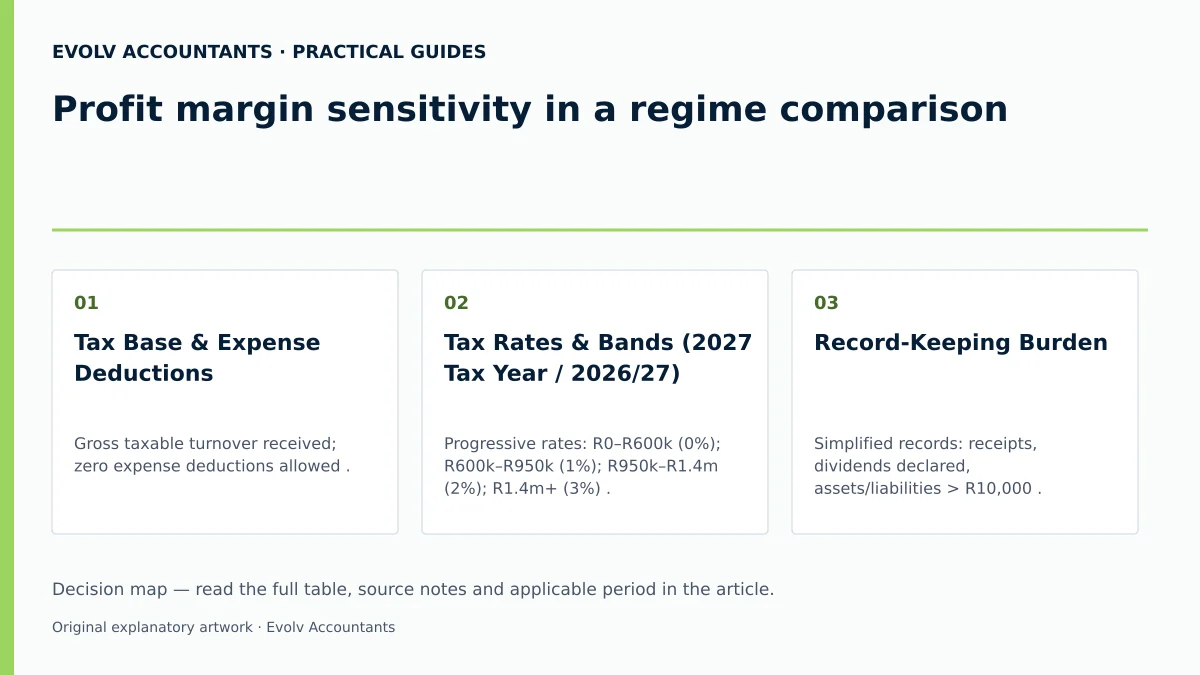
| Tax Base & Expense Deductions | Gross taxable turnover received; zero expense deductions allowed 1 2 3. | Net taxable income (gross income less allowable business deductions) 2 8. | Income Tax Act Sixth Schedule vs standard income tax rules 2 9. | High-margin businesses benefit under Option A; low-margin businesses benefit under Option B 2. |
| Tax Rates & Bands (2027 Tax Year / 2026/27) | Progressive rates: R0–R600k (0%); R600k–R950k (1%); R950k–R1.4m (2%); R1.4m+ (3%) 5 12. | Personal tax brackets from 18% (above R99k threshold) to 45% (above R1,878,600) 8 15. | Budget 2026 FAQs & SARS Turnover Tax schedules 5 8 12. | Option A offers lower marginal tax rates on gross sales compared to Option B's marginal income tax brackets 5 8. |
| Record-Keeping Burden | Simplified records: receipts, dividends declared, assets/liabilities > R10,000 13 16 17. | Full financial accounting: income, line-item expenses, invoices, logbooks, vouchers 2. | Paragraph 14 of Sixth Schedule vs standard SARS audit requirements 2 16 17. | Option A significantly reduces administrative overhead and bookkeeping costs 1 13. |
| Payment Frequency & Provisional Tax | Two TT02 payments: six months after the tax year begins and at its end; annual TT03 return current payment guidance. | Two provisional tax payments (31 August and 28/29 February); annual ITR12 return 20. | Payment Advice TT02 and Provisional Tax rules 14 18 20. | Both regimes require bi-annual interim payments, but Option A replaces provisional tax calculations 1 18. |
| Ineligible Services / Professional Exclusions | Disqualified if >20% of total receipts derived from professional services 6 7 21. | No professional service percentage restriction 8. | Section 1 of Sixth Schedule definition of professional services 7 21 22. | Consultants, lawyers, accountants, and IT specialists over 20% must use Option B 6 21 23. |
How the obligations differ: documented completion and exceptions
Tax law establishes the structural criteria for Turnover Tax in the Sixth Schedule, while regulator guidance from the South African Revenue Service (SARS) defines administrative submission procedures 9 11. Evolv recommends establishing a formal decision record before switching regimes to verify compliance across all statutory criteria.
— Practical point from this guide
Documented compliance checklist for sole proprietors
- Verify Qualifying Turnover Eligibility: Confirm that annual business receipts do not exceed the statutory threshold of R2.3 million per annum (effective 1 April 2026 for the 2027 year of assessment; historical threshold was R1 million for tax years up to 28 February 2026) 4 5 11 24 26 32.
- Conduct the 20% Professional Services Test: Ensure that fees from professional services (such as consulting, accounting, engineering, health, IT, or legal services) do not exceed 20% of total business receipts 6 7 21 22.
- Submit Form TT01 Registration: Apply via the SARS Online Query System (SOQS), schedule an eBooking appointment, or submit form TT01 via email (contactus@sars.gov.za) 33 34 35 36 37. New businesses must apply within two calendar months of trading commencement; existing businesses must register before the start of the tax year on 1 March 33 35 38.
- Make two interim TT02 payments: The first is due six months after the enterprise’s tax year begins and the second at that year-end. For the February-year-end sole-proprietor examples below, those periods fall in August and February current payment guidance.
- File Annual Turnover Tax Return (TT03 & ITR12): Submit the annual TT03 return declaring taxable turnover alongside the standard ITR12 personal income tax return 16 18 19 31 41.
- Maintain Mandatory Records for Five Years: Retain documentation of all cash receipts, dividends declared, and asset/liability records exceeding R10,000 for five years from return submission 13 16 17.
Two business situations with different outcomes: profit margin sensitivity in a regime comparison
The following reproducible scenarios demonstrate how profit margin sensitivity determines the optimal tax regime for the 2027 year of assessment (1 March 2026 – 28 February 2027).
Scenario 1: High profit margin sole proprietor (E-commerce Digital Artisan)
- Hypothetical Facts: A sole proprietor sells custom digital designs online. Total gross turnover (qualifying and taxable turnover) received is R1,200,000 5 42. Allowable operating expenses (software licences, web hosting) total R300,000, yielding a 75% profit margin (net taxable profit of R900,000) 2 8.
Turnover Tax Calculation (2027 Tax Year Rates) :
- Taxable turnover = R1,200,000 5.
- Band applicable: R950,001 to R1,400,000 = R3,500 + 2% of taxable turnover above R950,000 5 12.
- Calculation: R3,500 + 2% × (R1,200,000 - R950,000) = R3,500 + (2% × R250,000) = R3,500 + R5,000 = R8,500 5 12.
Ordinary Personal Income Tax Calculation (2026/27 Tax Brackets) :
- Net taxable income = R1,200,000 - R300,000 = R900,000 8.
- Bracket applicable: R887,001 to R1,878,600 = R259,783 + 41% above R887,000 8.
- Gross tax: R259,783 + 41% × (R900,000 - R887,000) = R259,783 + (41% × R13,000) = R265,113 8.
- Less Primary Rebate (under age 65): R17,820 8 15.
- Net tax payable: R265,113 - R17,820 = R247,293 8 15.
Outcome: Turnover Tax reduces tax liability by R238,793 (R247,293 vs R8,500) because high profit margins are penalized under progressive income tax brackets, whereas Turnover Tax charges a low rate on gross revenue 2 5 8.
Scenario 2: Low profit margin sole proprietor (Retail Spaza Shop)
- Hypothetical Facts: A sole proprietor operates a retail grocery shop. Total gross turnover received is R1,800,000 5 42. Cost of goods sold and retail overheads total R1,600,000, yielding an 11.1% profit margin (net taxable profit of R200,000) 2 8.
Turnover Tax Calculation (2027 Tax Year Rates) :
- Taxable turnover = R1,800,000 5.
- Band applicable: R1,400,001 and above = R12,500 + 3% of taxable turnover above R1,400,000 5 12.
- Calculation: R12,500 + 3% × (R1,800,000 - R1,400,000) = R12,500 + (3% × R400,000) = R12,500 + R12,000 = R24,500 5 12.
Ordinary Personal Income Tax Calculation (2026/27 Tax Brackets) :
- Net taxable income = R1,800,000 - R1,600,000 = R200,000 8.
- Bracket applicable: R0 to R245,100 = 18% 8.
- Gross tax: 18% × R200,000 = R36,000 8.
- Less Primary Rebate (under age 65): R17,820 8 15.
- Net tax payable: R36,000 - R17,820 = R18,180 8 15.
Outcome: Ordinary Personal Income Tax is R6,320 lower than Turnover Tax (R18,180 vs R24,500) because heavy operating costs reduce net taxable income, whereas Turnover Tax levies tax on total gross sales 2 5 8.
When the comparison needs specialist input: documented completion and exceptions
Certain commercial arrangements and legal thresholds require specialist tax evaluation before making a regime election 6 21 22 51.
Professional service disqualifications
SARS defines a "person with a qualifying turnover that does not exceed R1 million" for historical periods 10. For sole proprietors, if more than 20% of total receipts during a tax year derive from rendering professional services, the business is strictly disqualified from Turnover Tax 6 7 23. Professional services include accounting, architecture, auditing, consulting, engineering, health, information technology, law, real estate broking, surveying, and valuation 21 22.
Personal service providers and labour brokers
Sole proprietors operating as labour brokers without a valid SARS exemption certificate, or businesses classified as personal service providers, are excluded from the Turnover Tax system regardless of turnover level 6 51 52 53.
Capital disposal thresholds
If receipts from the disposal of business immovable property and other capital assets exceed R1.5 million cumulatively over a three-year period (comprising the current and prior two tax years), the sole proprietor is disqualified from Turnover Tax 51 53 54.
Next steps for Turnover tax
To establish your decision record:
- Compile monthly income and expense statements for the preceding 12 months.
- Calculate your exact net profit margin percentage.
- Compare projected tax under 2027 Turnover Tax bands against 2026/27 Personal Income Tax brackets.
- Verify that professional service receipts do not exceed 20% of total income.
Frequently Asked Questions
Can a sole proprietor register for Turnover Tax while remaining registered for VAT?
Yes. Turnover Tax and Value-Added Tax (VAT) operate as separate statutory systems 24 25. A sole proprietor registered for Turnover Tax can elect to register voluntarily for VAT or remain registered if taxable supplies exceed the voluntary threshold 24 26 27.
How is investment income treated for a sole proprietor under Turnover Tax?
Investment income (such as interest, dividends, and property rental) earned by a natural person is excluded from taxable turnover under Turnover Tax 28 29 30. It must be declared separately on the annual personal income tax return (ITR12) and taxed under normal income tax rules, allowing the individual to retain personal interest exemptions 29 30 31.
What happens if a sole proprietor's turnover temporarily exceeds the qualifying limit?
If qualifying turnover exceeds R2.3 million per annum (effective 1 April 2026), compulsory deregistration is triggered 4 26 43 44. However, if the business can demonstrate to SARS that the increase is "nominal and temporary", it may apply to remain in the Turnover Tax regime 44 45. Otherwise, written notification must be sent to SARS within 21 days 43 46.
How does a partial trading year affect the Turnover Tax eligibility threshold?
When trading commences mid-year, the annual qualifying turnover threshold is proportionately reduced for each full month not traded using the "fixed amount method" 47 48 49. For example, under the historical R1 million threshold, each full month not traded reduced the limit by R83,333.33 48 50.
Are business expenses deductible when calculating Turnover Tax liability?
No. Turnover Tax is calculated strictly on gross taxable receipts received, and no deductions are allowed for operating costs, inventory, or expenses 1 2 3.
Related guides
- Who qualifies for turnover tax in South Africa
- Turnover tax and VAT registration
- The Proactive SARS Audit Guide: Keeping Your Business Ledger Sanitised
Sources
- Budget 2026 Frequently Asked Questions | South African Revenue Service
- https://www.sars.gov.za/wp-content/uploads/Ops/Guides/Legal-Pub-Guide-TT01-Tax-Guide-for-Micro-Businesses.pdf
- https://www.sars.gov.za/wp-content/uploads/Ops/Guides/Legal-Pub-FAQs-TT01-FAQs-on-Turnover-Tax.pdf
- https://www.sars.gov.za/wp-content/uploads/Ops/Guides/TT-GEN-01-G01-Administration-of-Turnover-Tax-External-Guide.pdf
- Turnover Tax | South African Revenue Service
- Turnover Tax | South African Revenue Service