
Turnover tax and VAT registration
9 March 2025

Understanding the distinction between turnover tax and VAT registration requires evaluating their separate thresholds, turnover calculations and compliance duties for South African micro-businesses.
Current period and year-end: SARS’s Budget 2026 guidance states that the tax year-end restriction is removed. Use the enterprise’s own year of assessment: the first TT02 payment is due six months after its tax year begins and the second at that year-end. August/February dates in a worked example assume a February year-end.
Check the entity’s current SARS payment and filing notices; older guides do not establish a current February-only eligibility test current SARS guidance.
Small and micro-enterprises operating in South Africa must distinguish between Turnover Tax and Value-Added Tax (VAT) as distinct, independent tax regimes administered by the South African Revenue Service (SARS) 1 2 3. Turnover Tax is a simplified, single-tax framework designed to reduce compliance overhead by replacing normal Corporate Income Tax, Capital Gains Tax (CGT), and Dividends Tax for eligible entities 3 4 5. VAT is a indirect transaction tax levied on taxable supplies made by vendors 6 7.
Registration for Turnover Tax does not automatically mandate or exclude VAT registration; qualifying businesses may participate in Turnover Tax while electing to register for VAT voluntarily or remaining outside the VAT system depending on their turnover levels and client requirements 1 2 3 8.
Separate VAT and turnover tax obligations
Turnover Tax as a simplified single-tax system
Turnover Tax was introduced under the Sixth Schedule to the Income Tax Act 58 of 1962 to alleviate administrative burdens for micro-businesses 5 9 10. For a registered micro-business, Turnover Tax replaces the statutory obligations to calculate normal income tax, CGT on business assets, and Dividends Tax on dividend distributions up to R200,000 per year of assessment 3 5 11. The tax is calculated by applying a progressive rate structure to the entity's "taxable turnover" earned during the tax year 4 12 13.
For the 2027 year of assessment (1 March 2026 to 28 February 2027), the statutory annual turnover limit for Turnover Tax eligibility increases to R2.3 million (up from the historical limit of R1.0 million), as announced in Budget 2026 and implemented by SARS effective 1 April 2026 6 14 15 16.
SARS’s current guidance removes the former February-only year-end restriction; apply the enterprise’s actual assessment year current year-end guidance.
Value-Added Tax as a transaction levy
VAT is governed separately under the Value-Added Tax Act 89 of 1991 and is charged on the supply of goods and services in South Africa 7 18. Unlike Turnover Tax, which taxes total business receipts, VAT functions as a multi-stage consumption tax where vendors collect Output VAT on sales and claim Input VAT on qualifying enterprise expenses 6 19 20.
Effective 1 April 2026, the statutory VAT thresholds are adjusted as follows 6 15:
- Compulsory VAT registration threshold: R2.3 million per annum of taxable supplies (increased from the historical R1.0 million threshold) 6 15.
- Voluntary VAT registration threshold: R120,000 per annum of taxable supplies (increased from the historical R50,000 threshold) 6.
Dual registration flexibility
A business registered for Turnover Tax is not prohibited from registering for VAT 1 2 3. If a micro-business makes taxable supplies exceeding R120,000, it may voluntarily apply for VAT registration if operating as a VAT vendor benefits its trading relationships 6 8 20.
To minimise bookkeeping overhead for dual-registered entities, SARS permits micro-businesses registered for VAT to apply for Category D filing, allowing them to submit VAT returns and payments every six calendar months (ending the last day of August and February) to align with their twice-yearly Turnover Tax interim payment dates 18 21 22 23.
Category D VAT periods do not establish a universal February tax year-end for turnover tax; check the VAT period assignment and the enterprise’s separate assessment year current year-end guidance.
— Practical point from this guide
Compare the criteria that matter: separate vat
Scope of tax base and turnover definition
Evaluating tax options requires contrasting how receipts and supplies are defined across statutory frameworks 24.
- Qualifying Turnover: A statutory test used solely to establish initial registration eligibility and determine ongoing qualification 24 25 26. It comprises total receipts from South African business activities, excluding amounts of a capital nature and tax-exempt government grants or small business funding entity (SBFE) grants 26 27 28. If an entity is registered for VAT, qualifying turnover includes the VAT charged on supplies 25 28.
- Taxable Turnover: The actual monetary base upon which Turnover Tax is calculated 13 24 29. It includes gross revenue receipts, 50% of capital receipts from disposing of business assets (excluding financial instruments), and investment income (for companies, excluding local/foreign dividends) 30 31 32. It excludes natural persons' investment income, exempt grants, supplier refunds, and receipts previously taxed under normal income tax 33 34.
- VAT Taxable Supplies: The total value of goods or services supplied in the course of an enterprise, subject to standard (15%) or zero-rate (0%) VAT 6 35.
Decision comparison matrix
| Criterion | Option A: Turnover Tax Regime | Option B: Standard VAT Registration | Evidence or assumption | Implication for this reader |
|---|---|---|---|---|
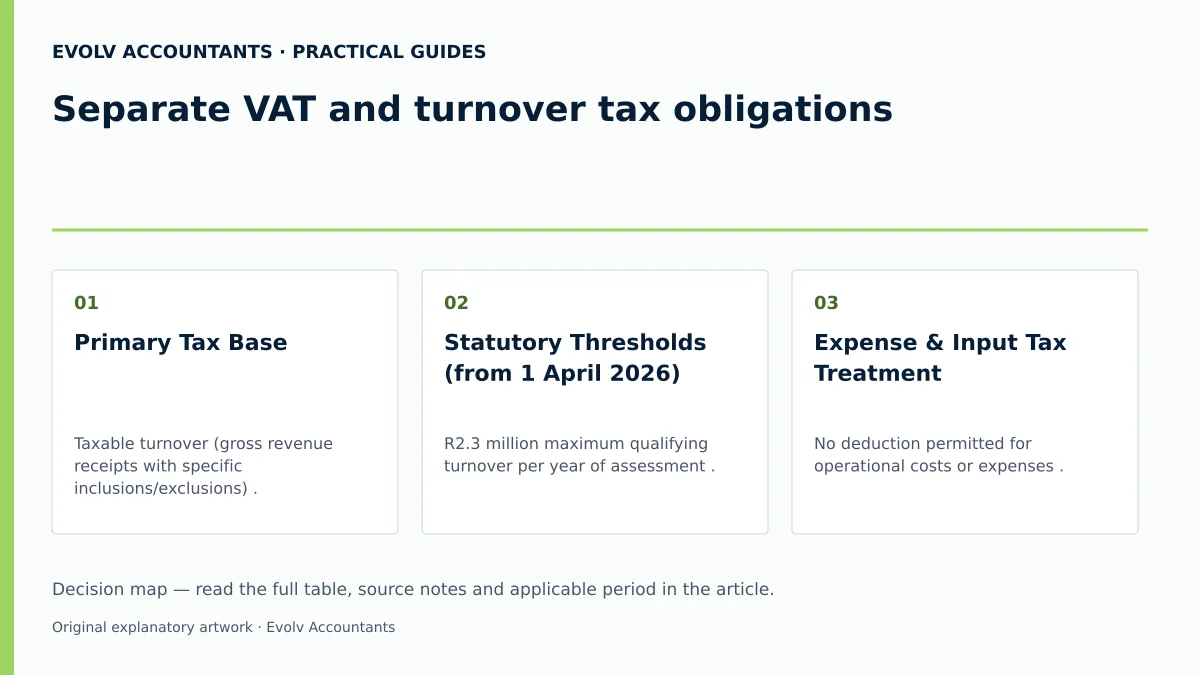
| Primary Tax Base | Taxable turnover (gross revenue receipts with specific inclusions/exclusions) 13 29 32. | Taxable supplies (value of goods/services supplied) 6 35. | Sixth Schedule to Income Tax Act vs VAT Act 10 18. | Turnover tax levies revenue directly; VAT collects tax on customer invoice value 4 6. |
| Statutory Thresholds (from 1 April 2026) | R2.3 million maximum qualifying turnover per year of assessment 6 14 15. | R2.3 million compulsory threshold; R120,000 voluntary threshold 6 15. | Budget 2026 FAQ & SARS Turnover Tax Guide 6 14 16. | Both compulsory thresholds align at R2.3m from 1 April 2026 6 15. |
| Expense & Input Tax Treatment | No deduction permitted for operational costs or expenses 13 36. | Input VAT on qualifying business expenses is deductible from Output VAT 19 20. | Sixth Schedule par 5 vs VAT Act s 26 13 20. | High-margin, low-cost businesses benefit from Turnover Tax; high-input businesses benefit from VAT 2 19. |
| Administrative schedule | Two TT02 payments relative to the enterprise’s own tax year; annual TT03 current payment guidance. | VAT follows the assigned category and SARS period notices 18 21 22. | Compare the actual notices for each tax type. | Category D VAT periods must not be assumed to coincide with every enterprise’s turnover-tax year. |
| Disqualification Criteria | Exceeding R2.3m turnover, >20% professional service/investment income, or corporate shareholding restrictions 41 42 43. | Falling below R120,000 voluntary threshold risks cancellation by SARS 6. | Sixth Schedule par 3 vs VAT Act s 23 6 42 43. | Technical disqualification forces immediate transition to normal corporate income tax 35 44 45. |
How the obligations differ: turnover tax obligations
Sourced legal and regulatory rules
Turnover Tax is governed by Part IV and the Sixth Schedule to the Income Tax Act 58 of 1962 9 10 46 47. The legislation establishes negative eligibility criteria that disqualify an entity from Turnover Tax regardless of its turnover level 42 48:
- Professional Services Restriction: Natural persons earning more than 20% of total receipts from rendering professional services are excluded 41 42 49. For companies, the 20% ceiling applies to the combined total of professional service income and investment income 41 42 50. SARS defines professional service as a service in the field of "accounting, actuarial science, architecture, auctioneering, auditing, broadcasting, consulting, draftsmanship, education, engineering, financial service broking, health, information technology" 51 52.
- Personal Service Providers: Companies classified as personal service providers or labour brokers without a valid exemption certificate are disqualified 41 53 54 55.
- Corporate Ownership Restrictions: A company is excluded if any shareholder is not a natural person, or if a shareholder holds shares in another unlisted trading company (subject to minor statutory exceptions for liquidating entities or non-trading shelf companies with assets under R5,000) 41 42 43 56.
- Capital Disposals: Entities realizing receipts exceeding R1.5 million from the disposal of business capital assets over a 3-year rolling period (the current and preceding two tax years) are disqualified 53 55 57.
- Assessment year: Record the enterprise’s actual year-end. SARS’s 2026 guidance says the former February-only year-end restriction is removed current year-end guidance.
Payment schedules and form administration
Turnover Tax compliance follows a structured annual timeline 37 38 39:
- First interim payment (TT02): Due six months after the enterprise’s tax year begins. Estimate annual taxable turnover and apply the required first-payment share current payment guidance 58.
- Second interim payment (TT02): Due at the enterprise’s tax year-end. Re-estimate annual tax and deduct the first interim payment current payment guidance 59.
- Annual turnover tax return (TT03): Submit after the assessment year ends, by the applicable SARS filing notice. The current guidance links an individual’s TT03 filing to the annual income-tax return current filing guidance. SARS calculates the assessed balance due or refundable 37 62 63.
While Turnover Tax replaces corporate income tax, registered micro-businesses remain fully liable to deduct and pay Employees' Tax (PAYE), Skills Development Levies (SDL), and Unemployment Insurance Fund (UIF) contributions for employees 18 21 64. Micro-businesses may elect to remit payroll liabilities twice yearly, within seven days following the end of August and February 21 22 64.
Evolv professional recommendations
Registered micro-businesses are statutorily required to maintain specific accounting records for a minimum of five years from the return submission date 65 66: records of all gross receipts, logs of dividends declared, and registers of assets and liabilities exceeding R10,000 at year-end 65 66.
Evolv advises micro-businesses to evaluate their client base prior to electing voluntary VAT registration 19 20. Businesses selling directly to retail consumers (B2C) generally benefit from remaining unregistered for VAT under the R2.3 million threshold, as adding 15% Output VAT increases prices for end-consumers 19 20.
Conversely, businesses supplying corporate clients (B2B) who are registered VAT vendors should consider voluntary VAT registration, as corporate buyers can claim back the Input VAT, while the micro-business gains the ability to recover Input VAT on its operational expenses 19 20.
Two business situations with different outcomes: separate vat
Hypothetical Situation 1: B2C Retail Bakery (2027 Year of Assessment)
- Entity Facts: A micro-company operates a local retail bakery selling goods directly to individual consumers.
- Assessment Period: 1 March 2026 to 28 February 2027 (2027 tax year).
- Financial Results:
- Gross sales from baked goods: R1,200,000 (illustrative value).
- Capital receipt from selling an old delivery oven (used >50% for business): R20,000 (illustrative value) 30 32 67.
- Operating expenses: R750,000 (illustrative value).
- Turnover Tax & VAT Analysis:
- Qualifying Turnover: R1,200,000 (capital receipts are excluded from qualifying turnover) 26 27 28. The entity complies with the R2.3 million eligibility ceiling 12 14.
- Taxable Turnover Calculation: Gross sales (R1,200,000) + 50% of capital receipt (R10,000) = R1,210,000 30 32 68.
- *2027 Turnover Tax Payable (Statutory Rates for 1 March 2026 – 28 February 2027) 12 14 69 70:*
- R0 – R600,000 at 0% = R0 12 14 69 70.
- R600,001 – R950,000 (R350,000 at 1%) = R3,500 12 14 69 70.
- R950,001 – R1,210,000 (R260,000 at 2%) = R5,200 12 14 69 70.
- Total Turnover Tax = R8,700 12 14 69 70.
- VAT Recommendation: Taxable supplies of R1,200,000 fall below the compulsory R2.3 million threshold 6 15. Remaining unregistered for VAT prevents adding 15% to retail counter prices, protecting retail sales margins while keeping tax compliance costs minimal 19 20.
Hypothetical Situation 2: B2B Freight Logistics Operator (2027 Year of Assessment)
- Entity Facts: A close corporation provides commercial road freight transport services exclusively to corporate manufacturing clients.
- Assessment Period: 1 March 2026 to 28 February 2027 (2027 tax year).
- Financial Results:
- Freight transport revenue: R1,800,000 (illustrative value).
- Heavy operational costs (diesel, fleet maintenance, insurance): R1,100,000 (including VAT) (illustrative value).
- Turnover Tax & VAT Analysis:
- Qualifying Turnover: R1,800,000. Complies with the R2.3 million micro-business limit 12 14.
- Taxable Turnover: R1,800,000 13 29.
- *2027 Turnover Tax Payable (Statutory Rates for 1 March 2026 – 28 February 2027) 12 14 69 70:*
- Base tax on first R1,400,000 = R12,500 12 14 69 70.
- Tax on portion above R1,400,000 (R400,000 at 3%) = R12,000 12 14 69 70.
- Total Turnover Tax = R24,500 12 14 69 70.
- VAT Recommendation: Freight turnover exceeds the R120,000 voluntary VAT threshold 6. Registering voluntarily for VAT allows the company to claim Input VAT deductions on diesel and maintenance expenses 19 20. Because corporate clients are registered VAT vendors, charging them Output VAT creates no commercial friction, as the clients recover the VAT as Input VAT 19 20.
When the comparison needs specialist input: turnover tax obligations
Taxpayers should seek specialist accounting and legal advice when facing complex statutory thresholds or transition rules:
- Professional Service Receipts Boundary: Determining whether technical, advisory, or IT activities cross the statutory 20% professional service receipts limit requires careful review of revenue contracts 41 42 50 51 71.
- Personal Service Provider (PSP) Exposure: Entities providing client-dedicated labour or services at client premises risk PSP classification, which triggers immediate Turnover Tax disqualification 41 53 54 55.
- Connected Person Income-Splitting: The Sixth Schedule contains specific anti-avoidance rules aggregating qualifying turnover across connected persons to prevent artificial business-splitting to stay under the R2.3 million threshold 72 73 74.
- Nominal and temporary excess: Do not treat a percentage above the ceiling as an automatic safe harbour. Where the turnover ceiling is exceeded, obtain prompt advice on notification, a possible application to remain registered and any resulting deregistration. The 2% to 3% illustrations in older guides related to their older threshold; they are not a current entitlement under the R2.3 million ceiling. Confirm SARS’s applicable requirements and obtain its written decision current threshold guidance.
- Deemed Exit VAT Liability: Voluntarily or compulsorily deregistering from VAT triggers a deemed disposal of business trading stock and capital assets under the VAT Act 19 78. Deemed Output VAT must be declared on the lesser of cost or open market value in the final VAT 201 return, though SARS allows the resulting liability to be settled in six equal monthly instalments 1 19 78.
Next steps for Turnover tax
Checked next actions checklist
- Verify Qualifying Turnover: Confirm that gross business receipts for the year of assessment do not exceed the R2.3 million eligibility limit taking effect 1 April 2026 6 14 15.
- Execute SARS Quick Test Screening: Complete the statutory screening questions on Form TT01 to confirm positive qualification and verify that no negative disqualifications apply 79 80.
- Assess Commercial VAT Position: Review client types (B2B vs B2C) and expense structures to determine whether to remain outside VAT or apply for voluntary VAT registration 6 8 19 20.
- Confirm the assessment year: Record the taxpayer’s actual SARS assessment period and relative payment dates; do not impose the removed February-only restriction current year-end guidance.
- Submit Registration (Form TT01): Submit application form TT01 via the SARS Online Query System (SOQS) or by booking a branch eBooking appointment 60 79 81 82. Existing businesses must apply prior to the start of the new tax year (1 March) 81 83 84.
- Establish Record-Keeping Controls: Implement accounting tracking for gross receipts, exempt grants, capital sales, and asset/liability registers exceeding R10,000 for five-year statutory retention 65 66.
Relevant internal guides and CTA
For further detailed guidance, consult the official SARS Tax Guide for Micro Businesses (TT01) and Administration of Turnover Tax External Guide (TT-GEN-01-G01) 3 47 85 86.
Frequently Asked Questions
Can a business be registered for Turnover Tax and VAT at the same time?
Yes. Turnover Tax and VAT are separate systems administered independently by SARS 1 2 3. A registered micro-business may choose to register for VAT voluntarily provided its taxable supplies exceed R120,000 per annum (effective 1 April 2026) 1 2 6 8.
What happens if a micro-business exceeds the R2.3 million turnover limit during the year?
If turnover exceeds the ceiling, do not assume that a nominal percentage excess preserves registration. Seek prompt advice on the applicable notification and application requirements, and obtain SARS’s written decision. Older percentage illustrations are not an automatic safe harbour under the current R2.3 million ceiling current threshold guidance.
Are professional service providers eligible for Turnover Tax?
Natural persons or companies earning more than 20% of total receipts from rendering professional services (such as accounting, consulting, engineering, IT development, health, or legal services) are disqualified from Turnover Tax 41 42 49 50 51 71.
What are the key payment deadlines for Turnover Tax?
Micro businesses make two TT02 payments: six months after their tax year begins and at that year-end. Submit TT03 after year-end by the applicable SARS filing notice current payment and filing guidance.
Does Turnover Tax cover employees' payroll tax (PAYE), SDL and UIF?
No. Turnover Tax replaces normal income tax, CGT, and Dividends Tax, but does not replace payroll duties 3 5 18 21. Micro-businesses remain liable to deduct and remit PAYE, SDL, and UIF, but may elect to remit payroll taxes twice yearly (at the end of August and February) to simplify administration 18 21 64.
Related guides
- Who qualifies for turnover tax in South Africa
- Turnover tax rates and a worked business example
- The Proactive SARS Audit Guide: Keeping Your Business Ledger Sanitised
Sources
- Budget 2026 Frequently Asked Questions | South African Revenue Service
- Turnover Tax | South African Revenue Service
- https://www.sars.gov.za/wp-content/uploads/Ops/Guides/Legal-Pub-Guide-TT01-Tax-Guide-for-Micro-Businesses.pdf
- https://www.sars.gov.za/wp-content/uploads/Ops/Guides/Legal-Pub-FAQs-TT01-FAQs-on-Turnover-Tax.pdf
- https://www.sars.gov.za/wp-content/uploads/Ops/Guides/TT-GEN-01-G01-Administration-of-Turnover-Tax-External-Guide.pdf
- Turnover Tax | South African Revenue Service