
Registering for VAT after winning a large contract
30 March 2026

Registering for VAT after winning a large contract requires a South African SME to assess its written contractual obligations against statutory turnover triggers.
Winning a substantial commercial contract can immediately trigger a legal obligation for a South African small or medium enterprise (SME) to register as a Value-Added Tax (VAT) vendor 1 2. When a written contractual obligation guarantees that the value of taxable supplies will exceed the compulsory registration threshold within a consecutive 12-month period, the business becomes liable to register from the commencement of the month in which that period begins 2 3.
Under current South African Revenue Service (SARS) administrative guidance, the compulsory registration threshold is administered at R2.3 million in taxable supplies 2 4, whereas older official guides (such as the VAT 404 Guide for Vendors) reflect a R1 million statutory threshold 3 5. The business must submit its registration application to SARS within 21 business days of becoming liable 2 3.
Completing registration requires establishing representative vendor authority, gathering accepted contractual and financial evidence, navigating the SARS eFiling platform, and fulfilling ongoing operational duties including issuing valid tax invoices and filing periodic VAT201 returns 6 7 8 9.
Contracted turnover and the registration trigger
Framework for South African SMEs
For small and medium enterprises operating within the Republic of South Africa, Value-Added Tax is governed by the Value-Added Tax Act and administered under the Tax Administration Act 1 10. Registration as a VAT vendor is mandatory once a business meets specific turnover criteria while carrying on an enterprise 1 4. An enterprise is defined as any activity carried on continuously or regularly in or partly in South Africa where goods or services are supplied to another person for consideration 1 11.
Completion of the VAT registration task means that an SME transitions legally from a non-vendor to a registered VAT vendor 1 5. Operational completion requires receiving an official Notice of Registration from SARS containing a unique ten-digit VAT reference number, establishing the effective liability date, and incorporating VAT compliance into daily trading operations 8 12 13 14.
Once registered, the SME must charge output tax at the standard rate of 15% on all standard-rated taxable supplies, submit periodic VAT201 declarations, and maintain complete accounting records for at least five years 6 14 15 16.
— Practical point from this guide
Statutory thresholds versus current SARS administrative position
Understanding when a contract triggers VAT registration requires distinguishing between statutory legislation, regulator guidance, and professional advisory practices:
- The Law (Statutory Duty): Under the VAT Act, compulsory registration is required when the total value of taxable supplies made by a person in any consecutive 12-month period exceeds the statutory threshold, or where a person has entered into a written contractual obligation to make taxable supplies exceeding that threshold in a 12-month period 2 3 5.
- Regulator Guidance (Administrative Position): Current official SARS web portal guidance administers the compulsory VAT registration threshold at R2.3 million in taxable supplies over a consecutive 12-month period 2 4. Conversely, older published SARS guides—including the VAT 404 Guide for Vendors and the VAT-REG-02-G01 External Guide—continue to list the compulsory threshold at R1 million 3 5 17 18. This administrative stance governs SARS's online application processing and risk evaluation engines 19 20. Business owners and advisers must recognise this administrative position without asserting an unqualified statutory amendment or attributing threshold adjustments to annual rates legislation 4 5.
- Evolv Recommendations: Evolv Accountants advises SMEs winning new commercial contracts to review projected gross revenues immediately. Where a single signed agreement or accumulated turnover guarantees taxable supplies exceeding SARS's administrative threshold over 12 months, the firm should initiate registration preparations before issuing the first contract invoice to prevent severe backdating penalties and unrecoverable output tax liabilities 2 3 14.
Prepare the information and authority: contracted turnover
Required documentation and acceptable evidence
To register for VAT on the basis of contracted turnover, an SME must compile objective documentary evidence proving that its future taxable supplies will exceed the registration trigger 2 21. SARS applies strict document verification standards to prevent fraudulent registrations 19 22.
Acceptable sources of financial evidence to substantiate contracted turnover include 21:
- Signed Written Contracts: Copies of legally binding, fully executed contracts signed by both supplier and client, specifying the scope of work, duration, and contract value 2 21.
- Awarded Tender Documents: Official written notification or letter of award from a client or public entity confirming that a tender has been formally awarded to the business 21.
- Issued Invoices and Lease Agreements: Copies of tax invoices already issued or signed commercial lease agreements showing binding financial terms 21.
- Going Concern Purchase Agreements: Evidence of taxable turnover generated by the seller when acquiring an existing business as a going concern 21 23.
SARS explicitly rejects speculative or non-binding documentation 24. Unacceptable documents that cannot be used to prove taxable turnover include ambitious non-factual business plans, unvalidated cash flow projections, purchase orders without proof of supply, and tender proposals submitted prior to formal award 24 25.
Legal entity definitions and representative authority
Registration must be completed under the correct legal structure and representative authority 26 27:
- Person and Entity Category: A "person" under the VAT Act includes private companies (Pty Ltd), close corporations (CC), sole proprietorships, partnerships, trusts, and municipalities 1 28. A business operating multiple branches or divisions must combine total turnover across all units under a single registration unless separate branch registration approval is granted by SARS 29 30.
- Representative Taxpayer / Representative Vendor: Every registered company or non-natural entity must appoint a resident natural person as its representative taxpayer (Public Officer for a company, main member for a CC, or main partner for a partnership) 27 31. The representative vendor bears personal statutory liability for performing all VAT obligations 27 32.
- Power of Attorney (POA): If an SME uses an authorised registered tax practitioner to submit the registration application, a formal SARS Power of Attorney must accompany the submission 33. However, tax practitioners are prohibited from signing the final registration declaration on behalf of the applicant or representative vendor 32 34.
- Banking Details: The application requires a valid South African bank account opened in the exact registered name or trading name of the enterprise 35 36. Third-party bank accounts are strictly prohibited, except for foreign entities or qualifying holding/subsidiary structures within a group of companies submitting a completed form VAT119i indemnity 36 37 38.
Complete the task step by step: the registration trigger
SMEs triggering compulsory VAT registration following a contract award must follow a sequenced, primary-source application workflow using SARS eFiling 7 8 19 39 40:
Detailed Sequenced Action List
- Calculate the Effective Liability Date: Calculate the liability date as the first day of the calendar month in which the written contract commences or in which the 12-month period begins where contracted sales exceed the threshold 3 41 42. The application must be submitted within 21 business days of reaching this liability date 2 3.
- Access eFiling Registration Maintenance: Log onto the SARS eFiling profile 39. Navigate to the Organisations menu tab, select SARS Registered Details, and click Maintain SARS Registered Details to open Form RAV01 39 40. Accept the legal authorisation agreement to proceed 40.
- Add the VAT Product Registration: Under the Revenue left menu, select VAT under My tax products and click Add new product registration 8 40.
- Complete the VAT Container Fields:
- Liability Date: Enter the calculated effective date 8 41.
- Business Activity Code: Select the four-digit classification code reflecting the main business activity from the VAT 403 Trade Classification Guide 8 43.
- Value of Taxable Supplies: Enter actual historical turnover and prospective standard-rated and zero-rated turnover for the next 12 months 8 44.
- Accounting Basis: Select the Invoice Basis (accrual method), which is compulsory for companies and juristic entities 8 45 46. The Payments Basis (cash method) is restricted to natural persons or sole partnerships with turnover under R2.5 million 46 47.
- Tax Period Category: Select Category A or Category B (standard two-monthly filing periods ending on alternate month-ends) 48 49 50. Category C (monthly filing) is mandatory only if annual taxable turnover exceeds R30 million 49 50.
- Execute Biometric Verification and Form Submission: Submit Form RAV01. Individual taxpayers or representative vendors may be prompted to complete facial biometric authentication via eFiling instructions 19 40.
- Submit Supporting Evidence for Review: Where no risk is detected, SARS issues a VAT reference number immediately 12 39. If selected for verification, SARS issues a Registration Application Review Notice with a case number 19. Upload all requested supporting evidence (signed contract, bank statement, CIPC registration documents, physical address proof, and ID copies) via eFiling within 21 business days 19 51. Failure to submit documents within 21 business days results in immediate rejection of the application 51.
Check the result against the evidence: contracted turnover
SMEs must verify successful registration through independent completion evidence rather than assuming electronic form submission equates to final SARS acceptance 13 19 52.
Primary completion indicators include:
- Official SARS Notice of Registration: Confirmation is established only upon generating or receiving the official Notice of Registration (historically referred to as Form VAT103) 13 52 53. This document reflects the registered name, trading name, 10-digit VAT number, allocated tax period, accounting basis, and official effective liability date 8 13 52. Registered eFilers can download this notice directly from eFiling by clicking the Notice of Registration icon or navigating to SARS Registered Details -> Notice of Registration -> VAT 13.
- Public VAT Vendor Search Database: The business can independently verify active registration by querying its details on the public SARS online tool under VAT Vendor Search on the SARS portal 12 13 52.
- eFiling Profile and Compliance Status: The business profile on eFiling will display the VAT product as active, and the enterprise tax status can be viewed under My Compliance Profile 40 54.
Handle exceptions and unresolved cases: the registration trigger
Edge Cases and Specific Scenarios
- Unawarded Tenders: A business intending to submit a tender or bid for project work cannot register for VAT in anticipation of winning 25 55. SARS explicitly denies pre-award registration applications to avoid unnecessary administrative burden 25 55. Registration must occur only after the contract or tender is formally awarded in writing 21 25.
- Backdating Registration Beyond Six Months: Compulsory registration backdating on eFiling Form RAV01 is system-restricted to a maximum of six months from the application date 41. If winning a contract reveals that liability arose more than six months prior, the business cannot complete registration online 41. The representative vendor must book a virtual or branch appointment with SARS to submit manual financial statements, contracts, and sales records 7 41.
- Voluntary Registration Option: Where a new contract increases turnover above R120,000 (under current web guidance) rather than the R50,000 figure in older VAT404 text but below the compulsory threshold, the business may apply for voluntary VAT registration 23 56 57 58. Qualifying grounds include written contracts guaranteeing taxable supplies over the current SARS-administered R120,000 threshold in the following 12 months, or historical average sales exceeding R4,200 per month 56 58 59. Voluntary applications may be refused if the business lacks a fixed place of business, proper accounting records, or a local RSA bank account 35.
- Non-Resident and Group Branch Registrations: Foreign entities conducting enterprise activities in South Africa or group companies seeking single-branch registration under section 23(2A) must follow specialized application routes via email or dedicated SARS channels 60 61.
Specialist Evolv Advisory Boundaries
When registration involves complex commercial terms—such as cross-border electronic services, domestic reverse charges on valuable metals, or mixed exempt and taxable supplies—SMEs should engage Evolv Accountants for specialized tax advisory 2 53 60 62.
The five-year period is a minimum, not an automatic destruction date. SARS record-keeping guidance requires the relevant records to remain available; retain them beyond the ordinary minimum where an ongoing audit, investigation, objection or appeal or another applicable rule requires it.
Next steps for VAT registration
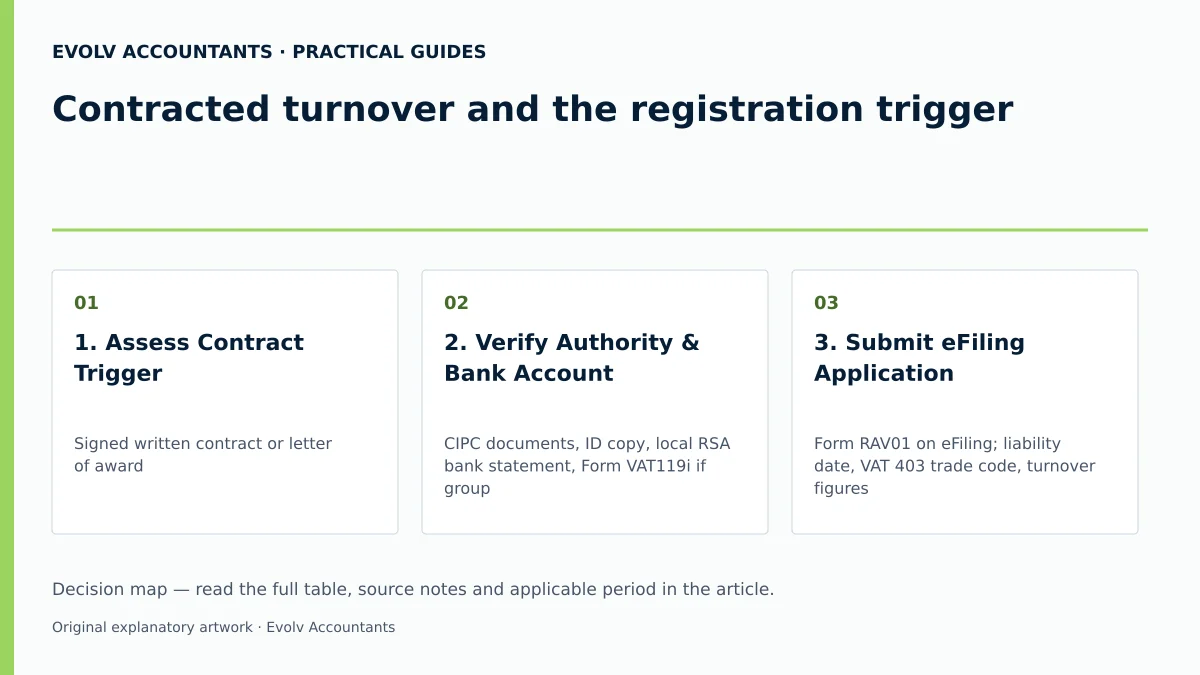
Task and completion checklist
| Step | Input or evidence | Responsible person | Completion check | Exception or next action |
|---|---|---|---|---|
| 1. Assess Contract Trigger | Signed written contract or letter of award 2 21 | Managing Director / Financial Head | Projected 12-month taxable turnover exceeds compulsory threshold 2 3 | If under compulsory trigger, evaluate voluntary registration rules 23 56 58 |
| 2. Verify Authority & Bank Account | CIPC documents, ID copy, local RSA bank statement, Form VAT119i if group 26 36 38 | Public Officer / Representative Vendor 27 31 | RSA bank account active in exact entity name; Public Officer details updated 27 35 36 | If using tax practitioner, execute SARS Power of Attorney 33 |
| 3. Submit eFiling Application | Form RAV01 on eFiling; liability date, VAT 403 trade code, turnover figures 8 40 43 | Representative Vendor / Tax Practitioner 33 40 | RAV01 submitted; facial biometric step completed if prompted 19 40 | If backdating exceeds 6 months, book SARS branch appointment 7 41 |
| 4. Upload Review Documents | Signed contract, bank statement, ID, address proof, review notice 19 21 51 | Representative Vendor | All supporting documents uploaded via eFiling within 21 business days 19 51 | Ensure documents match SARS case number to avoid application rejection 19 51 |
| 5. Confirm Active Status & Invoicing | Official SARS Notice of Registration; updated tax invoice template 9 13 52 | Accountant / Evolv Support Team | Active VAT number verified on SARS Vendor Search portal 12 52 | Update billing software to charge 15% VAT and issue valid tax invoices 9 14 16 |
Reproducible hypothetical example
- Scenario: Apex Engineering (Pty) Ltd, a South African SME providing industrial maintenance, historically generated R80,000 per month in taxable supplies (accumulating R960,000 over 12 months). On 1 November, Apex Engineering signs a written agreement with a commercial client to deliver factory refurbishment services valued at R3 million over the next 12 months.
- Trigger Assessment: The signed contract guarantees R3 million in future taxable supplies. The R3 million future contract by itself exceeds the currently administered R2.3 million compulsory threshold; the R960,000 historical total is a separate retrospective test 2 3 5. Apex Engineering becomes compulsorily liable to register for VAT 2 3.
- Timelines and Liability Date:
- Effective Liability Date: 1 November (the first day of the month in which the contracted 12-month period begins) 3 41.
- Application Deadline: Apex Engineering must submit its VAT registration application within 21 business days from 1 November 2 3.
- Invoicing and Financial Calculation: Once registered, all standard-rated quotes and invoices issued by Apex Engineering must include 15% VAT 14 16. For a monthly milestone billing of R250,000:
Output Tax Charged = R250,000 × 15% = R37,500 Total Invoice Amount = R250,000 + R37,500 = R287,500 Alternatively, if billing a VAT-inclusive contract amount of R287,500, output tax is extracted using the tax fraction (15/115) 63: Output Tax = R287,500 × (15 ÷ 115) = R37,500
- Filing Duty: Allocated to Category A (two-monthly tax period), Apex Engineering submits its first VAT201 declaration electronically by the last business day of the month following the period end, paying net VAT (output tax collected minus permissible input tax paid on business inputs) 15 64 65 66.
Frequently Asked Questions
What happens if our contracted turnover exceeds the registration threshold but actual sales fall short?
Compulsory registration is legally triggered by the existence of a written contractual obligation guaranteeing taxable supplies over the threshold within a 12-month period, regardless of whether performance has been fully completed 2 3. If the contract is subsequently cancelled or actual turnover falls permanently below the threshold, the vendor may apply to SARS for cancellation of registration once total taxable supplies fall below the compulsory limit over a 12-month period 67 68.
Can our SME issue tax invoices and charge VAT before receiving an official SARS VAT number?
No. A business cannot charge VAT or issue tax invoices displaying a VAT charge until it has been formally registered as a vendor and allocated an active VAT number by SARS 1 9 69. Issuing invoices claiming to charge VAT without an active registration constitutes an offence 70. Once registered with a backdated liability date, valid tax invoices must be issued for all taxable supplies made from that liability date 5 41 71 72.
How strictly is the 21 business day application rule enforced after signing a large contract?
Under the Tax Administration Act and VAT Act, an SME that becomes compulsorily liable must apply within 21 business days of reaching the trigger 2 3 10. Failure to apply timeously can result in SARS backdating the registration liability date, creating retroactive output tax liabilities, interest, and late payment penalties on sales made during the unregistered period 5 14 41.
Can our company choose the cash-based Payments Basis when registering for VAT?
No. Juristic entities such as private companies (Pty Ltd), close corporations, and trusts are legally restricted to the accrual-based Invoice Basis 8 45 47. The Payments Basis (accounting for output tax only when cash is received) is available only to natural persons or partnerships of natural persons whose taxable turnover is under R2.5 million, or specific public entities 46 47.
What supporting documents are rejected by SARS when applying under contracted turnover?
SARS rejects subjective, non-binding financial documents 24. Unacceptable items include ambitious non-factual business plans, cash flow projections, purchase orders without proof of supply, and tender submissions prior to official contract award 24 25. Only fully executed, signed written contracts or official letters of tender award are accepted as prospective proof 2 21. Ask Evolv about contracted turnover and the registration trigger. Share the relevant records so the support required can be scoped. Ask Evolv about contracted turnover and the registration trigger
Related guides
- Checking a supplier VAT registration number
- When a South African business must register for VAT
- The Proactive SARS Audit Guide: Keeping Your Business Ledger Sanitised
Sources
- Register for VAT | South African Revenue Service
- https://www.sars.gov.za/wp-content/uploads/Ops/Guides/Legal-Pub-Guide-VAT404-VAT-404-Guide-for-Vendors.pdf
- Obligations of a VAT vendor | South African Revenue Service
- FAQs for VAT vendors | South African Revenue Service
- https://www.sars.gov.za/wp-content/uploads/Ops/Guides/VAT-REG-02-G01-Guide-for-Completion-of-VAT-Application-External-Guide.pdf