
Rolling turnover versus financial year turnover for VAT
31 May 2025

Tracking rolling twelve-month taxable turnover requires continuous evaluation of consecutive months to establish Value-Added Tax registration obligations.
Determining Value-Added Tax (VAT) registration liabilities in South Africa depends on assessing taxable turnover across a continuous, rolling twelve-month window rather than relying on an entity's internal financial year. While financial year turnover measures performance over a fixed twelve-month accounting period for corporate reporting and income tax, VAT legislation and regulatory guidance mandate a running total of taxable supplies at the close of every month 1.
Understanding this distinction prevents late registration penalties and ensures compliance with South African Revenue Service (SARS) administrative standards.
A rolling twelve month turnover worksheet
A rolling twelve-month turnover calculation evaluates the cumulative value of taxable supplies made by a business across any consecutive twelve-calendar-month period 1 2. At the end of each calendar month, the business adds the latest month's taxable sales to the previous eleven months and drops the corresponding month from the prior year 1. This creates a continuous, twelve-month moving window that is updated twelve times a year.
In contrast, financial year turnover measures cumulative taxable supplies strictly within the twelve-month accounting period defined by the entity's financial year-end (for example, 1 March to 28 February). Financial year turnover resets to zero at the start of each new financial period.
Neither method is universally superior; rather, each serves a distinct legal and operational function:
- Rolling twelve-month turnover is the statutory and administrative metric used by SARS to establish compulsory VAT registration liabilities and voluntary registration eligibility 1 2 3.
- Financial year turnover serves internal financial reporting, statutory auditing, and income tax assessment under the Income Tax Act 4 5 6.
Relying exclusively on financial year turnover to monitor VAT liability exposes businesses to compliance risk. A business experiencing rapid growth or seasonal surges midway through its financial year could breach statutory thresholds on a rolling twelve-month basis several months before its financial year-end.
Compare the criteria that matter: a rolling twelve month turnover worksheet
Evaluating turnover tracking methods across core business constraints highlights how operational controls, cash flows, and legal liabilities differ between rolling and financial year tracking.
Decision comparison matrix
| Criterion | Option A: Rolling 12-Month Turnover Tracking | Option B: Financial Year Turnover Tracking | Evidence or assumption | Implication for this reader |
|---|---|---|---|---|
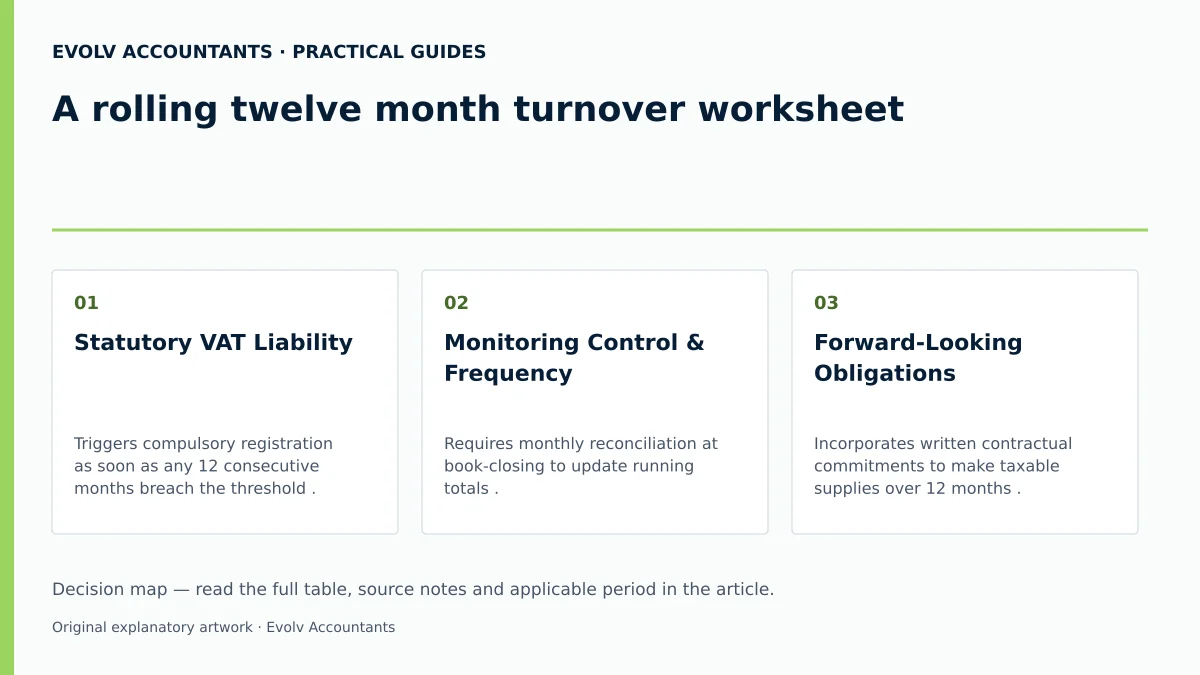
| Statutory VAT Liability | Triggers compulsory registration as soon as any 12 consecutive months breach the threshold 1 2. | Fails to detect mid-year breaches because cumulative figures reset annually 1. | SARS administers compulsory registration on a consecutive 12-month basis 1 2 3. | Relying on financial year totals risks unregistered trading and retrospective SARS assessments 1 7. |
| Monitoring Control & Frequency | Requires monthly reconciliation at book-closing to update running totals 1. | Reviewed periodically or annually during financial statement preparation 6. | SARS requires vendors to maintain running totals at monthly closing 1. | Businesses must implement a monthly rolling worksheet to maintain continuous compliance 1. |
| Forward-Looking Obligations | Incorporates written contractual commitments to make taxable supplies over 12 months 3 8. | Retrospective focus on historical financial results 6. | Written contracts exceeding threshold trigger compulsory registration immediately 3 8. | Prospective contract awards require immediate registration within 21 business days 3 9. |
| Cash Flow & Tax Liability | Ensures output tax collection begins on the correct liability date, avoiding uncollected tax liabilities 7 10. | Late detection causes retroactive tax liabilities where VAT cannot be recovered from past clients 7 10. | Registered vendors must collect output tax on all taxable supplies from liability date 7 10 11. | Uncollected output tax on past sales becomes an unrecoverable direct cash cost 10 11. |
| Operational Constraints | Applies across all enterprise activities, branches, and trading divisions combined 12 13. | Often analysed per business unit or division for internal management 12 14. | Liability is determined by aggregating turnover across all enterprises of a person 12 13 14. | Multi-venture sole proprietors or companies must aggregate sales across all divisions 12 14. |
How the obligations differ: documented completion and exceptions
Navigating VAT compliance requires distinguishing statutory legal requirements and SARS administrative positions from professional accounting standards and advisory support.
Sourced legal rules and SARS administrative positions
- Compulsory Registration Threshold: Under current SARS web guidance, compulsory VAT registration is administered when the total value of taxable supplies in any consecutive twelve-month period exceeds, or is contractually obligated to exceed, R2.3 million 2 3. Older SARS publication guides (such as the VAT 404 Guide) refer to a statutory threshold of R1 million 15. SARS administers new applications based on the updated R2.3 million threshold 16.
- Voluntary Registration Criteria: Voluntary registration is administered where taxable supplies in a past twelve-month period have exceeded R120 000 17 (compared to R50 000 in older guides 18 19). Alternatively, voluntary registration applies where taxable supplies have been made for at least one month exceeding R4 200, or average R4 200 per month over two to eleven months 20 21 22.
- Application Timeline: A person must apply for compulsory VAT registration within 21 business days of becoming liable 3 9.
- Effective Date and Backdating: Voluntary registration is effective from the date of application and backdating is not permitted without SARS approval and supporting evidence 7. Compulsory registration backdating via eFiling is limited to six months; backdating beyond six months requires a SARS branch appointment 7.
- Record Retention: Vendors must retain tax invoices, accounting records, and supporting documents for a minimum of five years 10 23.
Professional recommendations (Evolv guidance)
- Maintain a dedicated rolling twelve-month turnover worksheet updated within five business days of monthly ledger closing.
- Perform pre-submission document reviews to verify bank details, enterprise activity codes, and proof of turnover before lodging SARS applications, preventing review notice delays 24 25 26.
- Align accounting software registers to flag prospective contractual commitments exceeding threshold limits 3 8.
Numbered compliance checklist: Documented completion
- Extract Monthly Sales Data: Compile monthly sales totals of all standard-rated and zero-rated taxable supplies 9 27.
- Exclude Non-Taxable Receipts: Deduct exempt supplies (for example, financial services or residential accommodation fees), private sales, and capital asset disposal proceeds 27 28 29.
- Aggregate Enterprise Activities: Combine taxable turnover from all divisions, trading names, and branches operated by the same legal entity 12 13 14.
- Calculate Rolling 12-Month Sum: Sum the latest twelve consecutive months of net taxable supplies 1.
- Assess Prospective Contracts: Review binding written agreements for supplies to be executed over the next twelve months 3 8.
- Compare Against SARS Thresholds: Check rolling totals against the R2.3 million compulsory threshold and R120 000 voluntary threshold 3 17.
- Document Decision Record: File the completed monthly worksheet and supporting revenue ledgers in the tax compliance record file 10 23.
Two business situations with different outcomes: a rolling twelve month turnover worksheet
The practical application of the rolling turnover calculation is demonstrated through two contrasting business scenarios.
Scenario A: Seasonal business with a mid-year revenue spike
- Business Profile: Apex Industrial Solutions CC operates on a financial year ending 28 February. It supplies commercial equipment and experiences seasonal demand spikes.
- Financial Facts:
- March to August taxable sales: Average R120 000 per month (Total: R720 000).
- September to October taxable sales: Exceptional contract deliveries of R850 000 per month (Total: R1 700 000).
- Previous year November to February sales: R200 000 total.
- Evaluation:
- Financial Year-to-Date Turnover (March to October): R2 420 000.
- Rolling 12-Month Turnover (November prior year to October current year): R200 000 + R720 000 + R1 700 000 = R2 620 000.
- Outcome: The compulsory VAT registration threshold of R2.3 million was breached at the end of October 1 3. Apex Industrial Solutions CC is legally obligated to apply to SARS for compulsory VAT registration within 21 business days from 1 November 3 9. It cannot wait until the financial year-end in February to evaluate its tax position.
Scenario B: Steady growth enterprise with a prospective written contract
- Business Profile: Beacon Logistics Pty Ltd operates on a financial year ending 30 June. It provides domestic logistics services.
- Financial Facts:
- Historical 12-month taxable supplies (November prior year to October current year): R1 100 000 (average R91 667 per month).
- On 15 November, Beacon Logistics signs a binding, written commercial transport contract to supply freight services valued at R2 500 000 over the following twelve months, commencing 1 December.
- Evaluation:
- Historical Rolling 12-Month Turnover: R1 100 000 (well below the R2.3 million compulsory threshold 3).
- Prospective 12-Month Contractual Commitment: R2 500 000 3 8.
- Outcome: Compulsory registration is triggered immediately in November by virtue of the written contractual obligation exceeding R2.3 million over a twelve-month period 3 8. Beacon Logistics must submit its VAT registration application within 21 business days of signing the contract, with its liability date set to the start of the month in which the contract performance begins 7 9.
When the comparison needs specialist input: documented completion and exceptions
Certain commercial arrangements and structural transactions fall outside basic turnover rules and require specialized tax and legal evaluation:
- Exempt versus Taxable Supplies: Income derived from financial services, residential letting, or public passenger transport constitutes exempt supplies 28 29 30. Exempt income is excluded from taxable turnover calculations and does not count toward VAT thresholds 27 29 31.
- Disposal of Capital Assets and Business Closure: SARS’s registration table excludes the specified closure, substantial permanent scale-reduction and capital-replacement transactions. This does not exclude every ordinary capital disposal 27.
- Separate Branch or Division Registrations: Entities seeking separate VAT registration numbers for independent branches or divisions must maintain independent accounting systems and obtain SARS approval 14 32. Without formal approval, all turnover remains aggregated under the parent entity 12 14.
- Tenders and Unawarded Proposals: Submitting tenders or contract proposals does not trigger or permit VAT registration 33 34. SARS rejects registration applications submitted in anticipation of tenders prior to formal contract award 33 34.
- Non-Resident Electronic Services: Foreign entities or intermediaries supplying electronic services to South African residents are subject to compulsory registration upon reaching the threshold, with specific intermediary aggregation rules 3 8 35.
The five-year period is a minimum, not an automatic destruction date. SARS record-keeping guidance requires the relevant records to remain available; retain them beyond the ordinary minimum where an ongoing audit, investigation, objection or appeal or another applicable rule requires it.
— Practical point from this guide
Next steps for VAT registration
To maintain verified compliance, South African SMEs should establish an internal decision record and implement standardized tracking controls.
Compliance decision record
- Reconcile historical monthly turnover for the preceding twelve calendar months against bank statements and general ledgers 1 26.
- Identify binding prospective customer contracts to quantify forward-looking twelve-month revenue commitments 3 8.
- Determine whether compulsory threshold criteria (R2.3 million) 3 or voluntary criteria (R120 000 or R4 200/month average) 17 20 have been met.
- Prepare standard supporting documentation—including certified ID copies, proof of South African bank details, municipal utility bills, and revenue ledgers—prior to initiating eFiling submissions 26 36.
Frequently Asked Questions
What is the current compulsory VAT registration threshold in South Africa?
Under current SARS administrative guidance, compulsory VAT registration applies when taxable turnover exceeds or is contractually committed to exceed R2.3 million in any consecutive twelve-month period 2 3 16. Older guide publications cite R1 million 15, but SARS administers current applications under the R2.3 million threshold 16.
Which income sources must be excluded from the rolling turnover calculation?
Exempt supplies—such as financial services, residential dwelling rentals, and public rail or road passenger transport—must be excluded 27 28 29. SARS’s registration table also excludes the specified closure, substantial permanent scale-reduction and capital-replacement transactions. This does not mean that every capital-asset sale is excluded 27.
How quickly must a business apply to SARS once the compulsory threshold is breached?
An application for compulsory VAT registration must be lodged with SARS within 21 business days from the date the threshold is exceeded or from the date a binding contract exceeding the threshold is signed 3 9.
Can a business backdate its VAT registration effective date?
Compulsory VAT registration backdating via eFiling is allowed up to six months from the date the threshold was exceeded 7. Backdating beyond six months requires a physical appointment at a SARS branch with financial evidence 7. Voluntary registrations cannot be backdated without explicit SARS approval 7.
How long must a business keep records supporting its turnover calculations?
Vendors are legally required to retain all tax invoices, accounting records, general ledgers, and turnover calculations for at least five years 10 23.
Related guides
- VAT registration when a business has not started selling
- When a South African business must register for VAT
- The Proactive SARS Audit Guide: Keeping Your Business Ledger Sanitised
Sources
- https://www.sars.gov.za/wp-content/uploads/Ops/Guides/Legal-Pub-Guide-VAT404-VAT-404-Guide-for-Vendors.pdf
- Register for VAT | South African Revenue Service
- Obligations of a VAT vendor | South African Revenue Service
- https://www.sars.gov.za/wp-content/uploads/Ops/Guides/VAT-REG-02-G01-Guide-for-Completion-of-VAT-Application-External-Guide.pdf