
VAT registration when a business has not started selling
9 August 2026

VAT registration before a business has started selling requires qualifying taxable activity and supporting evidence; a business plan alone does not establish eligibility.
Registering for South African VAT before making sales requires demonstrating pre-trading enterprise activities through valid contracts, bank finance, or qualifying capital expenditure.
South African businesses that have not yet generated turnover can access voluntary Value-Added Tax (VAT) registration under specific administrative frameworks established by the South African Revenue Service (SARS) 1 2. When a startup incurs significant capital expenses or signs forward supply agreements prior to trading, voluntary registration enables the business to integrate into the tax system and claim deductible input tax 2 3.
SARS enforces strict documentary gates to ensure that registration requests are grounded in verifiable pre-trading evidence rather than speculative forecasts 4 5.
Start up intention contracts and pre trading evidence
For startup enterprise founders and South African Small and Medium Enterprises (SMEs) operating within the Republic of South Africa, completing VAT registration prior to making taxable supplies requires establishing that an "enterprise" exists for tax purposes 1 3. Under Section 1(1) of the Value-Added Tax Act No. 89 of 1991, the statutory definition of an enterprise explicitly encompasses "anything done in connection with the commencement or termination of an enterprise" 6.
Successful completion of this task means obtaining an official Notice of Registration and an active 10-digit VAT reference number from SARS based on verified pre-trading documentation 7 8.
To evaluate eligibility, business owners must distinguish between statutory law, regulator administrative guidance, and Evolv recommendations:
— Practical point from this guide
- Statutory Law: The VAT Act establishes the baseline requirements for enterprise activity, compulsory registration thresholds, and voluntary registration categories 1 2 9.
- Regulator Guidance (SARS): SARS publishes administrative guides and web instructions governing registration procedures and document verification 10 11 12. Current SARS administrative web guidance applies a compulsory registration threshold of R2.3 million in taxable turnover over a consecutive 12-month period 9 13. For voluntary registrations based on written contracts, finance agreements, or pre-trading expenditure, current SARS web guidance administers a threshold of R120 000 3. Conversely, older SARS publications (such as the VAT 404 Guide for Vendors and VAT-REG-02-G01 Guide) retain references to a R1 million compulsory threshold and a R50 000 voluntary expenditure threshold 14 15 16. This R2.3 million figure reflects SARS's operational administrative alignment and does not represent an unqualified statutory amendment to Section 23 of the VAT Act 11 14.
- Evolv Recommendations: Evolv advises SMEs to assemble structured contractual and financial evidence packs prior to initiating electronic registration, avoiding common administrative rejections caused by submitting non-qualifying records 4 5.
Prepare the information and authority: start up intention contracts
Before initiating a voluntary VAT application on pre-trading grounds, applicants must compile specific primary evidence, verify legal definitions, and confirm representative authority 4 17 18.
Required Evidence and Categories
Under current SARS voluntary registration guidelines, a pre-trading business must qualify under at least one of the following evidence streams 2 3:
- Start-Up Intention / Written Contracts: A binding, written contractual obligation requiring the applicant to make taxable supplies exceeding R120 000 within the 12-month period following the registration date 3 13.
- Pre-Trading Expenditure or Finance Agreements: Proof of capital expenditure incurred (or contractually to be incurred) exceeding R120 000 for starting the enterprise, or a credit agreement with a registered financial institution requiring repayments exceeding R120 000 in the subsequent 12 months 3.
- Nature of Activity (GN 446 / Section 23(3)(d)): Continuous activities where taxable supplies can only be made after a development period due to the nature of the industry (for example, agriculture, mining, property development, infrastructure development, or plant manufacturing) 2 11 19 20.
Representative Authority and Governance
The registration form must be executed by an authorised representative vendor 18 21:
- For a private company, the representative vendor is the registered Public Officer 22.
- For an individual or sole proprietor, it is the owner 21.
- Where an external tax practitioner manages the submission, a valid SARS Power of Attorney (POA) must be attached, though the legal declaration itself must be signed by the representative vendor 21 23.
Acceptable versus Unacceptable Documentation
SARS strictly enforces documentary rules regarding pre-trading evidence 4 5 24:
| Category | Acceptable Primary Evidence 4 | Unacceptable Documents 5 |
|---|---|---|
| Contractual | Executed, signed supply contracts; binding sales agreements; signed commercial leases 4. | Draft contracts; unsigned agreements; tender proposals prior to formal award 5 25. |
| Financial | Signed bank finance agreements; verified supplier purchase invoices for capital assets 3 4. | Non-factual business plans; cash flow projections; unconfirmed purchase orders 5. |
| Property / Infrastructure | Approved building plans; formal rezoning approvals; signed property purchase offers 4. | Ambitious non-factual development concepts 5. |
Complete the task step by step: pre trading evidence
To apply for VAT registration when sales have not yet commenced, follow this sequenced process through the SARS eFiling system 7 12:
- Access SARS Registered Details (RAV01): Log on to the SARS eFiling profile. Navigate to Organisations (or Home for individuals), select SARS Registered Details, and choose Maintain SARS Registered Details 7 17. Confirm authorisation to update company profile details 17.
- Add Product Registration: Within the registration container, select My Tax Products, choose VAT, and click Add new product registration 17 26.
- Complete Field Containers:
- Enter the trading name and select the correct 4-digit Trade Classification Code (from the SARS VAT 403 guide) 26 27.
- Select the proposed Liability Date (which cannot be backdated for voluntary registrations without explicit SARS approval and supporting evidence, and cannot exceed 3 months in the future) 28.
- Select the Accounting Basis (the default is the Invoice Basis; the Payments Basis is restricted to natural persons or specific entities meeting statutory requirements) 29 30 31.
- Select the allocated Tax Period (typically Category A or Category B two-monthly cycles for standard businesses) 32 33.
- Select Voluntary Registration Reason: Under the financial particulars container, mark Yes for voluntary registration where taxable supplies have not exceeded R120 000 3 34. Select the specific supporting ground: written contracts, pre-trading expenditure/finance, or nature of activity 3 35 36.
- Biometric Authentication and Submission: Submit the RAV01 form. If prompted, the representative vendor must complete biometric facial authentication via the SARS mobile interface 17 37.
- Submit Supporting Documents: Once submitted, check the eFiling correspondence page for a Registration Application Review Notice 37. Upload all prescribed pre-trading proof (signed contracts, bank agreements, asset invoices, and proof of banking details) through eFiling or the SARS Online Query System within 21 business days 12 38.
Check the result against the evidence: start up intention contracts
Submitting an eFiling application does not equate to tax registration 37. Applicants must verify completion through independent evidence:
- Notice of Registration: SARS issues an official Notice of Registration (historically termed VAT103) reflecting the 10-digit VAT reference number, effective liability date, accounting basis, and assigned tax period 8 37 39.
- Online Vendor Verification: Confirm active status by searching the registered business details via the public "VAT Vendor Search" tool on the SARS website or requesting a Tax Compliance Status via eFiling 8 40 41.
- Review Notice Clearance: Verify that no outstanding queries or audit holds remain on the eFiling work page 37.
Handle exceptions and unresolved cases: pre trading evidence
When pre-trading VAT applications encounter procedural delays or complex structures, specific rules apply:
Application Review Notices and Document Deadlines
If SARS issues a Registration Application Review Notice, required supporting documents must be submitted within 21 business days 37 38. Failure to submit complete evidence within this period results in automatic rejection of the application 38.
Pre-Incorporation Expenses
Where business founders incur enterprise commencement expenses prior to formal company incorporation with the Companies and Intellectual Property Commission (CIPC), the newly formed company may claim the associated input tax after registration 42 43. To qualify, the company must fully reimburse the founder for the expenditure, and the goods or services must have been acquired strictly for the company's enterprise activities 43.
Unawarded Tenders and Conditional Bids
Entities preparing to bid for public or private tenders cannot register for VAT solely in anticipation of winning a contract 25. SARS will refuse voluntary registration where the primary proof relies on an unawarded tender proposal 5 25. Registration can only proceed after the tender outcome is final and the contract is formally awarded 25.
Formal Specialist Rulings
If a pre-trading entity enters into complex commercial arrangements whose VAT classification is ambiguous, the business may submit a formal application for a binding VAT Ruling under Section 41B of the VAT Act using Form VAT301 44 45.
The five-year period is a minimum, not an automatic destruction date. SARS record-keeping guidance requires the relevant records to remain available; retain them beyond the ordinary minimum where an ongoing audit, investigation, objection or appeal or another applicable rule requires it.
Next steps for VAT registration
To establish VAT compliance efficiently prior to trading, follow this structured task checklist:
- Review business model and confirm enterprise eligibility under Section 1(1) 1.
- Gather primary pre-trading evidence exceeding the R120 000 administrative threshold (signed contracts, asset expenditure invoices, or bank finance agreements) 3 4.
- Confirm appointment of the Public Officer / Representative Vendor on SARS records 18 22.
- Submit RAV01 application on SARS eFiling and complete biometric verification 7 37.
- Upload supporting documentation within 21 business days of review notice issuance 38.
- Obtain official Notice of Registration and integrate VAT record-keeping for a minimum retention period of 5 years 8 46.
Task and completion checklist
| Step | Input or evidence | Responsible person | Completion check | Exception or next action |
|---|---|---|---|---|
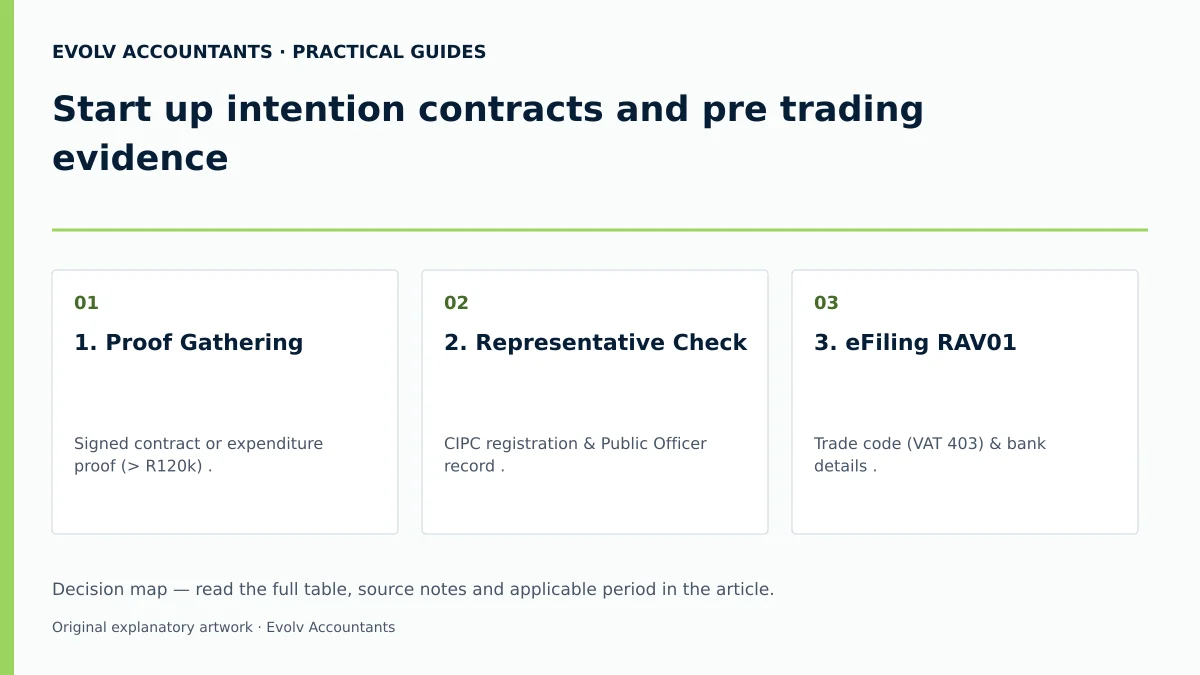
| 1. Proof Gathering | Signed contract or expenditure proof (> R120k) 3 4. | Founder / Financial Director | All documents signed; no draft plans 4 5. | Replace unawarded tenders with binding agreements 5 25. |
| 2. Representative Check | CIPC registration & Public Officer record 18 22. | Public Officer | Representative profile active on eFiling 17. | Update SARS registered details if representative changed 47. |
| 3. eFiling RAV01 | Trade code (VAT 403) & bank details 26 48. | Representative Vendor / Practitioner 21 | Submission confirmation generated 37. | Complete facial biometric screening if prompted 37. |
| 4. Document Upload | Review Notice & packed PDF evidence 4 37. | Representative Vendor | eFiling case status shows submitted 37. | Submit within 21 business days to avoid rejection 38. |
| 5. Verification | Notice of Registration 8. | Public Officer | VAT number active on SARS Vendor Search 8 41. | Contact SARS Contact Centre if review exceeds 21 days 10. |
Practical Example: Pre-Trading Voluntary VAT Registration
A South African private company, Alpha Manufacturing (Pty) Ltd, plans to build a specialised processing facility. The company has not yet produced goods or made taxable sales.
- Financial & Contractual Inputs: Alpha Manufacturing signs a written commercial lease for factory premises requiring R150 000 in rental expenditure over the next 12 months 3 4. It also secures a equipment finance facility from a registered bank with annual repayments of R200 000 3.
- Threshold Qualification: Although actual sales are R0, total qualifying pre-trading expenditure (R150 000) and bank finance repayments (R200 000) each exceed the R120 000 voluntary registration threshold administered by SARS 3.
- Process & Result: The Public Officer submits an RAV01 form on eFiling under voluntary registration (expenditure/finance option) 26 35 36. Within 21 business days, Alpha Manufacturing uploads the signed lease agreement, bank finance contract, and corporate bank statement via eFiling 3 4 38. SARS approves the application and issues a Notice of Registration 8 37. Alpha Manufacturing can now claim input tax on qualifying startup purchases, subject to holding valid tax invoices 49 50.
Frequently Asked Questions
Can a business register for VAT if it has zero turnover and no sales invoices?
Yes. A business with zero turnover can register voluntarily if it possesses written supply contracts exceeding R120 000 in expected taxable supplies over the next 12 months, or has incurred/will incur pre-trading capital expenses/finance repayments exceeding R120 000 2 3.
What is the difference between the R2.3 million and R1 million compulsory thresholds?
Current SARS administrative web guidance applies a R2.3 million compulsory turnover threshold 9 13. Older printed SARS guides retain references to the historical R1 million compulsory threshold 14. SARS administers applications based on current web guidance, which represents its operational administrative position rather than a statutory amendment to Section 23 of the VAT Act 11 14.
Are business plans or cash flow forecasts accepted as proof of start-up intention?
No. SARS explicitly excludes business plans, cash flow projections, non-factual growth concepts, and unawarded tender proposals as proof of taxable supplies 5. Applicants must provide binding written contracts, signed lease agreements, or bank finance documentation 4.
How long does a business have to submit supporting documents after applying on eFiling?
Supporting documents requested under a Registration Application Review Notice must be submitted within 21 business days 37 38. Failure to submit documents within this timeframe leads to application rejection 38.
How far back can a pre-trading voluntary VAT registration be backdated?
Backdating of voluntary VAT registrations is generally not permitted 28. The effective liability date is set according to the application date unless the applicant submits specific supporting documentation to SARS justifying an earlier date 28. Ask Evolv about start up intention contracts and pre trading evidence. Share the relevant records so the support required can be scoped.
Related guides
- Registering for VAT after winning a large contract
- When a South African business must register for VAT
- The Proactive SARS Audit Guide: Keeping Your Business Ledger Sanitised
Sources
- Register for VAT | South African Revenue Service
- https://www.sars.gov.za/wp-content/uploads/Ops/Guides/VAT-REG-02-G01-Guide-for-Completion-of-VAT-Application-External-Guide.pdf
- https://www.sars.gov.za/wp-content/uploads/Ops/Guides/Legal-Pub-Guide-VAT404-VAT-404-Guide-for-Vendors.pdf
- FAQs for VAT vendors | South African Revenue Service
- Obligations of a VAT vendor | South African Revenue Service