
Tax clearance certificates versus tax compliance status
3 February 2026

A SARS tax compliance status PIN allows an authorised third party to check a taxpayer’s live status; a clearance certificate is a historical record.
South African small and medium enterprises (SMEs) navigating commercial tenders, vendor onboardings, or foreign transfers frequently encounter legacy contractual terms requesting a "Tax Clearance Certificate" (TCC). Historically, SARS issued paper certificates that verified compliance at a single moment in time. Under modern revenue administration, paper certificates have been superseded by the electronic Tax Compliance Status (TCS) system, which generates a real-time security PIN for online verification.
While third parties may still use historical certificate terminology in contracts, statutory compliance requires active eFiling management, continuous profile monitoring, and complete alignment across all registered tax types.
Historical certificate terminology versus live status
Evolution from paper certificates to real-time digital status
The governance of tax verification in South Africa underwent a fundamental shift when the South African Revenue Service (SARS) modernised its operational architecture 1 2. The practice of issuing paper tax clearance certificates was codified in Section 19.5 of the Tax Administration Act, 28 of 2011 (TAA), which prescribed the formal framework for confirming a taxpayer's compliance standing 3. In 2015, SARS introduced the electronic Tax Compliance Status (TCS) system to replace physical paper certificates entirely 1.
Under the TCS functionality on eFiling, an eligible business no longer receives a static paper document to present to commercial counterparties 1 4. Instead, the taxpayer applies online for a Tax Compliance Status PIN 1 4. As SARS notes, a PIN "enables you to authorise any third party (an organisation or government) to view your status online via eFiling" 1.
This digital mechanism allows public sector entities, corporate clients, and financial institutions to verify an entity's live compliance profile directly against SARS records 1 5.
— Practical point from this guide
Legal status versus operational reality
Although commercial contracts and tender specifications still routinely request a "Tax Clearance Certificate", the operational reality in South African law is that physical certificates no longer exist for active compliance management 1 3. A TCS PIN represents secure access to view a taxpayer's current compliance status at the exact date and timestamp of verification 1 4 6.
Crucially, a TCS PIN is not a permanent guarantee or an enduring certificate of future compliance 4 6. A taxpayer's compliance standing is dynamic and fluctuates continuously based on real-time return filings, assessment changes, and payment settlements 4 6. Furthermore, under Section 19.5.2 of the TAA, SARS retains explicit statutory authority to alter a taxpayer's status from compliant to non-compliant if a confirmation was issued in error, or was obtained through fraud, misrepresentation, or the non-disclosure of material facts 7.
Consequently, holding an active PIN issued on a prior date does not protect a business if an intervening default turns its live profile red 7 8.
Compare the criteria that matter: historical certificate terminology
Evaluating compliance under legacy certificate terminology versus live status requires analysing six fundamental operational constraints: control, liability, reporting, tax, cash flow, and governance.
Control and visibility constraints
Under historical certificate procedures, a business had zero visibility over how or when a third party evaluated its standing once a paper document was handed over 1. In contrast, the eFiling TCS dashboard provides total administrative control 9 10. Registered users can issue new PINs, set specific request types, or cancel existing PINs at any time before expiry 9 11.
The "Who viewed my status" functionality logs the exact identity of every third party that verified the PIN, along with the date, timestamp, and compliance result displayed during that inspection 10 12.
Reporting, tax, and cash flow liabilities
SARS evaluates five mandatory statutory criteria on the eFiling "My Compliance Profile" (MCP) dashboard before confirming a compliant status 8 13:
- Registration Status: The entity must be registered and active for all tax types for which it is legally liable, including Income Tax (IT), Pay As You Earn (PAYE), or Value Added Tax (VAT) 8 13 14.
- Submission of Returns: Zero tax returns liable across all registered tax types may be outstanding past their stipulated filing due dates 8 13.
- Debt Standing: The taxpayer must have no outstanding tax debt owed to SARS, unless a formal instalment payment arrangement, compromise agreement, or suspension of payment pending dispute has been granted 7 8 13 15.
- Registered Particulars: All corporate demographic details, physical addresses, banking details, and registered representative records must be updated and verified on the RAV01 form 13 16.
- Merged Profiles: All registered tax reference numbers across different portfolios must be fully declared and merged using the eFiling Merge tool 13 17.
An unfiled return or an unpaid debt balance in one tax product (such as a minor administrative penalty under PAYE) immediately compromises the overall compliance status of the entire entity, rendering the overall indicator non-compliant (red) across all tax types 8 17.
Operational and contract governance
Legacy certificates created a false sense of security for vendors and procurement officers. A vendor could submit a paper certificate valid for 12 months while quietly accumulating substantial tax liabilities or defaulting on VAT submissions during the contract period 1 8. Modern live verification ensures that contracting authorities inspect real-time standing 4 6. For SMEs, this operational reality necessitates continuous, proactive bookkeeping and tax oversight rather than annual scramble operations 18.
How the obligations differ: live status
Navigating live compliance requires distinguishing between statutory law, regulator administrative guidance, and professional accounting recommendations.
Sourced rules versus professional advisory standards
- Statutory Law (Tax Administration Act, 2011): Imposes mandatory legal duties on taxpayers to register for taxes (§25–27), file complete returns on time (§25), pay assessed liabilities (§162–168) 19, and retain accounting records, books of account, and supporting documents for a minimum of five years from return submission (§29) 18 20. The TAA establishes SARS's power to issue final demand notices giving 10 business days before initiating debt recovery (§11.2) 21, and sets a 21 business day period for processing formal compliance status applications (§19.5.1) 22.
- Regulator Guidance (SARS eFiling External Guides): Provides operational instructions for navigating digital platforms 2 23. This includes activating TCS rights under the Tax Status menu 17 23, conducting RAV01 profile verifications 14 16, monitoring green (compliant) versus red (non-compliant) dashboard lights 8 24, using eFiling "Fix My Account" features 25, and submitting a "Challenge Status" case (form TCR01) when disallowing indicators are contested 26 27 28.
- Evolv Recommendations: Professional accounting and advisory guidance for SMEs to establish robust internal controls. Evolv recommends monthly reconciliations of SARS Statements of Account (SAO), bi-weekly eFiling MCP dashboard reviews, and maintaining integrated oversight across bookkeeping, payroll, tax filing, and CIPC statutory compliance.
SME live status compliance checklist
SMEs should implement the following six-step workflow to maintain continuous tax compliance:
- Activate eFiling TCS Rights: Ensure your organisation portfolio has activated "Tax Compliance Status" and "Tax Compliance Status Verification" user rights under eFiling Security Details 17 23.
- Execute Entity Merging: Access the Merge tool on eFiling to consolidate all income tax, PAYE, VAT, and custom reference numbers into a single corporate profile 13 17.
- Verify RAV01 Registered Particulars: Confirm that all legal details, registered representative information, and contact numbers on record are accurate and verified 13 16. Note that updating RAV01 contact details does not update eFiling security details used for One-Time PIN (OTP) authentication 16.
- Monitor My Compliance Profile (MCP): Inspect the MCP dashboard regularly to confirm green indicators across Registration, Submission of Returns, and Debt 8 24. For newly registered businesses prior to their first filing due date, verify that the status correctly reflects "Compliant (New Taxpayer)" 24.
- Generate a TCS Good Standing PIN: Submit a TCS application (TCR01 form) under the Tax Compliance Status Request tab to generate a 10-digit security PIN 28 29 30 31.
- Issue and Audit PIN Access: Share the active PIN and tax reference number with commercial clients or tender boards 1 5. Periodically review the "Who viewed my status" tab to audit third-party verifications 10 12.
Two business situations with different outcomes: historical certificate terminology
To illustrate how legacy terminology contrasts with live digital compliance, consider a practical business scenario involving a South African SME.
Scenario setup and facts
- Taxpayer: Enterprise Bravo (Pty) Ltd, an SME supplying specialised technical services to municipal entities.
- Contract Requirement: The municipal tender agreement contains legacy wording requiring "submission of a valid Tax Clearance Certificate throughout the contract term."
- Event: During Year 2 of the contract, an administrative delay in processing monthly PAYE returns results in SARS raising an estimated assessment, creating an illustrative debt balance of R35,000 (labelled illustrative value) on the entity's statement of account 32.
Comparative outcomes analysis
- Case A: Legacy Paper Certificate Model (Historical Assumption)
Enterprise Bravo relies on a paper TCC issued at contract inception. Management assumes compliance is secured for the entire 12-month period. Because the paper document remains physically valid on its face, Enterprise Bravo does not address the pending PAYE assessment. However, during an annual audit, the municipality discovers the unfiled PAYE return and outstanding debt. The municipality cancels the contract for breach of compliance, imposing financial penalties and reputational damage.
- Case B: Live TCS PIN System (Modern Operational Reality)
Enterprise Bravo shares its TCS PIN with the municipal procurement office. The procurement office performs monthly online verifications 4 10. On day 1 of the PAYE dispute, the MCP dashboard switches Enterprise Bravo's status indicator from green to red due to the debt balance 8.
Because live status is monitored, Enterprise Bravo immediately identifies the red debt indicator 8. Management engages Evolv Tax Advisory to submit an eFiling request for an instalment payment arrangement or suspension of payment pending dispute resolution 13 15 21. Upon SARS agreeing to the payment suspension, the eFiling MCP system automatically restores Enterprise Bravo's overall compliance status indicator to green 7 8 13.
The municipality verifies the updated status online, and contract payments proceed without interruption 5 6.
Decision comparison matrix
| Criterion | Option A: Legacy Paper Certificate | Option B: Live TCS PIN System | Evidence or assumption | Implication for this reader |
|---|---|---|---|---|
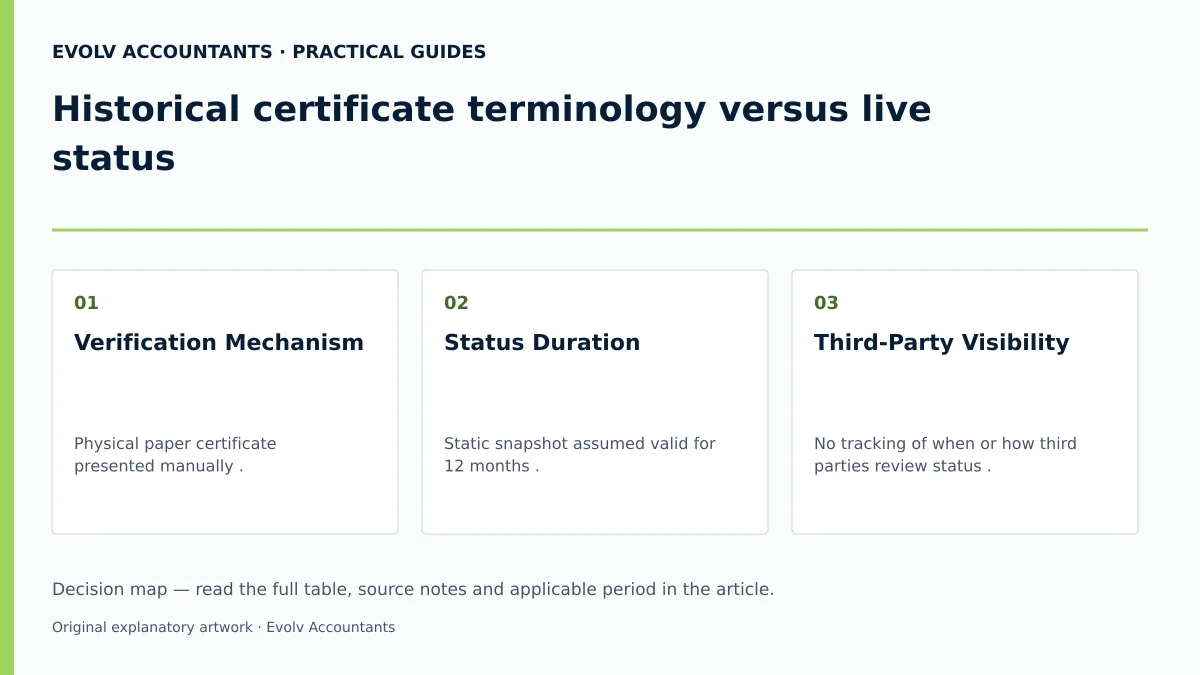
| Verification Mechanism | Physical paper certificate presented manually 1. | Digital 10-digit PIN verified online via eFiling 1 4. | Sourced from SARS TCS External Guide 1 4. | Legacy contractual terms asking for a "certificate" require issuing a live eFiling PIN 1 3. |
| Status Duration | Static snapshot assumed valid for 12 months 1. | Real-time dynamic standing subject to continuous change 4 6. | Sourced from TAA 2011 §19.5 and eFiling Guide 3 4. | Holding an issued PIN does not guarantee compliance if unfiled returns or debts arise 4 8. |
| Third-Party Visibility | No tracking of when or how third parties review status 1. | Detailed log in "Who viewed my status" with date and result 10. | Sourced from SARS eFiling External Guide 10. | SMEs can audit exactly which clients or tender boards verified their compliance 10. |
| Remediation Speed | Delayed manual intervention at branch offices 25. | Online eFiling tools ("Fix My Account", "Challenge Status") 25 26. | Sourced from eFiling TCS External Guide 25 26. | Non-compliance indicators can be corrected rapidly online through formal SARS procedures 15 25. |
| Statutory Grounds for Revocation | Limited manual cancellation procedures 7. | Instant status alteration to non-compliant for error or fraud 7. | Sourced from TAA 2011 §19.5.2 7. | SARS automatically toggles standing to red upon unaddressed default 7 8. |
When the comparison needs specialist input: live status
Certain complex tax situations and technical legal circumstances fall outside routine eFiling management and require specialist accounting, legal, or tax advisory intervention:
- Approval International Transfer (AIT) Applications: When individuals or entities seek to transfer funds offshore, SARS enforces heightened verification requirements, including capital gain declarations, source of funds verification, and proof of non-resident tax cessation 1 30. Under TAA §19.5.1, SARS may extend the standard 21 business day review period to conduct deep audit verifications 22.
- Formal Debt Relief and Dispute Management: Negotiating formal instalment payment arrangements under TAA §167 15 19, submitting compromise requests for undisputed tax debt under TAA §200–205 15, or requesting suspensions of payment under TAA §164 during dispute proceedings require specialised tax law expertise 7 15.
- Voluntary Disclosure Programme (VDP) Submissions: Taxpayers seeking relief from administrative penalties or criminal prosecution for historical non-compliance must apply under the statutory VDP framework (§225–233 of the TAA) 33 34. Qualifying VDP agreements grant 100% relief from administrative non-compliance penalties (excluding late filing penalties) 33.
- Understatement Penalty Disputes: Where SARS levies understatement penalties under TAA Chapter 16 (ranging from illustrative statutory rates of 25% for lack of reasonable care up to 75% or 100% for obstructive behaviour or impermissible avoidance) 35, formal legal representations and formal tax opinions are required to contest the assessment 35.
- Complex Entity Restructuring and Unmerging: Merging or unmerging complex corporate groups, registering specialised tax products such as Withholding Tax on Interest (WTI) 36, or resolving severe profile mismatches on RAV01 require professional statutory compliance management 13 16 36.
Next steps for Tax clearance and compliance
To maintain seamless commercial readiness and protect your enterprise from sudden vendor disqualification, SMEs should implement a formal compliance decision record and regular internal review process.
Decision record and operational governance
- Establish an internal Tax Compliance Register that tracks all active eFiling TCS PINs, issue dates, and expiry dates 9.
- Conduct bi-weekly eFiling MCP dashboard reviews to detect unallocated payments, administrative penalty notices, or unfiled return alerts before they impact live status 8 24.
- Ensure all corporate accounting, payroll, and statutory record retention complies strictly with the 5-year statutory mandate under Section 29 of the Tax Administration Act 18 20.
Frequently Asked Questions
Can a third party access our full financial records if we give them a TCS PIN?
No. To protect taxpayer confidentiality, sharing a TCS PIN only authorises the third party to view your high-level overall compliance status, registered trading names, and tax reference numbers at the date and timestamp of verification 1 5 6. Third parties cannot access your bank details, tax returns, financial statements, or detailed income records 1.
How long does SARS take to process a Tax Compliance Status request?
For standard Good Standing requests where all returns are filed and no debt is outstanding, eFiling generates the TCS PIN instantly on the dashboard 1 37. However, under Section 19.5.1 of the Tax Administration Act, SARS has a statutory period of up to 21 business days to issue or decline a compliance status confirmation, which may be extended if detailed audit verifications are required 22.
What should we do if our eFiling dashboard shows a red "Non-Compliant" status?
You must inspect the expanded My Compliance Profile (MCP) menu to identify which category triggered the red indicator: Registration, Submission of Returns, or Debt 8. Outstanding returns must be submitted immediately 8 13. For debt balances, you can use eFiling "Fix My Account", apply for an instalment payment arrangement, or log a "Challenge Status" case (form TCR01) if the assessment is disputed 15 25 26.
How does a newly registered company obtain a TCS PIN before its first filing due date?
Newly registered entities can activate TCS rights on eFiling and apply for a Good Standing PIN immediately 14 24 30. SARS displays a specific compliance indicator on the MCP stating "Compliant (New Taxpayer)", confirming that the entity is compliant but has not yet reached its first tax return or payment due date 24 38.
What is the difference between a TCS PIN for Good Standing and one for Approval International Transfer?
A Good Standing PIN confirms general tax compliance for tenders, contracts, and vendor onboardings 29 30. An Approval International Transfer (AIT) PIN is specifically required for individuals or entities transferring capital or income offshore, and requires submitting supporting documentation regarding foreign exchange control compliance and asset declarations 1 30.
Related guides
- Obtaining a tax compliance status PIN
- Checking why a SARS compliance status is non compliant
- The Proactive SARS Audit Guide: Keeping Your Business Ledger Sanitised
Sources
- Manage your Tax Compliance Status | South African Revenue Service
- https://www.sars.gov.za/wp-content/uploads/Ops/Guides/GEN-ELEC-08-G01-Guide-to-the-Tax-Compliance-Status-functionality-on-eFiling-External-Guide.pdf
- https://www.sars.gov.za/wp-content/uploads/Ops/Guides/LAPD-TAdm-G01-Short-Guide-to-the-Tax-Administration-Act-2011.pdf
- https://www.sars.gov.za/wp-content/uploads/Ops/Guides/GEN-REG-01-G04-How-to-Complete-the-Registration-Amendments-and-Verification-Form-RAV01-External-Guide.pdf