
UIF obligations when an employee works for two employers
17 November 2024

Managing UIF obligations for an employee working for two employers requires each employer to calculate, deduct, and declare contributions independently on remuneration paid.
Each employer must independently test whether its employment relationship falls within the UIF rules, calculate contributions on the UIF remuneration it pays, and retain its own employee declaration and payment evidence. Apply the hours exclusion and earnings ceiling separately for each employer.
Another employer’s contributions do not replace these duties. SARS UIF scope; contribution rules.
Separate employers and contribution evidence
This guidance is tailored for South African small and medium enterprise (SME) employers, payroll managers, and tax practitioners navigating dual employment scenarios 1 2 3. In the South African jurisdiction, employer obligations regarding the Unemployment Insurance Fund (UIF) are governed by the Unemployment Insurance Act 63 of 2001 (UI Act) and the Unemployment Insurance Contributions Act 4 of 2002 (UIC Act), alongside the Tax Administration Act 28 of 2011 (TA Act) 1 4 5.
For the current tax period, statutory completion means that an SME employer has independently established its UIF registration status, accurately calculated and withheld monthly contributions on its own payroll, remitted the total 2% contribution to SARS or the UI Commissioner within the prescribed deadlines, submitted monthly employee declaration records, and successfully reconciled its annual filings 6 7 8 9 10.
— Practical point from this guide
Legal independence of distinct employment contracts
The Fourth Schedule to the Income Tax Act and Section 1 of the UIC Act define an employer as any person who pays or is liable to pay remuneration to an employee 3 11. Because each employer constitutes a separate legal and tax entity, an employer's statutory duty is assessed strictly within the context of its own employment contract 3 12. Even if an employee earns income from another company, the primary legal evidence confirms that each employer must perform its own statutory deductions without adjusting for external income 7 12 13.
Applicable statutory rates and contribution ceilings
Under Section 6 of the UIC Act, the statutory contribution rate is 1% of remuneration contributed by the employee through monthly payroll deduction, plus an equal 1% contributed by the employer, creating a total monthly contribution of 2% 7 13. Effective from 1 June 2021, the maximum statutory remuneration ceiling for UIF contribution calculations is R17,712 per month (or R212,544 annually) 7 14 15.
Consequently, the maximum monthly deduction per employer-employee relationship is capped at R177.12 for the employee and R177.12 for the employer, totalling R354.24 per month per employer 14.
Prepare the information and authority: separate employers
To maintain full statutory compliance when managing dual-employed personnel, SME employers must compile specific documentation, secure formal authorisations, and establish robust payroll data inputs 16 17.
Document requirements and payroll inputs
Employers must assemble and maintain the following core evidence:
- Written Employment Contracts: Proof of employment establishing the agreed working hours, remuneration structure, and job scope for the specific employer 16 18.
- Employee Identification & Tax Details: Certified copy of the employee's South African identity document or passport, full names, physical address, and personal income tax reference number 16 19.
- Payroll Register: Detailed monthly records reflecting gross remuneration paid, hours worked, statutory deductions, and net pay 16.
- UI-19 / uFiling Employee Declarations: Documentation reflecting the start date, employment status, monthly deductible earnings, and occupation details submitted to the UI Commissioner 20 21 22.
Permissions and representative authority
Under Paragraph 1 of the Fourth Schedule and the Tax Administration Act, a representative employer—such as a company director, public officer, or manager—is legally responsible for fulfiling statutory tax duties 17 23. Where an SME uses external tax practitioners or payroll agents, the employer must delegate specific uFiling or SARS eFiling profile permissions (such as Capture Declarations, Submit Declarations, or Pay) to authorised individuals while retaining ultimate legal liability for compliance 17 24 25 26.
Complete the task step by step: contribution evidence
Executing UIF duties for an employee working across two companies requires a disciplined, step-by-step operational sequence grounded in SARS external guides and Department of Employment and Labour uFiling procedures 6 20 27.
Step 1: Verify employee eligibility and statutory exclusions
Before setting up payroll deductions, examine whether the employee falls under statutory exclusions 18 28.
Under Section 4 of the UIC Act, an employee is excluded from UIF contributions if they work for the specific employer for less than 24 hours in a calendar month 18 28. (Other exclusions apply to national/provincial public service officers and elected public office holders 18 28.) If the employee works 24 hours or more in the month for your business, UIF contributions are compulsory regardless of their employment status elsewhere 18 28 29.
Step 2: Calculate monthly remuneration and apply the statutory ceiling
Determine the employee's "remuneration" for UIC purposes 15 30. Under Section 1 of the UIC Act, remuneration includes standard salary, wages, and taxable allowances, but excludes pensions, superannuation allowances, retiring allowances, statutory gross income lump sums, and commission 30 31.
- Calculate 1% of the employee's UIC-eligible remuneration paid by your company for the month 7 13.
- If the employee's monthly remuneration from your business exceeds R17,712, cap the remuneration at R17,712, resulting in a maximum employee deduction of R177.12 and an employer contribution of R177.12 7 14 15. Do not attempt to aggregate or cross-check earnings paid by the employee's second employer 7 12.
Step 3: Deduct employee contribution and remit payment to SARS or UI Commissioner
Deduct the 1% employee portion from remuneration paid during the payroll cycle 12. Combine it with the 1% employer portion (total 2%) 7 13.
- SARS-Registered Employers: If your business is registered with SARS for PAYE or Skills Development Levy (SDL), declare the total UIF contribution on the Monthly Employer Declaration (EMP201) 6 14 32 33. Remit payment to SARS within seven (7) days following the end of the month in respect of which the contribution is payable 8 34. If the 7th day falls on a weekend or public holiday, payment must be received by the last business day prior 8 34. Always use the pre-populated 19-digit Payment Reference Number (PRN) on the EMP201 to link the electronic funds transfer (EFT) or bank deposit 14 35.
- Non-PAYE/SDL Employers: Employers who are not liable to register with SARS for PAYE or SDL must register directly with the UI Commissioner and remit payments via uFiling or authorised banking channels 6 27 33.
Step 4: Submit monthly UI-19 employee declarations to the UI Commissioner
Crucially, payment to SARS does not automatically fulfil the requirement to update the national UIF worker database 10 36 37. Irrespective of whether contribution payments are made to SARS or the UI Commissioner, all employers must submit monthly employee declaration records (UI-19 details) directly to the Unemployment Insurance Commissioner by no later than the 7th of every month 10 20 22 36.
- On the uFiling platform, navigate to the Declarations Manager, capture or update the employee's employment details, monthly deductible earnings, and hours worked, and submit the return 20 38 39 40. Alternatively, employers using integrated payroll software can generate and submit electronic UI-19 files in the format prescribed by the UI Commissioner 22.
Step 5: Perform annual reconciliation (EMP501) and issue tax certificates
At the close of the tax year, SARS-registered employers must submit an Employer Reconciliation Declaration (EMP501) 3 9 41. This statement reconciles all monthly UIF contributions declared and paid on EMP201s against the total UIF amounts reflected on employee IRP5/IT3(a) certificates issued for the tax year 9 41.
Check the result against the evidence: separate employers
Employers must verify compliance using independent, official proof rather than assuming that transmitting a declaration guarantees statutory acceptance 9 39 40.
Primary verification documents
Validate completion against the following primary evidence records:
- SARS Payment Confirmation Receipts: Official bank or eFiling payment receipts displaying the unique 19-digit PRN matching the submitted EMP201 declaration 14 35.
- uFiling submission status: Retain the confirmation message and check the declaration status. The cited guide says successful submission changes the status to “Submitted”; it does not prescribe a subsequent “Submitted” to “Accepted” transition. uFiling submission instructions.
- UIF Employee Database Status: Verification that employee details, employment start dates, and monthly earnings accurately reflect on the UI Commissioner's database 20 37 42.
- SARS EMP501 Reconciled Status: Official SARS notification confirming that the annual reconciliation balances without variance 9 41.
Handle exceptions and unresolved cases: contribution evidence
Dual employment introduces specific edge cases, non-compliance risks, and procedural boundaries that require careful management 28 43 44.
Edge Case 1: Employee total earnings exceed ceiling across both jobs
A common question arises when an employee earns R15,000 per month at Employer A and R15,000 per month at Employer B. Each employer independently calculates 1% on R15,000 (R150 employee deduction + R150 employer contribution = R300 total per employer) 7 13. Combined, the employee has R300 deducted across both jobs on total earnings of R30,000 7 13. Legally, neither employer has over-deducted under its own contract, as neither company paid in excess of the R17,712 monthly ceiling 7 12 14.
Primary statutory guidance explicitly prohibits an employer from deducting less than 1% on its own remuneration paid unless that specific employer's remuneration exceeds R17,712 7 12 14.
Edge Case 2: Employee works under 24 hours per month for one employer
If an employee works 40 hours per month for Employer A (compulsory UIF contribution) but only 15 hours per month for Employer B, Employer B must exclude the employee from UIF contributions under Section 4 of the UIC Act 18 28. Employer B records the employee as exempt on its payroll register, while Employer A deducts and remits UIF normally 16 18 28.
Late payments, interest, and penalties
Failure to pay monthly UIF contributions by the due date triggers statutory enforcement under Chapter 12 and Chapter 15 of the Tax Administration Act 44 45. Interest accrues at the prescribed rate from the day following the due date until full payment is received 44 45. In addition, a compulsory 10% penalty is imposed on default amounts 45. Under Chapter 8 of the TA Act, SARS may issue estimated assessments where returns are missing or inaccurate 46.
Intentional non-compliance or submitting false statements constitutes an offence punishable by a fine or imprisonment up to two years 5 10 43 47.
Professional specialist boundaries
When payroll anomalies arise—such as disputed employment statuses, retroactive back-pay across multiple employers, or SARS audit queries—SME directors should seek specialist tax advisory and payroll assistance rather than attempting manual adjustments 48.
Next steps for UIF employer duties
To assist SME business owners and payroll officers in executing dual-employer UIF duties, the following task checklist outlines the sequence of actions and required verification controls.
Task and completion checklist
| Step | Input or evidence | Responsible person | Completion check | Exception or next action |
|---|---|---|---|---|
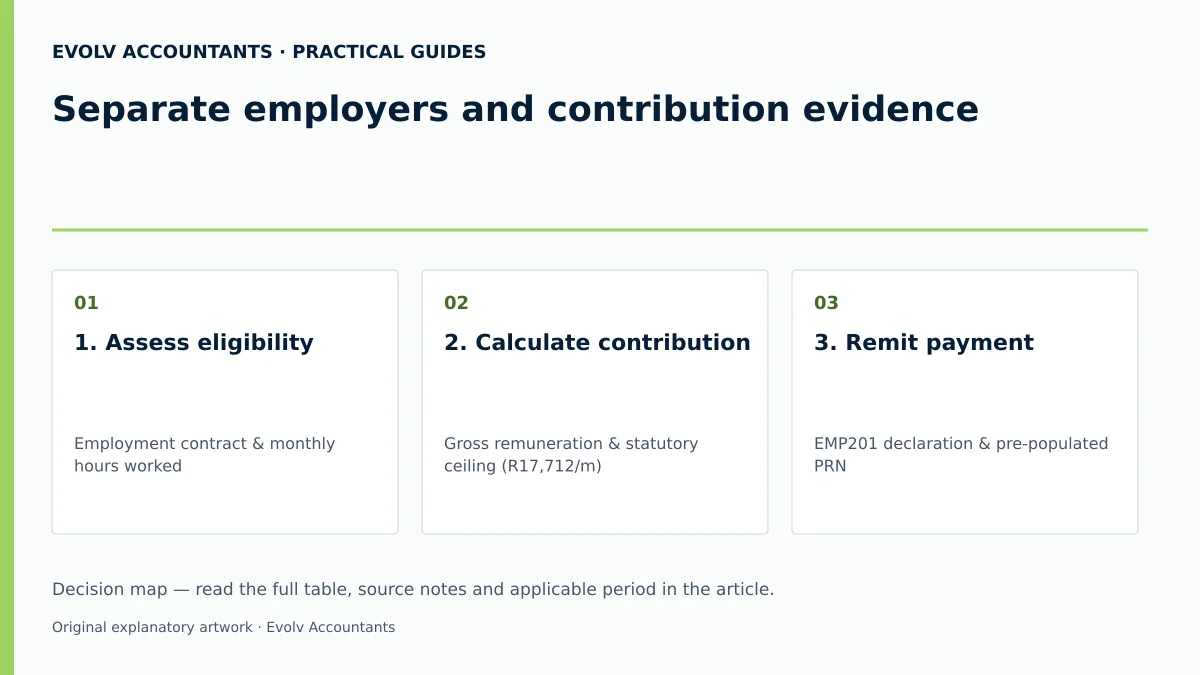
| 1. Assess eligibility | Employment contract & monthly hours worked | Payroll Administrator / Representative Employer | Confirm employee works ≥24 hours/month for this entity | If <24 hours/month, mark exempt from UIF on payroll register 18 28 |
| 2. Calculate contribution | Gross remuneration & statutory ceiling (R17,712/m) | Payroll Administrator | Apply 1% employee deduction & 1% employer portion up to R177.12 max 7 14 | Do not aggregate earnings from second employer 7 12 |
| 3. Remit payment | EMP201 declaration & pre-populated PRN | Financial Controller / Tax Practitioner | Payment cleared to SARS/UIF within 7 days post month-end 8 34 35 | Inspect the collecting authority’s account and any applicable late-payment notice |
| 4. Submit UI-19 data | uFiling platform / electronic payroll file | Payroll Administrator / uFiling Delegate | UI-19 submission confirmation & status "Submitted" on uFiling 10 20 39 40 | Inspect the issue and follow the prescribed correction or support route; retain the eventual submission confirmation |
| 5. Annual reconciliation | EMP501 return & issued IRP5/IT3(a) certificates | Public Officer / External Tax Advisor | Zero variance between EMP201 totals & IRP5 UIF values 9 41 | Adjust variances during statutory EMP501 filing window 9 41 |
Practical hypothetical example
Consider a scenario where an experienced accountant, Mr. Sipho Nkosi, works concurrently for two independent South African SMEs during the 2026/2027 tax year:
- Employer A (Retail SME) pays Sipho a gross monthly salary of R12,000 for 80 hours of work per month.
- Employer B (Consulting SME) pays Sipho a gross monthly salary of R25,000 for 80 hours of work per month.
Employer A Calculation:
- Remuneration paid by Employer A: R12,000 per month (below R17,712 ceiling) 7 15.
- Employee contribution (1%): R120.00 7 13.
- Employer contribution (1%): R120.00 7 13.
- Total monthly contribution remitted by Employer A to SARS: R240.00 7 14.
Employer B Calculation:
- Remuneration paid by Employer B: R25,000 per month (exceeds R17,712 monthly ceiling) 7 14 15.
- Statutory capped remuneration: R17,712 per month 7 14 15.
- Employee contribution (1% capped): R177.12 14.
- Employer contribution (1% capped): R177.12 14.
- Total monthly contribution remitted by Employer B to SARS: R354.24 14.
Compliance Outcome: Both Employer A and Employer B operate in full accordance with statutory rules 6 7 12. Employer A does not reduce its contribution because Sipho earns additional income elsewhere, and Employer B correctly caps its contribution at the R17,712 statutory ceiling based solely on its own payroll figures 7 12 14. Both employers submit monthly EMP201 returns to SARS and UI-19 declarations to the UI Commissioner 10 14 20.
Frequently Asked Questions
If an employee works for two employers, can one employer stop deducting UIF if the employee already pays maximum UIF at the other job?
No. Under Section 6 and Section 7 of the Unemployment Insurance Contributions Act, each employer must calculate and deduct UIF contributions based strictly on the remuneration paid under its own employment relationship 7 12 13. An employer has no statutory legal standing to waive or reduce UIF deductions based on earnings received from an independent third-party employer 7 12 49.
How does the R17,712 monthly statutory ceiling apply when an employee has two jobs?
The R17,712 monthly earnings ceiling applies independently to each employer-employee relationship 7 14 15. Each employer caps its UIF calculation at R17,712 for remuneration paid by that specific business, resulting in a maximum employee deduction of R177.12 and a maximum employer contribution of R177.12 per month per employer 14.
Does submitting an EMP201 payment to SARS automatically fulfil our UIF declaration duties?
No. The EMP201 submitted to SARS is a financial payment declaration 14 35. Irrespective of payment registration, all employers must also submit monthly employee UI-19 declaration details directly to the UI Commissioner (via uFiling or payroll electronic upload) to update individual worker records on the UIF database 10 20 22 36.
What happens if an employee works less than 24 hours a month for our company but works full-time elsewhere?
Under Section 4 of the UIC Act, an employee who works less than 24 hours in a calendar month for a specific employer is legally excluded from UIF contributions for that specific employment 18 28. Your business must record the employee as exempt from UIF on your payroll register, regardless of how many hours they work for another employer 16 18 28.
What are the penalties if an employer fails to pay monthly UIF contributions on time?
Under Chapter 12 and Chapter 15 of the Tax Administration Act, late payment of UIF contributions attracts interest at the statutory prescribed rate from the day following the due date, plus an automatic 10% penalty on the unpaid contribution amount 44 45. Persistent failure to submit returns or remit funds constitutes a statutory offence punishable by a fine or imprisonment for up to two years 5 10 43 47. Tell Evolv which UIF registration, declaration or payment question you need help to resolve.
Related guides
- Reconciling UIF payments to declarations
- When a small business must register for UIF
- Compliance and Regulations: Keeping Your Business on Track
Sources
- https://www.sars.gov.za/wp-content/uploads/Ops/Guides/UIF-GEN-01-G01-Guide-for-Employers-in-respect-of-the-Unemployment-Insurance-Fund-External-Guide.pdf
- Unemployment Insurance Fund | South African Revenue Service
- https://www.labour.gov.za/DocumentCenter/Publications/Unemployment%20Insurance%20Fund/uFiling%20System%20User%20Guide.pdf
- Unemployment Insurance Fund