
Understanding VAT201 input tax fields
5 January 2026

Understanding VAT201 input tax fields requires South African SMEs to hold the prescribed documentary evidence and correctly categorise permissible deductions while excluding prohibited claims.
Claiming input tax on a South African Revenue Service (SARS) VAT201 declaration involves completing specific return fields (Fields 14 to 18) supported by valid documentary evidence retained for five years 1 2. Small and medium enterprises (SMEs) must distinguish between capital goods, operational expenses, and imported goods while strictly excluding prohibited expenses such as staff entertainment, passenger motor vehicles, and recreational club subscriptions under Section 17 of the Value-Added Tax Act 3 4.
Operating under statutory provisions and SARS administrative guides, registered vendors calculate allowable input tax to offset against output tax, determining the net tax payable or refundable position for each tax period 5 6.
Input tax evidence and excluded claims
What the VAT201 input section records
In South African VAT administration, the primary record for claiming input tax is the valid tax invoice 7 8. Its underlying decision purpose is to establish an unyielding audit trail proving that standard-rated VAT (currently 15%) was lawfully levied by a registered supplier and incurred by the vendor for making taxable supplies 1 9.
Without a valid tax invoice (or specialized primary documentation such as a Customs bill of entry or a signed VAT264 declaration), SARS disallows the deduction during verification, treating the input tax claim as unsubstantiated 7 8 10.
From a legal standpoint, Section 16(2) of the VAT Act mandates that no input tax deduction may be made unless the vendor holds the prescribed documentation at the time the return is submitted 7 11. SARS regulator guidance in VAT 404 - Guide for Vendors establishes that commercial invoices, order notes, or pro-forma quotes do not constitute tax invoices and cannot support a VAT claim 12.
Evolv Accountants recommends implementing a mandatory pre-filing document check to verify that every purchase ledger entry matches a valid tax invoice before populating Part B of the VAT201 return.
Required Primary Documents for Input Tax Claims
Different business transactions require specific primary documents to substantiate input tax claims 7 10:
- Local Standard-Rated Purchases (more than R5 000): Requires a Full Tax Invoice reflecting the words "Tax Invoice", "VAT Invoice", or "Invoice"; supplier name, address, and VAT registration number; recipient name, address, and VAT registration number; serial number and date; full description of goods or services; quantity or volume; and explicit VAT charge or statement that the price includes VAT at 15% 13 14.
- Local Standard-Rated Purchases (R5 000 or less): Requires an Abridged Tax Invoice containing supplier details, date, serial number, description, and VAT charged, but omitting recipient details 13.
- Petty Cash Purchases (R50 or less): Does not require a formal tax invoice, but requires a till slip, cash docket, or sales slip showing supplier details and VAT charged 15 16.
- Imported Goods: Requires an EDI Customs Status 1 Release Message, a valid Bill of Entry (SAD 500), and an official eFiling Customs payment receipt verifying that import VAT was paid 10 17 18. If imported through an agent, a formal statement under Section 54(3)(b) issued within 21 days of month-end is required 17 19.
- Second-Hand Goods (Notional Input Tax): Requires a completed and signed Form VAT264 declaration, proof of payment, supplier identity document copy, and a record detailing the non-taxable acquisition 10 20.
Excluded Claims Under Section 17
Statutory law explicitly denies input tax claims on certain goods and services, even when incurred for business purposes 3:
- Entertainment Expenses: Input tax is disallowed on food, beverages, staff refreshments (tea, coffee, snacks), year-end parties, client lunches, staff canteen facilities, and hospitality boxes 21 22 23. Limited exceptions apply to vendors in the business of supplying entertainment, or subsistence meals enjoyed by staff away on overnight business trips 24 25.
- Motor Cars: Input tax is denied on vehicles defined as "motor cars" (vehicles with 3+ wheels, designed mainly for passenger transport on public roads, including sedans, station wagons, SUVs, minibuses, and double-cab bakkies) 4 26. Exceptions apply to motor vehicle dealers or car rental firms, and single-cab bakkies, delivery trucks, or buses designed to carry more than 16 persons 26 27.
- Club Subscriptions: VAT paid on membership fees for recreational, sporting, or private clubs is strictly denied 28. Subscriptions to professional trade journals or industry publications directly related to the business enterprise remain fully claimable 28.
Read the fields and definitions correctly: input tax evidence
Define terms, period, units and assumptions
When completing the VAT201 return on eFiling, Part B calculates Total Input Tax across editable green entry fields 2 29 30. Each field serves a distinct accounting category:
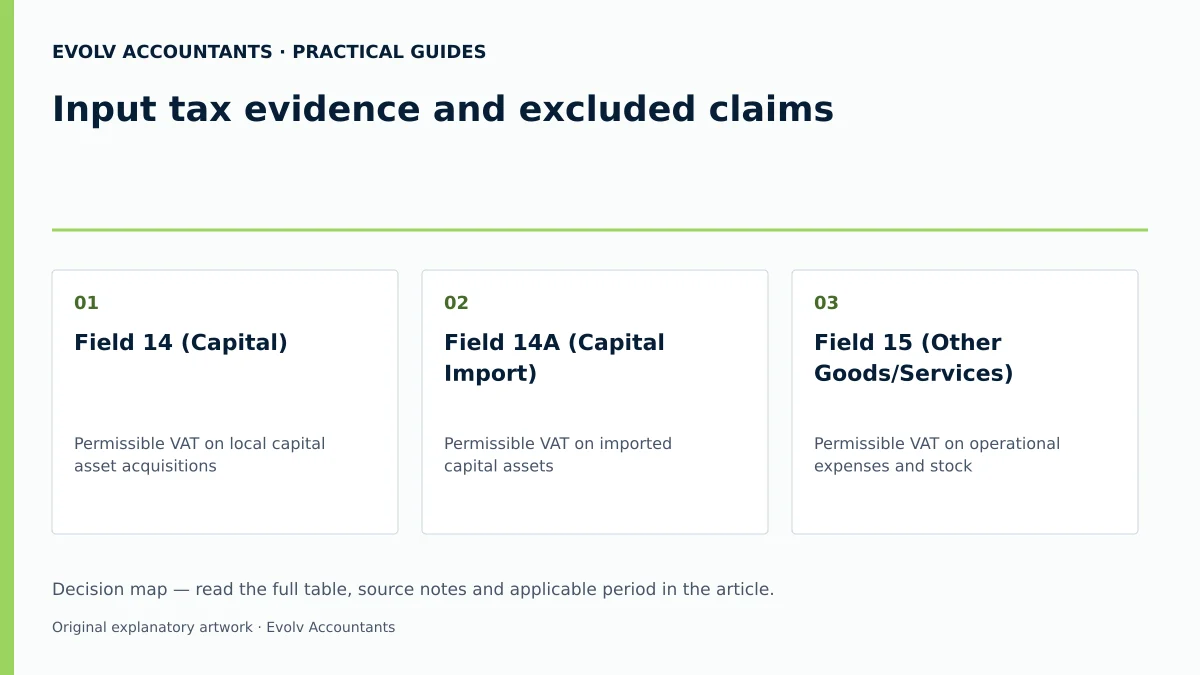
- Field 14 (Capital goods and/or services supplied to you): The permissible VAT amount on local capital acquisitions (e.g. office equipment, plant machinery, commercial buildings) charged at 15% VAT, supported by valid tax invoices 31.
- Field 14A (Capital goods imported by you): The permissible VAT amount paid on imported capital assets, requiring a valid Customs Code, bill of entry, release document, and payment receipt 32 33.
- Field 15 (Other goods and/or services supplied to you): Permissible VAT on non-capital operational expenses and trading stock (e.g. raw materials, stationery, commercial rent, accounting fees, electricity, telephone) 33.
- Field 15A (Other goods imported by you): Permissible VAT paid on imported operational stock and non-capital goods 34.
- Field 16 (Change in use): Input tax adjustments where goods or services previously acquired for non-taxable or private use are converted to taxable enterprise use 35 36.
- Field 17 (Bad debts): Input tax relief for irrecoverable debts written off where output tax was previously declared under the invoice accounting basis 35.
- Field 18 (Other): Permissible input tax adjustments, including credit notes issued, debit notes received, change in accounting basis adjustments, and Domestic Reverse Charge (DRC) input tax adjustments on valuable metals 5 30 37.
- Field 19 (Total Input Tax): An auto-calculated field summing Fields 14, 14A, 15, 15A, 16, 17, and 18 5 30.
- Field 20 (Net VAT Payable / Refundable): The final auto-calculated net liability or refund, representing Total Output Tax (Field 13) minus Total Input Tax (Field 19) 5 30.
- Field 19 (Total Input Tax) = Field 14 + Field 14A + Field 15 + Field 15A + Field 16 + Field 17 + Field 18
- Field 20 (Net Payable/Refund) = Field 13 (Total Output Tax) - Field 19 (Total Input Tax)
Tax periods are assigned by SARS into Category A or B (bi-monthly), Category C (monthly for vendors with taxable turnover exceeding R30 million), Category D (6-month agricultural period for qualifying turnover under R1.5 million), or Category E (annual) 38 39 40. All monetary values entered in Part B represent South African Rand (ZAR) VAT amounts calculated using the tax fraction:
VAT Amount = VAT-Inclusive Consideration × (15 ÷ 115)
Apportionment for Mixed Supplies
Vendors making both taxable and exempt (or non-taxable) supplies cannot claim 100% of input tax on general overheads 41. The standard turnover-based apportionment method calculates the claimable percentage 42:
Apportionment Ratio = (Taxable Turnover (excl. VAT) ÷ Total Income (excl. VAT)) × 100
Under the regulator's de minimis rule, if the calculated taxable apportionment ratio is 95% or higher, the vendor may deduct 100% of the input tax on mixed operational expenses 43.
Work through an example: excluded claims
Hypothetical purchase example
Consider an SME manufacturing business registered as a VAT vendor on the invoice basis. During a two-month Category B tax period, the business incurs the following expenditure (all figures are illustrative VAT-inclusive values at the 15% standard rate):
- Factory Machinery Purchase (Capital Asset): R115 000 (VAT-inclusive).
- Raw Materials & Operational Stock: R57 500 (VAT-inclusive).
- New Double-Cab Bakkie (Passenger Vehicle): R230 000 (VAT-inclusive).
- Staff Catering & Client Golf Entertainment: R11 500 (VAT-inclusive).
- Single-Cab Delivery Bakkie Maintenance: R23 000 (VAT-inclusive).
Step-by-Step Calculation and Categorisation
- Item 1 (Factory Machinery): Qualifies as a local capital asset. Supported by a valid full tax invoice.
VAT Claimable (Field 14) = R115 000 × (15 ÷ 115) = R15 000.00
- Item 2 (Raw Materials): Qualifies as operational stock (non-capital). Supported by valid tax invoices.
VAT Claimable (Field 15) = R57 500 × (15 ÷ 115) = R7 500.00
- Item 3 (Double-Cab Bakkie): Defined as a "motor car" under Section 1 26. Input tax is strictly denied under Section 17 27.
VAT Claimable = R0.00 (R30 000.00 input tax denied)
- Item 4 (Catering & Golf Entertainment): Defined as entertainment under Section 1 21. Input tax is strictly denied under Section 17 3.
VAT Claimable = R0.00 (R1 500.00 input tax denied)
- Item 5 (Single-Cab Bakkie Repairs): Single-cab bakkies are excluded from the "motor car" definition 26. Maintenance and repair expenses incurred for taxable enterprise supplies qualify for input tax 44 45.
VAT Claimable (Field 15) = R23 000 × (15 ÷ 115) = R3 000.00
Summary of Return Field Entries
- Field 14 (Capital Goods/Services): R15 000.00
- Field 15 (Other Goods/Services): R7 500.00 + R3 000.00 = R10 500.00
- Field 19 (Total Input Tax): R15 000.00 + R10 500.00 = R25 500.00
- Total Disallowed/Denied Input Tax: R30 000.00 (Vehicle) + R1 500.00 (Entertainment) = R31 500.00
- Field 14 (Capital): R 15 000.00
- Field 15 (Operational): R 10 500.00
- Field 19 (Total Input): R 25 500.00
- Total Denied Input: R 31 500.00
Reconcile it with related records: input tax evidence
Connecting VAT201 Declarations to General Ledger Records
Input tax claimed in Part B of the VAT201 return must reconcile directly with the business's general ledger VAT Input Control Account and underlying source documents 1. Evolv Accountants recommends performing a monthly three-way reconciliation:
- General Ledger vs Return Entries: Match the total debits in the VAT Input Control Account to the sum of Fields 14, 14A, 15, 15A, 16, 17, and 18 2.
- Purchase Ledger vs Tax Invoices: Verify that every transaction in the purchase journal is backed by an authentic, un-altered tax invoice held in physical or electronic form 7 46.
- Bank Statements vs Supplier Accounts: Ensure payments made correlate with invoice balances to verify transaction authenticity during SARS audit checks 1.
Under Chapter 4 of the Tax Administration Act (TA Act) and Section 55 of the VAT Act, all primary records—including tax invoices, credit notes, debit notes, bills of entry, customs receipts, VAT264 forms, and bank statements—must be retained in their original form for five years 1 47 48.
Audit Verification and Supporting Document Packs
When SARS flags a VAT201 return for verification (frequently triggered by high Field 14 capital claims or refund positions in Field 20), the vendor receives a formal Request for Supporting Documents 49. The vendor must compile and submit a verification pack on eFiling within prescribed timeframes, comprising:
- The VAT201 return summary and general ledger reconciliation.
- A schedule listing the top purchase invoices included in Fields 14 and 15.
- Copies of valid full tax invoices matching the schedule.
- Customs release documentation and eFiling payment receipts for any import claims in Fields 14A or 15A 10 17.
Common misinterpretations and limits: excluded claims
Registration Thresholds and Administrative Positions
Current SARS registration guidance administers new applications from 1 April 2026 at R2.3 million in taxable supplies over any consecutive 12 months for compulsory registration and R120 000 for the standard voluntary route, with specified alternative conditions. Older guides quote R1 million and R50 000. These older figures must not be presented as the current application thresholds, and the administrative guidance does not itself prove an amendment to section 23.
Current SARS registration guidance administers new applications from 1 April 2026 at R2.3 million in taxable supplies over any consecutive 12 months for compulsory registration and R120 000 for the standard voluntary route, with specified alternative conditions. Older guides quote R1 million and R50 000. These older figures must not be presented as the current application thresholds, and the administrative guidance does not itself prove an amendment to section 23.
Misconceptions Regarding Excluded Claims and Vehicles
- Commercial vs Tax Invoices: Vendors often mistakenly claim input tax using commercial quotes, pro-forma invoices, or delivery notes. Input tax is legally denied without a document meeting Section 20 full or abridged tax invoice standards 8 12.
- Double-Cab Bakkies and Passenger Cars: Business owners frequently assume double-cab bakkies qualify for input tax because they are used for site visits or carrying tools. Statutory law classifies double-cab bakkies as "motor cars", strictly denying the initial purchase or lease input tax 26 27. However, running costs (fuel, oil, insurance, and repairs) on double-cab bakkies and passenger cars do qualify for input tax, provided the vehicle is used in making taxable supplies 44 45.
- Staff Refreshments and Business Lunches: Claiming VAT on coffee, tea, staff lunches, or client entertainment is a major audit exposure. Section 17 denies all entertainment expenses unless specific statutory exceptions apply 3 21.
Five-Year Time Limit on Input Tax Claims
Under Section 16(3), input tax may be claimed once the prescribed evidence is held, subject to the relevant tax period and time limit 11. If an invoice is missed, the vendor has a maximum limit of five years from the end of the tax period in which the invoice should have been issued to claim the deduction 11 54. Claims made past this five-year window are permanently forfeited 11.
The five-year period is a minimum, not an automatic destruction date. SARS record-keeping guidance requires the relevant records to remain available; retain them beyond the ordinary minimum where an ongoing audit, investigation, objection or appeal or another applicable rule requires it.
Next steps for VAT returns
Checklist for Preparing VAT201 Input Claims
- Extract Purchase Ledgers: Download the purchase journal for the tax period and split transactions into capital assets, general operational expenses, imports, and adjustments 2.
- Filter Denied Expenses: Review ledgers to exclude prohibited claims under Section 17, including staff entertainment, client catering, recreational club fees, and passenger motor car acquisitions 3 4.
- Validate Primary Tax Invoices: Inspect invoices for mandatory Section 20 requirements (supplier/recipient VAT numbers, serial numbers, tax invoice wording, correct 15% calculations) 13.
- Assemble Import Documentation: Confirm that all import VAT claims in Fields 14A and 15A are supported by a SAD 500 bill of entry, Customs release notice, and eFiling payment receipt 10 17.
- Reconcile and File: Reconcile ledger totals to Fields 14, 14A, 15, 15A, 16, 17, and 18 on eFiling before submitting Part B 2.
Key Strategic Question for Evolv Accountants
"Has our business conducted a pre-filing audit of our purchase ledgers to ensure all input tax claimed in Fields 14 and 15 is supported by valid, verified tax invoices, while fully isolating prohibited entertainment and passenger vehicle expenses?"
Annotated Document or Metric Example
| Field or measure | Meaning | Underlying record | Illustrative result | Limit or question |
|---|---|---|---|---|
| Field 14 (Capital) | Permissible VAT on local capital asset acquisitions 31 | Full Tax Invoice (Section 20(4)), asset register, contract 13 31 | R15 000.00 | Does the asset meet capital criteria and is a valid full tax invoice held? 31 |
| Field 14A (Capital Import) | Permissible VAT on imported capital assets 33 | Bill of Entry (SAD 500), release notice, Customs receipt 10 17 | R0.00 | Is the Customs Code recorded and eFiling payment receipt attached? 33 |
| Field 15 (Other Goods/Services) | Permissible VAT on operational expenses and stock 33 | Full/Abridged Tax Invoices, petty cash slips (R50 or less) 13 15 | R10 500.00 | Have all Section 17 denied entertainment and motor car costs been removed? 3 |
| Field 15A (Other Imports) | Permissible VAT on imported trading stock 34 | Bill of Entry (SAD 500), Customs release notice, payment receipt 17 34 | R0.00 | Does the importer of record match the vendor registration details exactly? 17 |
| Field 17 (Bad Debts) | Input tax relief on irrecoverable debts written off 35 | General ledger write-off journal, original sales invoice 35 | R0.00 | Was output tax previously declared under the invoice accounting basis? 35 |
| Section 17 Excluded Claims | Prohibited input tax on entertainment and passenger vehicles 3 | Denied supplier invoices (catering, double-cab bakkie, club fees) 21 26 | R31 500.00 (Denied) | Are any prohibited vehicle or staff entertainment expenses incorrectly claimed? 3 |
Frequently Asked Questions
What is the difference between a full tax invoice and an abridged tax invoice?
A full tax invoice is legally required when the consideration for a supply is more than R5 000 (VAT-inclusive) 12. It must contain specific details, including the name, address, and VAT registration number of both the supplier and the recipient 13. An abridged tax invoice may be issued when the consideration is R5 000 or less; it contains supplier details, date, serial number, and VAT charged, but may omit recipient details 13.
Can a business claim input tax on a double-cab bakkie used for company operations?
No. The VAT Act defines a double-cab bakkie as a "motor car" because it is constructed mainly for carrying passengers 26. Section 17 strictly denies input tax on the acquisition or lease of a motor car, regardless of whether it is used for business activities 27. However, input tax on running costs (repairs, maintenance and insurance on which deductible VAT is actually charged) for the double-cab bakkie can be claimed if used for making taxable supplies 44 45.
What evidence is required to claim input tax on imported trading stock?
To claim import VAT in Field 15A, the vendor must hold three primary documents: the Customs Bill of Entry (SAD 500), the EDI Customs Status 1 Release Message confirming release, and an official eFiling Customs payment receipt showing the VAT payment to SARS 10 17 18. If an agent cleared the goods, a formal agent statement under Section 54(3)(b) issued within 21 days of month-end is required 17 19.
How long does a vendor have to claim an input tax deduction after receiving an invoice?
Input tax should ideally be claimed in the tax period in which the tax invoice was received 11. If an invoice is misplaced or overlooked, Section 16(3) allows the vendor to claim the deduction in a subsequent return falling within five years from the end of the tax period in which the invoice should originally have been issued 11 54.
How does SARS administer the compulsory VAT registration threshold?
Current SARS registration guidance administers new applications from 1 April 2026 at R2.3 million in taxable supplies over any consecutive 12 months for compulsory registration and R120 000 for the standard voluntary route, with specified alternative conditions. Older guides quote R1 million and R50 000. These older figures must not be presented as the current application thresholds, and the administrative guidance does not itself prove an amendment to section 23. Ask Evolv about input tax evidence and excluded claims. Share the relevant records so the support required can be scoped.
Related guides
- Input VAT on meals and entertainment
- Completing a VAT201 return step by step
- The Proactive SARS Audit Guide: Keeping Your Business Ledger Sanitised
Sources
- Obligations of a VAT vendor | South African Revenue Service
- https://www.sars.gov.za/wp-content/uploads/Ops/Guides/Legal-Pub-Guide-VAT404-VAT-404-Guide-for-Vendors.pdf
- https://www.sars.gov.za/wp-content/uploads/Ops/Guides/GEN-ELEC-04-G01-Guide-for-completing-the-Value-Added-Tax-VAT201-Declaration-External-Guide.pdf
- Tax periods for VAT | South African Revenue Service
- Register for VAT | South African Revenue Service