
Understanding VAT201 output tax fields
6 November 2024

Accurately completing Section A of the South African VAT201 vendor declaration requires aligning gross consideration with valid underlying transaction evidence across all output tax fields.
Registered vendors operating in South Africa must account for output tax on all taxable supplies, adjustments, and imported services in Section A of the VAT201 declaration 1 2. Selecting the correct output category—whether standard-rated, zero-rated, accommodation, or specific adjustments—ensures strict alignment between sales ledgers, issued tax invoices, and statutory declarations submitted to the South African Revenue Service (SARS) 1 2 3.
Output tax categories and transaction evidence
In South African Value-Added Tax (VAT) administration, the primary operational mechanism for reporting liabilities is Section A ("Calculation of Output Tax and Imported Services") of the SARS VAT201 Vendor Return 2. The fundamental decision purpose of this document and its metrics is to establish a verifiable audit trail connecting gross business revenue to statutory output tax obligations 1 4.
Registered vendors act as tax collectors on behalf of the state, collecting consumption tax on taxable supplies of goods or services made in the course or furtherance of their enterprise 1 5.
Every commercial transaction entered into by an SME must be classified into its exact statutory output category before being transcribed onto eFiling 2 6. Categorisation dictates whether output tax is calculated at the standard rate (currently 15%), charged at the zero rate (0%), or classified as an exempt supply or non-supply where no tax is levied 7 8 9 10.
Maintaining accurate transaction evidence—specifically tax invoices, credit notes, debit notes, and customs documentation—is essential because SARS notes that tax invoices form "an audit trail which SARS uses to verify that a vendor has complied with the law" 1 4.
— Practical point from this guide
Read the fields and definitions correctly: output tax categories
Correctly reading and populating Section A requires understanding the precise field definitions, tax period boundaries, reporting units, and operational assumptions prescribed in SARS external guides 2 11:
- Field 1 — Standard rate (excluding capital goods/services and accommodation): Captures total consideration received or invoiced (VAT inclusive) for ordinary standard-rated supplies 7.
- Field 1A — Standard rate (only capital goods and/or services): Reflects VAT-inclusive consideration for the sale of enterprise capital assets (such as plant, equipment, or commercial property) or VAT on assets retained upon deregistration 7 12.
- Field 2 — Zero rate (excluding goods exported): Captures total consideration for local zero-rated supplies, such as qualifying basic foodstuffs, fuel levy goods, or the sale of a business as a going concern 8 13 14.
- Field 2A — Zero rate (only exported goods): Reports consideration for goods physically exported from South Africa 9. Entering an amount here renders the Customs Code field mandatory 9.
- Field 3 — Exempt and non-supplies: Captures income from non-taxable activities, such as financial services, residential accommodation letting, or passenger road transport 9 15. No output tax is calculated, and related input tax cannot be claimed 9 15.
- Fields 5 to 9 — Commercial accommodation: Field 5 captures VAT-exclusive consideration for accommodation exceeding 28 days, automatically multiplied by 60% in Field 6 16 17. Field 7 captures accommodation not exceeding 28 days 17. Field 8 sums these values, and Field 9 applies the 15% rate 18.
- Fields 10 & 11 — Change in use and export of second-hand goods: Captures VAT-inclusive amounts for goods/services shifted from taxable to non-taxable use, or second-hand goods exported where notional input tax was previously claimed 18 19.
- Field 12 — Other and imported services: Captures output tax adjustments including debit notes issued, credit notes received, bad debts recovered, barter transactions, imported services for non-taxable supplies, and accounting basis changes 3.
- Field 13 — Total Output Tax: Auto-calculated sum of Fields 4, 4A, 9, 11, and 12 3.
Period and Reporting Units: All values must be reported in South African Rand (ZAR) for the specific, allocated tax period 11 20. Tax periods are categorised by SARS as Category A or B (two-monthly), Category C (monthly for turnover exceeding R30 million), Category D (six-monthly for qualifying farming/micro-businesses), or Category E (annual) 21 22 23 24.
Accounting Basis Assumptions: Vendors account on the invoice (accrual) basis by default—declaring output tax at the earlier of invoice issuance or payment receipt 25 26. Vendors approved for the payments basis only account for output tax as payments are actually received, subject to statutory limits such as the R100,000 threshold rule 27 28 29.
Businesses must avoid assuming that a fixed output-to-turnover ratio represents a universal ideal, as the ratio varies naturally according to an enterprise's unique operational mix of standard, zero-rated, and exempt supplies.
Work through an example: transaction evidence
To demonstrate how underlying evidence flows into Section A, consider the following transparent, hypothetical scenario for an SME vendor operating on the invoice accounting basis during a bi-monthly tax period. All values are illustrative.
Hypothetical Transaction Ledger (Tax Period)
- Standard Commercial Sales: Issued standard tax invoices totalling R115,000 (VAT-inclusive at 15%) 7 30.
- Capital Asset Disposal: Sold redundant office machinery for R23,000 (VAT-inclusive at 15%) 7.
- Local Zero-Rated Goods: Sold qualifying basic foodstuffs totalling R10,000 (taxed at 0%) 8.
- Direct Exports: Exported manufactured goods valued at R20,000 directly to a foreign client, supported by valid customs export documentation 9 31.
- Exempt Financial Interest: Earned R5,000 in interest on enterprise cash reserves 9.
- Debit Note Adjustment: Issued a debit note to a client to correct an under-invoiced standard sale, reflecting additional VAT payable of R1,500 3 32.
Calculation Breakdown and Return Completion
- Field 1 (Standard Sales): Enter R115,000 7. Field 4 auto-calculates output tax using the tax fraction: R115,000 × (15 ÷ 115) = R15,000.00 33.
- Field 1A (Capital Disposal): Enter R23,000 7. Field 4A auto-calculates output tax: R23,000 × (15 ÷ 115) = R3,000.00 16.
- Field 2 (Local Zero Rate): Enter R10,000 8. Output tax = R0.00.
- Field 2A (Export Zero Rate): Enter R20,000 9. Output tax = R0.00 (Customs Code provided) 9.
- Field 3 (Exempt Supplies): Enter R5,000 9. Output tax = R0.00.
- Field 12 (Adjustments): Enter R1,500.00 3.
- Field 13 (Total Output Tax): Auto-calculated as R15,000.00 + R3,000.00 + R0.00 + R0.00 + R1,500.00 = R19,500.00 3.
Reconcile it with related records: output tax categories
Field 13 (Total Output Tax) does not exist in isolation; it must reconcile seamlessly across four primary internal and external accounting records 1 4 34:
- General Ledger Sales Accounts: The gross figures entered in Fields 1, 1A, 2, 2A, and 3 must tie directly to monthly trial balances and revenue accounts, adjusted for unbilled accruals or timing differences under the time of supply rules 4 26.
- Tax Invoice and Adjustment Registers: Every Rand declared in Fields 1 and 1A must be supported by a sequential invoice listing containing mandatory elements (such as serial numbers, vendor VAT numbers, and explicit tax amounts) 30 35. Adjustments in Field 12 must tie to credit and debit note logs 3 32.
- SARS Value-Added Tax Statement of Account (VATSOA): Upon submitting the VAT201 via eFiling, SARS generates a Payment Reference Number (PRN) and posts the declared Field 13 liability to the vendor's official VATSOA 34 36 37. Vendors can request a VATSOA on eFiling across specific tax periods to confirm that posted assessment liabilities match return submissions 34 37.
- Income Tax Financial Statements: Annual turnover reported for corporate income tax must reconcile with aggregated VAT201 turnover (Fields 1, 1A, 2, 2A, and 3), providing SARS with an audit trail across tax types 1 38.
Common misinterpretations and limits: transaction evidence
Misunderstanding VAT rules or relying on outdated regulatory assumptions creates severe compliance exposure for South African SMEs. Key misinterpretations and limits include:
- Statutory Threshold vs. Administrative Guidance: Section 23(1)(a) of the Value-Added Tax Act establishes the compulsory registration threshold at R1 million in taxable turnover over a 12-month period 39 40. Current SARS administrative guidance operates a registration threshold of R2.3 million; however, older published guides retain the R1 million benchmark 39. Vendors must recognise this administrative position as an operational practice rather than an unqualified statutory amendment to Section 23.
- Output Tax is Not Net Tax Liability: Field 13 represents total gross output tax collected or accrued 3. It does not indicate net tax payable or refundable until set off against allowable input tax claims in Section B (Field 19) 41 42.
- Rules on Return Revisions and Input Tax Deductions: Vendors can revise the VAT portion of a submitted VAT201 return on eFiling for any tax period within 5 years (and 2 years for diesel) 43. From version 3 onwards, supporting documentation must be uploaded 44. Crucially, SARS rules prohibit vendors from increasing input tax deductions on a revised past return; any omitted input tax must instead be claimed on a current or future VAT return within 5 years of entitlement 45 46.
- Stale Tax Rates: Transactions spanning historical tax rate changes (such as the 14% to 15% rate change) must follow specific reporting rules 36 47 48. Output tax for standard supplies charged at 14% is declared under Field 12 rather than Field 1 48.
The five-year period is a minimum, not an automatic destruction date. SARS record-keeping guidance requires the relevant records to remain available; retain them beyond the ordinary minimum where an ongoing audit, investigation, objection or appeal or another applicable rule requires it.
Next steps for VAT returns
Reader Action Checklist
- Audit Sales Tax Invoices: Verify that all invoices issued during the tax period meet statutory full or abridged requirements and match sales ledger totals 20 35 49.
- Confirm Export & Zero-Rate Evidence: Ensure valid customs release notifications and proof of payment are archived for all Field 2A export entries before filing 9 31 50.
- Reconcile Debit/Credit Notes: Update Field 12 with all debit notes issued and credit notes received during the tax period 3 32.
- Verify Category & Accounting Basis: Check eFiling profile parameters to confirm submission under the correctly assigned tax period category (A, B, C, D, or E) and accounting basis 11 21 25 28.
- Request Statement of Account: Generate a SARS VATSOA post-submission to verify that return liabilities match posted balances and PRNs 34 36 37.
Strategic Question for Evolv
Has your SME performed a formal output tax reconciliation between general ledger revenue, tax invoice registers, and historical VAT201 eFiling declarations to eliminate exposure prior to a SARS verification audit?
Artefact: Annotated Document or Metric Example
| Field or measure | Meaning | Underlying record | Illustrative result | Limit or question |
|---|---|---|---|---|
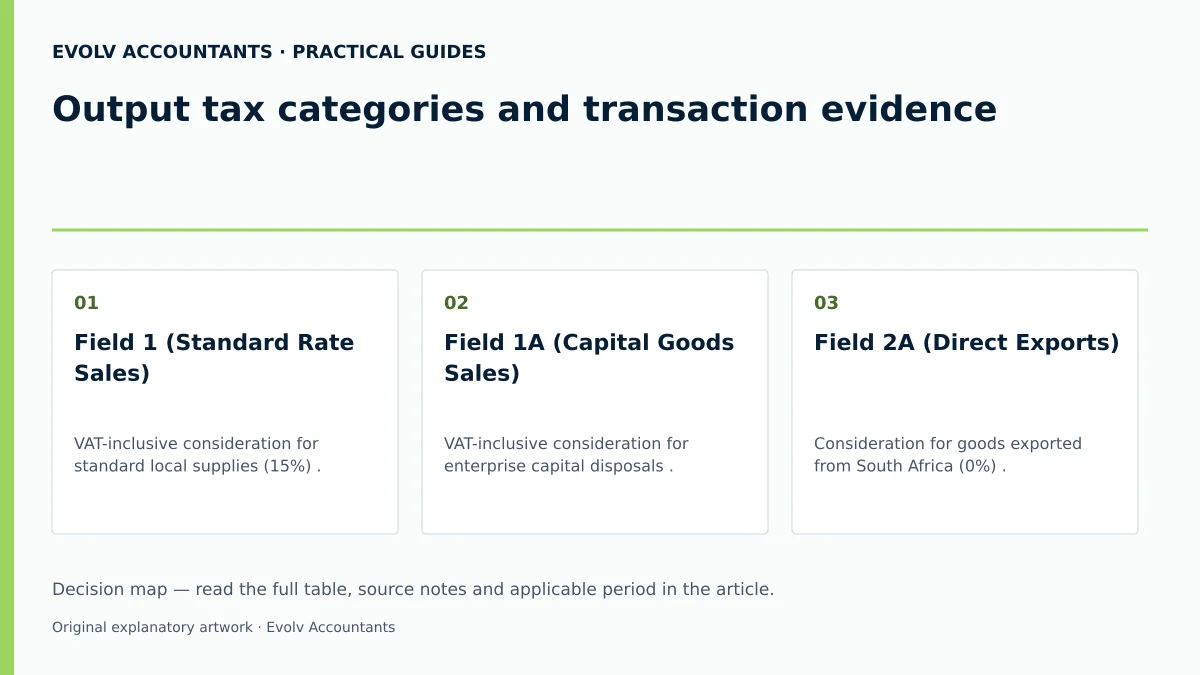
| Field 1 (Standard Rate Sales) | VAT-inclusive consideration for standard local supplies (15%) 7. | Sales invoice register, cash receipts ledger 30. | R115,000.00 | Excludes capital asset sales and accommodation 7. |
| Field 1A (Capital Goods Sales) | VAT-inclusive consideration for enterprise capital disposals 7. | Asset register, capital sale agreements 7. | R23,000.00 | Does not include routine inventory/stock sales 7. |
| Field 2A (Direct Exports) | Consideration for goods exported from South Africa (0%) 9. | Customs bills of entry, export shipping documents 9 50. | R20,000.00 | Mandatory Customs Code required; subject to 90-day export rule 9 31. |
| Field 12 (Output Adjustments) | Output tax on debit notes issued, credit notes received and bad debts recovered 3. | Debit/credit note log, bad debt recovery records 3 32. | R1,500.00 | Cannot be used to claim omitted past input tax 45 46. |
| Field 13 (Total Output Tax) | Auto-calculated total gross output tax obligation 3. | Sum of Fields 4, 4A, 9, 11, and 12 3. | R19,500.00 | Represents gross liability, not net SARS payment 41 42. |
Frequently Asked Questions
1. What is the fundamental difference between standard-rated, zero-rated, and exempt supplies on the VAT201?
Standard-rated supplies attract VAT at 15% (reported in Field 1 or 1A) 7. Zero-rated supplies are taxable supplies charged at 0% (reported in Field 2 or 2A), allowing the vendor to claim input tax on related expenses 8 9 10. Exempt supplies (reported in Field 3) are non-taxable supplies where no output tax is charged and no input tax may be claimed 9 10 15.
2. How does an SME's approved accounting basis dictate when output tax must be declared?
Under the default invoice basis, output tax must be declared in the tax period when an invoice is issued or payment is received, whichever occurs first 26. Under the approved payments basis, output tax is deferred until cash payment is actually received from the customer, except for supplies of R100,000 or more which revert to the invoice basis 27 29 51.
3. What documentary evidence must a vendor hold to support zero-rated exports in Field 2A?
To support zero-rating in Field 2A, the vendor must hold valid customs bills of entry, official customs release notifications, transport documents proving direct export, and proof of payment 9 31 50. If complete documentation is not obtained within prescribed timeframes, output tax must be declared at the standard rate 52.
4. How are debit notes and credit notes reported in the output tax section of the VAT201?
Debit notes issued (which increase consideration) and credit notes received from suppliers are reported as output tax adjustments in Field 12 3 32. Conversely, credit notes issued to customers (which decrease output tax) are accounted for as input tax adjustments in Field 18 32 41.
5. What are the statutory limits and rules when revising output tax on a previously submitted VAT201?
A vendor may revise the VAT portion of a VAT201 return on eFiling within 5 years of the original assessment date 43. Revisions from version 3 onwards require supporting documents 44. While output tax corrections can be made via revision, vendors cannot increase past input tax deductions on a revised return and must claim omitted input tax on a subsequent return 45 46.
Related guides
- Understanding VAT201 input tax fields
- Completing a VAT201 return step by step
- The Proactive SARS Audit Guide: Keeping Your Business Ledger Sanitised
Sources
- Obligations of a VAT vendor | South African Revenue Service
- https://www.sars.gov.za/wp-content/uploads/Ops/Guides/GEN-ELEC-04-G01-Guide-for-completing-the-Value-Added-Tax-VAT201-Declaration-External-Guide.pdf
- https://www.sars.gov.za/wp-content/uploads/Ops/Guides/Legal-Pub-Guide-VAT404-VAT-404-Guide-for-Vendors.pdf
- Tax periods for VAT | South African Revenue Service