
VAT invoices in a foreign currency
13 March 2025

Issuing a tax invoice in a foreign currency requires conversion into South African Rand in accordance with statutory guidelines 1.
Standard value-added tax rules in South Africa mandate that tax invoices for local taxable supplies be issued in South African Rand, whereas foreign currency invoicing is strictly restricted to zero-rated supplies such as direct or indirect exports and specific non-resident electronic services 1. Vendor compliance depends on maintaining verifiable currency conversion evidence, issuing fully compliant tax invoices, and declaring accurate Rand-equivalent values on periodic VAT201 returns on SARS eFiling 2 3 4.
Currency conversion evidence and invoice information
Scope, Jurisdiction, and Completion Criteria
This practical guide is designed for South African small and medium-sized enterprises (SMEs), financial managers, and registered Value-Added Tax (VAT) vendors operating within the jurisdiction of the Republic of South Africa 5 6. Managing VAT invoices in foreign currency applies across both bi-monthly (Category A and B) and monthly (Category C) tax periods 7 8.
Complete compliance means that a vendor holds compliant tax invoices, verifiable foreign exchange rate documentation, and supporting evidence for all transactions, ensuring that output tax and input tax deductions declared on the VAT201 return on eFiling reconcile to an auditable 5-year accounting record 2 3 4.
— Practical point from this guide
Statutory Law, Regulatory Guidance, and Evolv Recommendations
To maintain compliance, vendors must distinguish between statutory legislation, South African Revenue Service (SARS) regulatory guidance, and Evolv Accountants professional recommendations:
- Statutory Law: The Value-Added Tax Act 89 of 1991 (VAT Act) and the Tax Administration Act 28 of 2011 (TA Act) establish legal obligations for levying VAT, issuing tax invoices within 21 days, retaining documentation for five years, and submitting tax returns 2 5 9.
- Regulator Guidance: SARS guides (such as the VAT 404 Guide for Vendors and GEN-ELEC-04-G01 External Guide), Binding General Rulings (BGRs), and official web FAQs specify operational rules, form fields on the VAT201 return, and acceptable documentary formats 1 10 11.
- Evolv Recommendations: Evolv Accountants advises SMEs to establish automated exchange rate feeds, perform monthly general ledger-to-VAT201 reconciliations, and maintain separate foreign currency calculation schedules to avoid verification delays or section 95 estimated assessments 12 13.
Administrative Registration Threshold Position
Under section 23 of the VAT Act, compulsory VAT registration is statutorily required when total taxable turnover exceeds R1 million in a consecutive 12-month period 14. However, current SARS administrative web guidance administers a threshold of R2.3 million for registration processing. Vendors should note that this administrative position governs operational processing at SARS branches and on eFiling, but does not represent an unqualified statutory amendment to section 23 of the VAT Act 14 15.
Prepare the information and authority: currency conversion evidence
Primary Document and Record Requirements
Before issuing or processing foreign currency transactions, vendors must assemble specific primary records and evidence 2 16:
- Tax Invoices and Commercial Invoices: Valid tax invoices reflecting standard-rated or zero-rated supply details 17 18.
- Currency Conversion Proof: Documented exchange-rate method and rate meeting the applicable BGR 11 requirements 1.
- Customs Clearance Documents: Bills of Entry (SAD 500), EDI Customs Status 1 Release Messages, and SARS eFiling payment receipts for imported or exported goods 19 20.
- Agent Statements: Statements furnished by clearing agents within 21 days of month-end detailing imported goods values and eFiling receipt numbers 20.
- Contracts and Proof of Payment: Signed customer orders, transport documentation, and bank SWIFT or EFT payment confirmations 21.
Statutory Authority and Ruling Mechanisms
The general rule under section 20 of the VAT Act requires tax invoices to be denominated in South African currency 1. As SARS guides note, "A tax invoice must be in South African currency, except for a zero-rated supply" 1. Binding General Ruling 11 (BGR 11) sets out the conditions under which exchange rates may be applied for zero-rated exports and non-resident electronic services 1 18.
Where standard documentary proof cannot be obtained due to circumstances beyond the vendor's control, section 16(2)(g) of the VAT Act allows vendors to apply to the SARS Commissioner for a specific VAT ruling using form VAT301 22 23.
Key Definitions and Calculation Inputs
- Standard Rate: The default VAT rate of 15% applied to local taxable supplies 5 24.
- Tax Fraction: The fraction 15/115 used to extract the VAT component from a VAT-inclusive Rand amount 25.
- Output Tax: VAT collected or levied on taxable supplies made by the vendor 3 5.
- Input Tax: VAT paid by the vendor on enterprise inputs, deductible against output tax 3 5.
- Imported Services: Services supplied by a non-resident to a South African resident for non-taxable (exempt or private) purposes 26.
Complete the task step by step: invoice information
Step-by-Step Practical Workflow
Step 1: Determine the Tax Treatment of the Supply
Identify whether the transaction is a local standard-rated supply (15% VAT), a zero-rated direct or indirect export (0% VAT), an exempt supply, or an imported service 5 26 27. Local standard-rated supplies made to South African clients must always be invoiced in South African Rand 1.
Step 2: Establish Currency and Exchange Rate Authority
For zero-rated exports of goods or qualifying electronic services supplied by non-residents, foreign currency denomination is permitted 1. Convert the foreign currency consideration into South African Rand using a documented method and rate that meet BGR 11, with consistent supporting evidence 1.
Step 3: Issue a Valid Full or Abridged Tax Invoice
Where the consideration exceeds R5,000 (VAT inclusive), issue a full tax invoice containing all mandatory fields 17:
- The words "Tax Invoice", "VAT Invoice", or "Invoice" 17.
- Name, address, and 10-digit VAT registration number of the supplier 17 19.
- Name, address, and VAT registration number of the recipient (if the recipient is a registered vendor) 17.
- Individual serialised invoice number and date of issue 17.
- Full and proper description, quantity, or volume of goods or services supplied 17.
- The consideration in the required currency, using an accepted display method: price excluding VAT plus VAT and inclusive total; inclusive consideration plus the VAT rate; or inclusive consideration plus the VAT amount 11.
- For zero-rated exports, issue a full tax invoice regardless of consideration amount, reflecting the recipient's VAT number and customs code where required 18 19.
Step 4: Record Mixed Supplies Correctly
If an invoice includes mixed supplies (such as standard-rated accommodation, zero-rated goods, and exempt passenger transport), clearly distinguish the VAT status and separate Rand values for each line item on the tax invoice 28.
Step 5: Declare Values on the VAT201 Return via eFiling
Log into SARS eFiling and complete the pre-populated VAT201 return for the tax period 29 30:
- Standard-Rated Sales: Declare total VAT-inclusive Rand consideration in Field 1; output tax is calculated automatically in Field 4 31.
- Zero-Rated Exports: Declare total zero-rated exported goods consideration in Field 2A (Customs Code required) and other zero-rated supplies in Field 2 19 32.
- Imported Services: Declare VAT payable on imported services in Field 12 33 34.
- Input Tax Deductions: Claim permissible input tax on local capital goods in Field 14, imported capital goods in Field 14A, local operational goods/services in Field 15, and imported operational goods in Field 15A 35.
Reproducible Hypothetical Example
Scenario: SA Exporters (Pty) Ltd, a registered Category B VAT vendor in South Africa, sells industrial machinery to a client in Botswana for \$20,000.00 (USD) as a direct zero-rated export 8 27. On the date of invoice issuance, assume a qualifying conversion method gives the illustrative exchange rate \$1.00 = R18.50 1.
- Foreign Currency Value: \$20,000.00
- Exchange Rate Applied: 18.50 ZAR/USD
- Converted Rand Value: 20,000.00 × 18.50 = R370,000.00
- VAT Rate Applicable: 0% (Zero-rated export under section 11(1)(a)) 27
- Output Tax Levied: R0.00 27
- VAT201 Return Entry: SA Exporters (Pty) Ltd reflects R370,000.00 in Field 2A ("Zero rate - only exported goods") on its VAT201 return on eFiling and enters its mandatory Customs Code 19 32.
- Evidence Retained: Tax invoice showing Rand equivalent, SARS Customs Declaration (SAD 500), EDI Release Message, bill of lading, and foreign currency bank payment receipt 20 21.
Check the result against the evidence: currency conversion evidence
Independent Completion Evidence Verification
Submitting a return on eFiling does not imply that SARS has accepted the currency conversion or tax treatment 13 36. Vendors must verify completion against independent primary evidence:
- eFiling Work Page Status: Confirm that the VAT201 status displays "Filed through eFiling" and retrieve the 19-digit Payment Reference Number (PRN) pre-populated by SARS on the VAT201 4 29.
- Statement of Account (VATSOA): Request a Statement of Account on eFiling to verify that submitted return figures have posted accurately to the vendor's tax balance 37.
- Customs EDI Release Matching: Reconcile Field 2A export entries and Field 14A/15A import entries against the official EDI Customs Status 1 Release Messages and eFiling receipt numbers 20 32.
- Audit Trail File: Confirm that all foreign currency calculations, bank conversion slips, and tax invoices are indexed in an auditable compliance folder retained for five years 2.
Handle exceptions and unresolved cases: invoice information
Submit the requested material within the 40-business-day period applicable to the section 95(1)(c) estimate, or request an extension promptly. The SARS guide describes the extension-button availability up to five years and 40 business days after the original assessment for which verification was created; this is not an automatic extension.
Check the date and conditions in the actual notice and any approved extension. SARS VAT201 guide.
Specialist Boundaries and Escalation
When currency conversion rules are complex, or when applying for alternative apportionment methods or self-invoicing approvals under BGR 15, vendors should submit a formal VAT ruling application (form VAT301) to SARS or consult Evolv Accountants for specialist advisory support 23 44.
The five-year period is a minimum, not an automatic destruction date. SARS record-keeping guidance requires the relevant records to remain available; retain them beyond the ordinary minimum where an ongoing audit, investigation, objection or appeal or another applicable rule requires it.
Next steps for VAT invoices
Task and Completion Checklist
| Step | Input or evidence | Responsible person | Completion check | Exception or next action |
|---|---|---|---|---|
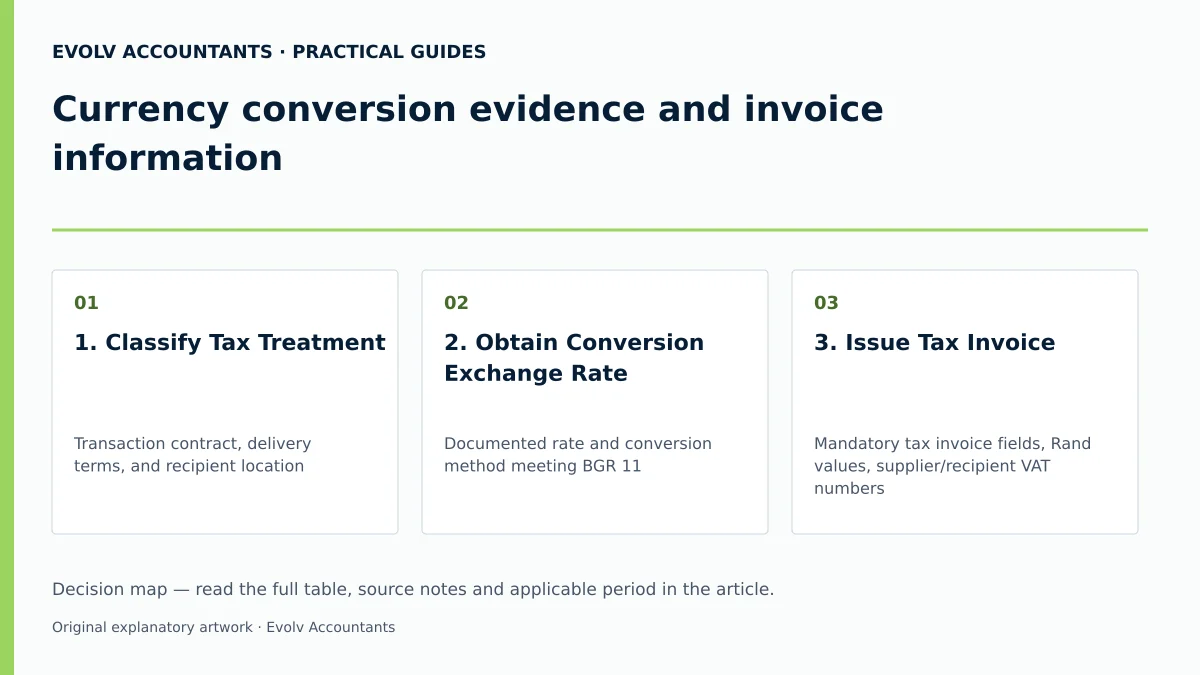
| 1. Classify Tax Treatment | Transaction contract, delivery terms, and recipient location 26 27 | Tax / Accounts Officer | Supply classified as standard-rated (15%), zero-rated (0%), or exempt 5 27 | If status is ambiguous, seek advice from Evolv Accountants 23. |
| 2. Obtain Conversion Exchange Rate | Documented rate and conversion method meeting BGR 11 1 | Finance Manager | Conversion rate documented and attached to invoice calculation sheet 1 | Confirm rate complies with BGR 11 guidelines 1. |
| 3. Issue Tax Invoice | Mandatory tax invoice fields, Rand values, supplier/recipient VAT numbers 17 | Invoicing Clerk | Full or abridged tax invoice issued within 21 days of supply 9 17 | Issue full tax invoice for all zero-rated supplies 18. |
| 4. Reconcile Customs & Import Docs | Bills of Entry (SAD 500), EDI Status 1 Release Messages, eFiling receipts 20 | Customs / Logistics Officer | Import/export Rand values match customs release documents 20 | Obtain agent monthly statement within 21 days 20. |
| 5. File VAT201 Return on eFiling | Reconciled sales, output tax, input tax, and imported service values 29 33 | Registered eFiler / Tax Practitioner | Return submitted on eFiling with the SARS-pre-populated 19-digit PRN recorded 4 29 | If selected for verification, upload docs via eFiling 13 41. |
| 6. Archive 5-Year Record Pack | Invoices, exchange rate proof, bank statements, VAT201 return receipts 2 37 | Compliance Officer | Audit trail filed electronically or physically for 5 years 2 | If docs are missing, apply for section 16(2)(g) ruling 22. |
Frequently Asked Questions
Can a South African VAT vendor issue a tax invoice denominated solely in foreign currency for domestic sales?
No. Under South African VAT law, a tax invoice for local taxable supplies must be denominated in South African Rand 1. Foreign currency tax invoices are strictly restricted to zero-rated supplies (such as direct or indirect exports of goods) and specific electronic services supplied by non-residents 1.
What exchange rate source must be used to convert foreign currency invoice values into Rand?
Apply the exchange-rate requirements of Binding General Ruling 11 (BGR 11). Retain the chosen permitted method, rate, relevant date and conversion working paper; do not assume that any bank or Reserve Bank spot rate on either date automatically complies 1.
How are foreign currency export sales declared on the VAT201 return?
Foreign currency export sales must be converted into South African Rand and declared in Field 2A ("Zero rate - only exported goods") on the VAT201 return on eFiling 19 32. The vendor must enter its valid Customs Code when completing Field 2A 19.
How long must foreign currency conversion evidence and VAT invoices be kept?
All tax invoices, foreign currency conversion slips, bills of entry, EDI release messages, and accounting records must be retained for at least five years from the date of the return to build an auditable trail for SARS 2.
What should a vendor do if SARS issues a section 95 estimate assessment due to missing conversion evidence?
Submit the requested material within the 40-business-day period applicable to the section 95(1)(c) estimate, or request an extension promptly. The SARS guide describes the extension-button availability up to five years and 40 business days after the original assessment for which verification was created; this is not an automatic extension. Check the date and conditions in the actual notice and any approved extension. SARS VAT201 guide.
Related guides
- Registering for VAT when turnover rises unexpectedly
- What a valid South African tax invoice must contain
- The Proactive SARS Audit Guide: Keeping Your Business Ledger Sanitised
Sources
- https://www.sars.gov.za/wp-content/uploads/Ops/Guides/Legal-Pub-Guide-VAT404-VAT-404-Guide-for-Vendors.pdf
- Obligations of a VAT vendor | South African Revenue Service
- https://www.sars.gov.za/wp-content/uploads/Ops/Guides/GEN-ELEC-04-G01-Guide-for-completing-the-Value-Added-Tax-VAT201-Declaration-External-Guide.pdf