
VAT refunds offset against another tax debt
30 May 2026

A South African Revenue Service Value-Added Tax refund set-off requires applying eligible tax credits to liquidate outstanding tax debts across allied tax types.
Under South African tax administration, when a Value-Added Tax (VAT) vendor generates an input tax deduction exceeding output tax on a VAT201 return 1 2, the South African Revenue Service (SARS) applies statutory debt equalisation 3. Before disbursing a cash payout to the vendor's verified bank account 3 4, SARS automatically sets off the refundable credit against any existing outstanding tax obligations owed by the enterprise across different tax types or registered branches 3 5.
This administrative set-off process ensures that outstanding tax liabilities are systematically cleared before net funds are released 3 5.
Set off entries and other tax debt reconciliation
This practical guide is written for South African small and medium enterprises (SMEs), financial controllers, and business owners navigating tax compliance within the jurisdiction of the Republic of South Africa 6 7. The administrative procedures apply across all standard tax reporting periods allocated by SARS, including bi-monthly Category A or Category B tax periods 8, monthly Category C tax periods 8, six-monthly Category D tax periods 9, and annual Category E tax periods 10.
In practical accounting, completing set-off entries and debt reconciliation means achieving full mathematical and ledger alignment between the business's internal accounting software, the official SARS Statement of Account (VATSA) 11, and formal SARS notices of assessment 12 13. Achieving completion ensures that all automated transfer entries made by SARS are accurately reflected in the general ledger and supported by clear documentary evidence 11 14.
— Practical point from this guide
To maintain technical accuracy, tax management must distinguish between statutory law, regulatory guidance, and professional accounting practice:
- Statutory Law: Governed primarily by the Value-Added Tax Act 89 of 1991 (VAT Act) 6 15 and Chapter 13 of the Tax Administration Act 28 of 2011 (TAA) 16. The refund and debt-recovery provisions in Chapter 13 of the TAA govern entitlement and set-off against outstanding tax liabilities 3 16.
- Regulator Guidance: Provided by official SARS administrative guides, including the VAT 404 - Guide for Vendors 6, the Guide for completing the Value-Added Tax (VAT201) Declaration 17, and published SARS web guidance on vendor refunds 18. These documents detail how SARS applies automated offset algorithms across main and branch registrations 3.
- Evolv Recommendations: Professional advice provided by Evolv Accountants to ensure general ledger sub-accounts match the SARS eFiling profile, preventing unverified discrepancies from distorting monthly management accounts.
Prepare the information and authority: set off entries
Required Documents and Data Inputs
Before performing a tax debt reconciliation for set-off entries, the finance team must gather the following primary source documents and data inputs:
- SARS Statement of Account (VATSA): Requested directly via SARS eFiling or the SARS Contact Centre to obtain a line-by-line record of processed transactions, tax assessments, and offset allocations 11.
- Submitted VAT201 Declarations: Copies of filed returns reflecting declared output tax, input tax deductions, and net field calculations 2 19.
- Notices of Assessment (VAT217): Official assessment notices issued by SARS following return processing, verification, or estimation 12 20.
- eFiling Refund Dashboard Logs: Real-time electronic audit trails showing whether a refund is pending payout, selected for audit, or transferred to offset another debt 21 22.
- Form VAT119i (If Applicable): Indemnity forms and supporting company resolutions required where refunds or set-offs involve third-party or group bank accounts 23 24.
- Bank Account Confirmation: Validated banking details registered with SARS to ensure payout processing is not suspended 4 25.
Statutory Permissions and Representative Authority
Reconciliation and set-off management must be executed under proper legal authority. Under the VAT Act and TAA, the representative taxpayer acting in the statutory capacity applicable to the entity, such as the appointed public officer for a company bears primary legal responsibility for fulfilling tax duties 26 27. For an internal set-off reconciliation using records supplied by the vendor, document the accountant’s engagement authority.
When an external practitioner represents the vendor before SARS, obtain the authority required for that action, including a Power of Attorney where prescribed for an application 28 29. Furthermore, vendors must note the statutory five-year limitation period: a VAT refund on a return must be claimed within five years from the date the return was originally due 3 5.
Current SARS registration guidance administers new applications from 1 April 2026 at R2.3 million in taxable supplies over any consecutive 12 months for compulsory registration and R120 000 for the standard voluntary route, with specified alternative conditions. Older guides quote R1 million and R50 000. These older figures must not be presented as the current application thresholds, and the administrative guidance does not itself prove an amendment to section 23.
Complete the task step by step: other tax debt reconciliation
Executing a thorough tax debt reconciliation requires a structured process grounded in primary SARS administrative instructions 3 17.
Sequenced Set-Off Reconciliation Process
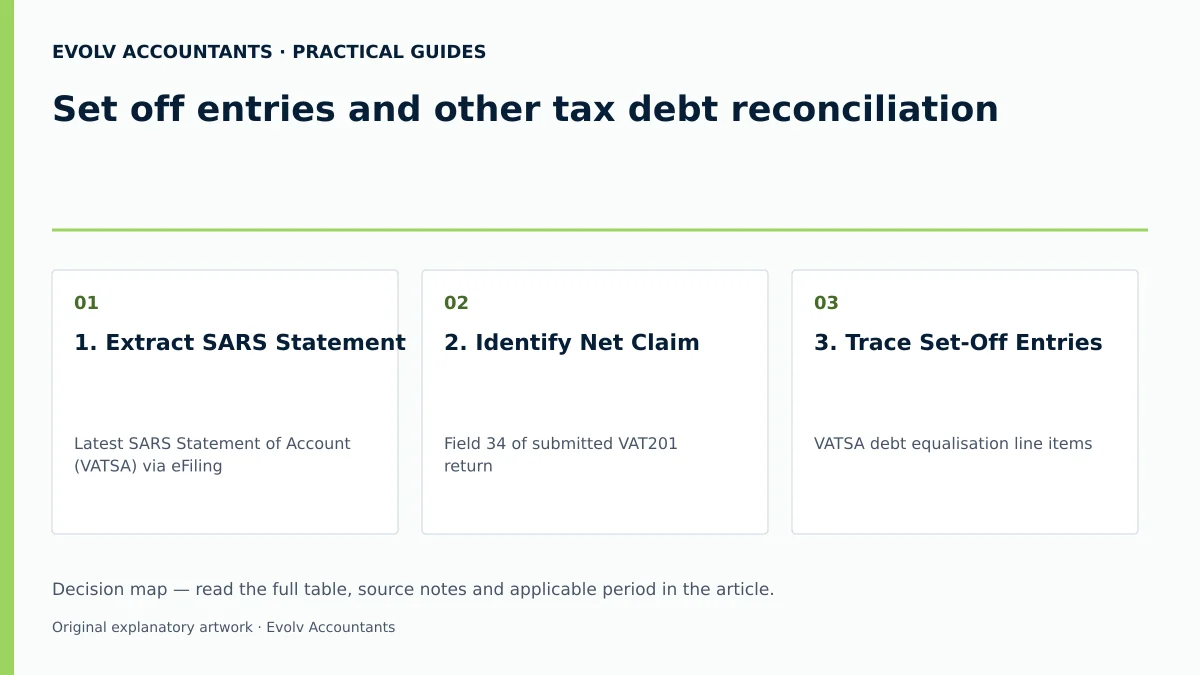
- Extract Official Statements of Account: Access SARS eFiling and generate the latest VATSA alongside corresponding statements for allied tax types (such as Corporate Income Tax or EMP201 employer taxes) 11 37.
- Identify the Net VAT Refund Claim: Verify the refund figure calculated in Field 34 of the relevant VAT201 return (Field 20 net liability adjusted for allowable diesel refund claims) 19 38.
- Trace Automated Offset Allocations: Review the transaction details on the VATSA to identify set-off entries where SARS transferred funds to satisfy outstanding liabilities in other tax categories or sub-branch accounts 3 37.
- Inspect the eFiling Refund Dashboard: Confirm whether any remaining portion of the refund was withheld due to pending verifications 4 25, unsubmitted tax returns 4 25, or invalid banking details 4 25.
- Journalise General Ledger Adjustments: Post exact journal entries in the business accounting system, debiting the specific SARS tax liability accounts (e.g., PAYE or Income Tax payable) and crediting the VAT refund control account to reflect debt liquidation.
- Verify Final Balance Payout: Ensure that any net balance remaining after total debt equalisation is remitted directly into the vendor’s verified bank account within the statutory 21-business-day timeframe 4 39.
Check the result against the evidence: set off entries
Independent Completion Evidence
A vendor must never assume that submitting a refund-reflecting return equals successful processing or debt set-off 40. Complete, independent evidence requires verifying the following records:
- Clean SARS Statement of Account: A VATSA displaying an explicit "Set-Off" line item with a zero net balance for the specific tax period 3 11.
- Absence of Estimated Assessments: Confirmation that SARS has not issued a Section 95(1)(c) estimated assessment (VAT217) due to outstanding verification materials 12.
- Official Closure Letters: Written notification from SARS confirming that any compliance verification or audit case linked to the refund return has been formally finalised 20 40.
Verification and Audit Standards
SARS relies on an automated risk engine to identify high-risk refund claims for inspection 41. When selected for verification, the vendor must supply supporting documentation—such as tax invoices, credit/debit notes, and operational logbooks—via eFiling or the SARS Online Query System 6 42 43.
Under statutory guidelines, SARS must pay valid VAT refunds within 21 business days of receiving a correctly completed return and all requested supporting documents 4 44. If payment is delayed beyond 21 business days, SARS is obligated to pay interest at the prescribed rate 4 21.
SARS reserves the statutory right to suspend or recalculate the 21-business-day period without paying interest if the return is defective 4 42, banking details are missing or incorrect 4 42, outstanding returns exist across any tax type 4 42, or the vendor fails to grant SARS access to accounting records 42.
Handle exceptions and unresolved cases: other tax debt reconciliation
Managing Disputes and Suspension of Payment
Where SARS sets off a VAT refund against a tax debt that the vendor believes was raised in error or is subject to an active dispute, the vendor must initiate formal administrative remedies under the Tax Administration Act 23 45 46.
Crucially, lodging an objection or appeal does not automatically pause SARS’s collection actions or debt set-off mechanisms 46. To prevent or pause debt collection during a dispute, the vendor must submit a formal Request for Suspension of Payment under Section 164 of the TAA via eFiling 20 46. As SARS guidance emphasizes, "The obligation to pay tax is not automatically suspended by an objection or appeal" 46.
Request for Correction (RFC) Constraints
If an accounting error on a previously submitted VAT201 return resulted in an incorrect refund or offset calculation, the vendor may submit a Request for Correction (RFC) on eFiling 47 48. However, strict administrative limitations apply:
- No Input Tax Increases on Past Periods: Vendors are explicitly prohibited from increasing input tax deductions for a past tax period via an RFC 49. Any omitted input tax must instead be claimed in a subsequent return, provided it is claimed within five years from the date of first entitlement 3 49.
- Full Revised Return Requirement: When submitting an RFC, the vendor must submit a completely revised VAT201 return declaring full corrected figures across all fields, rather than entering net variance amounts 48 49.
- Group banking and debt set-off: Keep these separate. SARS permits specified group-company or foreign-company third-party banking arrangements supported by VAT119i. The indemnity concerns payment into a nominated bank account; it is not, by itself, evidence authorising set-off of one legal entity’s refund against another legal entity’s tax debt. Reconcile the taxpayer identity and the actual SARS allocation before posting a transfer.
Next steps for VAT refunds
Reproducible Hypothetical Example
To illustrate the application of set-off entries, consider the following hypothetical example involving a registered South African SME, Apex Manufacturing (Pty) Ltd, operating as a Category A bi-monthly vendor 8:
Input Financial Data (illustrative two-month tax period)
- Standard-rated sales made (inclusive of 15% VAT): R345 000
- Output tax declared in Field 13 (R345 000 × 15/115): R45 000 19 31
- Allowable input tax incurred on business inputs (Field 19): R75 000 19 51
- Preliminary net VAT refund claimed in Field 20/34: R30 000 (Credit) 19 38 52
Existing Debt Positions on SARS Profile
- Outstanding Corporate Income Tax (CIT) liability: R12 000
- Outstanding Employee Tax (PAYE) liability on branch account: R8 000
- Total outstanding tax debts across enterprise profile: R20 000 3
Set-Off Reconciliation Outcome
- Gross Refund Declared: R30 000 38.
- Automated Debt Equalisation Applied by SARS: R20 000 offset (R12 000 allocated to CIT debt + R8 000 allocated to PAYE debt) 3 5.
- Net Cash Refund Disbursed: R10 000 remitted to Apex Manufacturing’s verified bank account 3 5.
- Processing Timeframe: Net payout completed within 21 business days from return submission, avoiding interest accrual 4 44.
Task and Completion Checklist
| Step | Input or evidence | Responsible person | Completion check | Exception or next action |
|---|---|---|---|---|
| 1. Extract SARS Statement | Latest SARS Statement of Account (VATSA) via eFiling 11 | Finance Manager / Accountant | VATSA shows recent transactional activities 11 | Check the tax-period selection and use the VAT Work Page’s “Request Statement of Account” function 53 |
| 2. Identify Net Claim | Field 34 of submitted VAT201 return 38 | Tax Practitioner / Preparer | Field 34 reflects a negative amount (refund credit) 38 52 | Verify input tax documentation if Field 34 is zero/positive 51 |
| 3. Trace Set-Off Entries | VATSA debt equalisation line items 3 | Accountant | Set-off amounts match exact outstanding debt figures on allied tax accounts 3 37 | Submit eFiling query if set-off allocation is unrecognised 37 |
| 4. Audit Dashboard Status | eFiling Refund Dashboard logs 22 | Compliance Officer | Status indicates "Approved" or "Set-Off Applied" 22 | If status is "Held", inspect verification letters or update bank details 4 25 42 |
| 5. Post Ledger Journals | Internal General Ledger accounting software | Bookkeeper / Accountant | Tax liability accounts reflect reduced or zero balance | Reconcile residual balance variances with Evolv advisory team |
| 6. Confirm Net Payout | Bank statement reflecting SARS deposit | Finance Director | Net cash payout reconciled after set-off; apply the refund clock and its exceptions 4 | Check statutory interest if the applicable 21-business-day period lapses after any permitted recalculation or suspension 4 21 |
Frequently Asked Questions
How long does SARS have to process a VAT refund before paying interest?
SARS is required to pay a valid VAT refund within 21 business days of receiving a correctly completed VAT201 return and all requested supporting documents 4 44. If payment is not made within this period, SARS must pay interest at the prescribed statutory rate 4 21. However, the 21-day counter may be suspended or recalculated if the return is defective, bank details are invalid, or outstanding returns exist 4 42.
Can SARS offset a VAT refund against debts from a different tax type or branch?
Yes. Under statutory debt equalisation rules under the TAA refund and debt-recovery provisions, SARS is entitled to set off a VAT refund against any outstanding tax debt owed by the vendor across other tax categories (such as Corporate Income Tax or PAYE) 3 5 16. Set-offs may also occur between the main registration and registered branch accounts of the same legal entity 3.
What happens if my banking details on eFiling are incorrect when a refund is due?
If banking details are missing or incorrect, SARS will withhold the refund payout and recalculate or suspend the 21-business-day processing period 4 25 42. The vendor must update banking particulars promptly; for refund claims resulting from erroneous overpayments, valid banking details must be provided within 90 days 5.
Can I increase my input tax claim for a past period by submitting a Request for Correction (RFC)?
No. SARS rules strictly prohibit increasing input tax deductions on a past tax period via an RFC 49. If a vendor omitted valid input tax in a previous period, the deduction must be claimed in a current or future VAT return submitted within five years from the date of first entitlement 3 49.
What are the current compulsory and voluntary VAT registration thresholds?
Current SARS registration guidance administers new applications from 1 April 2026 at R2.3 million in taxable supplies over any consecutive 12 months for compulsory registration and R120 000 for the standard voluntary route, with specified alternative conditions. Older guides quote R1 million and R50 000. These older figures must not be presented as the current application thresholds, and the administrative guidance does not itself prove an amendment to section 23.
Related guides
- VAT verification versus a VAT audit
- Why a VAT refund can be delayed
- The Proactive SARS Audit Guide: Keeping Your Business Ledger Sanitised
Sources
- VAT Refunds for vendors | South African Revenue Service
- https://www.sars.gov.za/wp-content/uploads/Ops/Guides/Legal-Pub-Guide-VAT404-VAT-404-Guide-for-Vendors.pdf
- https://www.sars.gov.za/wp-content/uploads/Ops/Guides/GEN-ELEC-04-G01-Guide-for-completing-the-Value-Added-Tax-VAT201-Declaration-External-Guide.pdf
- https://www.sars.gov.za/wp-content/uploads/Ops/Guides/VAT-REG-02-G01-Guide-for-Completion-of-VAT-Application-External-Guide.pdf
- Register for VAT | South African Revenue Service
- FAQs for VAT vendors | South African Revenue Service