
VAT verification versus a VAT audit
29 May 2025

A VAT verification is generally a check of a specific return. A VAT audit can examine wider records and multiple periods; follow the scope and requests in the SARS notice.
A VAT verification generally checks a specific return, while a VAT audit can examine wider records and multiple periods.
When the South African Revenue Service (SARS) queries a Value-Added Tax (VAT) return or halts a expected refund, South African small and medium enterprises (SMEs) must immediately distinguish between a routine verification and a formal audit. A verification generally focuses on substantiating items on a specific VAT201 return using uploaded source documents, whereas a formal audit entails a comprehensive examination of ledgers, accounting systems, and cross-period tax compliance.
Understanding these procedural differences allows vendors to respond accurately, protect cash flow, and avoid administrative default assessments.
Verification scope versus a formal audit
Defining a SARS VAT verification
A VAT verification is an automated or risk-based administrative review conducted by SARS to validate the accuracy of a vendor's declared output tax, input tax, or refund claim for a specific tax period 1 2 3. SARS notes that verification is "a less intensive process than an audit although it entails the evaluation of the accuracy of the vendor's records" 3.
— Practical point from this guide
The scope of a verification is generally targeted and limited to a single, recent VAT201 reporting period 3. In practice, verifications are triggered automatically by the SARS risk engine when a return reflects a net refund claim, an unusual ratio of input to output tax, or capital purchases 1 2 4. SARS communicates a verification by issuing a formal letter under the "SARS Correspondence" section on eFiling, opening a dedicated upload container for supporting documents on the VAT201 Work Page 5 6.
Defining a formal SARS VAT audit
A formal VAT audit is a thorough, detailed check on the general correctness of a vendor's tax returns, underlying accounting entries, and statutory payments across multiple historical tax periods 7. Audits are initiated when SARS identifies systemic risk patterns, third-party data discrepancies, or potential tax defaults 2 7 8.
Unlike a verification, an audit begins with a formal "Notification of Intention to Conduct an Audit" sent directly to the vendor 7. SARS auditors examine source journals, general ledgers, bank statements, customer contracts, and third-party records 3 7. Throughout the process, SARS is legally required to provide regular status updates and issue a letter of proposed audit findings if adjustments are recommended, giving the vendor 21 business days to submit formal written representations before raising an assessment 8 9.
Evaluating neither option as a universal winner
Neither administrative process represents a superior position for a business; rather, each serves a distinct function within SARS tax administration 3 7 8. A verification offers a narrow scope and a quicker resolution pathway, but it directly freezes pending refund payouts until SARS reviews the uploaded material 3 10 11. Conversely, an audit demands extensive administrative time, exposes prior financial years to scrutiny, and creates tax exposure if historical record-keeping is defective 7 12 13.
Compare the criteria that matter: verification scope
SARS may withhold a refund while verifying entitlement. Interest and the 21-business-day calculation depend on the applicable statutory exceptions, including defective returns, banking details and access to records; selection for verification alone should not be treated as proof of an unlimited interest-free suspension. Check the dates, notices and the specific withholding or recalculation ground. SARS refund guidance.
For a formal audit, cash flow constraints can extend over several months 7. If SARS determines that tax has been understated or incorrectly claimed, it issues an Additional Assessment (VAT217) 13. Late payment of VAT can attract a 10% late-payment penalty under the applicable rules. An audit shortfall may also attract an understatement penalty if its separate statutory conditions are met; the outcome depends on the facts and the assessment 14 17.
Control and reporting constraints
Both procedures require strict compliance with statutory record-keeping rules 12 18. Vendors must hold original, valid tax invoices to substantiate every input tax deduction 12 19. Under Section 20 of the VAT Act, supplies exceeding R5,000 (including VAT) require a full tax invoice displaying the name, address, and VAT registration number of both the supplier and the recipient 20 21. Supplies R5,000 or less allow an abridged tax invoice, while supplies R50 or less require till slips or cash dockets 20 21 22.
All accounting records, customs EDI Status 1 release messages, import bills of entry, and VAT264 declarations for second-hand goods must be retained for at least five years from the date of the relevant return submission 12 23 24.
Decision comparison matrix
| Criterion | Option A (VAT Verification) | Option B (VAT Audit) | Evidence or assumption | Implication for this reader |
|---|---|---|---|---|
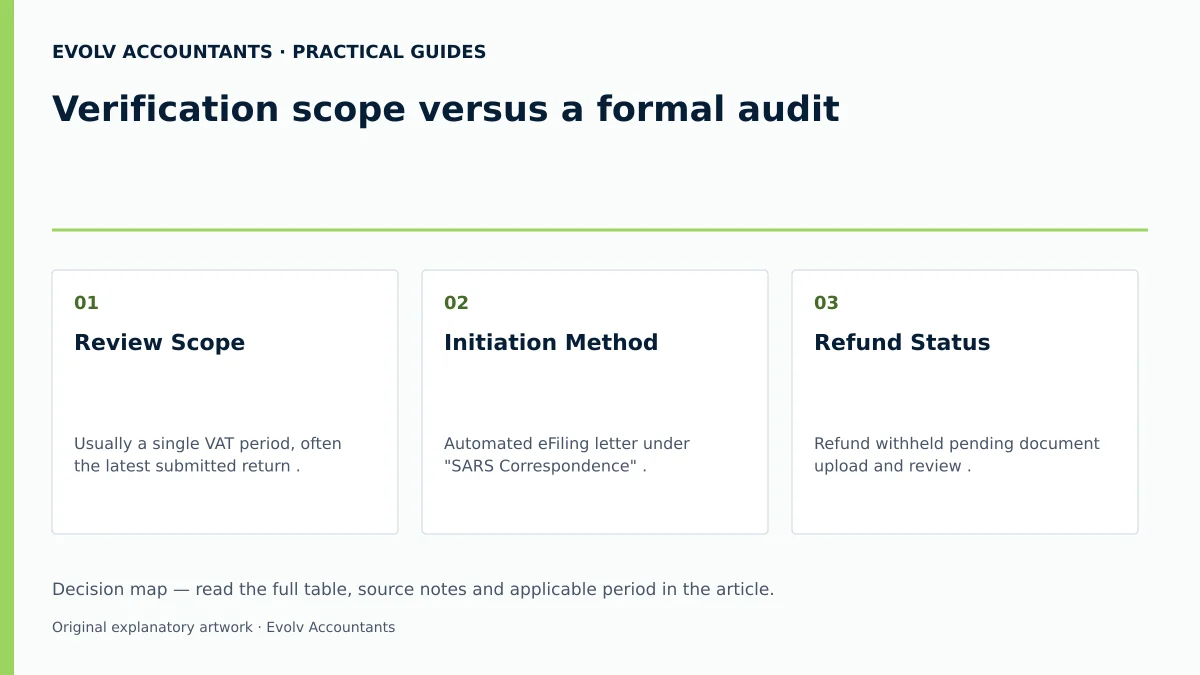
| Review Scope | Usually a single VAT period, often the latest submitted return 3. | Can cover multiple historical tax periods and wider records 7. | Sourced from SARS VAT404 Guide Chapter 16 3 7. | Verification requires targeted document extraction; audits require full ledger preparation. |
| Initiation Method | Automated eFiling letter under "SARS Correspondence" 5 6. | Formal written Notification of Intention to Conduct an Audit 7. | Sourced from GEN-ELEC-04-G01 and VAT404 5 7. | Check eFiling correspondence regularly to prevent missing verification deadlines 5. |
| Refund Status | Refund withheld pending document upload and review 10 11. | Refund withheld or set-off against audited tax liabilities 1 10 25. | Sourced from SARS VAT Refunds Guidance 1 10. | Expect cash flow delays during verification; do not budget unverified refunds. |
| Vendor Response Window | The deadline specified in the SARS request for supporting documents 5 14. | 21 business days to respond to proposed audit adjustments 9. | Sourced from VAT404 Guide Chapter 16 9. | Failure to provide requested material may lead to a section 95 estimate assessment 26 27. |
| Assessment Outcome | Verification Finalisation Letter or Section 95 Estimated Assessment 26 27. | Notice of Additional Assessment (VAT217) with potential penalties 13. | Sourced from Tax Administration Act provisions in VAT404 13. | Audits carry higher risk of administrative penalties and interest charges 14 17. |
How the obligations differ: a formal audit
Sourced statutory and regulatory rules
Tax compliance obligations in South Africa are established by primary legislation—specifically the Value-Added Tax Act 89 of 1991 and the Tax Administration Act 28 of 2011—and administered via official SARS regulator guidance, such as External Guides and Interpretation Notes 28 29 30.
Under statutory law, submitting a VAT201 return constitutes an original self-assessment 31 32. When SARS selects a return for verification or audit, it exercises its statutory power to request "relevant material" foreseeably necessary to verify tax liability 29. If a vendor fails to provide requested supporting documents during a verification, SARS is empowered under Section 95(1)(c) of the Tax Administration Act to issue an estimated assessment 26 27 31.
Crucially, vendors are legally prohibited from lodging a direct objection against a Section 95 estimated assessment; they must instead submit the outstanding supporting documents or formally apply for a suspension of payment 26 27.
Evolv professional recommendations
Evolv Accountants recommends that South African SMEs implement systematic internal controls to handle SARS reviews effectively:
- Pre-submission reconciliation: Reconcile all general ledger input tax accounts directly against valid tax invoices before submitting the monthly or bi-monthly VAT201 return 4 19 33.
- Digital document indexing: Store tax invoices, EDI Customs Status 1 release messages, and proof of payment in digital folders organised by VAT201 field line items (Fields 1 to 18) 4 24 33.
- Single-batch uploads: Submit all requested verification documents in a single, complete submission via eFiling to avoid partial reviews or administrative rejections 5 6.
VAT registration thresholds and administrative positions
To maintain complete compliance, SMEs must correctly determine their VAT registration status 34 35. Under Section 23(1) of the VAT Act, compulsory VAT registration is statutorily required when the total value of taxable supplies (turnover) exceeds or is contractually expected to exceed R1 million in any consecutive 12-month period 34 36 37.
A business may apply for voluntary VAT registration if its taxable supplies meet the current SARS-administered R120,000 voluntary threshold or the applicable alternative conditions, including the written-contract route 35 38 39.
While older published guides reflect the R1 million compulsory threshold 34 37, current SARS registration guidance administers an updated operational threshold of R2.3 million as an administrative position. This operational threshold reflects SARS's current administrative practice rather than an unqualified statutory amendment to Section 23 of the VAT Act.
Two business situations with different outcomes: verification scope
Reproducible hypothetical scenario setup
To illustrate how verification and audit procedures apply in practice, consider two hypothetical South African SMEs operating under the standard 15% VAT rate 40 41:
- Scenario A (Alpha Logistics Pty Ltd — Routine Verification): Alpha Logistics is a registered Category B vendor submitting a bi-monthly VAT201 return 30 42. For the period, Alpha declares standard-rated consideration of R345,000 in Field 1 and output tax of R45,000 in Field 4 (based on standard-rated commercial sales of R345,000 inclusive, calculated using the standard tax fraction of R345,000 × 15/115 = R45,000) 40. Alpha also claims Input Tax of R90,000 in Field 14 for a new delivery vehicle purchased for enterprise activities (R690,000 inclusive, calculated as R690,000 × 15/115 = R90,000) 4 40. Field 20 reflects a net VAT refund claimed of R45,000 (R45,000 Output Tax minus R90,000 Input Tax) 33 43.
- Scenario B (Beta Trading CC — Multi-Period Audit): Beta Trading submits a Request for Correction (RFC) on a previously finalised VAT201 return from a prior tax year, attempting to increase its historical input tax claims by R60,000 for omitted operational expenses 44 45.
- Hypothetical Net VAT Calculation (Alpha Logistics):
- Output Tax (Field 4: R345,000 × 15/115) = R 45,000 33 40
- Input Tax (Field 14: R690,000 × 15/115) = -R 90,000 4 40
- Net Refund Claimed (Field 20) = -R 45,000 33 43
Application of criteria and outcome analysis
- Alpha Logistics Outcome (Verification): The R45,000 refund claim triggers the SARS risk engine 1 2. SARS places the return in verification and issues an eFiling correspondence letter 3 5. Alpha's accountant uploads the full tax invoice (showing Alpha's name and VAT registration number) 21 and bank proof of payment 12. Assume SARS completes the verification in this hypothetical case, issuing a verification finalisation letter and paying the R45,000 refund into Alpha's verified bank account 10 11 14.
- Beta Trading outcome: An RFC cannot increase past-period input tax. Beta must route the omitted deduction to a current or future return within the applicable five-year limit, supported by the prescribed evidence. A blocked or rejected RFC does not, by itself, establish that SARS will initiate an audit, raise an additional R60,000 assessment or impose a R6,000 penalty. Any actual assessment and charges must be checked against the notice and underlying facts.
When the comparison needs specialist input: a formal audit
Complex tax transactions and contract structures
Certain technical VAT scenarios fall outside routine accounting maintenance and require specialist tax advisory and compliance support:
- Section 95 Estimated Assessments: When SARS issues an estimated assessment due to missing documents, a specialist is required to prepare the outstanding material, submit a formal extension request, or draft a Suspension of Payment application 26 27.
- Voluntary Disclosure Programme (VDP): If an SME identifies historical output tax understatements or unallowable input tax claims, filing a voluntary disclosure through the VDP before SARS selects the business for an audit can secure relief from understatement penalties and administrative non-compliance penalties 50 51 52.
- Complex Enterprise Transactions: Transactions involving foreign electronic services 53 54, Domestic Reverse Charge (DRC) valuable metals 55 56, diesel refund concessions 57, or the acquisition of an enterprise as a going concern 37 require expert interpretation of statutory provisions.
Excluded situations and technical judgements
General commercial advice cannot replace formal legal or tax judgements when responding to formal audit findings letters, lodging administrative disputes, or appealing adverse SARS decisions 9 58 59.
Where a vendor seeks to rely on alternative documentary proof to substantiate an input tax deduction because original invoices were lost due to circumstances beyond control, a formal VAT ruling application must be submitted to the SARS Commissioner under Section 16(2)(g) at least two months prior to the expiry of the five-year entitlement window 60 61.
The five-year period is a minimum, not an automatic destruction date. SARS record-keeping guidance requires the relevant records to remain available; retain them beyond the ordinary minimum where an ongoing audit, investigation, objection or appeal or another applicable rule requires it.
Next steps for VAT refunds
Numbered verification readiness checklist
To ensure rapid finalization of VAT refund verifications and avoid audit escalations, SMEs should complete the following checked next actions:
- Monitor eFiling correspondence daily: Access the "SARS Correspondence" tab on eFiling immediately after submitting a refund-yielding VAT201 return to detect verification request letters 5 62.
- Audit tax invoice compliance: Inspect all supporting supplier invoices to confirm they display "Tax Invoice", serial numbers, dates, exact descriptions, and both supplier and recipient VAT numbers for amounts exceeding R5,000 20 21.
- Assemble import documentation: For imported goods, match supplier invoices with official Customs EDI Status 1 release messages and eFiling VAT payment receipts 24 63.
- Verify registered bank details: Confirm that the enterprise's banking details on eFiling are active and accurately match SARS records to prevent refund withholding 10 11.
- Upload complete document batches: Upload all requested schedules and invoices via eFiling or the SARS Online Query System as a single, complete submission within the specified timeframe 5 6 64.
Frequently Asked Questions
How long does SARS have to pay a VAT refund during a verification?
SARS may withhold a refund while verifying entitlement. Interest and the 21-business-day calculation depend on the applicable statutory exceptions, including defective returns, banking details and access to records; selection for verification alone should not be treated as proof of an unlimited interest-free suspension. Check the dates, notices and the specific withholding or recalculation ground. SARS refund guidance.
Can a business object directly to a SARS Section 95 estimated assessment?
No. Under Section 95(1)(c) of the Tax Administration Act, a vendor cannot lodge a direct dispute or objection against an estimated assessment raised due to a failure to submit supporting documents 26 27. The vendor must instead submit the requested relevant material or request a suspension of payment while delivering the outstanding documents to SARS 26 27.
How far back can SARS inspect records during a formal VAT audit?
SARS can examine records covering multiple historical tax periods 7. Under Section 55 of the VAT Act and Chapter 4 of the Tax Administration Act, vendors are legally obligated to retain all original tax invoices, accounting records, general ledgers, bank statements, and customs documents for at least five years from the date the relevant return was submitted 12 18 48.
Can an SME increase its input tax claims by revising a past VAT201 return?
No. SARS operational rules strictly forbid vendors from increasing input tax deductions when submitting a revision or Request for Correction (RFC) for a past tax period 46 47. Omitted input tax must be claimed in a current or future VAT201 return within five years from the date of first entitlement 46 47 48.
What is the compulsory VAT registration threshold in South Africa?
Under Section 23(1) of the VAT Act, compulsory registration is required when total taxable turnover exceeds or is contractually expected to exceed R1 million in a 12-month period 34 37. While older SARS guides publish the R1 million statutory figure 34 37, current SARS registration guidance administers an updated operational threshold of R2.3 million as an administrative position.
Related guides
- Rolling turnover versus financial year turnover for VAT
- Why a VAT refund can be delayed
- The Proactive SARS Audit Guide: Keeping Your Business Ledger Sanitised
Sources
- VAT Refunds for vendors | South African Revenue Service
- https://www.sars.gov.za/wp-content/uploads/Ops/Guides/Legal-Pub-Guide-VAT404-VAT-404-Guide-for-Vendors.pdf
- https://www.sars.gov.za/wp-content/uploads/Ops/Guides/GEN-ELEC-04-G01-Guide-for-completing-the-Value-Added-Tax-VAT201-Declaration-External-Guide.pdf
- FAQs for VAT vendors | South African Revenue Service
- https://www.sars.gov.za/wp-content/uploads/Ops/Guides/VAT-REG-02-G01-Guide-for-Completion-of-VAT-Application-External-Guide.pdf