
VAT registration for businesses selling online
31 March 2026

VAT registration for South African businesses selling online requires accurately establishing taxable turnover and submitting verified supporting documents to SARS.
An online seller operating in South Africa that conducts continuous commercial activity must register for Value-Added Tax (VAT) when taxable turnover exceeds or is contractually expected to exceed administrative thresholds 1 2 3.
When selling goods through online marketplaces where the platform does not contractually or legally assume VAT liability as an intermediary, the individual merchant remains the primary vendor responsible for tax registration, accounting for output tax at the applicable rate and issuing compliant tax invoices, and submitting periodic VAT201 returns 4 5 6.
Registration requires navigating South African Revenue Service (SARS) administrative guidelines, submitting verified operational records within 21 business days, and maintaining complete accounting records for five years 4 7 8.
Marketplace sales without assuming platform responsibility
This guidance applies to Small and Medium Enterprises (SMEs) operating within the Republic of South Africa that supply taxable goods or digital services via online marketplace channels 1.
In transactions where an online marketplace operates merely as a display listing or order-handling venue without assuming platform responsibility (that is, where the platform is not deemed to be the statutory supplier making intermediary sales under Section 54(2B) of the Value-Added Tax Act), the legal obligation to account for VAT rests entirely on the underlying merchant 1 4 6.
Completion of this task means that the online merchant successfully registers as a VAT vendor with SARS, receives an official Notice of Registration displaying an active 10-digit VAT number, correctly levies 15% output VAT on marketplace sales, issues compliant tax invoices, and claims allowable input VAT on business expenses for its allocated VAT tax periods 2 5 9 10.
Statutory law, regulator guidance, and Evolv advisory practice must be clearly distinguished:
- Statutory Law: The Value-Added Tax Act 89 of 1991 (VAT Act) and the Tax Administration Act 28 of 2011 (TA Act) establish the underlying legal obligation for any person carrying on an enterprise to register as a VAT vendor when making taxable supplies 1 11 12.
- Regulator Guidance: SARS currently administers a compulsory VAT registration threshold of R2.3 million in taxable turnover over any consecutive 12-month period based on updated administrative web guidance effective from 1 April 2026 2 13. Older printed SARS vendor guides retain a historical compulsory threshold of R1 million 14. SARS also administers an updated voluntary registration threshold of R120 000 based on current web guidance, whereas older publications cite R50 000 15 16 17.
- Evolv Recommendations: Evolv Accountants advises online merchants to track platform gross sales monthly and maintain channel-by-channel sales logs to ensure liability dates are recognised immediately 18.
Reproducible Hypothetical Example
Consider an online retail business, "Kynsna Crafts", selling homeware goods via a South African marketplace platform that does not assume platform responsibility 1 6.
- Turnover Assessment: Assume Kynsna Crafts began trading on 1 April 2026, made R2 400 000 in taxable marketplace sales during April 2026, and had no earlier registration liability 2. Because total taxable supplies exceed the SARS administrative compulsory threshold of R2.3 million, Kynsna Crafts becomes liable for compulsory VAT registration from 1 May 2026 2 18 19.
- Filing Output Tax: In its first two-month tax period (Category A/B), gross sales total R345 000 (VAT inclusive) 20 21. Using the standard tax fraction of 15 / 115, output tax is calculated as:
Output Tax = R345 000 × ((15 ÷ 115)) = R45 000 5 22
- Claiming Input Tax: During the same period, allowable business expenses (inventory, marketplace fees, packaging, and accounting software) total R115 000 (VAT inclusive), supported by valid tax invoices 4 23 24. Input tax is calculated as:
Input Tax = R115 000 × ((15 ÷ 115)) = R15 000 9 25
- Net VAT Payable: On its VAT201 return, Kynsna Crafts calculates its net VAT liability payable to SARS:
Net Liability = Output Tax (R45 000) - Input Tax (R15 000) = R30 000 9 26
Prepare the information and authority: marketplace sales without assuming platform responsibility
Before initiating a VAT registration application, online sellers must gather specific operational documents, verify legal capacity, and define key accounting parameters 27 28.
Statutory Definitions and Authority
- Enterprise: Any activity carried on continuously or regularly in or partly in South Africa where goods or services are supplied for consideration 1 29.
- Representative Vendor: For a private or public company, the Public Officer appointed under the TA Act serves as the representative vendor legally responsible for performing VAT duties 28 30.
- Power of Attorney (POA): If a registered tax practitioner or external representative submits the application, a formal SARS Power of Attorney must accompany the submission 31. However, the representative vendor or business owner must sign the final statutory declaration personally; tax practitioners may not sign the declaration on behalf of applicants 32 33 34.
Document and Input Requirements
- Identity and Entity Registration: CIPC company registration documents, trust deeds, or partnership agreements, alongside copies of identity documents or passports for all directors, members, or sole proprietors 27 30 35.
- Banking Particulars: Official proof of a active South African bank account in the name or trading name of the vendor 36 37. SARS permits specified third-party banking arrangements for foreign/non-resident companies and qualifying holding/subsidiary group companies, subject to the required VAT119i indemnity and supporting evidence 37 38.
- Proof of Operating Address: A current utility bill, lease agreement, or municipal account (less than three months old) confirming the physical business address 39 40.
- Acceptable Financial Proof: To substantiate taxable turnover exceeding the administrative threshold, applicants must upload copies of tax invoices issued, signed financial statements, signed commercial contracts, sale or lease agreements, or written tender award approvals 41.
- Unacceptable Documentation: SARS explicitly rejects non-factual business plans, cash flow projections, unfulfilled purchase orders, or unawarded tender proposals as proof of taxable turnover 42.
Complete the task step by step: documented completion and exceptions
Online sellers registering for VAT must follow a structured, sequential process via the SARS eFiling system 43 44.
Sequenced Registration Procedure
- Access eFiling Profile: Logon to the SARS eFiling portal and navigate to the 'Organisations' or 'Individual' portfolio 44.
- Initiate Details Maintenance: Select 'SARS Registered Details' on the side menu and click 'Maintain SARS Registered Details' 44 45. Accept the legal declaration tab ('I Agree') to access maintenance functions 45.
- Add Tax Product: Navigate to 'My tax products', select 'Revenue', and choose 'VAT' under product registrations to generate the registration container (Form RAV01) 45 46.
- Complete RAV01 Container Fields:
- Particulars: Complete registered details, trading name, and main business activity code obtained from the VAT 403 Trade Classification Guide 46 47.
- Liability Date: Enter the exact date compulsory turnover exceeded administrative thresholds, or the target voluntary date 19 38.
- Accounting Basis: Select the 'Invoice Basis' (accrual method) required for standard commercial enterprises 48 49.
- Tax Period: Select the default Category A or B bi-monthly tax period 21 50.
- Biometric Verification and Submission: Submit the form and complete facial biometric authentication if requested by the eFiling system 51.
- Review Processing Notice: Upon submission, SARS immediately issues a VAT number if no risk is identified 44 52. If selected for validation, SARS generates a Registration Application Review Notice on eFiling detailing required supporting documentation 51.
- Upload Supporting Evidence: Upload clear, unedited A4 supporting documents via eFiling, the SARS Online Query System, or present them in A4 format at a SARS branch by appointment within 21 business days 7 43 53.
Check the result against the evidence: marketplace sales without assuming platform responsibility
Submitting an eFiling application does not guarantee registration acceptance; vendors must independently verify successful completion against official SARS evidence 51 54.
— Practical point from this guide
- Primary Completion Evidence: The primary evidence of completed registration is the official SARS Notice of Registration 10 54. Vendors can obtain this document directly on eFiling by clicking the 'Notice of Registration' icon on the home screen or selecting 'Notice of Registration' under 'SARS Registered Details' 10.
- Independent Vendor Search: Vendors can verify that their VAT registration is active across SARS systems by conducting a query on the official "VAT Vendor Search" tool on the SARS portal using their business registration details 35 52 54.
- Review Notice Tracking: If the registration notice is delayed, vendors must check the eFiling correspondence tab for a Registration Application Review Notice 51. This notice provides a unique case number linked to the application 7. Failure to submit complete supporting evidence within 21 business days results in immediate rejection of the application 7 51.
Handle exceptions and unresolved cases: documented completion and exceptions
When managing non-standard online business models, vendors must observe legal boundaries and procedural exceptions 6 19 55.
Backdating Compulsory Registrations
The SARS eFiling system allows automated backdating of compulsory VAT registrations up to six months from the date the compulsory threshold was exceeded 19. If liability backdating exceeds six months, the vendor cannot complete the application online and must schedule a virtual or branch appointment with SARS, providing historical financial statements and signed contracts 19 43.
Non-Resident Suppliers and Intermediaries
Foreign electronic service providers supplying digital content or software to South African residents must register for VAT if taxable supplies exceed administrative thresholds 3 56. Non-resident suppliers submit form VAT 101 via email to eCommerceRegistration@sars.gov.za 57. Where a marketplace acts as an intermediary facilitating electronic services for a non-resident principal not registered for VAT, the intermediary is deemed the supplier and must account for output tax under Section 54(2B) 6 55.
Next steps for VAT registration
To ensure a structured approach to VAT compliance, online sellers should execute the task checklist below.
| Step | Input or evidence | Responsible person | Completion check | Exception or next action |
|---|---|---|---|---|
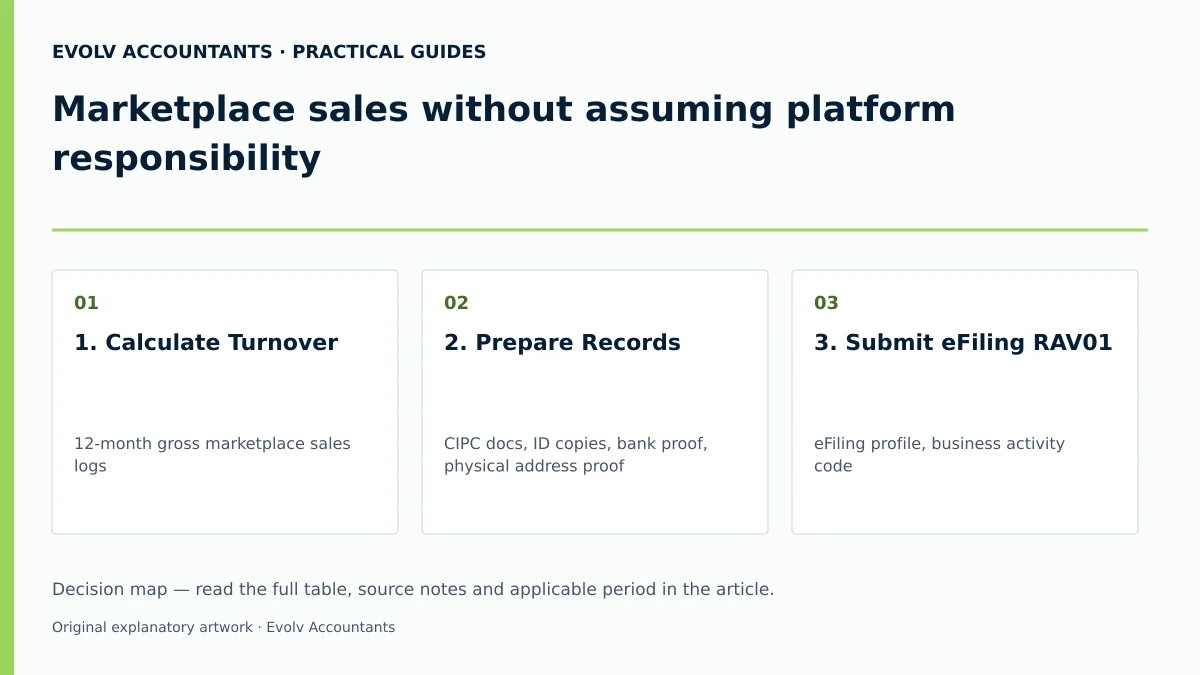
| 1. Calculate Turnover | 12-month gross marketplace sales logs 2 18 | Financial Manager / Owner | Turnover compared against R2.3m compulsory threshold 2 13 | If under R2.3m, evaluate voluntary R120k threshold 15 16 |
| 2. Prepare Records | CIPC docs, ID copies, bank proof, physical address proof 27 | Representative Vendor 28 | Records verified; bank/address proof meets the applicable recency requirements 31 40 | Execute VAT 119i form if third-party group banking is used 37 |
| 3. Submit eFiling RAV01 | eFiling profile, business activity code 44 46 | Registered Tax Practitioner / Owner | WRAV01 completed and biometric verification passed if prompted 45 51 | If backdating exceeds 6 months, book SARS appointment 19 43 |
| 4. Respond to Review | Registration Application Review Notice 51 | Representative Vendor | Supporting documents uploaded within 21 business days 7 51 | If deadline missed, review the rejection notice and obtain SARS instructions 7 51 |
| 5. Verify Registration | SARS Notice of Registration / Vendor Search 10 52 | Compliance Officer | 10-digit VAT number verified on official search portal 52 54 | Update marketplace invoicing software to display VAT 4 61 |
Frequently Asked Questions
How does an online merchant determine if a marketplace platform assumes VAT responsibility?
Under South African VAT law, a marketplace platform is only deemed the supplier if specific electronic services intermediary provisions apply under Section 54(2B) where the platform handles invoicing and payment collection for non-resident suppliers 6 55. For standard local product sales where the marketplace merely hosts product listings, the seller remains the principal supplier responsible for VAT registration and tax invoicing 1 4 6.
What is the current compulsory VAT registration threshold for an online seller?
SARS administers a compulsory VAT registration threshold of R2.3 million in taxable turnover across any consecutive 12-month period based on administrative guidance effective 1 April 2026 2 13. Older printed SARS guides retain a historical figure of R1 million 14. Compulsory registration applications must be lodged within 21 business days of exceeding the threshold 3.
Can a new online business register voluntarily before achieving high sales volume?
Yes, voluntary VAT registration is permitted if taxable supplies made in the preceding 12 months exceeded R120 000 (or R50 000 in older guide text) 15 17. Alternatively, if sales have occurred for only one month exceeding R4 200, or average R4 200 per month across 2 to 11 months, or if written contractual/finance commitments exceed R120 000, voluntary registration may be applied for 16 58.
What occurs if supporting documentation is not submitted within 21 business days?
If an applicant fails to submit all requested supporting documents within 21 business days of SARS issuing a Registration Application Review Notice, SARS automatically rejects the VAT registration application 7 51. Check the rejection notice and obtain SARS instructions on the appropriate next application or review step.
Which accounting basis should an online business select upon registration?
Standard online businesses must register on the invoice basis (accrual method), declaring output tax on the earlier of invoice issuance or payment receipt 48 49. The invoice basis is the default. The payments basis requires eligibility and SARS approval; qualifying categories include certain natural persons or partnerships, public bodies, non-profit bodies and non-resident electronic-service suppliers. Check the applicable category rather than treating public entities as exempt suppliers 59 60. The five-year period is a minimum, not an automatic destruction date. SARS record-keeping guidance requires the relevant records to remain available; retain them beyond the ordinary minimum where an ongoing audit, investigation, objection or appeal or another applicable rule requires it.
Related guides
- VAT invoices in a foreign currency
- When a South African business must register for VAT
- The Proactive SARS Audit Guide: Keeping Your Business Ledger Sanitised
Sources
- Register for VAT | South African Revenue Service
- Obligations of a VAT vendor | South African Revenue Service
- https://www.sars.gov.za/wp-content/uploads/Ops/Guides/Legal-Pub-Guide-VAT404-VAT-404-Guide-for-Vendors.pdf
- https://www.sars.gov.za/wp-content/uploads/Ops/Guides/VAT-REG-02-G01-Guide-for-Completion-of-VAT-Application-External-Guide.pdf
- FAQs for VAT vendors | South African Revenue Service