
VAT registration for non resident businesses
12 July 2026

Registering a non-resident enterprise for South African VAT requires establishing the relevant enterprise activity and following the SARS route applicable to its supplies.
Non-resident businesses expanding operations into South Africa or supplying digital services to local recipients must determine whether their commercial activities trigger a mandatory Value-Added Tax (VAT) registration under South African law 1 2 3. The South African Revenue Service (SARS) administers VAT under the Value-Added Tax Act 89 of 1991 (the VAT Act) and the Tax Administration Act 28 of 2011 (the TA Act) 4 5.
To achieve full statutory compliance, foreign enterprises must accurately calculate their South African taxable supplies against administrative thresholds, assemble prescribed authority and identification documents, appoint the representative required for the applicable registration route and submit formal registration applications via approved SARS digital or branch channels 2 6 7 8 9.
Non resident enterprise and specialised scope
This guide is structured for financial managers, foreign business directors, and South African SME advisors managing cross-border commercial arrangements within the jurisdiction of the Republic of South Africa 1 10. Completion of the VAT registration process means that the non-resident enterprise is formally assigned a South African VAT reference number, registered on the SARS tax database, and authorised to levy output tax and claim allowable input tax deductions 4 11 12 13.
Statutory Definition of an Enterprise for Non-Residents
Under Section 1(1) of the VAT Act, a "person" (which includes foreign companies, trusts, and partnerships) carries on an "enterprise" if it conducts any activity continuously or regularly in or partly in South Africa, where goods or services are supplied to another person for a consideration 1 14. According to SARS guidance, an enterprise encompasses "any activity carried on continuously or regularly by any person in or partly in South Africa" 1.
Specialized non-resident enterprise categories defined by law and regulator guidance include:
- Foreign Suppliers of Electronic Services: Non-resident e-commerce providers making electronic supplies to South African recipients where at least two of the following conditions are met: the recipient is a South African resident, payment originates from a South African bank account, or the recipient has a South African residential, postal, or business address 2 3 15.
- Intermediaries: Foreign or local platforms that facilitate electronic service supplies on behalf of non-resident principals and manage invoicing and payment collection 2 16 17.
- Foreign Group Branches (Section 23(2A)): Where multiple foreign entities belonging to the same "group of companies" (as defined in the Income Tax Act) must register for VAT in South Africa, Section 23(2A) permits a single branch VAT registration, provided a main registered vendor in the group already conducts an enterprise locally 18.
- Cross-Border Lessors of Ships, Aircraft, and Rolling Stock: Under proviso (xiii) to Section 1(1), the foreign leasing of ships, aircraft, or railway rolling stock for use in South Africa is excluded from being an "enterprise" if the resident lessee enters the goods for home consumption, pays import VAT, and is not reimbursed by the lessor 19 20 21.
- Flash Title Sales: A non-resident entity that acquires ownership of goods inside South Africa solely on a flash title basis and immediately resells them to other non-resident non-vendors is excluded from carrying on an enterprise 22.
Current Administrative Position on Registration Thresholds
A key distinction must be drawn between statutory text, regulator guidance, and current administrative practice regarding turnover thresholds:
- Compulsory Threshold: SARS web portal guidance administers the compulsory VAT registration threshold at R2.3 million in any consecutive 12-month period 2 23. An application must be submitted within 21 business days of exceeding or contractually agreeing to exceed this threshold 2. Conversely, historical guides (such as Issue 15 of the VAT 404 Guide) state the older compulsory threshold of R1 million 24. SARS explicitly clarifies that while formal regulations are pending updates, SARS administers new applications based on the increased threshold announced with effect from 1 April 2026 25.
- Voluntary Threshold: Current SARS administrative guidance sets the standard voluntary registration threshold at R120 000 in taxable supplies made in the past 12 months, or expected under written contracts or finance agreements 26 27. Historical guidance retained the prior R50 000 minimum threshold 28 29.
- Legal Nature of Thresholds: Describing these figures reflects SARS's operational administrative position rather than an unqualified statutory amendment; the Rates and Monetary Amounts and Amendment of Revenue Laws Act does not directly amend Section 23 of the VAT Act in this regard.
Prepare the information and authority: non resident enterprise
To successfully lodge a VAT registration application for a foreign enterprise, applicants must compile prescribed documentation and establish statutory authority in accordance with SARS guide VAT-REG-02-G01 30 31 32 33.
Statutory Identification and Corporate Documentation
- Foreign Entity Details: Certificate of incorporation, registered name, registration number, and official registered physical address in the country of origin 34 35.
- Individual Identification: Passports, identity numbers, and full contact details for all foreign directors, trustees, or major shareholders 33 36.
- Power of Attorney (POA): If a registered tax practitioner or representative submits the application, a formal SARS Power of Attorney must accompany the file 10 37 38.
Appointment of a Resident Representative Vendor
Under Section 246 of the Tax Administration Act read with the VAT Act, the ordinary non-resident-enterprise registration route requires appointment of a representative vendor; specialised electronic-service suppliers must check the requirements of their separate SARS route 8 9.
— Practical point from this guide
- Qualification under the ordinary route: The representative vendor must be a natural person who resides in South Africa 8 9. For companies, this is typically the appointed Public Officer or a designated resident manager 9.
- Legal Responsibility: The representative vendor bears personal statutory responsibility for fulfilling all duties imposed by the VAT Act, including submitting returns, ensuring payment of VAT liabilities, and responding to SARS queries 8 9 38.
Banking Requirements and Indemnity (Form VAT119i)
- Local Bank Account Rule: Applicants are generally required to furnish details of an operational South African bank account opened in the name of the vendor 39 40.
- Third-Party Banking Exception: Foreign companies and entities within a group of companies that do not hold a direct South African bank account may use the local bank account of a parent company or subsidiary 40 41. In such cases, the account holder must execute form VAT119i (Indemnity in respect of VAT Bank Details) to indemnify SARS against losses from payment transfers 40.
Evidentiary Proof of Taxable Supplies
Applicants must submit verified financial evidence demonstrating that taxable supplies meet or will meet the applicable thresholds 42 43.
Acceptable Primary Evidence:
- Copies of tax invoices issued for local supplies 43.
- Signed customer contracts or written agreements specifying supply values 43.
- Audited or signed financial statements reflecting South African revenue 43.
- Written notification of a awarded tender 43.
Unacceptable Evidence: SARS explicitly rejects non-factual submissions, including unfulfilled purchase orders, speculative business plans, cash flow projections, or unawarded tender proposals 44.
Complete the task step by step: specialised scope
The procedural pathway for registering a non-resident business depends on whether the entity operates as a foreign supplier of electronic services or conducts general commercial enterprise activities 6 7.
Pathway A: Foreign Suppliers of Electronic Services
- Form Completion: Complete application form VAT101 7 10.
- Email Submission: Submit form VAT101 along with foreign entity registration documents, director passport copies, and customer contract summary to the dedicated SARS mailbox: eCommerceRegistration@sars.gov.za 7.
- eFiling Onboarding: Upon receipt of the VAT reference number, the foreign supplier must register on SARS eFiling to enable electronic submission of periodic VAT201 returns and international payment processing 7 45.
Pathway B: Standard Non-Resident Enterprise & Branch Registration
- eFiling Registration Details Maintenance: Log on to the SARS eFiling profile, navigate to SARS Registered Details, and select Maintain SARS Registered Details (RAV01) 46 47.
- Product Addition: Add the VAT product container, entering the business activity code (derived from the VAT 403 Trade Classification Guide), financial year-end, and physical/postal addresses 48 49.
- Section 23(2A) Foreign Group Branch Application: For foreign group entities registering via a main registered vendor branch, submit form VAT102 to establish a separate branch registration, maintaining an independent accounting system 18 50.
- Biometric Verification: Complete facial biometric authentication steps on eFiling or attend a virtual/branch appointment if requested by SARS 6 47 51.
Tax Period and Accounting Basis Allocation
During registration, the enterprise must select its operating tax parameters 48 52:
- Tax Period Categories:
- Category A / B: Two-monthly cycles ending on alternating calendar months (standard default for small/medium vendors) 52 53 54.
- Category C: Monthly tax periods, mandatory where annual taxable turnover exceeds R30 million 52 54.
- Category D: Six-monthly cycles for qualifying farming or micro-businesses with turnover below R1.5 million 55 56.
- Category E: Annual returns for specific connected-person property/management entities 56 57.
- Accounting Basis: The invoice basis is the default; the approved basis must be checked for the particular non-resident vendor, including specialised electronic-service rules 58 59 60. The Payments (Cash) Basis is strictly restricted to natural persons with turnover under R2.5 million, public authorities, and qualifying foreign suppliers of electronic services 17 61 62.
Check the result against the evidence: non resident enterprise
Submission of a VAT registration application does not constitute legal completion; the business must obtain independent completion evidence confirming active vendor status 11 13 51. SARS Registration Workflow
| Application Stage | Validation Stage | Completion Stage |
|---|---|---|
| • Submit RAV01/VAT101 | • SARS Risk Engine | • Notice of |
| • Upload Primary | Evaluation | Registration Issued |
| Supporting Evidence | • Application Review | • Verification via |
| • Appoint Resident | Notice (21 Days) | VAT Vendor Search |
| Representative Vendor | • Biometric Auth | • Active eFiling Profile |
Verification Criteria
- Notice of Registration: The official SARS Notice of Registration confirms the allocated 10-digit VAT reference number, effective liability date, assigned tax period category, and branch code 11 13. It can be downloaded directly from eFiling via the shortcut menu 11.
- SARS Online VAT Vendor Search: Validate the active registration status publicly by querying the business details on the official SARS online search portal 13 63.
- Review Notice Resolution: If the application triggers risk engine validation, SARS issues a Registration Application Review Notice requiring specific supporting documents to be submitted within 21 business days 51 64. Failure to submit documents within this timeframe results in automated rejection of the application 64.
Handle exceptions and unresolved cases: specialised scope
Non-resident registrations frequently encounter complex legal edge cases that require specialist accounting and legal interpretation.
Title-Specific Edge Cases
- Temporary Abnormal Circumstances (Section 23(1A)): Non-resident electronic service providers that exceed the compulsory registration threshold solely due to temporary, abnormal circumstances (e.g., an isolated single large transaction) are exempt from compulsory registration under proviso to Section 23(1A) 2 65 66.
- Tender Applications: Foreign businesses submitting commercial project tenders in South Africa cannot register for VAT in anticipation of winning a contract 67 68. SARS will reject anticipatory applications; registration can only proceed once the tender is formally awarded 67 68.
- Imported Services vs Enterprise Taxable Supplies: Where a foreign service provider renders services to a South African resident who uses them for non-taxable (exempt or private) purposes, and the foreign provider is not registered for VAT, the local resident must account for VAT on "imported services" using form VAT215 69 70 71. If the foreign supplier is registered as a vendor, standard output tax applies instead under Section 7(1)(a) 72.
Unresolved Evidence Conflicts and Delays
If an application is delayed due to conflicting address records, foreign bank account verification, or missing representative vendor documentation, the applicant must log a query via the SARS Online Query System or request an escalation through a virtual branch appointment 6 73.
The five-year period is a minimum, not an automatic destruction date. SARS record-keeping guidance requires the relevant records to remain available; retain them beyond the ordinary minimum where an ongoing audit, investigation, objection or appeal or another applicable rule requires it.
Next steps for VAT registration
Task and Completion Checklist
| Step | Input or evidence | Responsible person | Completion check | Exception or next action |
|---|---|---|---|---|
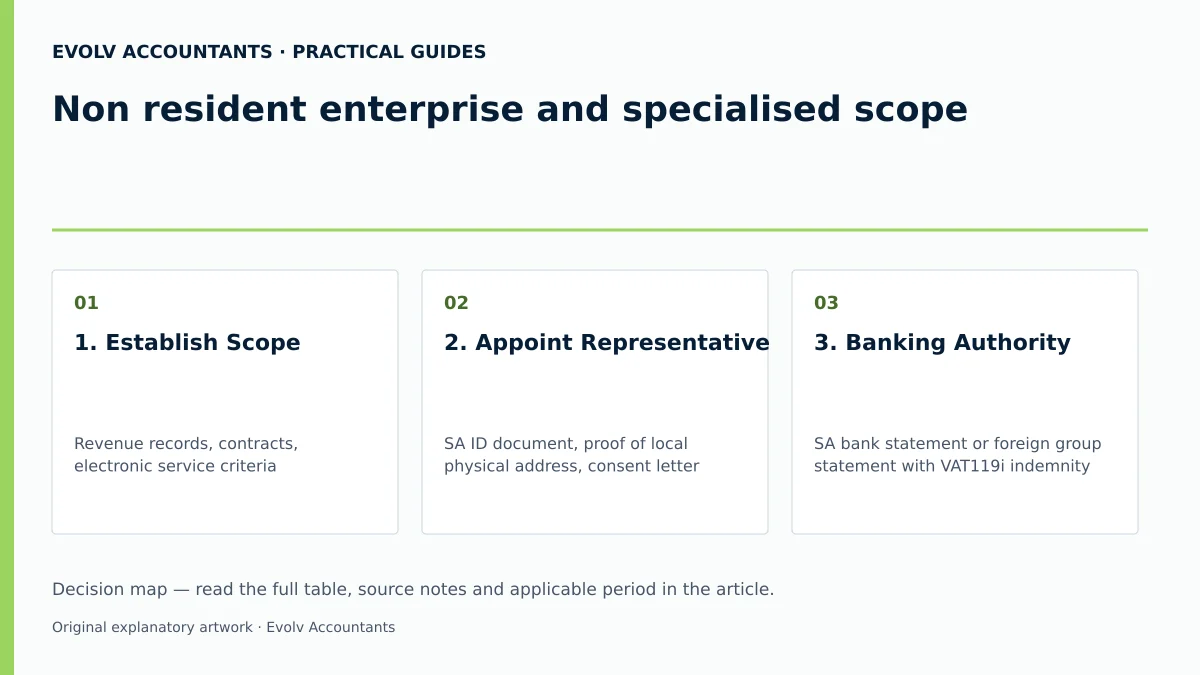
| 1. Establish Scope | Revenue records, contracts, electronic service criteria 1 3 43 | Financial Director / Evolv Advisor | SA taxable supplies calculated against R2.3m / R120k thresholds 23 26 | Apply Section 23(1A) abnormal circumstance exception if temporary surge 65 |
| 2. Appoint Representative | SA ID document, proof of local physical address, consent letter 8 9 | Representative Vendor / Public Officer | Ordinary-route resident representative nominated; specialised electronic-service requirements checked 8 9 | Appoint local resident manager if entity has no resident directors 8 |
| 3. Banking Authority | SA bank statement or foreign group statement with VAT119i indemnity 40 41 | Company Treasurer | Bank account details validated on eFiling container 40 48 | Execute VAT119i indemnity if using SA parent/subsidiary account 40 |
| 4. Application Lodge | Form VAT101 (email) or eFiling RAV01 container 7 10 46 | Tax Practitioner / Representative Vendor | Application reference or SARS acknowledgement retained for the selected submission channel 51 | Attend virtual SARS branch appointment if biometrics fail 6 51 |
| 5. Verification & Review | Primary contracts, invoices, review notice response 43 64 | Representative Vendor | Supporting documents uploaded within 21 business days 64 | Meet the 21-business-day document deadline; contact SARS promptly if unable to comply 64 |
| 6. Post-Registration Onboarding | Notice of Registration, active eFiling product 7 11 13 | Bookkeeper / Evolv Tax Compliance | VAT number verified via online SARS Vendor Search 13 63 | Align accounting software to issue valid SA tax invoices 74 75 |
Post-Registration Operational Requirements
Upon receiving a VAT registration number, the non-resident enterprise must implement strict operational compliance controls:
- Issue Valid Tax Invoices: Tax invoices for taxable supplies exceeding R5 000 must include the words "Tax Invoice", the vendor's name, address, and VAT registration number, the recipient's name, address, and VAT number, an individual serial number, date, full description of goods/services, and exact VAT charged at 15% 76 77 78.
- Submit Periodic VAT201 Returns: Complete and submit VAT201 declarations via eFiling on or before the last business day of the month following the end of each tax period 45 79 80.
- Retain Accounting Records: Retain all primary records, tax invoices, bank statements, and customs declarations for a minimum of 5 years 74 81 82.
- Notify Registered Detail Changes: Inform SARS in writing within 21 business days of any change in business address, representative vendor, banking details, or corporate structure 83 84.
Reproducible Hypothetical Example
Scenario: Global Tech Solutions Ltd, a foreign software enterprise based in the United Kingdom, supplies cloud software-as-a-service (SaaS) directly to South African business clients and individual consumers.
- Turnover Evaluation: Over the preceding 12 months, the company generated R2,800,000 in taxable electronic supplies from South African customers (exceeding the compulsory threshold of R2.3 million) 2 23.
- Registration Channel: As a foreign supplier of electronic services, Global Tech Solutions Ltd checks the specialised registration requirements, completes form VAT101 and emails the application file to eCommerceRegistration@sars.gov.za 7 8 9.
- VAT Accounting Calculation (Monthly Tax Period - Category C):
- Total SA Monthly Invoiced Revenue (Tax Inclusive): R287,500 54 85
- Applicable Tax Fraction: 15 / 115 85
- Output Tax Liability: R287,500 × ((15 ÷ 115)) = R37,500 85 86
- Allowable Local Input Tax: Local SA consultant tax invoice of R11,500 (inclusive of 15% VAT = R1,500 input tax) 86 87 88
- Net VAT Payable to SARS: R37,500 - R1,500 = R36,000 12 86
- Filing & Payment: The net VAT liability of R36,000 is remitted electronically by EFT using the applicable 19-digit Payment Reference Number (PRN) before the last business day of the month 45 79 89.
Frequently Asked Questions
Must a foreign e-commerce business register for VAT if it only sells digital services to South African customers?
Yes. Non-resident suppliers of electronic services must register for VAT if the total value of taxable supplies exceeds R2.3 million in any consecutive 12-month period, provided at least two supply location indicators (resident recipient, SA bank payment, or SA address) are present 2 3. Registration is completed via form VAT101 emailed directly to SARS 7.
Can a foreign company appoint an overseas director as its SARS representative vendor?
No. Under South African tax law, the representative vendor responsible for a foreign company's VAT obligations must be a natural person who is a resident of South Africa 8 9. The representative vendor assumes personal legal responsibility for the entity's VAT compliance 8 38.
How does Section 23(2A) benefit foreign entities operating as a group of companies?
Section 23(2A) permits a foreign group of companies to hold a single branch VAT registration under a main registered vendor already conducting an enterprise in South Africa 18. This eliminates the requirement for each separate foreign group entity to obtain an independent registration, provided separate accounting records are maintained for the branch 18 50.
Is a non-resident business allowed to use a foreign bank account for SARS VAT registration?
No, SARS requires a South African bank account 39 40. However, a foreign company that does not hold a local bank account may nominate the South African bank account of a parent or subsidiary within its corporate group, provided an executed form VAT119i indemnity is submitted 40 41.
What happens if SARS issues a Registration Application Review Notice after submission?
If SARS flags an application for validation, it issues a review notice requesting specific supporting documents (e.g., invoices, bank statements, contracts) 51. The applicant must upload all requested primary evidence within 21 business days, or the registration application will be formally rejected 64. Ask Evolv about non resident enterprise and specialised scope. Share the relevant records so the support required can be scoped.
Related guides
- Choosing the correct VAT registration effective date
- When a South African business must register for VAT
- The Proactive SARS Audit Guide: Keeping Your Business Ledger Sanitised
Sources
- Register for VAT | South African Revenue Service
- https://www.sars.gov.za/wp-content/uploads/Ops/Guides/Legal-Pub-Guide-VAT404-VAT-404-Guide-for-Vendors.pdf
- https://www.sars.gov.za/wp-content/uploads/Ops/Guides/VAT-REG-02-G01-Guide-for-Completion-of-VAT-Application-External-Guide.pdf
- FAQs for VAT vendors | South African Revenue Service
- Obligations of a VAT vendor | South African Revenue Service